A French Word to Live By
How to Conjugate Aérer in French
/a.e.ʁe/
Aérer means to air, to ventilate — to throw the windows open and let fresh air sweep through a room, a bed, or even a page of text.
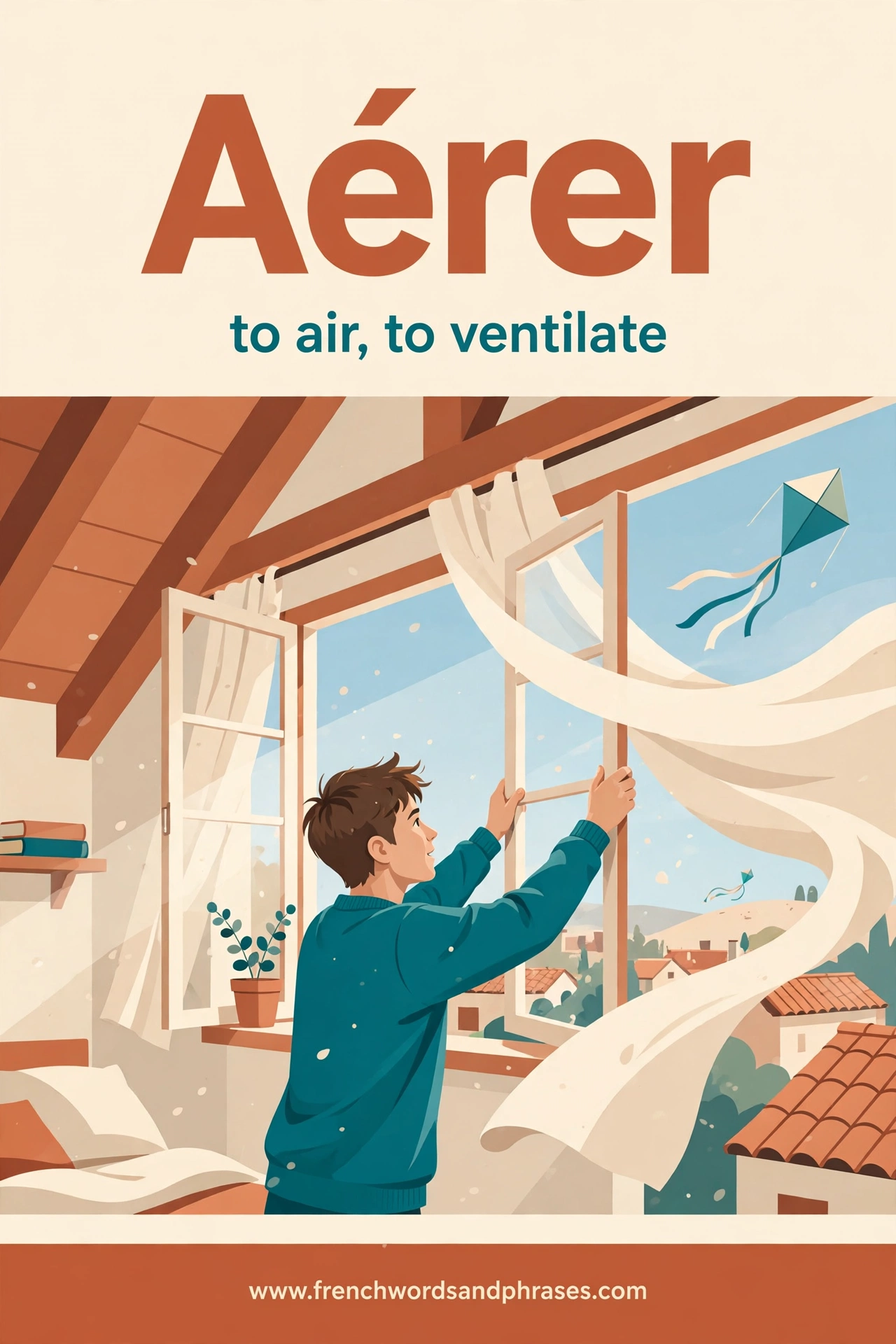
Shutters flung wide on a spring morning, blankets draped over a balcony rail, a cellar door opened after winter — aérer is the verb of fresh air on the move, sweeping the stale out and the new in.
In this guide, you’ll learn how to conjugate aérer in all the major French tenses and moods. Explore complete conjugation tables, French examples, English translations, and practice quizzes.
Understanding the French Verb Aérer
Aérer is a regular French verb belonging to the first group of verbs, those ending in-er.
It means to air, to ventilate. Beyond rooms and bedding, aérer works figuratively wherever something needs breathing space: a cook lets a wine aérer before serving, and an editor asks for a page aérée — a layout with air in it, margins and space instead of a wall of text.
Verb classification: First group (-er)
Auxiliary verb: Avoir
Past participle: aéré
Present participle: aérant
English equivalents: To air, to ventilate; aérer une chambre — to air a room; aérer le linge — to air the laundry; aérer un vin — to let a wine breathe; aérer un texte — to lighten a text with white space.
One important detail: aérer is a céder-type verb — the é of the stem opens to è wherever the next syllable is mute: j’aère, tu aères, il aère, ils aèrent, and all through the future and conditional: j’aèrerai, j’aèrerais. The é survives wherever the ending is sounded: nous aérons, vous aérez, j’aérais, en aérant, and in the infinitive and participle, aérer, aéré. The subjunctive splits along the same line: que j’aère, but que nous aérions.
Experience the Word
Aérer is the verb of the open window — the small daily ceremony by which a house breathes out the night and breathes in the morning.
Imagine a farmhouse bedroom at seven o’clock. The grandmother throws the shutters wide, hauls the quilt onto the windowsill and shakes the pillows into the cold air: elle aère la chambre, and the whole room smells of fields within minutes.
Nothing was cleaned, nothing moved. The room was simply aired — aérée — and it is a different room.
How to Conjugate Aérer: Complete French Conjugation Guide
Let’s explore every major conjugation of aérer, beginning with the indicative mood.
How to Conjugate Aérer in the Indicative Mood
The indicative mood is used to express facts, observations, actions, and events.
How to Conjugate Aérer in the Present Tense (Présent)
Used for actions happening now, habitual actions, and general truths.
| Subject | Conjugation |
|---|---|
| je | aère |
| tu | aères |
| il / elle | aère |
| nous | aérons |
| vous | aérez |
| ils / elles | aèrent |
Example
Chaque matin, j’aère la chambre à coucher.
Every morning, I air the bedroom.
Quick Quiz 1
Complete the sentence:
Chaque matin, j’______ la chambre à coucher.
Reveal the answer
aère
Chaque matin, j’aère la chambre à coucher.
Every morning, I air the bedroom.
How to Conjugate Aérer in the Passé Composé
Used for completed actions in the past. Aérer takes the auxiliary verb avoir.
| Subject | Conjugation |
|---|---|
| j’ | ai aéré |
| tu | as aéré |
| il / elle | a aéré |
| nous | avons aéré |
| vous | avez aéré |
| ils / elles | ont aéré |
Example
Elle a aéré toute la maison après le départ des invités.
She aired the whole house after the guests left.
How to Conjugate Aérer in the Imparfait (Imperfect Tense)
Used for habitual past actions, descriptions, and ongoing situations in the past.
| Subject | Conjugation |
|---|---|
| je | aérais |
| tu | aérais |
| il / elle | aérait |
| nous | aérions |
| vous | aériez |
| ils / elles | aéraient |
Example
Ma grand-mère aérait les couvertures tous les dimanches.
My grandmother used to air the blankets every Sunday.
Quick Quiz 2
Choose the correct form:
I air the room (present).
J’______ la pièce. (aére / aère)
Reveal the answer
aère
J’aère la pièce.
The stem é opens to è before a mute ending: j’aère.
How to Conjugate Aérer in the Plus-que-parfait
Used to describe an action that had already been completed before another past event.
| Subject | Conjugation |
|---|---|
| j’ | avais aéré |
| tu | avais aéré |
| il / elle | avait aéré |
| nous | avions aéré |
| vous | aviez aéré |
| ils / elles | avaient aéré |
Example
Il avait aéré la cave avant d’y descendre les bouteilles.
He had aired the cellar before taking the bottles down.
How to Conjugate Aérer in the Passé Simple
Primarily used in formal writing, literature, and historical narratives. It is rarely used in everyday conversation.
| Subject | Conjugation |
|---|---|
| je | aérai |
| tu | aéras |
| il / elle | aéra |
| nous | aérâmes |
| vous | aérâtes |
| ils / elles | aérèrent |
Example
Dès l’aube, elle aéra la chambre du malade.
At dawn, she aired the sick man’s room.
How to Conjugate Aérer in the Passé Antérieur
A literary tense used to express an action completed immediately before another past action, generally in the passé simple.
| Subject | Conjugation |
|---|---|
| j’ | eus aéré |
| tu | eus aéré |
| il / elle | eut aéré |
| nous | eûmes aéré |
| vous | eûtes aéré |
| ils / elles | eurent aéré |
Example
Quand il eut aéré la pièce, il alluma enfin une bougie.
When he had aired the room, he finally lit a candle.
How to Conjugate Aérer in the Future Tense (Futur Simple)
Used to describe actions that will take place in the future.
| Subject | Conjugation |
|---|---|
| je | aèrerai |
| tu | aèreras |
| il / elle | aèrera |
| nous | aèrerons |
| vous | aèrerez |
| ils / elles | aèreront |
Example
Demain, nous aèrerons les couvertures au soleil.
Tomorrow, we will air the blankets in the sun.
How to Conjugate Aérer in the Futur Antérieur (Future Perfect)
Used for an action that will have been completed before a particular point in the future.
| Subject | Conjugation |
|---|---|
| j’ | aurai aéré |
| tu | auras aéré |
| il / elle | aura aéré |
| nous | aurons aéré |
| vous | aurez aéré |
| ils / elles | auront aéré |
Example
À midi, tu auras aéré toutes les chambres.
By noon, you will have aired all the bedrooms.
How to Conjugate Aérer in the Near Future (Futur Proche)
Used to describe something that is going to happen soon. Formed with aller + infinitive.
| Subject | Conjugation |
|---|---|
| je | vais aérer |
| tu | vas aérer |
| il / elle | va aérer |
| nous | allons aérer |
| vous | allez aérer |
| ils / elles | vont aérer |
Example
Je vais aérer le salon, il sent le renfermé.
I am going to air the living room, it smells stuffy.
How to Conjugate Aérer in the Conditional Mood
The conditional mood expresses what would happen under certain circumstances. It is also frequently used to make polite requests or express wishes.
How to Conjugate Aérer in the Present Conditional
| Subject | Conjugation |
|---|---|
| je | aèrerais |
| tu | aèrerais |
| il / elle | aèrerait |
| nous | aèrerions |
| vous | aèreriez |
| ils / elles | aèreraient |
Example
Tu aèrerais plus souvent si la rue était calme.
You would air the rooms more often if the street were quiet.
How to Conjugate Aérer in the Past Conditional
| Subject | Conjugation |
|---|---|
| j’ | aurais aéré |
| tu | aurais aéré |
| il / elle | aurait aéré |
| nous | aurions aéré |
| vous | auriez aéré |
| ils / elles | auraient aéré |
Example
Elle aurait aéré la maison sans cette pluie.
She would have aired the house without this rain.
Aérer in the Literary Past Conditional Form
This less common literary form uses the imperfect subjunctive of avoir.
| Subject | Conjugation |
|---|---|
| j’ | eusse aéré |
| tu | eusses aéré |
| il / elle | eût aéré |
| nous | eussions aéré |
| vous | eussiez aéré |
| ils / elles | eussent aéré |
Example
Il eût aéré la chambre avant l’arrivée du médecin.
He would have aired the room before the doctor arrived.
How to Conjugate Aérer in the Subjunctive Mood
The subjunctive is used to express wishes, emotions, doubts, necessity, and uncertainty. It frequently follows expressions such as il faut que (it is necessary that) or bien que (although).
How to Conjugate Aérer in the Present Subjunctive
| Subject | Conjugation |
|---|---|
| que je | aère |
| que tu | aères |
| qu’il / qu’elle | aère |
| que nous | aérions |
| que vous | aériez |
| qu’ils / qu’elles | aèrent |
Example
Il faut que tu aères la pièce avant l’arrivée des invités.
You must air the room before the guests arrive.
Quick Quiz 3
Complete the sentence using the subjunctive:
Il faut que tu ______ la pièce avant l’arrivée des invités.
Reveal the answer
aères
Il faut que tu aères la pièce avant l’arrivée des invités.
You must air the room before the guests arrive.
How to Conjugate Aérer in the Imperfect Subjunctive
A literary tense, rarely encountered in modern spoken French.
| Subject | Conjugation |
|---|---|
| que je | aérasse |
| que tu | aérasses |
| qu’il / qu’elle | aérât |
| que nous | aérassions |
| que vous | aérassiez |
| qu’ils / qu’elles | aérassent |
Example
Le médecin voulait qu’on aérât la chambre du malade.
The doctor wanted the sick man’s room to be aired.
How to Conjugate Aérer in the Pluperfect Subjunctive
A literary construction used to express an action completed before another past action.
| Subject | Conjugation |
|---|---|
| que j’ | eusse aéré |
| que tu | eusses aéré |
| qu’il / qu’elle | eût aéré |
| que nous | eussions aéré |
| que vous | eussiez aéré |
| qu’ils / qu’elles | eussent aéré |
Example
On disait qu’elle eût aéré la maison dès l’aube.
People said she had aired the house at dawn.
How to Conjugate Aérer in the Past Subjunctive
| Subject | Conjugation |
|---|---|
| que j’ | aie aéré |
| que tu | aies aéré |
| qu’il / qu’elle | ait aéré |
| que nous | ayons aéré |
| que vous | ayez aéré |
| qu’ils / qu’elles | aient aéré |
Example
Je suis content que tu aies aéré le salon.
I am glad you aired the living room.
How to Conjugate Aérer in the Imperative
The imperative is used to give commands, instructions, invitations, or suggestions. Subject pronouns are omitted.
How to Conjugate Aérer in the Present Imperative
| Person | Conjugation |
|---|---|
| (tu) | aère |
| (nous) | aérons |
| (vous) | aérez |
Example
Aère la chambre, elle sent le renfermé !
Air the bedroom, it smells stuffy!
Quick Quiz 4
How would you say Air the bedroom (tu form)?
Reveal the answer
Aère la chambre !
French Participles of Aérer
Participles are verb forms that can be used in compound tenses and other grammatical constructions.
Present Participle of Aérer
aérant
En aérant le vin une heure, il révèle ses arômes.
By letting the wine breathe for an hour, it reveals its aromas.
Past Participle of Aérer
aéré
Aérée dès le matin, la chambre sentait le frais.
Aired first thing in the morning, the bedroom smelled fresh.
Aérer in Everyday French: Real-Life Examples
Now that you know the conjugations, let’s see how aérer appears in everyday French.
Example 1 — Present
Chaque matin, j’aère la chambre.
Every morning, I air the bedroom.
Example 2 — Passé composé
Elle a aéré toute la maison.
She aired the whole house.
Example 3 — Imparfait
Ma grand-mère aérait les couvertures le dimanche.
My grandmother used to air the blankets on Sundays.
Example 4 — Future
Nous aèrerons les couvertures au soleil.
We will air the blankets in the sun.
Example 5 — Conditional
Tu aèrerais plus souvent si la rue était calme.
You would air the rooms more often if the street were quiet.
Example 6 — Imperative
Aère la chambre, elle sent le renfermé !
Air the bedroom, it smells stuffy!
Beyond Translation: The Meaning of Aérer
Inside aérer is l’air itself, from the Latin aer that also gives English air and aerial.
The verb has learned to breathe figuratively, too.
A sommelier aère a young wine, a designer presents une mise en page aérée, and a teacher asks a pupil to aérer his copy — the same gesture everywhere: make room, let it breathe, let the fresh in.
How to Remember the French Verb Aérer
Remember it this way: Aérer is about shutters flung wide, blankets on the balcony rail.
- Céder-type stem change: j’aère with è, but nous aérons with é.
- The future and conditional take è all the way through: j’aèrerai.
- Not just rooms: on aère le linge, un vin, and even un texte.
The key idea is shutters flung wide, blankets on the balcony rail.
Test Your Knowledge of Aérer
Let’s see how much you’ve learned. Try answering these questions before revealing the answers.
Question 1
What happens to the é of aérer in je aère?
Reveal the answer
It opens to è — j’aère, tu aères, ils aèrent — wherever the next syllable is mute.
Question 2
How do you say Every morning, I air the bedroom in French?
Reveal the answer
Chaque matin, j’aère la chambre à coucher.
Question 3
Translate: Tomorrow, we will air the blankets in the sun.
Reveal the answer
Demain, nous aèrerons les couvertures au soleil.
Question 4
What is the past participle of aérer?
Reveal the answer
Aéré — aérée, aérés, aérées; the participle keeps é.
Question 5
Complete the sentence:
Il faut que tu ______ la pièce avant l’arrivée des invités.
Reveal the answer
aères
Il faut que tu aères la pièce avant l’arrivée des invités.
You must air the room before the guests arrive.
Your Final Challenge
Can You Use It?
How would you say this in French?
She airs the house in the early morning, and the day comes in with the fresh air.
Reveal the answer
Elle aère la maison au petit matin, et le jour entre avec l’air frais.
She airs the house in the early morning, and the day comes in with the fresh air.
A little French. A little curiosity. A richer everyday life.
LEARN FRENCH ONE WORD AT A TIME