
A French Word to Live By
Translate Accorné to English
/a.kɔʁ.ne/
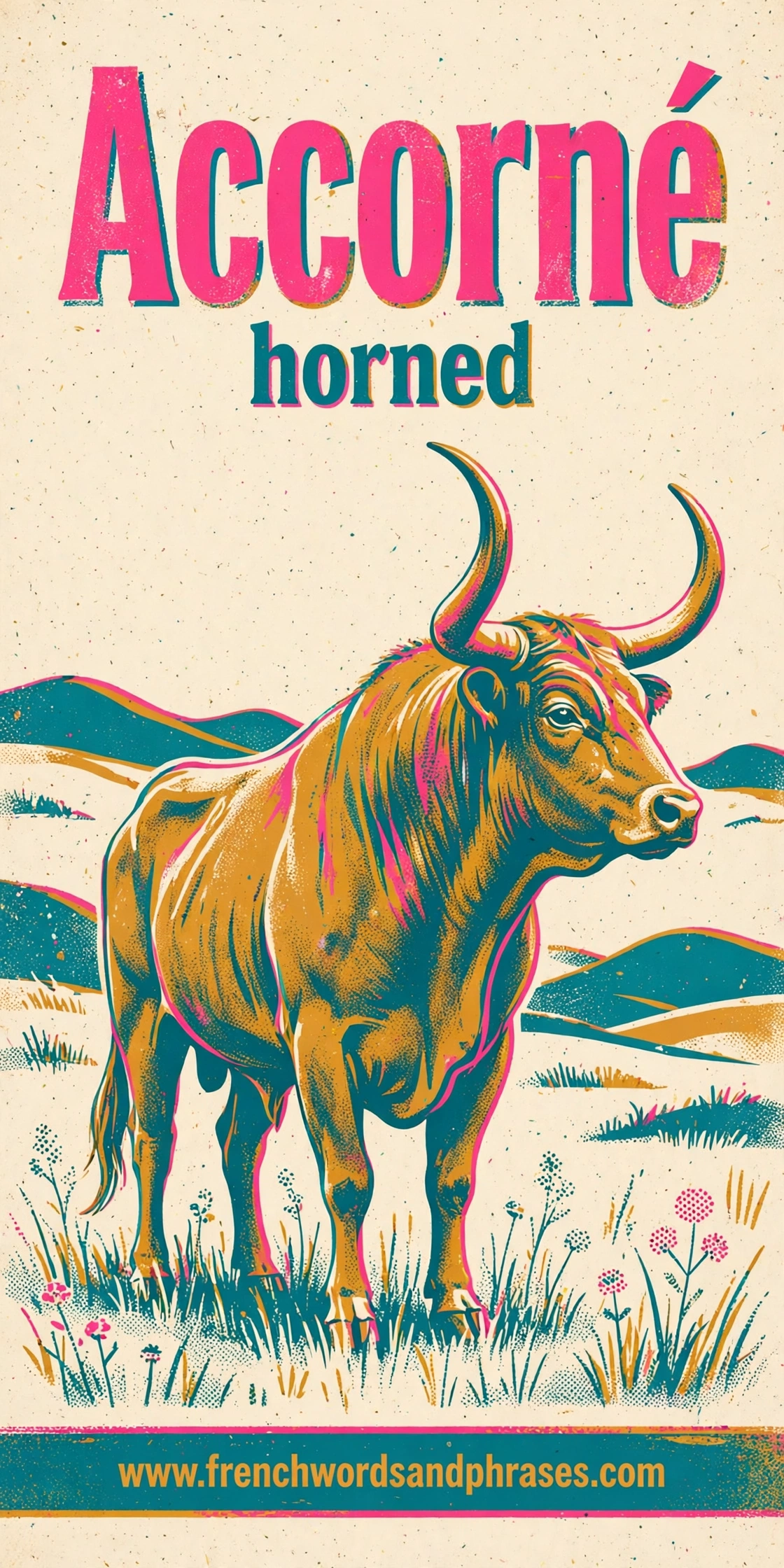
Accorné means horned.
On the old shield above the castle gate, a black goat climbs a golden hill — and her horns, alone, shine gold. The herald who painted her had a word for that detail: the goat is accornée, horned in a colour different from her body. Accorné is one of heraldry’s tiny precision words: it says an animal has horns, and it only bothers to speak when those horns wear a different colour from the beast itself.
In this guide, you’ll learn what accorné means in English, how its feminine accornée is formed, the heraldic rule that gives the word its job, and the neighbour écorné that means almost the opposite. Explore French examples, English translations, and practice quizzes.
Understanding the French Adjective Accorné
Accorné is a French adjective of quality — a specialist word of heraldry, the art of coats of arms. It describes an animal shown WITH its horns, and it is used only when the horns are of a different colour (a different enamel, as heralds say) from the animal’s body: une chèvre de sable accornée d’or, a black goat horned gold. It follows the regular participle pattern: accorné, accornée, accornés, accornées.
It means horned — bearing horns, with the heraldic twist that the horns’ colour is named because it differs from the body’s: un taureau accorné d’argent, a bull horned silver (with silver horns). Outside heraldry the word is rare, because ordinary French simply lets the horns show; but in a blazon — the formal description of a shield — accorné is the exact, necessary word.
Type: Adjective of quality — heraldry (specialist term)
Answers the question: What is it like? — horned, with horns of a named colour
Changes form: Feminine adds -e — accorné / accornée; plurals accornés / accornées
English equivalents: Horned; attired (the English heraldic word).
One important usage detail: accorné is followed by de plus the colour of the horns — accornée d’or, horned gold; accorné d’argent, horned silver. And guard the frontier with its near-twin: écorné means the opposite misfortune — an animal whose horns are broken or knocked off, dehorned. Accorné celebrates the horns; écorné mourns them.
Experience the Word
Accorné is the adjective of the herald’s magnifying glass — a word that exists because, on a shield, even a goat’s horns deserve their own line of description.
Imagine the painter of arms finishing a great bull for a knight’s banner. The body is red, fierce and finished. Then, with the smallest brush, he lays gold on the horns: the blazon will read accorné d’or, and five hundred years later a reader can repaint the bull exactly.
You have not just said an animal has horns. You have entered the jewel-box vocabulary of heraldry — accorné, where even the horns get their own colour and their own word.
How to Use Accorné in French: Complete Guide
Let’s explore how accorné works in French, beginning with the whole word on one card.
Accorné at a Glance
Before the details, here is the whole word on one card.
The Whole Word on One Card
Meaning, type, position and forms — accorné in four lines.
| Point | Accorné |
|---|---|
| Meaning | horned — with horns (of a different colour, in heraldry) |
| Type | adjective of quality — heraldry, specialist term |
| Usual position | after the animal, followed by de + colour — accornée d’or |
| Form | accorné / accornée — accornés / accornées in the plural |
Example
Une chèvre de sable accornée d’or orne l’écu.
A black goat horned gold adorns the shield.
The Four Forms of Accorné
Accorné follows the regular participle pattern: the feminine adds an e, the plurals add an s.
| Form | Accorné | Example |
|---|---|---|
| Masculine singular | accorné | un taureau accorné d’argent — a bull horned silver |
| Feminine singular | accornée | une chèvre accornée d’or — a goat horned gold |
| Masculine plural | accornés | des béliers accornés de gueules — rams horned red |
| Feminine plural | accornées | des vaches accornées d’argent — cows horned silver |
Example
Des vaches accornées d’argent paissent sur l’azur de l’écu.
Cows horned silver graze on the blue of the shield.
Quick Quiz 1
What is the feminine of accorné?
Reveal the answer
accornée
Une chèvre accornée — the feminine adds an e.
A horned goat.
The Feminine of Accorné: Accornée
Accornée is not a separate word to learn later — it is half of this word’s life, agreeing with every she-goat and cow in the bestiary of arms.
| Situation | Example |
|---|---|
| Masculine | un bouc accorné d’or — a he-goat horned gold |
| Feminine | une chèvre accornée d’or — identical but for the added e |
| Why | participle adjectives in -é form their feminine with -ée |
| The plural | add s — des chèvres accornées, horned goats |
Example
La chèvre, accornée d’or, grimpe au sommet de l’écu.
The goat, horned gold, climbs to the top of the shield.
Where Accorné Goes: After the Animal, with De
Accorné follows the animal it describes, and the horns’ colour follows with de.
| Pattern | Example |
|---|---|
| After the noun | un cerf accorné — a horned stag (in arms) |
| With de + colour | accorné d’argent — horned silver, with silver horns |
| After être | la chèvre est accornée d’or — the goat is horned gold |
| Before the noun | un accorné taureau — not in blazon or everyday French |
Example
Le taureau de l’écu est accorné d’argent.
The bull of the shield is horned silver.
Quick Quiz 2
How do you say ‘a goat horned gold’ — une chèvre accorné d’or or une chèvre accornée d’or?
Reveal the answer
une chèvre accornée d’or
The adjective agrees with the animal: chèvre is feminine, so accornée.
A goat horned gold.
More Accorné: Comparing with Accorné
Heralds do not grade horns with plus and moins — but the forms exist, and poets have played with them.
| Degree | Example |
|---|---|
| As horned as | aussi accorné que — as horned as |
| More horned | plus accorné — more horned |
| Less horned | moins accorné — less horned |
| The most horned (masc.) | le plus accorné — le plus accorné des taureaux |
| The most horned (fem.) | la plus accornée — la plus accornée des chèvres |
Example
Aucun taureau de l’écu n’est plus accorné que celui-ci.
No bull on the shield is more horned than this one.
Everyday Expressions with Accorné
Accorné lives in the blazon, the formal description of arms — its everyday is the herald’s desk.
| Expression | In English |
|---|---|
| accorné d’or | horned gold — with gold horns |
| accornée d’argent | horned silver — with silver horns |
| un animal accorné | a horned animal (in heraldry) |
| de sable accornée d’or | black, horned gold — classic blazon phrasing |
| les cornes | the horns — the noun at the word’s heart |
| le blason | the coat of arms; heraldry itself |
Example
Le blason se lit ainsi : de sable, une chèvre accornée d’or.
The blazon reads thus: black, a goat horned gold.
Quick Quiz 3
What does accornée d’or mean?
Reveal the answer
Horned gold
Accornée d’or — the animal’s horns are gold, a different colour from its body.
With gold horns.
Accorné and Its Neighbours
Accorné belongs to heraldry’s jewel-box of animal details, where every part of the beast can earn a word.
| French | In English |
|---|---|
| la corne | the horn — the body part it names |
| cornu | horned — the plain, everyday adjective |
| armé | armed — in heraldry, of teeth and claws in another colour |
| lampassé | langued — in heraldry, of the tongue in another colour |
| écorné | dehorned, horns broken off — the opposite misfortune |
| le blason | the coat of arms — the world it lives in |
Example
Armé d’argent, lampassé de gueules, accorné d’or : le lion de l’écu brille de partout.
Armed silver, langued red, horned gold: the lion of the shield shines everywhere.
Watch Out: The Traps Around Accorné
The great trap here is the near-twin écorné, which reports the horns’ destruction rather than their glory.
| Trap | The truth |
|---|---|
| The near-twin | écorné means horns broken or removed — dehorned; accorné means horns present and proudly coloured |
| The heraldic rule | accorné is used when the horns differ in colour from the body; if they match, the blazon stays silent |
| For deer | heralds prefer ramé for a stag’s antlers; accorné belongs to horned beasts — cattle, goats, rams |
| Agreement | une vache accornée, des vaches accornées — the participle agrees like any adjective |
Example
Après la tempête, le vieux taureau écorné n’avait plus qu’une corne.
After the storm, the old dehorned bull had only one horn left.
Quick Quiz 4
How do you say ‘cows horned silver’?
Reveal the answer
des vaches accornées d’argent
Accorné follows the noun and agrees: feminine plural accornées, then de names the horns’ colour.
Cows with silver horns.
Accorné in Everyday French: Real-Life Examples
Now that you know the word, let’s see how accorné appears in everyday French.
Example 1 — Reading a shield
Sur l’écu, une chèvre accornée d’or attire l’œil.
On the shield, a goat horned gold catches the eye.
Example 2 — A museum visit
Le guide décrit un taureau accorné d’argent.
The guide describes a bull horned silver.
Example 3 — A family crest
Nos armes portent des vaches accornées de gueules.
Our arms bear cows horned red.
Example 4 — An old book
Le blason ancien montre un bélier accorné d’or.
The old blazon shows a ram horned gold.
Example 5 — A contrast
Accorné, il brille ; écorné, il ferait pitié.
Horned, he shines; dehorned, he would be pitiful.
Example 6 — A game of arms
Dessine un bouc accorné d’argent sur ton écu.
Draw a he-goat horned silver on your shield.
Beyond Translation: The Meaning of Accorné
English heraldry borrowed accorné’s job and gave it an English name: an animal whose horns are of a different tincture is attired. French kept the honest word built on corne, horn — the same root as English horn’s Latin cousins in unicorn and cornucopia.
Accorné is heraldry in miniature: a whole art of precise seeing, compressed into one adjective that notices even the colour of a goat’s horns.
Learn it beside armé and lampassé, and you can read a coat of arms the way heralds wrote it — animal by animal, colour by colour, horn by horn.
How to Remember the French Adjective Accorné
Remember it this way: Accorné is the horned adjective — accorné for him, accornée for her, a herald’s word that never means hornless.
- You learn the pair together — un taureau accorné, une chèvre accornée.
- You add the colour — accornée d’or, les cornes brillent autrement que le corps.
- You dodge the twin — écorné pleure les cornes cassées ; accorné les célèbre.
The key idea is accorné / accornée means horned (heraldry: horns of a different colour, accorné d’or); écorné = dehorned.
Test Your Knowledge of Accorné
Let’s see how much you’ve learned. Try answering these questions before revealing the answers.
Question 1
What does accorné mean?
Reveal the answer
Horned — in heraldry, with horns of a different colour from the body.
Question 2
What is the feminine of accorné?
Reveal the answer
accornée — the feminine adds an e.
Question 3
Translate: a bull horned silver.
Reveal the answer
Un taureau accorné d’argent.
Question 4
Complete the sentence:
Les chèvres ______ d’or grimpent sur l’écu.
Reveal the answer
accornées
Les chèvres accornées d’or grimpent sur l’écu.
The goats horned gold climb on the shield.
Question 5
How do you say ‘dehorned, with horns broken off’?
Reveal the answer
écorné — the near-twin with the opposite meaning.
Your Final Challenge
Can You Use It?
How would you say this in French?
“A black goat horned gold adorns the shield.”
Reveal the answer
Une chèvre de sable accornée d’or orne l’écu.
A black goat horned gold adorns the shield.
A little French. A little curiosity. A richer everyday life.
LEARN FRENCH ONE WORD AT A TIME




