
A French Word to Live By
How to Conjugate Accorer in French
/a.kɔ.ʁe/
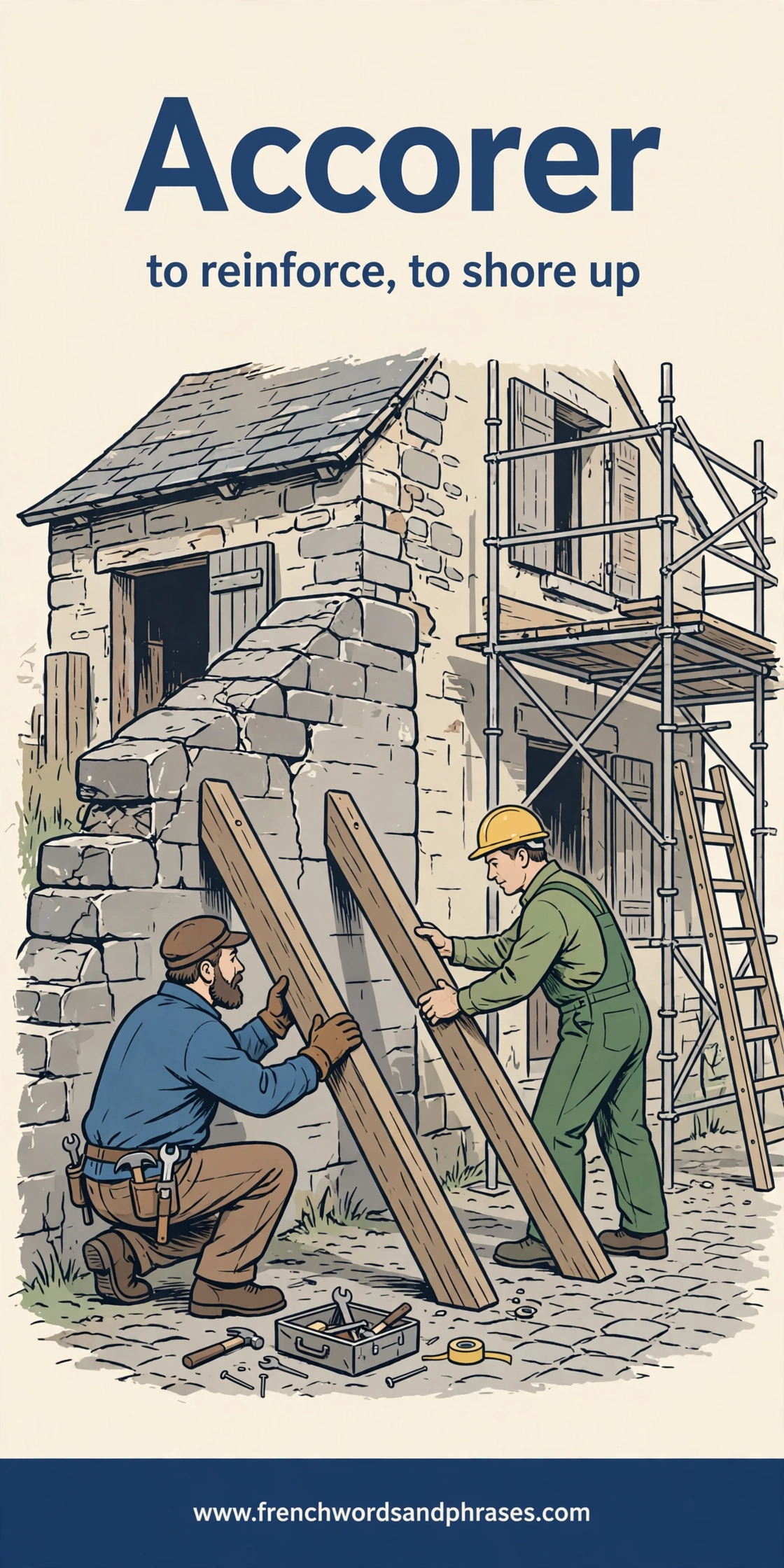
Accorer means to reinforce, to shore up — to prop a ship, a hull or anything at risk of falling with strong supports called accores.
A great ship lifted out of the water in dry dock, held upright by rows of massive timber props while workers swarm beneath her hull — accorer is the shipwright’s verb: to shore something heavy and precious so that it cannot topple while it is repaired.
In this guide, you’ll learn how to conjugate accorer in all the major French tenses and moods. Explore complete conjugation tables, French examples, English translations, and practice quizzes.
Understanding the French Verb Accorer
Accorer is a regular French verb belonging to the first group of verbs, those ending in-er.
It means to reinforce, to shore up. It lives in the vocabulary of dry docks, restoration yards and old sailing ships, where a vessel out of water must be accorée — shored — before anyone dares work under her. Outside that world it is rare, and mostly figurative: reinforcing a weak structure, an argument or an institution before it falls.
Verb classification: First group (-er)
Auxiliary verb: Avoir
Past participle: accoré
Present participle: accorant
English equivalents: To shore up, to prop up, to reinforce; accorer un navire — to shore up a ship in dry dock; accorer une coque — to prop up a hull; les accores — the shores, the timber props themselves; accorer un mur — to prop up a wall (rare, technical).
One important detail: accorer is a technical verb of shipyards and builders, almost always about something heavy held up by props — the props themselves are called des accores (feminine noun), and you will meet the pair together: on accore le navire avec des accores en chêne. Figuratively it can mean reinforcing anything at risk of failure. The verb is perfectly regular: j’accore, nous accorons, past participle accoré. Do not confuse it with accorder (to grant, to tune) — one letter changes the shipyard into a concert hall.
Experience the Word
Accorer is the verb of the prop and the shore — the quiet strength placed beside something great so that it can stand while it is healed.
Imagine a three-masted ship in dry dock at Brest. The water is gone, and the tall hull, built to float, would fall like a tree without the forest of oak props the workers are wedging along her sides, one by one, hammered home. They are not repairing her yet — ils l’accorent, and only then can the real work begin.
The ship has not moved an inch. She has been shored — accorée — held up by other people’s strength until her own returns.
How to Conjugate Accorer: Complete French Conjugation Guide
Let’s explore every major conjugation of accorer, beginning with the indicative mood.
How to Conjugate Accorer in the Indicative Mood
The indicative mood is used to express facts, observations, actions, and events.
How to Conjugate Accorer in the Present Tense (Présent)
Used for actions happening now, habitual actions, and general truths.
| Subject | Conjugation |
|---|---|
| je | accore |
| tu | accores |
| il / elle | accore |
| nous | accorons |
| vous | accorez |
| ils / elles | accorent |
Example
Les ouvriers accorent la coque du navire en cale sèche.
The workers shore up the ship’s hull in dry dock.
Quick Quiz 1
Complete the sentence:
Nous ______ le voilier pour l’hiver.
Reveal the answer
accorons
Nous accorons le voilier pour l’hiver.
We shore up the yacht for the winter.
How to Conjugate Accorer in the Passé Composé
Used for completed actions in the past. Accorer takes the auxiliary verb avoir.
| Subject | Conjugation |
|---|---|
| j’ | ai accoré |
| tu | as accoré |
| il / elle | a accoré |
| nous | avons accoré |
| vous | avez accoré |
| ils / elles | ont accoré |
Example
Le chantier a accoré le bateau avant la tempête.
The yard shored up the boat before the storm.
How to Conjugate Accorer in the Imparfait (Imperfect Tense)
Used for habitual past actions, descriptions, and ongoing situations in the past.
| Subject | Conjugation |
|---|---|
| je | accorais |
| tu | accorais |
| il / elle | accorait |
| nous | accorions |
| vous | accoriez |
| ils / elles | accoraient |
Example
Autrefois, on accorait les navires avec de grandes poutres en chêne.
In the old days, ships were shored up with great oak beams.
Quick Quiz 2
Choose the correct form:
The team shored up the hull.
L’équipe ______ la coque. (a accoré / est accoré)
Reveal the answer
a accoré
L’équipe a accoré la coque.
Accorer takes avoir.
How to Conjugate Accorer in the Plus-que-parfait
Used to describe an action that had already been completed before another past event.
| Subject | Conjugation |
|---|---|
| j’ | avais accoré |
| tu | avais accoré |
| il / elle | avait accoré |
| nous | avions accoré |
| vous | aviez accoré |
| ils / elles | avaient accoré |
Example
Ils avaient accoré la coque avant de la repeindre.
They had shored up the hull before repainting it.
How to Conjugate Accorer in the Passé Simple
Primarily used in formal writing, literature, and historical narratives. It is rarely used in everyday conversation.
| Subject | Conjugation |
|---|---|
| je | accordai |
| tu | accordas |
| il / elle | accorda |
| nous | accordâmes |
| vous | accordâtes |
| ils / elles | accorèrent |
Example
Le charpentier accora le mât qui menaçait de tomber.
The carpenter shored up the mast that threatened to fall.
How to Conjugate Accorer in the Passé Antérieur
A literary tense used to express an action completed immediately before another past action, generally in the passé simple.
| Subject | Conjugation |
|---|---|
| j’ | eus accoré |
| tu | eus accoré |
| il / elle | eut accoré |
| nous | eûmes accoré |
| vous | eûtes accoré |
| ils / elles | eurent accoré |
Example
Quand ils eurent accoré la coque, ils commencèrent les réparations.
When they had shored up the hull, they began the repairs.
How to Conjugate Accorer in the Future Tense (Futur Simple)
Used to describe actions that will take place in the future.
| Subject | Conjugation |
|---|---|
| je | accorerai |
| tu | accoreras |
| il / elle | accorera |
| nous | accorerons |
| vous | accorerez |
| ils / elles | accoreront |
Example
Demain, nous accorerons le voilier pour l’hiver.
Tomorrow, we will shore up the yacht for the winter.
How to Conjugate Accorer in the Futur Antérieur (Future Perfect)
Used for an action that will have been completed before a particular point in the future.
| Subject | Conjugation |
|---|---|
| j’ | aurai accoré |
| tu | auras accoré |
| il / elle | aura accoré |
| nous | aurons accoré |
| vous | aurez accoré |
| ils / elles | auront accoré |
Example
Quand vous aurez accoré le navire, vous pourrez travailler sous la coque.
When you have shored up the ship, you will be able to work under the hull.
How to Conjugate Accorer in the Near Future (Futur Proche)
Used to describe something that is going to happen soon. Formed with aller + infinitive.
| Subject | Conjugation |
|---|---|
| je | vais accorer |
| tu | vas accorer |
| il / elle | va accorer |
| nous | allons accorer |
| vous | allez accorer |
| ils / elles | vont accorer |
Example
Attention, ils vont accorer le bateau, écartez-vous !
Careful, they are going to shore up the boat, stand back!
How to Conjugate Accorer in the Conditional Mood
The conditional mood expresses what would happen under certain circumstances. It is also frequently used to make polite requests or express wishes.
How to Conjugate Accorer in the Present Conditional
| Subject | Conjugation |
|---|---|
| je | accorerais |
| tu | accorerais |
| il / elle | accorerait |
| nous | accorerions |
| vous | accoreriez |
| ils / elles | accoreraient |
Example
Sans étais solides, on n’accorerait pas ce navire.
Without solid props, no one would shore up this ship.
How to Conjugate Accorer in the Past Conditional
| Subject | Conjugation |
|---|---|
| j’ | aurais accoré |
| tu | aurais accoré |
| il / elle | aurait accoré |
| nous | aurions accoré |
| vous | auriez accoré |
| ils / elles | auraient accoré |
Example
Il aurait accoré la coque si le bois avait été sec.
He would have shored up the hull if the timber had been dry.
Accorer in the Literary Past Conditional Form
>
This less common literary form uses the imperfect subjunctive of avoir.
| Subject | Conjugation |
|---|---|
| j’ | eusse accoré |
| tu | eusses accoré |
| il / elle | eût accoré |
| nous | eussions accoré |
| vous | eussiez accoré |
| ils / elles | eussent accoré |
Example
Il eût accoré le mât sans la marée montante.
He would have shored up the mast, were it not for the rising tide.
How to Conjugate Accorer in the Subjunctive Mood
The subjunctive is used to express wishes, emotions, doubts, necessity, and uncertainty. It frequently follows expressions such as il faut que (it is necessary that) or bien que (although).
How to Conjugate Accorer in the Present Subjunctive
| Subject | Conjugation |
|---|---|
| que je | accore |
| que tu | accores |
| qu’il / qu’elle | accore |
| que nous | accorions |
| que vous | accoriez |
| qu’ils / qu’elles | accorent |
Example
Il faut que vous accoriez solidement cette coque.
You must shore up this hull solidly.
Quick Quiz 3
Complete the sentence using the subjunctive:
Il faut que tu ______ le navire avant la nuit.
Reveal the answer
accores
Il faut que tu accores le navire avant la nuit.
You must shore up the ship before nightfall.
How to Conjugate Accorer in the Imperfect Subjunctive
A literary tense, rarely encountered in modern spoken French.
| Subject | Conjugation |
|---|---|
| que je | accorasse |
| que tu | accorasses |
| qu’il / qu’elle | accorât |
| que nous | accorassions |
| que vous | accorassiez |
| qu’ils / qu’elles | accorassent |
Example
Le capitaine voulait que l’on accorât le navire avant la nuit.
The captain wanted the ship shored up before nightfall.
How to Conjugate Accorer in the Pluperfect Subjunctive
A literary construction used to express an action completed before another past action.
| Subject | Conjugation |
|---|---|
| que j’ | eusse accoré |
| que tu | eusses accoré |
| qu’il / qu’elle | eût accoré |
| que nous | eussions accoré |
| que vous | eussiez accoré |
| qu’ils / qu’elles | eussent accoré |
Example
On vérifia qu’ils eussent accoré le bateau selon les règles.
They checked that the boat had been shored up according to the rules.
How to Conjugate Accorer in the Past Subjunctive
| Subject | Conjugation |
|---|---|
| que j’ | aie accoré |
| que tu | aies accoré |
| qu’il / qu’elle | ait accoré |
| que nous | ayons accoré |
| que vous | ayez accoré |
| qu’ils / qu’elles | aient accoré |
Example
Je suis content que l’équipe ait accoré le voilier à temps.
I am glad the team shored up the yacht in time.
How to Conjugate Accorer in the Imperative
The imperative is used to give commands, instructions, invitations, or suggestions. Subject pronouns are omitted.
How to Conjugate Accorer in the Present Imperative
| Person | Conjugation |
|---|---|
| (tu) | accore |
| (nous) | accorons |
| (vous) | accorez |
Example
Accorez bien la coque avant de la poncer !
Shore up the hull well before sanding it!
Quick Quiz 4
How would you say Shore up the hull (tu form)?
Reveal the answer
Accore la coque !
French Participles of Accorer
Participles are verb forms that can be used in compound tenses and other grammatical constructions.
Present Participle of Accorer
accorant
En accorant le navire, les ouvriers vérifient chaque étai.
While shoring up the ship, the workers check every prop.
Past Participle of Accorer
accoré
Accoré avec soin, le bateau repose en sécurité.
Shored up with care, the boat rests safely.
Accorer in Everyday French: Real-Life Examples
Now that you know the conjugations, let’s see how accorer appears in everyday French.
Example 1 — Present
Les ouvriers accorent la coque en cale sèche.
The workers shore up the hull in dry dock.
Example 2 — Passé composé
Le chantier a accoré le voilier pour l’hiver.
The yard shored up the yacht for the winter.
Example 3 — Imparfait
On accorait les navires avec des poutres en chêne.
Ships were shored up with oak beams.
Example 4 — Future
Nous accorerons le bateau demain matin.
We will shore up the boat tomorrow morning.
Example 5 — Conditional
Sans étais, on n’accorerait pas ce navire.
Without props, no one would shore up this ship.
Example 6 — Imperative
Accorez solidement la coque !
Shore up the hull solidly!
Beyond Translation: The Meaning of Accorer
English shore up is the exact cousin of accorer — a shore is the prop, and to shore is to prop.
Great things out of their element need other things to lean on.
A ship in the water holds herself; a ship in dry dock must be accorée. French keeps the verb for that humbling moment, and lends it, figuratively, to anything grand and wobbling — a wall, a budget, a reputation — that props can still save.
How to Remember the French Verb Accorer
Remember it this way: Accorer is about the tall ship in dry dock, held upright by a forest of oak props.
- A shipyard verb: accorer un navire — to shore her up in dry dock with props called des accores.
- Nearly a twin of accorder, but the shipyard is not the concert hall: accorer = prop up, accorder = grant/tune.
- Regular -er: j’accore, nous accorons, past participle accoré.
The key idea is the tall ship in dry dock, held upright by a forest of oak props.
Test Your Knowledge of Accorer
Let’s see how much you’ve learned. Try answering these questions before revealing the answers.
Question 1
What do shipyard workers do when they accorent a ship?
Reveal the answer
They shore her up — they prop the hull with timbers (des accores) so she cannot fall while out of water.
Question 2
How do you say The yard shored up the boat before the storm in French?
Reveal the answer
Le chantier a accoré le bateau avant la tempête.
Question 3
Translate: In the old days, ships were shored up with oak beams.
Reveal the answer
Autrefois, on accorait les navires avec des poutres en chêne.
Question 4
What is the past participle of accorer?
Reveal the answer
Accoré.
Question 5
Complete the sentence:
Il faut que vous ______ solidement cette coque.
Reveal the answer
accoriez
Il faut que vous accoriez solidement cette coque.
You must shore up this hull solidly.
Your Final Challenge
Can You Use It?
How would you say this in French?
In dry dock, the workers shore up the hull of the old yacht before touching a single plank.
Reveal the answer
En cale sèche, les ouvriers accorent la coque du vieux voilier avant de toucher à la moindre planche.
In dry dock, the workers shore up the hull of the old yacht before touching a single plank.
A little French. A little curiosity. A richer everyday life.
LEARN FRENCH ONE WORD AT A TIME




