A French Word to Live By
Translate Absinthe to English
/ab.sɛ̃t/
L’Absinthe means absinthe.
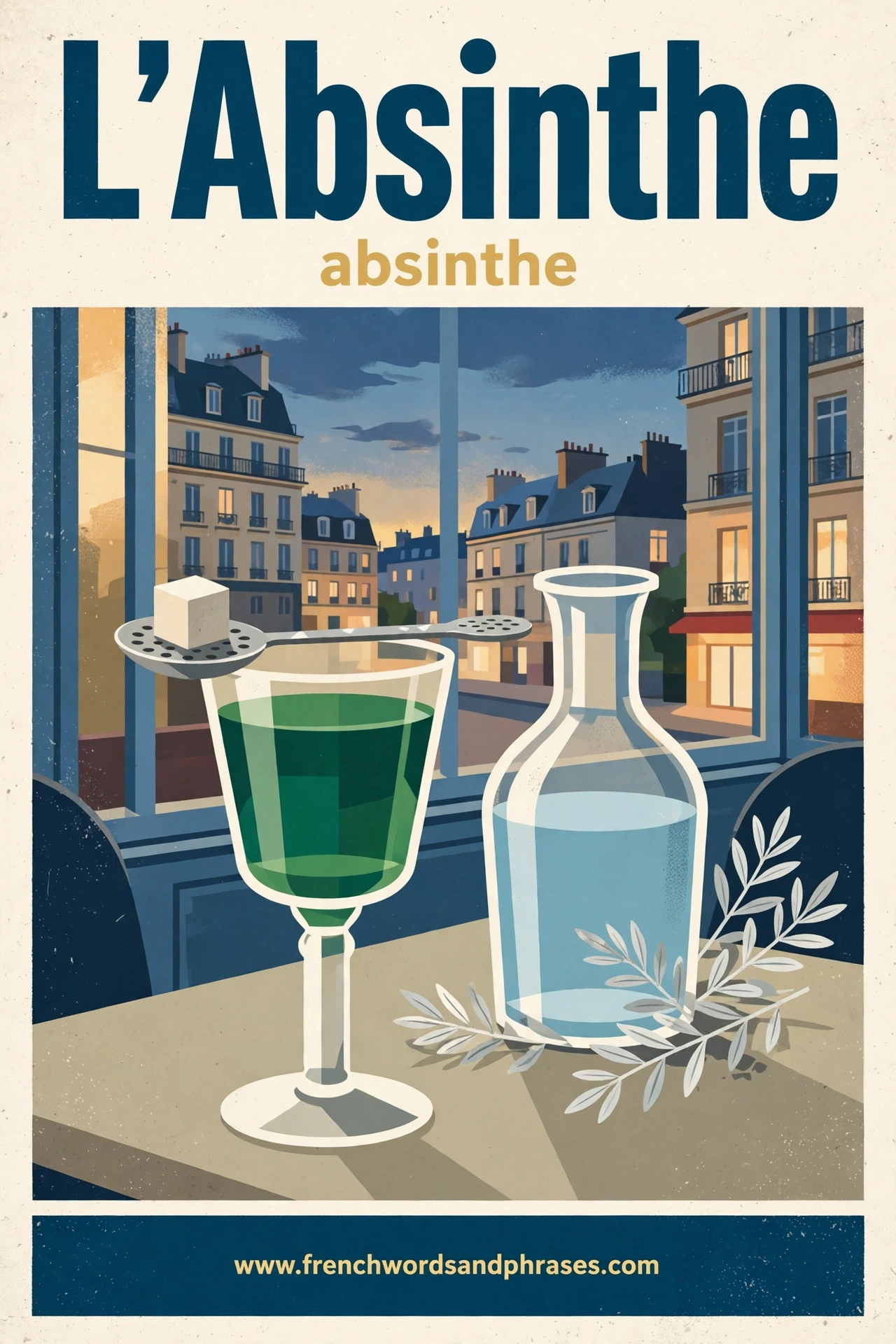
Paris, five o’clock, the famous green hour: at a café table a glass of emerald liquid slowly clouds as water drips over a sugar cube. Poets called it the green fairy — l’absinthe, the most legendary drink in French history.
In this guide, you’ll learn what absinthe means in English, how to use it with its articles, how to form its plural, and how it appears in everyday French. Explore French examples, English translations, and practice quizzes.
Understanding the French Noun Absinthe
Absinthe is a feminine French noun, learned with its article: l’absinthe, une absinthe — because it begins with a vowel, la shrinks to l’. The word names two things at once: the bitter herb itself, wormwood, and the famous green liqueur distilled from it, which carries the plant’s name and its perfume.
It means absinthe — first the plant, Artemisia absinthium (grande wormwood), a silvery, intensely bitter herb used for centuries in medicine and drinks. Then the liqueur: a strong green spirit flavoured with wormwood, anise and fennel, prepared in the glass with cold water poured over a sugar cube until it turns cloudy — le rituel de l’absinthe. Banned in France in 1915 as a danger to the nation, absinthe was authorised again in the late twentieth century, and the green fairy flies once more, legally.
Gender: Feminine
Definite article: l’ — l’absinthe (the absinthe)
Indefinite article: une — une absinthe (an absinthe)
Plural: les absinthes
Two senses: The herb (wormwood) and the green liqueur made from it
English equivalents: Absinthe; wormwood (the plant).
One important usage detail: you order une absinthe — a glass of absinthe — exactly as you order un café. For the plant in the garden, French often specifies la grande absinthe for wormwood itself. And the drink’s nickname is worth knowing: la fée verte, the green fairy, is how the poets of the belle époque spoke of it.
Experience the Word
Absinthe is more than a drink. It is a whole era in a glass — the cafés of Montmartre, the painters and poets, the slow green hour when Paris loosened its collar and talked art until dark.
Imagine the ritual: the slotted spoon, the sugar cube, the thin thread of iced water, and the green slowly blooming into opal as the glass clouds.
You have not just ordered a liqueur. You have summoned la fée verte — with all her legends.
How to Use Absinthe in French: Complete Guide
Let’s explore how absinthe works in French, beginning with its articles — then from the bitter herb to the green glass.
Absinthe with the Definite Article (L’, Les)
Absinthe begins with a vowel, so la shrinks to l’ — used for the plant or the drink in general.
| Form | French |
|---|---|
| Feminine singular | l’absinthe |
| Plural | les absinthes |
Example
L’absinthe a été interdite en France en 1915.
Absinthe was banned in France in 1915.
Absinthe with the Indefinite Article (Une, Des)
Used for a glass of absinthe — une absinthe, s’il vous plaît.
| Form | French |
|---|---|
| Feminine singular | une absinthe |
| Plural | des absinthes |
Example
Il commande une absinthe, comme autrefois.
He orders an absinthe, just like in the old days.
The Green Hour: Words Around the Absinthe
Sugar cubes, green fairies and cafés — the vocabulary that surrounds the absinthe.
| French | In English |
|---|---|
| la fée verte | the green fairy (its nickname) |
| le sucre | the sugar |
| la cuillère | the spoon (the slotted absinthe spoon) |
| amer | bitter |
| la liqueur | the liqueur |
| interdire | to ban, to forbid |
Example
On prépare l’absinthe avec de l’eau glacée et un morceau de sucre.
Absinthe is prepared with iced water and a lump of sugar.
Quick Quiz 1
Complete the sentence:
Les poètes appelaient ______ « la fée verte ».
Reveal the answer
l’absinthe
Les poètes appelaient l’absinthe « la fée verte ».
The poets called absinthe “the green fairy”.
The Plural of Absinthe
Absinthe adds an -s in the plural — les absinthes, several glasses or several varieties.
| Number | French |
|---|---|
| Singular | l’absinthe |
| Plural | les absinthes |
Example
Ce bar propose des absinthes de toute l’Europe.
This bar offers absinthes from all over Europe.
Absinthe with Possessive Adjectives (Mon, Ton, Son…)
A famous exception: absinthe is feminine but begins with a vowel, so it takes mon, ton, son — mon absinthe, never « ma absinthe ».
| Owner | French |
|---|---|
| my | mon absinthe |
| your (tu) | ton absinthe |
| his / her | son absinthe |
| our | notre absinthe |
| your (vous) | votre absinthe |
| their | leur absinthe |
Example
Il prépare son absinthe lentement, selon le rituel.
He prepares his absinthe slowly, following the ritual.
Quick Quiz 2
Complete the sentence:
______ absinthe devient trouble avec l’eau. (Her)
Reveal the answer
Son
Son absinthe devient trouble avec l’eau.
Her absinthe turns cloudy with the water — son, not sa, because absinthe begins with a vowel.
Absinthe with Demonstrative Adjectives (Cette, Ces)
Used to point: cette absinthe — cette, the feminine form.
| Form | French |
|---|---|
| Feminine singular | cette absinthe |
| Plural | ces absinthes |
Example
Cette absinthe vient d’une distillerie de Pontarlier.
This absinthe comes from a distillery in Pontarlier.
Absinthe with Adjectives
Adjectives agree with the feminine noun: une absinthe verte, une absinthe amère.
| Adjective | With Absinthe |
|---|---|
| verte (green) | une absinthe verte |
| amère (bitter) | une absinthe amère |
| forte (strong) | une absinthe forte |
| suisse (Swiss) | une absinthe suisse |
| ancienne (old, vintage) | une absinthe ancienne |
Example
Une absinthe verte et amère, voilà la vraie tradition.
A green, bitter absinthe — that is the real tradition.
Quick Quiz 3
Complete the sentence:
C’est une absinthe très ______. (bitter)
Reveal the answer
amère
C’est une absinthe très amère.
It is a very bitter absinthe — the adjective takes the feminine -e: amère.
Everyday Expressions with Absinthe
Rituals, nicknames and prohibitions — the absinthe phrases of café life.
| Expression | In English |
|---|---|
| la fée verte | the green fairy (absinthe’s nickname) |
| l’heure verte | the green hour (the old absinthe hour, 5 p.m.) |
| le rituel de l’absinthe | the absinthe ritual (water over sugar) |
| une absinthe bien préparée | a properly prepared absinthe |
| la grande absinthe | wormwood itself (the plant) |
| boire une absinthe | to drink an absinthe |
Example
À l’heure verte, les cafés de Paris se remplissaient.
At the green hour, the cafés of Paris used to fill up.
Words from the Same Family as Absinthe
Herbs, spirits and the belle époque — the words that travel with absinthe.
| French | In English |
|---|---|
| l’anis | anise (its partner flavour) |
| le fenouil | fennel |
| l’herbe | the herb |
| distiller | to distil |
| le pastis | pastis (its aniseed successor) |
| la prohibition | the ban, prohibition |
Example
Après l’interdiction de l’absinthe, le pastis a pris sa place.
After absinthe was banned, pastis took its place.
Quick Quiz 4
What are the two senses of absinthe?
Reveal the answer
The herb and the liqueur — wormwood the plant, and the green spirit distilled with it.
La grande absinthe est la plante ; l’absinthe du café est la liqueur.
Grande absinthe is the plant; the café’s absinthe is the liqueur.
Absinthe in Everyday French: Real-Life Examples
Now that you know the word, let’s see how absinthe appears in everyday French.
Example 1 — Ordering
Garçon, une absinthe, s’il vous plaît.
Waiter, an absinthe, please.
Example 2 — The ritual
Elle verse l’eau lentement sur le sucre.
She pours the water slowly over the sugar.
Example 3 — History
L’absinthe a été interdite pendant des décennies.
Absinthe was banned for decades.
Example 4 — In the garden
La grande absinthe pousse au fond du jardin.
Wormwood grows at the bottom of the garden.
Example 5 — A nickname
On surnommait l’absinthe la fée verte.
Absinthe was nicknamed the green fairy.
Example 6 — Tasting
Cette absinthe a un parfum d’anis et de fenouil.
This absinthe has a scent of anise and fennel.
Beyond Translation: The Meaning of Absinthe
No drink carries more stories than absinthe. It marched with soldiers, conquered the cafés, inspired Verlaine, Van Gogh and Toulouse-Lautrec, then frightened France so thoroughly that the nation banned it in 1915 — blaming the green fairy for madness and ruin. The ban outlived almost everyone who voted for it; when absinthe returned, legally, at the end of the twentieth century, it came back as heritage in a glass.
To say absinthe is to raise a glass to the whole belle époque — its genius and its excess.
It evokes the marble café table and the dripping fountain, the cloudy green turning to opal, and the poets who swore the fairy whispered their verses to them.
How to Remember the French Noun Absinthe
Remember it this way: Absinthe is both the bitter herb wormwood and the green liqueur — la fée verte — made from it.
- You order it — une absinthe, comme autrefois, avec le rituel.
- You nickname it — la fée verte, l’amie des poètes.
- You watch the vowel — l’absinthe, son absinthe, cette absinthe.
The key idea is l’absinthe — the herb, the liqueur, the green fairy.
Test Your Knowledge of Absinthe
Let’s see how much you’ve learned. Try answering these questions before revealing the answers.
Question 1
Is absinthe masculine or feminine?
Reveal the answer
Feminine — une absinthe, l’absinthe.
Question 2
What is la fée verte?
Reveal the answer
The green fairy — the famous nickname of absinthe, beloved of the belle époque poets.
Question 3
Translate: Absinthe was banned in 1915.
Reveal the answer
L’absinthe a été interdite en 1915.
Question 4
Why do we say son absinthe and not sa absinthe?
Reveal the answer
Because absinthe begins with a vowel sound — feminine nouns starting with a vowel take mon, ton, son.
Question 5
Complete the sentence:
Il commande ______ au café.
Reveal the answer
une absinthe
Il commande une absinthe au café.
He orders an absinthe at the café.
Your Final Challenge
Can You Use It?
How would you say this in French?
“The poets called absinthe the green fairy.”
Reveal the answer
Les poètes appelaient l’absinthe la fée verte.
The poets called absinthe the green fairy.
A little French. A little curiosity. A richer everyday life.
LEARN FRENCH ONE WORD AT A TIME