A French Word to Live By
Translate Abside to English
/ab.sid/
L’Abside means the apse.
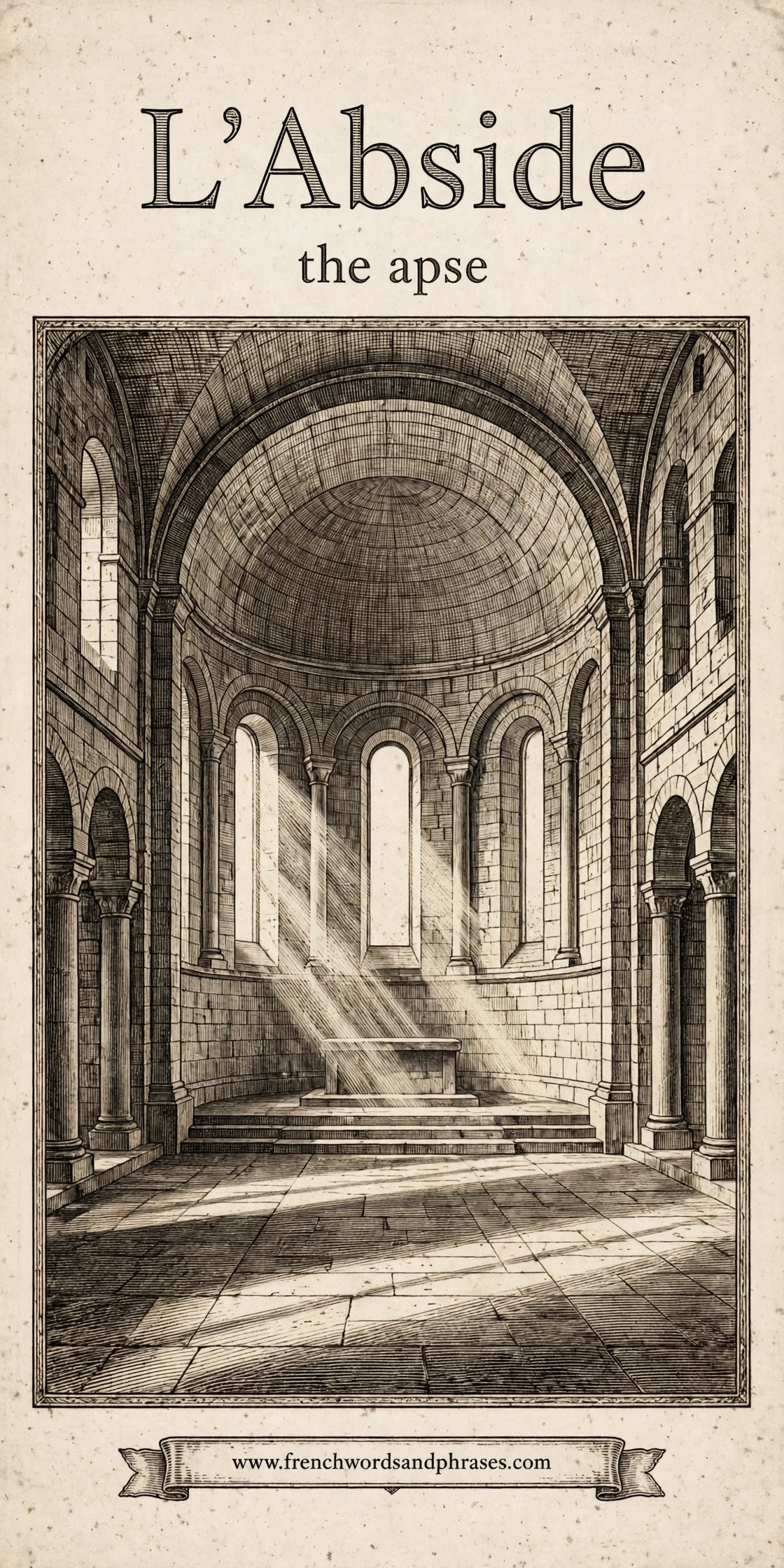
You step into an old stone church and look down the long nave: at the far end, the building opens into a glowing half-circle of windows and painted vaults, and the altar stands inside it. That rounded ending is l’abside.
In this guide, you’ll learn what abside means in English, how to use it with its articles, how to form its plural, and how it appears in everyday French. Explore French examples, English translations, and practice quizzes.
Understanding the French Noun Abside
Abside is a feminine French noun, learned with its article: l’abside, une abside — because it begins with a vowel, la shrinks to l’. It is a term of architecture: the semicircular or polygonal end of a church, the vaulted space behind the altar where the building comes to its rounded conclusion.
It means the apse — the great half-dome ending of a church, usually at the eastern end, housing the altar and often ringed with windows and small chapels. In Romanesque and Gothic churches the abside is the crown of the building: outside, you see its rounded wall rising beyond the roof; inside, its semi-dome — le cul-de-four — gathers the light over the choir. The word comes from the Greek for a vault or arch, and the shape descends from the Roman basilica.
Gender: Feminine
Definite article: l’ — l’abside (the apse)
Indefinite article: une — une abside (an apse)
Plural: les absides
Field: Architecture — the rounded east end of a church
English equivalents: The apse.
One important usage detail: abside names the whole rounded end of the church, inside and out — not just the dome. Its little sisters are les absidioles, the small apses of the side chapels that often cluster around it. And because the word begins with a vowel, the possessives are mon, ton, son: mon abside would never be « ma abside ».
Experience the Word
Abside is more than an architectural term. Stand inside one at morning mass and you understand it: the half-dome catches the light and the voices, and the whole church seems to lean towards it.
Imagine the pilgrim arriving at a Romanesque church after days on the road, seeing that rounded stone crown rise above the rooftops — the sign that the journey’s end is near.
You have not just seen a curved wall. You have seen a building come to rest — en demi-cercle, dans la lumière.
How to Use Abside in French: Complete Guide
Let’s explore how abside works in French, beginning with its articles — then into the old churches where the word belongs.
Abside with the Definite Article (L’, Les)
Abside begins with a vowel, so la shrinks to l’ — used for the apse of a particular church.
| Form | French |
|---|---|
| Feminine singular | l’abside |
| Plural | les absides |
Example
L’abside de la cathédrale domine la vieille ville.
The cathedral’s apse towers over the old town.
Abside with the Indefinite Article (Une, Des)
Used for an apse in general — une abside in any old church.
| Form | French |
|---|---|
| Feminine singular | une abside |
| Plural | des absides |
Example
Cette église romane possède une abside du XIIe siècle.
This Romanesque church has a twelfth-century apse.
In the Church: Words Around the Abside
Altars, choirs and half-domes — the vocabulary that surrounds the abside.
| French | In English |
|---|---|
| l’autel | the altar |
| le chœur | the choir (the part of the church) |
| la nef | the nave |
| le cul-de-four | the semi-dome over the apse |
| le vitrail | the stained-glass window |
| la voûte | the vault |
Example
L’autel se trouve au centre de l’abside.
The altar stands at the centre of the apse.
Quick Quiz 1
Complete the sentence:
______ de cette église est éclairée par cinq fenêtres.
Reveal the answer
L’abside
L’abside de cette église est éclairée par cinq fenêtres.
This church’s apse is lit by five windows.
The Plural of Abside
Abside adds an -s in the plural — les absides, the rounded ends of several churches.
| Number | French |
|---|---|
| Singular | l’abside |
| Plural | les absides |
Example
Les absides romanes de la région attirent les visiteurs.
The region’s Romanesque apses attract visitors.
Abside with Possessive Adjectives (Mon, Ton, Son…)
A famous exception: abside is feminine but begins with a vowel, so it takes mon, ton, son — mon abside, never « ma abside ».
| Owner | French |
|---|---|
| my | mon abside |
| your (tu) | ton abside |
| his / her | son abside |
| our | notre abside |
| your (vous) | votre abside |
| their | leur abside |
Example
La cathédrale est fière de son abside gothique.
The cathedral is proud of its Gothic apse.
Quick Quiz 2
Complete the sentence:
______ abside date du XIIe siècle. (Its)
Reveal the answer
Son
Son abside date du XIIe siècle.
Its apse dates from the twelfth century — son, not sa, because abside begins with a vowel.
Abside with Demonstrative Adjectives (Cette, Ces)
Used to point: cette abside — cette, the feminine form.
| Form | French |
|---|---|
| Feminine singular | cette abside |
| Plural | ces absides |
Example
Cette abside est la plus ancienne partie de l’église.
This apse is the oldest part of the church.
Abside with Adjectives
Adjectives agree with the feminine noun: une abside romane, une abside immense.
| Adjective | With Abside |
|---|---|
| romane (Romanesque) | une abside romane |
| gothique (Gothic) | une abside gothique |
| immense (immense) | une abside immense |
| ancienne (old) | une abside ancienne |
| principale (main) | l’abside principale |
Example
Une abside romane se reconnaît à son demi-cercle parfait.
A Romanesque apse is recognised by its perfect semicircle.
Quick Quiz 3
Complete the sentence:
C’est une abside ______. (Romanesque)
Reveal the answer
romane
C’est une abside romane.
It is a Romanesque apse — the adjective takes the feminine -e: romane.
Everyday Expressions with Abside
Visits, guides and old stones — the abside phrases of the church tour.
| Expression | In English |
|---|---|
| l’abside de l’église | the church’s apse |
| une abside romane | a Romanesque apse |
| l’abside principale | the main apse |
| les fenêtres de l’abside | the apse windows |
| sous l’abside | beneath the apse (in the crypt below) |
| l’abside et ses chapelles | the apse and its chapels |
Example
Le guide montre les fenêtres de l’abside aux visiteurs.
The guide shows the visitors the apse windows.
Words from the Same Family as Abside
Churches, chapels and half-circles — the words that travel with abside.
| French | In English |
|---|---|
| l’absidiole | the small side apse, the apsidiole |
| l’église | the church |
| la cathédrale | the cathedral |
| la chapelle | the chapel |
| le demi-cercle | the semicircle |
| roman | Romanesque (as an adjective) |
Example
Autour de l’abside, les absidioles abritent de petites chapelles.
Around the apse, the small apses house little chapels.
Quick Quiz 4
Where exactly is l’abside in a church?
Reveal the answer
At the rounded end, behind the altar — usually at the eastern end of the building.
L’abside termine l’église en demi-cercle.
The apse ends the church in a semicircle.
Abside in Everyday French: Real-Life Examples
Now that you know the word, let’s see how abside appears in everyday French.
Example 1 — On a visit
L’abside de cette cathédrale est magnifique.
This cathedral’s apse is magnificent.
Example 2 — With a guide
Le guide explique l’histoire de l’abside.
The guide explains the history of the apse.
Example 3 — From outside
On voit l’abside depuis la place du marché.
You can see the apse from the market square.
Example 4 — In a book
Ce livre décrit les absides romanes de France.
This book describes the Romanesque apses of France.
Example 5 — Restoring
Les ouvriers restaurent l’abside depuis un an.
The workmen have been restoring the apse for a year.
Example 6 — Morning light
Le matin, l’abside se remplit de lumière.
In the morning, the apse fills with light.
Beyond Translation: The Meaning of Abside
The abside is one of the oldest shapes in European building: Rome put it at the end of its basilicas, and the first Christians inherited it as the place of honour behind the altar. A thousand years later, Romanesque masons raised it over half the villages of France, and Gothic builders ringed it with chapels and glass. To walk the old pilgrim roads is to walk from abside to abside.
To say abside is to name the curve where a church gathers itself together.
It evokes cool stone and coloured light, the murmur of a guided tour, and the view from the village square — that rounded crown of masonry that has watched over the rooftops for eight hundred years.
How to Remember the French Noun Abside
Remember it this way: Abside is the apse — the rounded, vaulted end of a church, behind the altar.
- You place it — l’abside termine l’église, derrière l’autel.
- You see the shape — un demi-cercle : une abside romane.
- You watch the vowel — l’abside, son abside, cette abside.
The key idea is l’abside — the church’s rounded ending.
Test Your Knowledge of Abside
Let’s see how much you’ve learned. Try answering these questions before revealing the answers.
Question 1
Is abside masculine or feminine?
Reveal the answer
Feminine — une abside, l’abside.
Question 2
What shape is an abside?
Reveal the answer
A semicircle — the rounded end of a church, vaulted with a semi-dome.
Question 3
Translate: The apse of this church is very old.
Reveal the answer
L’abside de cette église est très ancienne.
Question 4
Why do we say son abside and not sa abside?
Reveal the answer
Because abside begins with a vowel sound — feminine nouns starting with a vowel take mon, ton, son.
Question 5
Complete the sentence:
L’autel se trouve au centre de ______.
Reveal the answer
l’abside
L’autel se trouve au centre de l’abside.
The altar stands at the centre of the apse.
Your Final Challenge
Can You Use It?
How would you say this in French?
“The altar stands at the centre of the apse.”
Reveal the answer
L’autel se trouve au centre de l’abside.
The altar stands at the centre of the apse.
A little French. A little curiosity. A richer everyday life.
LEARN FRENCH ONE WORD AT A TIME