A French Word to Live By
Translate Abricot to English
/a.bʁi.ko/
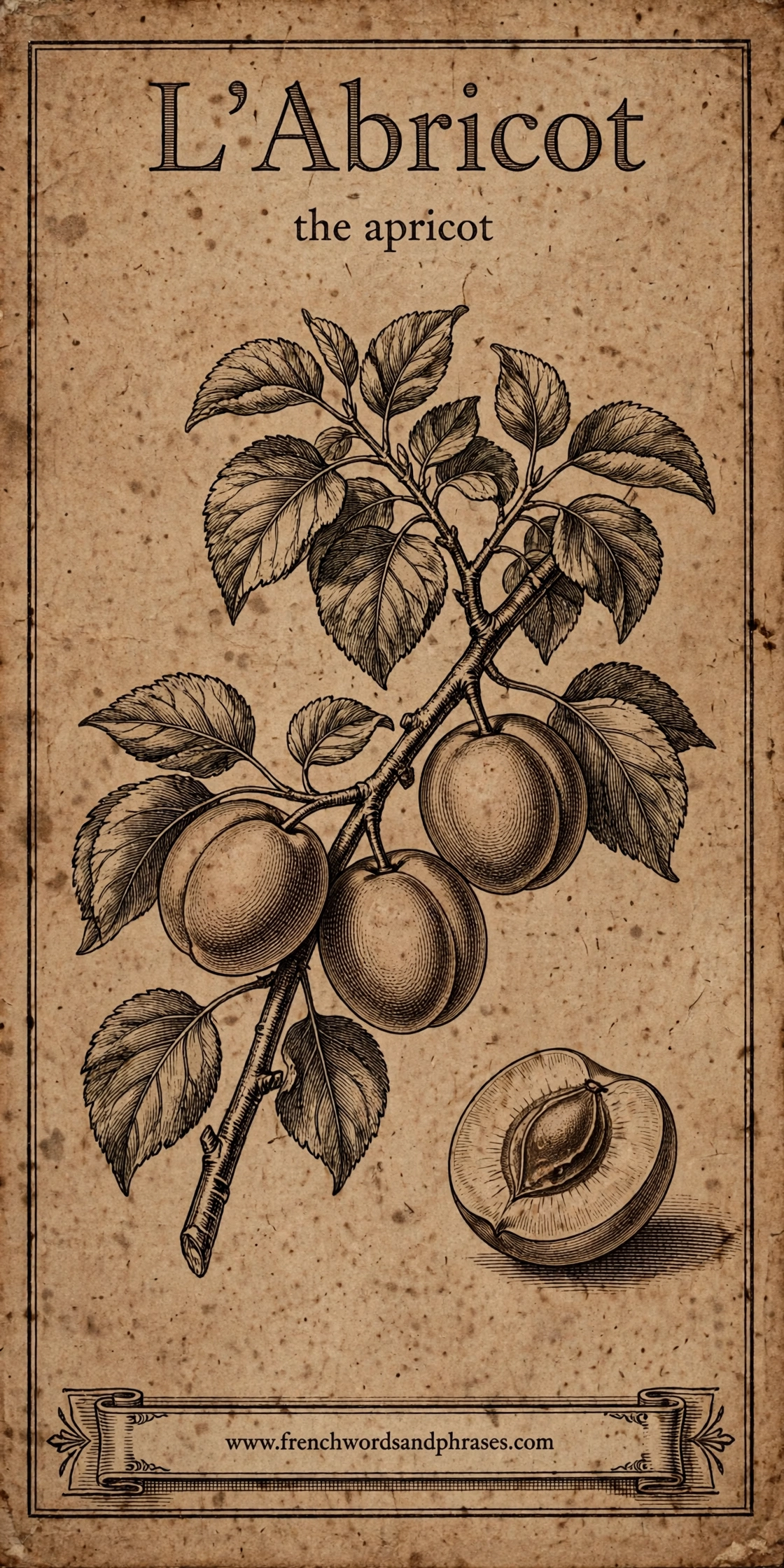
L’Abricot means the apricot.
July in the market: crates of small orange fruit, soft as velvet, warm from the sun. The stallholder cuts one open and hands you half — sweet, golden, gone in two bites. In French, it is l’abricot.
In this guide, you’ll learn what abricot means in English, how to use it with its articles, how to form its plural, and how it appears in everyday French. Explore French examples, English translations, and practice quizzes.
Understanding the French Noun Abricot
Abricot is a masculine French noun, learned with its article: l’abricot, un abricot — because it begins with a vowel, le shrinks to l’. It names the fruit of l’abricotier, the apricot tree. The same word also serves as an invariable colour word — une robe abricot, an apricot-coloured dress — but the fruit is the heart of the word.
It means the apricot — the small, round, orange stone fruit with velvet skin and sweet flesh, eaten fresh in summer, dried in winter, or cooked into la confiture d’abricots (apricot jam) and la tarte aux abricots (apricot tart). Inside sits le noyau, the stone. France’s apricots ripen early in the south, especially in the Roussillon and the Rhône valley.
Gender: Masculine
Definite article: l’ — l’abricot (the apricot)
Indefinite article: un — un abricot (an apricot)
Plural: les abricots
Also used as: An invariable colour adjective — une écharpe abricot (an apricot scarf)
English equivalents: The apricot.
One important usage detail: as a colour, abricot never agrees — des chaussures abricot, never « abricotes »; colour words taken from fruit and flowers stay invariable. As a fruit, of course, it behaves normally: un abricot, deux abricots. And mind the vowel start: l’abricot, never « le abricot ».
Experience the Word
Abricot is more than a fruit. It is the taste of the first hot weeks — market stalls in Provence, jam bubbling on a grandmother’s stove, the sticky fingers of children.
Imagine biting into an apricot still warm from the tree: the skin gives, the juice runs, and for a second the whole orchard is in your mouth.
You have not just eaten a fruit. You have tasted the start of summer — le soleil en bouche.
How to Use Abricot in French: Complete Guide
Let’s explore how abricot works in French, beginning with its articles — then the colour that borrows its name.
Abricot with the Definite Article (L’, Les)
Abricot begins with a vowel, so le shrinks to l’ — used for the apricot in front of you.
| Form | French |
|---|---|
| Masculine singular | l’abricot |
| Plural | les abricots |
Example
L’abricot que tu manges est bien mûr.
The apricot you are eating is nice and ripe.
Abricot with the Indefinite Article (Un, Des)
Used for an apricot in general — un abricot from the crate.
| Form | French |
|---|---|
| Masculine singular | un abricot |
| Plural | des abricots |
Example
Elle mange un abricot au goûter.
She eats an apricot for her afternoon snack.
At the Market: Words of the Abricot
Stones, jam and ripeness — the vocabulary that surrounds the abricot.
| French | In English |
|---|---|
| le noyau | the stone, the pit |
| mûr | ripe |
| la confiture d’abricots | apricot jam |
| les abricots secs | dried apricots |
| la tarte aux abricots | apricot tart |
| l’abricotier | the apricot tree |
Example
Attention au noyau quand tu manges un abricot.
Mind the stone when you eat an apricot.
Quick Quiz 1
Complete the sentence:
______ abricot est sucré et juteux.
Reveal the answer
Cet
Cet abricot est sucré et juteux.
This apricot is sweet and juicy — cet, because abricot begins with a vowel.
The Plural of Abricot
Abricot adds an -s in the plural — les abricots, a whole crate of them.
| Number | French |
|---|---|
| Singular | l’abricot |
| Plural | les abricots |
Example
Les abricots du Roussillon sont célèbres dans toute la France.
Apricots from the Roussillon are famous all over France.
Abricot with Possessive Adjectives (Mon, Ton, Son…)
Possessives agree with the noun — and abricot begins with a vowel, so it takes mon, ton, son.
| Owner | French |
|---|---|
| my | mon abricot |
| your (tu) | ton abricot |
| his / her | son abricot |
| our | notre abricot |
| your (vous) | votre abricot |
| their | leur abricot |
Example
Ne mange pas mon abricot, prends le tien !
Don’t eat my apricot, take yours!
Quick Quiz 2
Complete the sentence:
______ abricots sont déjà mûrs. (Our)
Reveal the answer
Nos
Nos abricots sont déjà mûrs.
Our apricots are already ripe — nos, the plural of notre.
Abricot with Demonstrative Adjectives (Cet, Ces)
Used to point: cet abricot — cet, not ce, because the word begins with a vowel.
| Form | French |
|---|---|
| Masculine singular | cet abricot |
| Plural | ces abricots |
Example
Ces abricots-ci sont plus sucrés que ceux-là.
These apricots are sweeter than those.
Abricot with Adjectives
Adjectives agree with the masculine noun: un abricot mûr, un abricot bien sucré.
| Adjective | With Abricot |
|---|---|
| mûr (ripe) | un abricot mûr |
| sucré (sweet) | un abricot sucré |
| juteux (juicy) | un abricot juteux |
| sec (dried) | un abricot sec |
| petit (small) | un petit abricot |
Example
Un abricot mûr et juteux, c’est le bonheur de l’été.
A ripe, juicy apricot is the joy of summer.
Quick Quiz 3
Is this colour correct?
Elle porte des chaussures abricotes.
Reveal the answer
No
Elle porte des chaussures abricot.
She is wearing apricot shoes — as a colour, abricot is invariable and never takes an -s.
Everyday Expressions with Abricot
Jam, tarts and summer markets — the abricot phrases of daily life.
| Expression | In English |
|---|---|
| la confiture d’abricots | apricot jam |
| la tarte aux abricots | apricot tart |
| un abricot bien mûr | a nice ripe apricot |
| les abricots secs | dried apricots |
| le noyau de l’abricot | the apricot stone |
| couleur abricot | apricot-coloured |
Example
Ma grand-mère fait la meilleure confiture d’abricots du village.
My grandmother makes the best apricot jam in the village.
Words from the Same Family as Abricot
Trees, stones and stone fruit — the words that travel with abricot.
| French | In English |
|---|---|
| l’abricotier | the apricot tree |
| le noyau | the stone, the pit |
| la pêche | the peach |
| la prune | the plum |
| le fruit | the fruit |
| le verger | the orchard |
Example
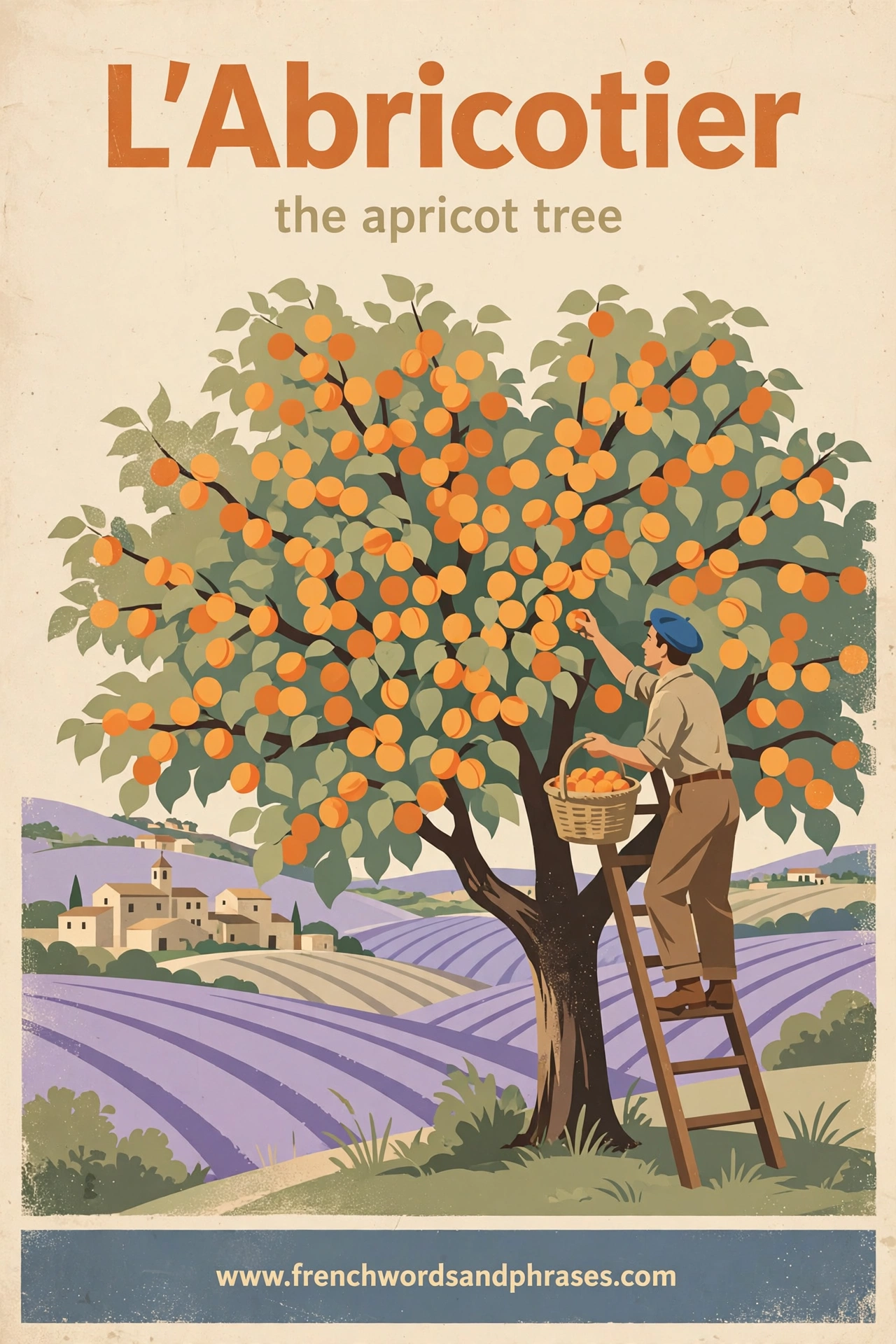
L’abricotier du jardin donne des abricots chaque été.
The apricot tree in the garden gives apricots every summer.
Quick Quiz 4
What is le noyau?
Reveal the answer
The stone — the hard pit at the centre of the apricot.
Un abricot sans noyau serait bien pratique !
An apricot without a stone would be very handy!
Abricot in Everyday French: Real-Life Examples
Now that you know the word, let’s see how abricot appears in everyday French.
Example 1 — At the market
Ces abricots sont mûrs et très parfumés.
These apricots are ripe and very fragrant.
Example 2 — Making jam
Nous faisons de la confiture d’abricots ce week-end.
We’re making apricot jam this weekend.
Example 3 — A snack
Il mange un abricot sec après le sport.
He eats a dried apricot after sport.
Example 4 — Baking
La tarte aux abricots est encore chaude.
The apricot tart is still warm.
Example 5 — In the garden
L’abricotier est couvert d’abricots cette année.
The apricot tree is covered in apricots this year.
Example 6 — A colour
Elle a choisi une robe abricot pour la fête.
She chose an apricot-coloured dress for the party.
Beyond Translation: The Meaning of Abricot
The abricot travelled a long road to the French orchard: born in China, carried along the Silk Road, named in Arabic and Catalan before it reached Provence — and its French name still carries that journey. In France it became the fruit of the south, of early summer, of jam made in copper pans and tarts eaten in the shade.
To say abricot is to name the first golden fruit of the hot season.
It evokes market crates at dawn, the smell of ripe fruit in a warm kitchen, and a colour so loved that French borrowed it back from the fruit to paint dresses and walls.
How to Remember the French Noun Abricot
Remember it this way: Abricot is the apricot — the golden fruit, and its name doubles as an invariable colour.
- You taste the fruit — l’abricot, un abricot mûr et sucré.
- You mind the stone — le noyau au centre de l’abricot.
- You wear the colour — une robe abricot, jamais d’accord.
The key idea is l’abricot — the fruit, and a colour that never agrees.
Test Your Knowledge of Abricot
Let’s see how much you’ve learned. Try answering these questions before revealing the answers.
Question 1
Is abricot masculine or feminine?
Reveal the answer
Masculine — un abricot, l’abricot.
Question 2
What tree does the abricot grow on?
Reveal the answer
L’abricotier — the apricot tree.
Question 3
Translate: The apricots are ripe.
Reveal the answer
Les abricots sont mûrs.
Question 4
Why is « des robes abricotes » wrong?
Reveal the answer
Because colour words borrowed from fruit are invariable — des robes abricot, with no agreement.
Question 5
Complete the sentence:
Elle mange ______ au goûter.
Reveal the answer
un abricot
Elle mange un abricot au goûter.
She eats an apricot for her afternoon snack.
Your Final Challenge
Can You Use It?
How would you say this in French?
“My grandmother makes apricot jam every summer.”
Reveal the answer
Ma grand-mère fait de la confiture d’abricots chaque été.
My grandmother makes apricot jam every summer.
A little French. A little curiosity. A richer everyday life.
LEARN FRENCH ONE WORD AT A TIME