A French Word to Live By
Translate Abribus to English
/a.bʁi.bys/
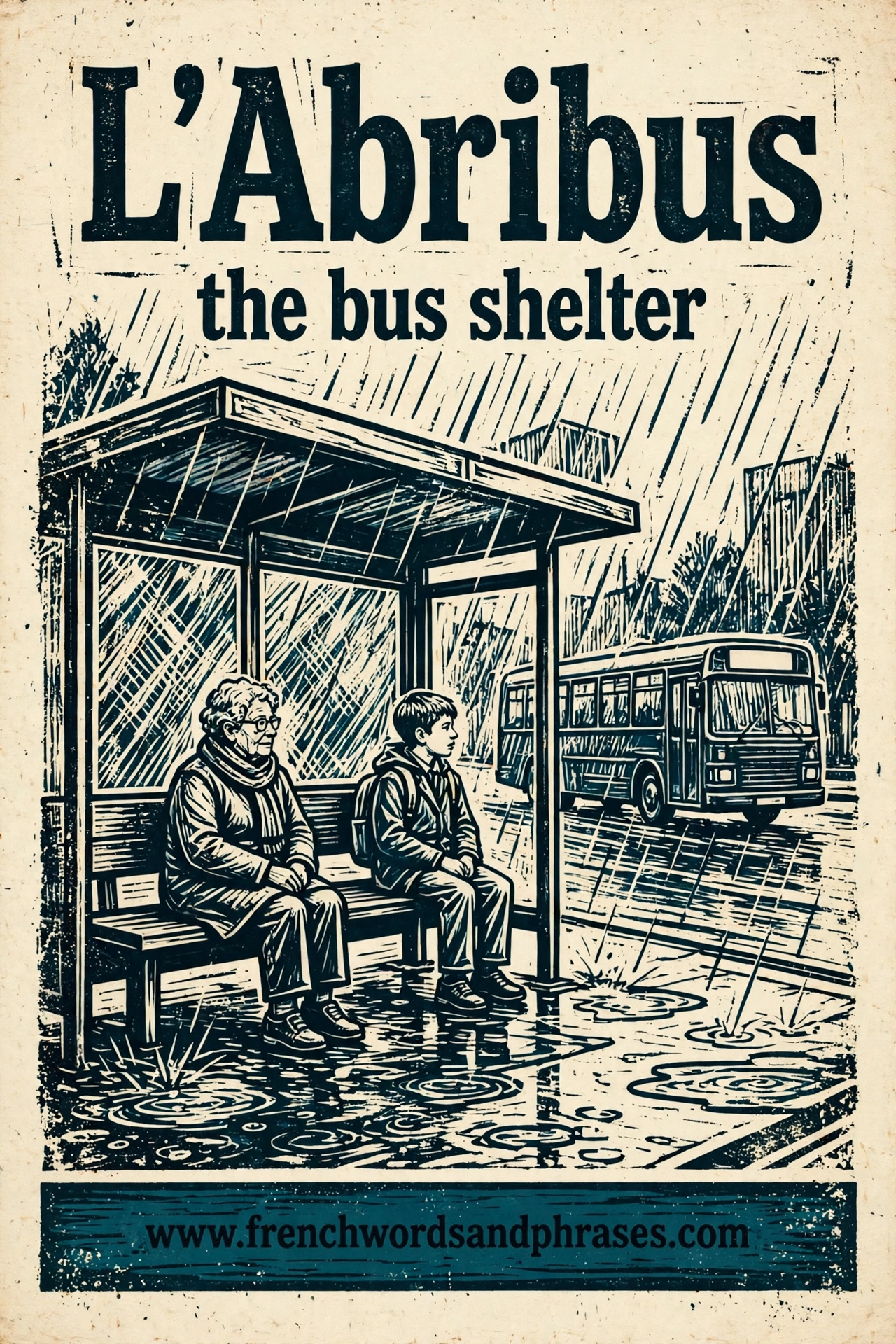
L’Abribus means the bus shelter.
The rain starts without warning, the bus is ten minutes late, and six strangers squeeze together under one small roof, watching the wet street in silence. That little roof has a name in French: l’abribus.
In this guide, you’ll learn what abribus means in English, how to use it with its articles, how to form its plural, and how it appears in everyday French. Explore French examples, English translations, and practice quizzes.
Understanding the French Noun Abribus
Abribus is a masculine French noun, learned with its article: l’abribus, un abribus — because it begins with a vowel, le shrinks to l’. It is a cheerful French coinage: the word began life as a brand name, Abribus, and slipped into everyday language as the ordinary word for a bus shelter.
It means the bus shelter — the small structure at a bus stop with a roof, a bench and glass or open sides, built to protect waiting passengers from rain and wind. You find un abribus at l’arrêt de bus (the bus stop), in town centres and villages alike, often carrying a timetable and an advertisement panel.
Gender: Masculine
Definite article: l’ — l’abribus (the bus shelter)
Indefinite article: un — un abribus (a bus shelter)
Plural: les abribus — the spelling never changes
Word origin: A former brand name that became the everyday word
English equivalents: The bus shelter.
One important usage detail: abribus is invariable in writing — one abribus, two abribus, the final -s is part of the word and never doubles. And mind the vowel start: you never say « le abribus », always l’abribus. The smaller word un abri means shelter in general; the abribus is the one built for bus passengers.
Experience the Word
Abribus is more than street furniture. It is the village’s smallest public room — the place where schoolchildren gather in the morning and where strangers share umbrellas and bus gossip.
Imagine a November evening: the glass steamed up, the bench crowded, everyone watching the corner for the first glow of the bus’s headlights.
You have not just waited for a bus. You have sheltered — à l’abri, out of the rain, the French way.
How to Use Abribus in French: Complete Guide
Let’s explore how abribus works in French, beginning with its articles — and with that fixed final -s that never changes.
Abribus with the Definite Article (L’, Les)
Abribus begins with a vowel, so le shrinks to l’ — used for the shelter at your own stop.
| Form | French |
|---|---|
| Masculine singular | l’abribus |
| Plural | les abribus |
Example
L’abribus de la place est plein quand il pleut.
The bus shelter in the square is full when it rains.
Abribus with the Indefinite Article (Un, Des)
Used for a bus shelter in general — un abribus on any street.
| Form | French |
|---|---|
| Masculine singular | un abribus |
| Plural | des abribus |
Example
La mairie installe un abribus près de l’école.
The town hall is putting up a bus shelter near the school.
At the Abribus: Words of the Bus Stop
Benches, timetables and rain — the vocabulary that surrounds the abribus.
| French | In English |
|---|---|
| l’arrêt de bus | the bus stop |
| le banc | the bench |
| le toit | the roof |
| les horaires | the timetable |
| attendre le bus | to wait for the bus |
| la pluie | the rain |
Example
Les élèves attendent le bus sous l’abribus.
The pupils wait for the bus under the bus shelter.
Quick Quiz 1
Complete the sentence:
Il pleut, vite, mettons-nous sous ______ !
Reveal the answer
l’abribus
Il pleut, vite, mettons-nous sous l’abribus !
It’s raining, quick, let’s get under the bus shelter — l’, because abribus begins with a vowel.
The Plural of Abribus
Abribus already ends in -s, so the plural is written exactly the same — only the article changes.
| Number | French |
|---|---|
| Singular | l’abribus |
| Plural | les abribus |
Example
Tous les abribus de la ville ont un banc et un toit.
All the bus shelters in town have a bench and a roof.
Abribus with Possessive Adjectives (Mon, Ton, Son…)
Possessives agree with the noun — and abribus begins with a vowel, so it takes mon, ton, son.
| Owner | French |
|---|---|
| my | mon abribus |
| your (tu) | ton abribus |
| his / her | son abribus |
| our | notre abribus |
| your (vous) | votre abribus |
| their | leur abribus |
Example
Notre abribus est juste en face de la boulangerie.
Our bus shelter is right opposite the bakery.
Quick Quiz 2
Complete the sentence:
______ abribus est le plus vieux du village. (Their)
Reveal the answer
Leur
Leur abribus est le plus vieux du village.
Their bus shelter is the oldest in the village.
Abribus with Demonstrative Adjectives (Cet, Ces)
Used to point: cet abribus — cet, not ce, because the word begins with a vowel.
| Form | French |
|---|---|
| Masculine singular | cet abribus |
| Plural | ces abribus |
Example
Cet abribus protège mal du vent.
This bus shelter doesn’t protect you much from the wind.
Abribus with Adjectives
Adjectives agree with the masculine noun: un abribus moderne, un abribus en verre.
| Adjective | With Abribus |
|---|---|
| nouveau (new) | un abribus nouveau |
| moderne (modern) | un abribus moderne |
| petit (small) | un petit abribus |
| en verre (glass) | un abribus en verre |
| plein (full, crowded) | un abribus plein |
Example
La ville remplace le vieil abribus par un abribus moderne.
The town is replacing the old bus shelter with a modern one.
Quick Quiz 3
Complete the sentence:
______ abribus est en verre. (This)
Reveal the answer
Cet
Cet abribus est en verre.
This bus shelter is made of glass — cet, because abribus starts with a vowel sound.
Everyday Expressions with Abribus
Waiting, raining and sheltering — the abribus phrases of daily life.
| Expression | In English |
|---|---|
| attendre sous l’abribus | to wait under the bus shelter |
| s’abriter sous l’abribus | to shelter under the bus shelter |
| l’abribus de la place | the bus shelter in the square |
| un abribus en verre | a glass bus shelter |
| courir à l’abribus | to run to the bus shelter |
| l’arrêt et son abribus | the stop and its shelter |
Example
Quand l’orage arrive, tout le monde court à l’abribus.
When the storm arrives, everyone runs to the bus shelter.
Words from the Same Family as Abribus
Shelter is the family business — abribus grows out of abri, the general word for shelter.
| French | In English |
|---|---|
| l’abri | the shelter (in general) |
| s’abriter | to take shelter |
| le bus | the bus |
| l’arrêt | the stop |
| le banc | the bench |
| abrité | sheltered, protected |
Example
Sans abribus, les voyageurs cherchent un abri sous les arbres.
Without a bus shelter, the travellers look for shelter under the trees.
Quick Quiz 4
What is the difference between un abri and un abribus?
Reveal the answer
An abri is any shelter; an abribus is the shelter built at a bus stop.
On attend le bus dans l’abribus, à l’abri de la pluie.
You wait for the bus in the bus shelter, sheltered from the rain.
Abribus in Everyday French: Real-Life Examples
Now that you know the word, let’s see how abribus appears in everyday French.
Example 1 — In the rain
Il pleut, les voyageurs se serrent sous l’abribus.
It’s raining; the travellers huddle under the bus shelter.
Example 2 — At the school stop
Les enfants attendent le car sous l’abribus.
The children wait for the school bus under the bus shelter.
Example 3 — A new shelter
La commune a installé un abribus tout neuf.
The council has installed a brand-new bus shelter.
Example 4 — Checking the timetable
Elle lit les horaires affichés dans l’abribus.
She reads the timetable posted in the bus shelter.
Example 5 — A crowded morning
Ce matin, l’abribus est plein de voyageurs.
This morning, the bus shelter is full of travellers.
Example 6 — Waiting together
Nous attendons le bus sous l’abribus depuis dix minutes.
We’ve been waiting for the bus under the shelter for ten minutes.
Beyond Translation: The Meaning of Abribus
Abribus is one of those happy accidents of French: a company put its name on shelters all over the country, and the name stuck so completely that it became the word itself. Dictionaries now list abribus as an ordinary noun, lower-case a and all — a little monument to the power of waiting for buses in the rain.
To say abribus is to name the smallest roof in French public life.
It evokes steamed-up glass and wet coats, the timetable read by torchlight, and the small solidarity of strangers watching the same corner for the same bus.
How to Remember the French Noun Abribus
Remember it this way: Abribus is the bus shelter — abri (shelter) plus bus, a word that began as a brand name and became everyone’s word.
- You see the parts — abri + bus : l’abribus, le toit de l’arrêt.
- You watch the vowel — l’abribus, cet abribus, mon abribus.
- You keep the -s — un abribus, des abribus, l’orthographe ne change pas.
The key idea is l’abribus — shelter plus bus, and the -s never changes.
Test Your Knowledge of Abribus
Let’s see how much you’ve learned. Try answering these questions before revealing the answers.
Question 1
Is abribus masculine or feminine?
Reveal the answer
Masculine — un abribus, l’abribus.
Question 2
Why do we say l’abribus and not le abribus?
Reveal the answer
Because abribus begins with a vowel — le shrinks to l’ before a vowel sound.
Question 3
Translate: The bus shelter is full this morning.
Reveal the answer
L’abribus est plein ce matin.
Question 4
Does the plural of abribus change the spelling?
Reveal the answer
No — un abribus, des abribus; the word is invariable, only the article changes.
Question 5
Complete the sentence:
Elle attend sous ______ depuis dix minutes.
Reveal the answer
l’abribus
Elle attend sous l’abribus depuis dix minutes.
She has been waiting under the bus shelter for ten minutes.
Your Final Challenge
Can You Use It?
How would you say this in French?
“The travellers wait under the bus shelter because it is raining.”
Reveal the answer
Les voyageurs attendent sous l’abribus parce qu’il pleut.
The travellers wait under the bus shelter because it is raining.
A little French. A little curiosity. A richer everyday life.
LEARN FRENCH ONE WORD AT A TIME