A French Word to Live By
How to Conjugate Aboyer in French
/a.bwa.je/
Aboyer means to bark — the sharp, repeated cry of a dog, at strangers, at the postman, at the moon.
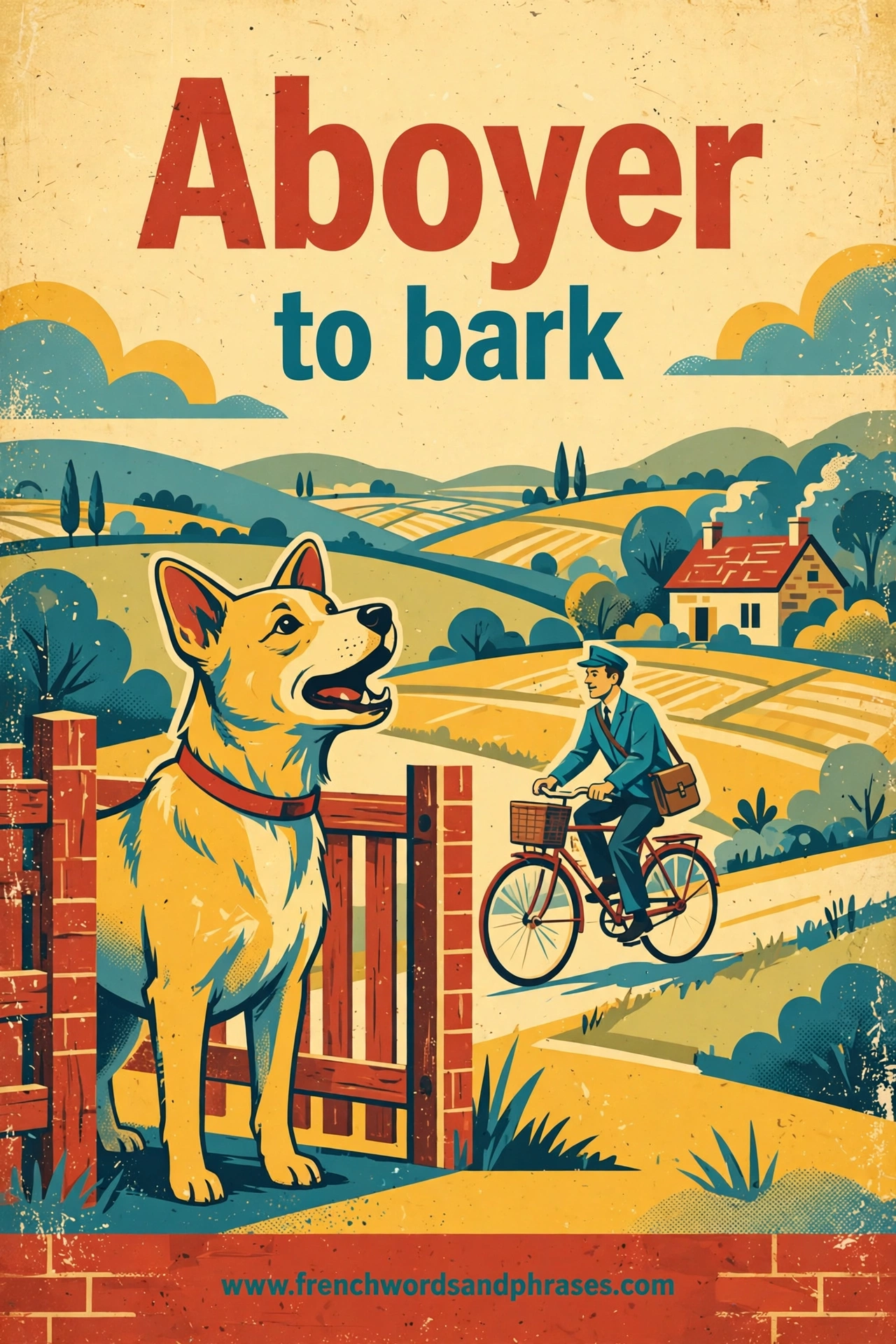
A gate rattling at midnight, a farmyard exploding at the postman’s bicycle, a small dog defending an enormous garden — aboyer is the verb of the dog’s voice: barking at the world, one sharp syllable at a time.
In this guide, you’ll learn how to conjugate aboyer in all the major French tenses and moods. Explore complete conjugation tables, French examples, English translations, and practice quizzes.
Understanding the French Verb Aboyer
Aboyer is a regular French verb belonging to the first group of verbs, those ending in-er.
It means to bark. It is used of dogs above all, and by extension of people who shout orders or complaints — un sergent qui aboie ses ordres, a sergeant who barks his orders. The noun un aboiement is a single bark; the famous proverb les chiens aboient, la caravane passe — the dogs bark, the caravan moves on — makes aboyer the sound of criticism that changes nothing.
Verb classification: First group (-er)
Auxiliary verb: Avoir
Past participle: aboyé
Present participle: aboyant
English equivalents: To bark, to bay; le chien aboie — the dog barks; aboyer après quelqu’un — to bark at someone; aboyer à la lune — to bark at the moon, to complain in vain; un aboiement — a bark; les aboiements — barking.
One important detail: aboyer belongs to the -oyer family — the y turns to i before a mute syllable: j’aboie, tu aboies, il aboie, ils aboient, and through the future and conditional: j’aboierai. The y survives where the ending is sounded: nous aboyons, vous aboyez, j’aboyais, en aboyant. Dogs bark après people and things — le chien aboie après le facteur — and aboyer à la lune, to bark at the moon, is to protest where nobody can hear.
Experience the Word
Aboyer is the oldest alarm system in the world — a dog, a gate, and a voice that fills the whole street.
Imagine a farmhouse at dusk. A bicycle crunches on the gravel, and before the postman has even swung his leg down, the yard erupts — le chien aboie, announcing to three villages that the mail has arrived.
The postman is a friend of ten years. The dog barks anyway — il aboie — because barking is the job.
How to Conjugate Aboyer: Complete French Conjugation Guide
Let’s explore every major conjugation of aboyer, beginning with the indicative mood.
How to Conjugate Aboyer in the Indicative Mood
The indicative mood is used to express facts, observations, actions, and events.
How to Conjugate Aboyer in the Present Tense (Présent)
Used for actions happening now, habitual actions, and general truths.
| Subject | Conjugation |
|---|---|
| je | aboie |
| tu | aboies |
| il / elle | aboie |
| nous | aboyons |
| vous | aboyez |
| ils / elles | aboient |
Example
Le chien aboie après le facteur chaque matin.
The dog barks at the postman every morning.
Quick Quiz 1
Complete the sentence:
Les chiens ______ après chaque passant.
Reveal the answer
aboient
Les chiens aboient après chaque passant.
The dogs bark at every passer-by.
How to Conjugate Aboyer in the Passé Composé
Used for completed actions in the past. Aboyer takes the auxiliary verb avoir.
| Subject | Conjugation |
|---|---|
| j’ | ai aboyé |
| tu | as aboyé |
| il / elle | a aboyé |
| nous | avons aboyé |
| vous | avez aboyé |
| ils / elles | ont aboyé |
Example
Le chien a aboyé toute la nuit.
The dog barked all night.
How to Conjugate Aboyer in the Imparfait (Imperfect Tense)
Used for habitual past actions, descriptions, and ongoing situations in the past.
| Subject | Conjugation |
|---|---|
| je | aboyais |
| tu | aboyais |
| il / elle | aboyait |
| nous | aboyions |
| vous | aboyiez |
| ils / elles | aboyaient |
Example
Autrefois, les chiens du village aboyaient à chaque voiture.
In the old days, the village dogs used to bark at every car.
Quick Quiz 2
Choose the correct form:
The dog barked all night.
Le chien ______ toute la nuit. (a aboyé / est aboyé)
Reveal the answer
a aboyé
Le chien a aboyé toute la nuit.
Aboyer takes avoir.
How to Conjugate Aboyer in the Plus-que-parfait
Used to describe an action that had already been completed before another past event.
| Subject | Conjugation |
|---|---|
| j’ | avais aboyé |
| tu | avais aboyé |
| il / elle | avait aboyé |
| nous | avions aboyé |
| vous | aviez aboyé |
| ils / elles | avaient aboyé |
Example
Le chien avait aboyé longtemps avant l’aube.
The dog had barked for a long time before dawn.
How to Conjugate Aboyer in the Passé Simple
Primarily used in formal writing, literature, and historical narratives. It is rarely used in everyday conversation.
| Subject | Conjugation |
|---|---|
| je | aboyai |
| tu | aboyas |
| il / elle | aboya |
| nous | aboyâmes |
| vous | aboyâtes |
| ils / elles | aboyèrent |
Example
Le chien de garde aboya dès qu’il entendit la grille.
The guard dog barked as soon as he heard the gate.
How to Conjugate Aboyer in the Passé Antérieur
A literary tense used to express an action completed immediately before another past action, generally in the passé simple.
| Subject | Conjugation |
|---|---|
| j’ | eus aboyé |
| tu | eus aboyé |
| il / elle | eut aboyé |
| nous | eûmes aboyé |
| vous | eûtes aboyé |
| ils / elles | eurent aboyé |
Example
Quand le chien eut aboyé trois fois, le fermier sortit.
When the dog had barked three times, the farmer came out.
How to Conjugate Aboyer in the Future Tense (Futur Simple)
Used to describe actions that will take place in the future.
| Subject | Conjugation |
|---|---|
| je | aboierai |
| tu | aboieras |
| il / elle | aboiera |
| nous | aboierons |
| vous | aboierez |
| ils / elles | aboieront |
Example
Si tu t’approches, le chien aboiera.
If you come closer, the dog will bark.
How to Conjugate Aboyer in the Futur Antérieur (Future Perfect)
Used for an action that will have been completed before a particular point in the future.
| Subject | Conjugation |
|---|---|
| j’ | aurai aboyé |
| tu | auras aboyé |
| il / elle | aura aboyé |
| nous | aurons aboyé |
| vous | aurez aboyé |
| ils / elles | auront aboyé |
Example
À minuit, le chien aura aboyé cent fois.
By midnight, the dog will have barked a hundred times.
How to Conjugate Aboyer in the Near Future (Futur Proche)
Used to describe something that is going to happen soon. Formed with aller + infinitive.
| Subject | Conjugation |
|---|---|
| je | vais aboyer |
| tu | vas aboyer |
| il / elle | va aboyer |
| nous | allons aboyer |
| vous | allez aboyer |
| ils / elles | vont aboyer |
Example
Attention, le chien va aboyer.
Careful, the dog is going to bark.
How to Conjugate Aboyer in the Conditional Mood
The conditional mood expresses what would happen under certain circumstances. It is also frequently used to make polite requests or express wishes.
How to Conjugate Aboyer in the Present Conditional
| Subject | Conjugation |
|---|---|
| je | aboierais |
| tu | aboierais |
| il / elle | aboierait |
| nous | aboierions |
| vous | aboieriez |
| ils / elles | aboieraient |
Example
Sans la clôture, il aboierait après tous les passants.
Without the fence, he would bark at every passer-by.
How to Conjugate Aboyer in the Past Conditional
| Subject | Conjugation |
|---|---|
| j’ | aurais aboyé |
| tu | aurais aboyé |
| il / elle | aurait aboyé |
| nous | aurions aboyé |
| vous | auriez aboyé |
| ils / elles | auraient aboyé |
Example
Le chien aurait aboyé si quelqu’un était passé.
The dog would have barked if anyone had passed.
Aboyer in the Literary Past Conditional Form
This less common literary form uses the imperfect subjunctive of avoir.
| Subject | Conjugation |
|---|---|
| j’ | eusse aboyé |
| tu | eusses aboyé |
| il / elle | eût aboyé |
| nous | eussions aboyé |
| vous | eussiez aboyé |
| ils / elles | eussent aboyé |
Example
Le chien eût aboyé toute la nuit sans son maître.
The dog would have barked all night without its master.
How to Conjugate Aboyer in the Subjunctive Mood
The subjunctive is used to express wishes, emotions, doubts, necessity, and uncertainty. It frequently follows expressions such as il faut que (it is necessary that) or bien que (although).
How to Conjugate Aboyer in the Present Subjunctive
| Subject | Conjugation |
|---|---|
| que je | aboie |
| que tu | aboies |
| qu’il / qu’elle | aboie |
| que nous | aboyions |
| que vous | aboyiez |
| qu’ils / qu’elles | aboient |
Example
Il est normal que le chien aboie après les étrangers.
It is normal for the dog to bark at strangers.
Quick Quiz 3
Complete the sentence using the subjunctive:
Il est normal que les chiens ______ après les étrangers.
Reveal the answer
aboient
Il est normal que les chiens aboient après les étrangers.
It is normal for dogs to bark at strangers.
How to Conjugate Aboyer in the Imperfect Subjunctive
A literary tense, rarely encountered in modern spoken French.
| Subject | Conjugation |
|---|---|
| que je | aboyasse |
| que tu | aboyasses |
| qu’il / qu’elle | aboyât |
| que nous | aboyassions |
| que vous | aboyassiez |
| qu’ils / qu’elles | aboyassent |
Example
Le voisin ne voulait pas que le chien aboyât si fort.
The neighbour did not want the dog to bark so loudly.
How to Conjugate Aboyer in the Pluperfect Subjunctive
A literary construction used to express an action completed before another past action.
| Subject | Conjugation |
|---|---|
| que j’ | eusse aboyé |
| que tu | eusses aboyé |
| qu’il / qu’elle | eût aboyé |
| que nous | eussions aboyé |
| que vous | eussiez aboyé |
| qu’ils / qu’elles | eussent aboyé |
Example
On racontait que le chien eût aboyé avant même l’incendie.
People said the dog had barked even before the fire.
How to Conjugate Aboyer in the Past Subjunctive
| Subject | Conjugation |
|---|---|
| que j’ | aie aboyé |
| que tu | aies aboyé |
| qu’il / qu’elle | ait aboyé |
| que nous | ayons aboyé |
| que vous | ayez aboyé |
| qu’ils / qu’elles | aient aboyé |
Example
Je suis surpris qu’il ait aboyé si peu.
I am surprised he barked so little.
How to Conjugate Aboyer in the Imperative
The imperative is used to give commands, instructions, invitations, or suggestions. Subject pronouns are omitted.
How to Conjugate Aboyer in the Present Imperative
| Person | Conjugation |
|---|---|
| (tu) | aboie |
| (nous) | aboyons |
| (vous) | aboyez |
Example
Aboie, mon chien, aboie après l’étranger !
Bark, my dog, bark at the stranger!
Quick Quiz 4
How would you say Bark at the stranger (tu form, to a dog)?
Reveal the answer
Aboie après l’étranger !
French Participles of Aboyer
Participles are verb forms that can be used in compound tenses and other grammatical constructions.
Present Participle of Aboyer
aboyant
En aboyant après la lune, le chien réveille le village.
By barking at the moon, the dog wakes the village.
Past Participle of Aboyer
aboyé
Aboyé par tous les chiens du quartier, le chat s’enfuit.
Barked at by all the dogs in the neighbourhood, the cat fled.
Aboyer in Everyday French: Real-Life Examples
Now that you know the conjugations, let’s see how aboyer appears in everyday French.
Example 1 — Present
Le chien aboie après le facteur.
The dog barks at the postman.
Example 2 — Passé composé
Le chien a aboyé toute la nuit.
The dog barked all night.
Example 3 — Imparfait
Les chiens aboyaient à chaque voiture.
The dogs used to bark at every car.
Example 4 — Future
Si tu t’approches, il aboiera.
If you come closer, he will bark.
Example 5 — Conditional
Il aboierait après tous les passants.
He would bark at every passer-by.
Example 6 — Imperative
Aboie après l’étranger !
Bark at the stranger!
Beyond Translation: The Meaning of Aboyer
English dogs bark, and French dogs aboient — a word that sounds like the noise itself, all jaw and echo.
The dogs bark, the caravan moves on.
The proverb les chiens aboient, la caravane passe has made aboyer the verb of noisy, powerless criticism — and aboyer à la lune, to bark at the moon, is French for complaining to an audience that cannot answer.
How to Remember the French Verb Aboyer
Remember it this way: Aboyer is about the farmyard at dusk — the postman arrives, the alarm goes off.
- Oyer spelling: j’aboie with i, but nous aboyons with y — and j’aboierai in the future.
- Dogs bark après their targets: le chien aboie après le facteur.
- Avoir throughout: le chien a aboyé toute la nuit; un aboiement is one bark.
The key idea is the farmyard at dusk — the postman arrives, the alarm goes off.
Test Your Knowledge of Aboyer
Let’s see how much you’ve learned. Try answering these questions before revealing the answers.
Question 1
What spelling change does aboyer make in j’aboie and ils aboient?
Reveal the answer
The y becomes i before a mute syllable — j’aboie, ils aboient — while the y survives in nous aboyons.
Question 2
How do you say The dog barks at the postman in French?
Reveal the answer
Le chien aboie après le facteur.
Question 3
Translate: The dog barked all night.
Reveal the answer
Le chien a aboyé toute la nuit.
Question 4
What is the past participle of aboyer?
Reveal the answer
Aboyé.
Question 5
Complete the sentence:
Il est normal que le chien ______ après les étrangers.
Reveal the answer
aboie
Il est normal que le chien aboie après les étrangers.
It is normal for the dog to bark at strangers.
Your Final Challenge
Can You Use It?
How would you say this in French?
The dog barks at the postman, as he has every morning for ten years.
Reveal the answer
Le chien aboie après le facteur, comme chaque matin depuis dix ans.
The dog barks at the postman, as he has every morning for ten years.
A little French. A little curiosity. A richer everyday life.
LEARN FRENCH ONE WORD AT A TIME