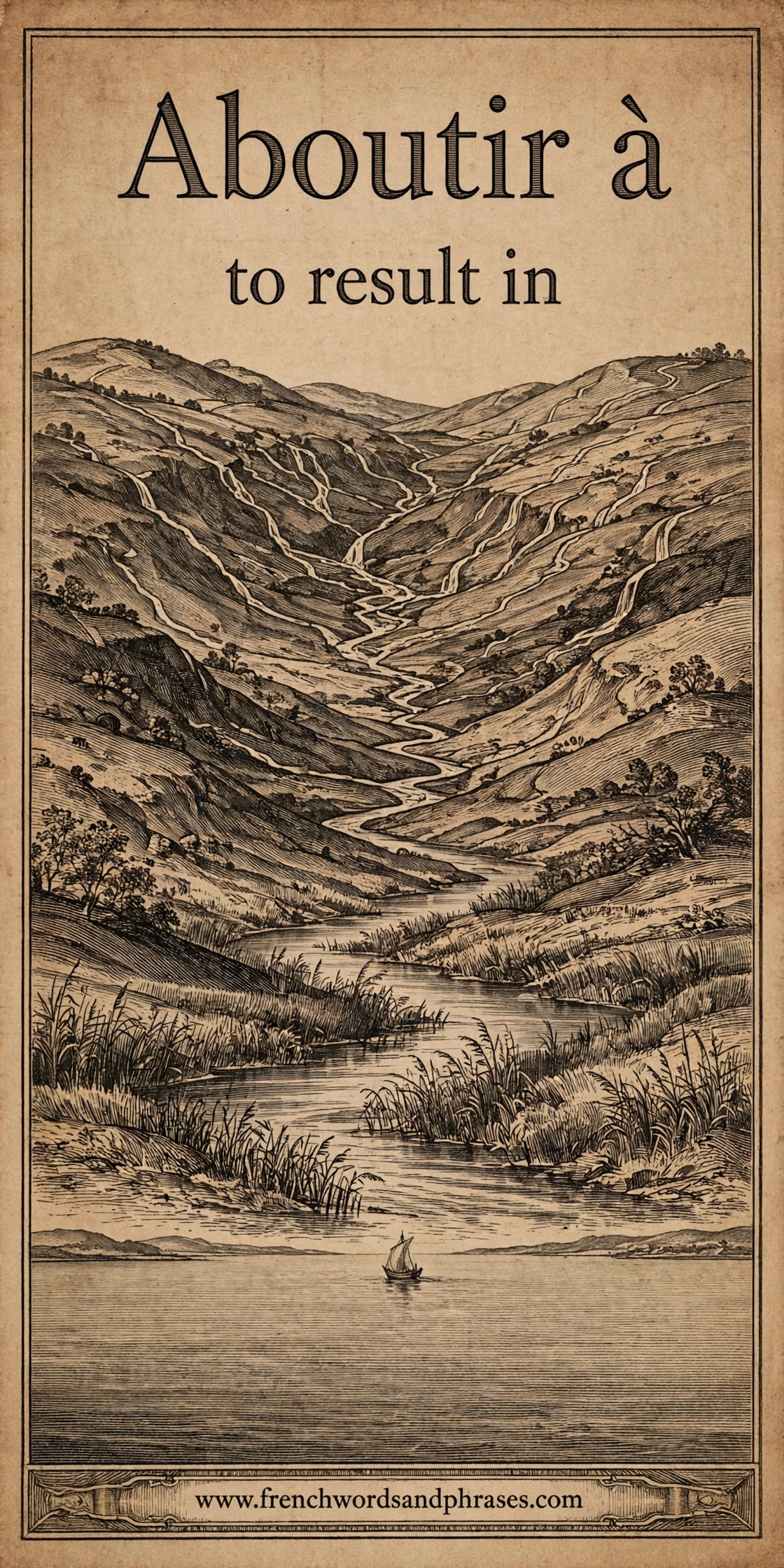
A French Word to Live By
Translate Aboutir à to English
/a.bu.tiʁ a/
Aboutir à means to result in — to lead to an outcome, to end in.
Six months of meetings, three draft agreements and one very long night of coffee in the town hall. At dawn the mayor shakes hands with the farmers’ spokesman, and the local paper gets its headline: les négociations ont abouti à un accord. The talks have resulted in an agreement.
Let’s explore how aboutir à works in French, beginning with the whole phrase on one card.
Understanding the French Phrase Aboutir à
Aboutir à is a French verb phrase built from aboutir (to lead to, to end up) and the preposition à. Aboutir hides a picture inside it: le bout is the end, the tip — aboutir is to reach the end of the road. Followed by à and a noun, it names the outcome all that travelling produced.
It means to result in, to lead to: les pourparlers ont abouti à un compromis, the talks resulted in a compromise. The subject is the process — talks, efforts, research, a road — and what follows à is where it all lands. Used without à, aboutir simply means to end up or to succeed: après des années d’efforts, son projet a abouti, after years of effort, his project came to fruition.
Type: Verb + preposition phrase — outcomes
Answers the need: Saying what a process finally produced
Register: Neutral to formal — news, reports, careful speech
Partner preposition: à + noun for the outcome; aboutir alone = to succeed, to end up
One important usage detail: the outcome after à is a noun — aboutir à un accord, à une impasse, à rien. The great negative of the phrase is n’aboutir à rien, to come to nothing. And mind the near-twin abouter: that is a different verb entirely, to join two pieces end to end, as a carpenter does.
Experience the Word
Aboutir à is the verb of long roads finally arriving — negotiations, investigations and novels all aboutissent somewhere.
Imagine the detective in the last chapter, pinning the final photograph to the board. Years of false leads, and at last the enquiry has a shape. L’enquête a abouti à une arrestation, she says: the investigation resulted in an arrest. The word carries the whole journey inside the arrival.
French loves an outcome with a road inside it. Aboutir is le bout, the end of the path, turned into a verb — to end up is to reach the tip.
How to Use Aboutir à in French: Complete Guide
Let’s explore how aboutir à works in French, beginning with the whole phrase on one card.
Aboutir à at a Glance
The Whole Phrase on One Card
Real meaning, literal picture, English twin and register — aboutir à in five lines.
| Point | Aboutir à |
|---|---|
| What it really means | to result in, to lead to an outcome |
| Word for word | to reach the end, at… — le bout is the end, the tip |
| English equivalent | to result in / to lead to / to end in |
| Register | neutral to formal — news and reports love it |
| Use it for | talks, efforts, enquiries, research — any process and its outcome |
Example
Les négociations ont abouti à un accord historique.
The negotiations resulted in a historic agreement.
Word by Word: Reaching the End
Two pieces — a verb with a road inside it, and the preposition that names the destination.
| Word | Literal meaning | Its job in the phrase |
|---|---|---|
| aboutir | to end up, to lead to | the verb of arrival — built on bout, the end or tip of something |
| à | to, in | introduces the outcome — the noun the process lands on |
| le bout | the end, the tip | the hidden picture: aboutir is to reach the end of the path |
| un aboutissement | an outcome, a culmination | the noun form — l’aboutissement de longues recherches |
Example
Ce sentier aboutit à une petite plage cachée.
This path leads to a little hidden beach.
Quick Quiz 1
What everyday noun hides inside aboutir?
Reveal the answer
Le bout — the end, the tip. Aboutir is to reach the end of the road, which is why it names outcomes.
Le chemin aboutit au bout du village.
The lane ends at the far end of the village.
When You Say It: Talks, Efforts and Enquiries
Aboutir à reports results — in headlines, offices and last chapters.
| Situation | Example |
|---|---|
| Negotiations | les pourparlers ont abouti à un compromis — the talks resulted in a compromise |
| An enquiry | l’enquête a abouti à une arrestation — the investigation led to an arrest |
| Research | ses recherches ont abouti à une découverte — his research led to a discovery |
| Efforts wasted | tous ces efforts n’ont abouti à rien — all those efforts came to nothing |
| A road | la ruelle aboutit à une cour — the alley leads into a courtyard |
Example
Après deux ans, l’enquête a enfin abouti à un procès.
After two years, the investigation finally led to a trial.
Make It Yours: The Phrase in All Its Forms
Aboutir conjugates like finir — and its negative form is one of the most useful in French.
| Form | French | In English |
|---|---|---|
| Present | les discussions aboutissent à un vote | the discussions result in a vote |
| Past | le projet a abouti à un beau livre | the project resulted in a fine book |
| The great negative | ça n’aboutira à rien | that will come to nothing |
| Without à: succeeded | son projet a abouti | his project came to fruition |
| A dead end | aboutir à une impasse | to end in deadlock |
| The noun | l’aboutissement d’un long travail | the culmination of long work |
Example
Sans argent, le projet n’aboutira à rien.
Without money, the project will come to nothing.
Quick Quiz 2
How do you say ‘it will come to nothing’ with aboutir?
Reveal the answer
Ça n’aboutira à rien — the classic negative of the phrase, with rien as the outcome after à.
Ces discussions n’aboutiront à rien.
These discussions will come to nothing.
Everyday Expressions: Building on the Outcome
Aboutir à slots into these everyday frames — each one ready to use as it stands.
| Frame | In English |
|---|---|
| aboutir à un accord | to result in an agreement |
| aboutir à une impasse | to end in deadlock |
| n’aboutir à rien | to come to nothing |
| aboutir à une décision | to lead to a decision |
| l’aboutissement de | the culmination of, the outcome of |
Example
La réunion a abouti à une décision claire.
The meeting led to a clear decision.
Close Cousins: The Other Verbs of Outcome
French has several roads to a result — aboutir à is the one that stresses the long journey’s end.
| Expression | The difference |
|---|---|
| aboutir à | to result in — the process reaches its end: les négociations ont abouti à… |
| mener à | to lead to — the road itself: cette route mène au village; tout mène à croire que… |
| conduire à | to lead to — formal twin of mener à |
| déboucher sur | to come out onto, to result in — the tunnel opening: les travaux débouchent sur un accord |
| se solder par | to end with — often a balance sheet: la journée s’est soldée par un échec |
| entraîner | to bring about, to entail — consequences follow automatically |
Example
La grève s’est soldée par un accord, après avoir abouti à de longues négociations.
The strike ended in an agreement, after leading to long negotiations.
Quick Quiz 3
A carpenter joins two planks end to end. Is that aboutir?
Reveal the answer
No — that is abouter, a different verb: to butt pieces end to end. Aboutir is about outcomes, not joinery.
Le menuisier aboute les planches ; le projet, lui, aboutit.
The carpenter butts the planks end to end; the project, meanwhile, comes to fruition.
Aboutir à and Its Neighbours
The outcome shelf around the phrase — ends, results and dead ends.
| French | In English |
|---|---|
| le bout | the end, the tip |
| un résultat | a result |
| une issue | an outcome, a way out |
| un accord | an agreement |
| une impasse | a dead end, deadlock |
| un aboutissement | a culmination, an outcome |
Example
Au bout de deux ans, l’aboutissement a récompensé leur patience.
At the end of two years, the outcome rewarded their patience.
Watch Out: The Traps Around Aboutir à
The traps: a carpenter’s twin, and an outcome that must be a noun.
| Trap | The truth |
|---|---|
| abouter is not aboutir | abouter joins pieces end to end (carpentry); aboutir reaches an outcome |
| à + noun | the outcome is a noun — aboutir à un accord; for an infinitive, French prefers mener à or finir par |
| nothing needs rien | n’aboutir à rien — the rien sits after à, as the (empty) outcome |
| no à, different meaning | aboutir alone means the project succeeded or ended up — son projet a abouti |
Example
Un projet peut aboutir sans aboutir à un accord.
A project can come to fruition without resulting in an agreement.
Quick Quiz 4
True or false: son projet a abouti means his project failed.
Reveal the answer
False — without à, aboutir means the project came to fruition, it succeeded in the end.
Après dix ans, son roman a enfin abouti.
After ten years, his novel finally came to fruition.
Aboutir à in Everyday French: Real-Life Examples
Now that you know the word, let’s see how aboutir à appears in everyday French.
Example 1 — The headline
Les négociations ont abouti à un accord sur les salaires.
The negotiations resulted in an agreement on pay.
Example 2 — The enquiry
L’enquête a abouti à l’arrestation du suspect.
The investigation led to the suspect’s arrest.
Example 3 — Wasted effort
Tous ces appels n’ont abouti à rien.
All those phone calls came to nothing.
Example 4 — The path
Le sentier aboutit à une plage déserte.
The path leads to a deserted beach.
Example 5 — Deadlock
La discussion a abouti à une impasse.
The discussion ended in deadlock.
Example 6 — Success at last
Après des années de travail, son projet a enfin abouti.
After years of work, his project finally came to fruition.
Beyond Translation: The Meaning of Aboutir à
Aboutir is a journey disguised as a verb. Inside it sits le bout — the end of the stick, the tip of the road — so every use quietly tells a story of travelling: the talks travelled, the enquiry travelled, and aboutir à names the place they arrived.
To say a process aboutit à something is to give it both a road and a destination.
That is why its great negative stings so much: n’aboutir à rien is not merely to fail — it is to have walked the whole road and arrived at nothing at all.
How to Remember the French Phrase Aboutir à
Remember it this way: Aboutir à is reaching le bout, the end of the road — the process travels, and what follows à is where it lands.
- You find the hidden noun — le bout, the end: aboutir is to reach the end of the path.
- You name the landing — à + a noun: aboutir à un accord, à une impasse, à rien.
- You keep the carpenter out — abouter joins planks; aboutir produces outcomes.
The key idea is aboutir à = to result in, the process reaching its end at the outcome after à.
Test Your Knowledge of Aboutir à
Let’s see how much you’ve learned. Try answering these questions before revealing the answers.
Question 1
What does aboutir à mean?
Reveal the answer
To result in, to lead to — the outcome a process finally produces: les négociations ont abouti à un accord.
Question 2
What noun hides inside aboutir?
Reveal the answer
Le bout — the end, the tip. Aboutir is to reach the end of the road.
Question 3
How do you say ‘the talks came to nothing’?
Reveal the answer
Les pourparlers n’ont abouti à rien — the classic negative, with rien after à.
Question 4
What does son projet a abouti mean, without à?
Reveal the answer
His project came to fruition — it succeeded, it reached its end happily.
Question 5
Complete the sentence:
La réunion a abouti ______ une décision importante. (The meeting led to an important decision.)
Reveal the answer
à
La réunion a abouti à une décision importante.
The meeting led to an important decision.
Your Final Challenge
Can You Use It?
How would you say this in French?
“The negotiations resulted in an agreement.”
Reveal the answer
Les négociations ont abouti à un accord.
The negotiations resulted in an agreement.
A little French. A little curiosity. A richer everyday life.
LEARN FRENCH ONE WORD AT A TIME