A French Word to Live By
Translate Abolitionnisme to English
/a.bɔ.li.sjɔ̃.nism/
L’abolitionnisme means abolitionism.
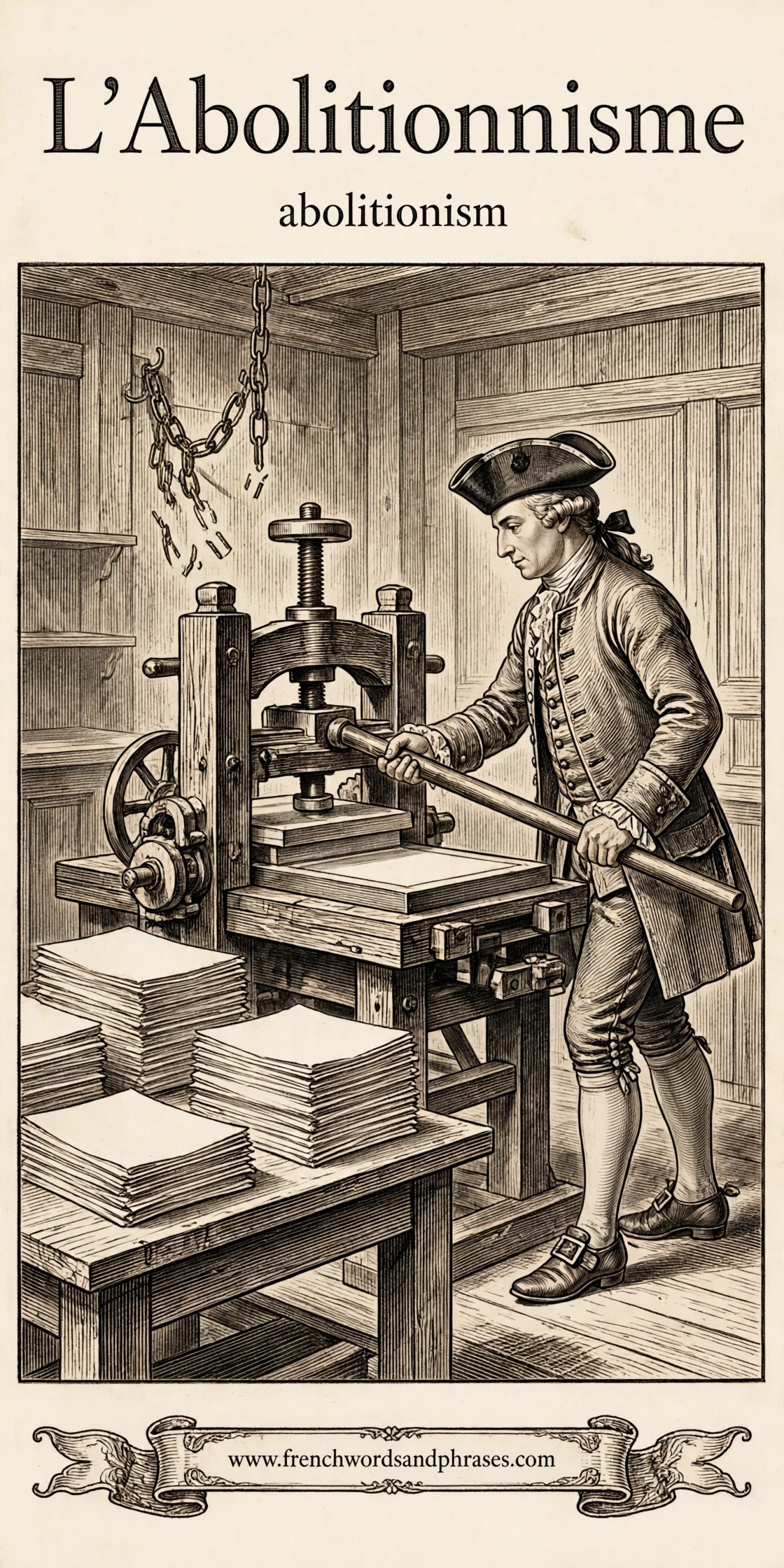
A printing press at midnight, pamphlets stacking up by candlelight, speeches drafted for tomorrow’s meeting: before a law can abolish anything, an idea has to march. The idea has a name: l’abolitionnisme.
In this guide, you’ll learn what abolitionnisme means in English, how to use it with its articles, how to form its plural, and how it appears in everyday French. Explore French examples, English translations, and practice quizzes.
Understanding the French Noun Abolitionnisme
Abolitionnisme is a masculine French noun, learned with its article: l’abolitionnisme, un abolitionnisme — le becomes l’ before the vowel. The ending -isme is the tell-tale sign: like le pacifisme or le féminisme, it names a doctrine, a movement — the organised belief that something must be abolished.
It means abolitionism — the movement and the ideas that campaign for the abolition of an institution, above all slavery. Where l’abolition is the legal act and the date, l’abolitionnisme is the long struggle before it: the books, the speeches, the societies and the campaigners — les abolitionnistes — who made the act thinkable, then inevitable.
Gender: Masculine
Definite article: l’ — l’abolitionnisme (abolitionism)
Indefinite article: un — un abolitionnisme
Plural: les abolitionnismes (rare)
The ending: -isme names a doctrine or movement
English equivalents: Abolitionism; the abolitionist movement.
One important usage detail: keep the family in order. L’abolition is the act — a decree, a date. L’abolitionnisme is the movement — the ideas and the campaign. Un abolitionniste is the person — the campaigner. French keeps act, idea and person in three separate words, and using the right one is most of the battle.
Experience the Word
Abolitionnisme is more than an opinion. Opinions sit still; an -isme marches — it prints, petitions, lectures and organises, year after year, until the unthinkable becomes the law of the land.
Imagine the long decades before 1848: a writer in Paris, a society in London, escaped witnesses telling their stories to crowded halls — an idea crossing oceans on paper, gathering names, until a decree could finally be signed.
You have not just learned a doctrine’s name. You have learned the word for an idea that refuses to sit down.
How to Use Abolitionnisme in French: Complete Guide
Let’s explore how abolitionnisme works in French, beginning with its articles — and with the -isme family it belongs to.
Abolitionnisme with the Definite Article (L’, Les)
Used for the movement itself — l’abolitionnisme, the great campaign of the nineteenth century.
| Form | French |
|---|---|
| Masculine singular | l’abolitionnisme |
| Plural | les abolitionnismes |
Example
L’abolitionnisme a triomphé en 1848.
Abolitionism triumphed in 1848.
Abolitionnisme with the Indefinite Article (Un, Des)
Rare — un abolitionnisme would present the movement as one doctrine among others.
| Form | French |
|---|---|
| Masculine singular | un abolitionnisme |
| Plural | des abolitionnismes |
Example
Un abolitionnisme militant animait ces journaux.
A militant abolitionism drove those newspapers.
The -isme Family: Doctrines and Movements
One ending, many causes — the family this word belongs to.
| French | In English |
|---|---|
| le pacifisme | pacifism |
| le féminisme | feminism |
| l’humanisme | humanism |
| le rationalisme | rationalism |
| l’idéalisme | idealism |
| le journalisme | journalism |
Example
Le pacifisme et l’abolitionnisme partagent un même idéal humain.
Pacifism and abolitionism share the same human ideal.
Quick Quiz 1
Complete the sentence:
______ est le mouvement qui lutte pour la fin de l’esclavage. (Abolitionism)
Reveal the answer
L’abolitionnisme
L’abolitionnisme est le mouvement qui lutte pour la fin de l’esclavage.
Abolitionism is the movement that fights for the end of slavery.
The Plural of Abolitionnisme
The plural is rare — historians use it when comparing the movements of different countries.
| Number | French |
|---|---|
| Singular | l’abolitionnisme |
| Plural | les abolitionnismes |
Example
Les abolitionnismes français et américain se répondaient.
The French and American abolitionisms echoed each other.
Abolitionnisme with Possessive Adjectives (Mon, Ton, Son…)
Abolitionnisme begins with a vowel, so it takes mon, ton, son — the forms used before a vowel sound.
| Owner | French |
|---|---|
| my | mon abolitionnisme |
| your (tu) | ton abolitionnisme |
| his / her | son abolitionnisme |
| our | notre abolitionnisme |
| your (vous) | votre abolitionnisme |
| their | leur abolitionnisme |
Example
Son abolitionnisme lui a coûté sa fortune et sa tranquillité.
His abolitionism cost him his fortune and his peace.
Quick Quiz 2
Complete the sentence:
______ abolitionnisme était connu dans toute l’Europe. (Their)
Reveal the answer
Leur
Leur abolitionnisme était connu dans toute l’Europe.
Their abolitionism was known throughout Europe.
Abolitionnisme with Demonstrative Adjectives (Cet, Ces)
Used to point: cet abolitionnisme — cet, not ce, because the word begins with a vowel.
| Form | French |
|---|---|
| Masculine singular | cet abolitionnisme |
| Plural | ces abolitionnismes |
Example
Cet abolitionnisme généreux a fini par vaincre.
This generous abolitionism ended up victorious.
Abolitionnisme with Adjectives
Militant, American, triumphant — the adjectives of movements and causes.
| Adjective | With Abolitionnisme |
|---|---|
| militant (militant) | un abolitionnisme militant |
| américain (American) | l’abolitionnisme américain |
| français (French) | l’abolitionnisme français |
| triomphant (triumphant) | un abolitionnisme triomphant |
| généreux (generous) | un abolitionnisme généreux |
Example
L’abolitionnisme américain a marqué l’histoire des États-Unis.
American abolitionism marked the history of the United States.
Quick Quiz 3
Complete the sentence:
______ abolitionnisme a changé le pays. (This)
Reveal the answer
Cet
Cet abolitionnisme a changé le pays.
This abolitionism changed the country — cet, because abolitionnisme begins with a vowel.
Everyday Expressions with Abolitionnisme
History essays and exhibitions — the abolitionnisme phrases in print.
| Expression | In English |
|---|---|
| défendre l’abolitionnisme | to defend abolitionism |
| l’abolitionnisme américain | American abolitionism |
| les idées de l’abolitionnisme | the ideas of abolitionism |
| le mouvement de l’abolitionnisme | the abolitionist movement |
| l’histoire de l’abolitionnisme | the history of abolitionism |
Example
Elle étudie l’histoire de l’abolitionnisme à l’université.
She studies the history of abolitionism at university.
Words from the Same Family as Abolitionnisme
The act, the movement and the campaigner — the words that travel with abolitionnisme.
| French | In English |
|---|---|
| l’abolition | the abolition (the act) |
| un abolitionniste | an abolitionist (the person) |
| abolir | to abolish |
| l’esclavage | slavery |
| la cause | the cause |
| le mouvement | the movement |
Example
Un abolitionniste défend l’abolitionnisme avant l’abolition.
An abolitionist defends abolitionism before the abolition.
Quick Quiz 4
What is un abolitionniste?
Reveal the answer
An abolitionist — the person who campaigns within the movement: l’abolitionnisme is the idea, l’abolitionniste is the campaigner, l’abolition is the victory.
Schœlcher était un abolitionniste célèbre.
Schœlcher was a famous abolitionist.
Abolitionnisme in Everyday French: Real-Life Examples
Now that you know the word, let’s see how abolitionnisme appears in everyday French.
Example 1 — A history essay
Sa dissertation porte sur l’abolitionnisme au XIXe siècle.
Her essay is about abolitionism in the nineteenth century.
Example 2 — Reading about America
L’abolitionnisme a changé l’histoire des États-Unis.
Abolitionism changed the history of the United States.
Example 3 — At a lecture
Le conférencier présente les idées de l’abolitionnisme.
The lecturer presents the ideas of abolitionism.
Example 4 — A museum exhibition
Cette exposition retrace le mouvement de l’abolitionnisme.
This exhibition traces the abolitionist movement.
Example 5 — A debate club
Ils débattent de l’abolitionnisme et de ses héros.
They are debating abolitionism and its heroes.
Example 6 — A biography
La biographie raconte l’abolitionnisme de Schœlcher.
The biography tells of Schœlcher’s abolitionism.
Beyond Translation: The Meaning of Abolitionnisme
Every -isme is a bet that an idea can move the world, and abolitionnisme is one of history’s winning bets. For decades it was pamphlets against empires: writers, preachers, former slaves and stubborn parliamentarians arguing, in French, English and a dozen other languages, that a human being cannot be property. The argument travelled by ship and by printing press, survived ridicule and repression, and in 1848 it became French law — proof, filed under one long noun, that movements are how laws are born.
To say abolitionnisme is to name the long march that comes before the decree.
The word still serves beyond its century: whenever a campaign organises itself around ending an institution, French reaches for the same pattern — a cause, an -isme, and people willing to be called by its name.
How to Remember the French Noun Abolitionnisme
Remember it this way: Abolitionnisme is abolitionism — the movement and the ideas; the -isme ending always names a doctrine on the march.
- You sort the family — l’abolition l’acte, l’abolitionnisme le mouvement, l’abolitionniste la personne.
- You hear the ending — -isme : pacifisme, féminisme, abolitionnisme.
- You picture the march — les pamphlets, les discours, puis le décret.
The key idea is l’abolitionnisme — the movement; abolition the act, abolitionniste the person.
Test Your Knowledge of Abolitionnisme
Let’s see how much you’ve learned. Try answering these questions before revealing the answers.
Question 1
What does abolitionnisme mean?
Reveal the answer
Abolitionism — the movement campaigning for the abolition of an institution, above all slavery.
Question 2
Is abolitionnisme masculine or feminine?
Reveal the answer
Masculine — l’abolitionnisme, un abolitionnisme.
Question 3
Translate: Abolitionism changed the history of the United States.
Reveal the answer
L’abolitionnisme a changé l’histoire des États-Unis.
Question 4
What does the ending -isme tell you about a French word?
Reveal the answer
It names a doctrine or movement — like le pacifisme or le féminisme.
Question 5
Complete the sentence:
______ est le mouvement, l’abolitionniste est la personne.
Reveal the answer
L’abolitionnisme
L’abolitionnisme est le mouvement, l’abolitionniste est la personne.
Abolitionism is the movement; the abolitionist is the person.
Your Final Challenge
Can You Use It?
How would you say this in French?
“Abolitionism changed the history of the United States.”
Reveal the answer
L’abolitionnisme a changé l’histoire des États-Unis.
Abolitionism changed the history of the United States.
A little French. A little curiosity. A richer everyday life.
LEARN FRENCH ONE WORD AT A TIME