A French Word to Live By
Translate Abolition to English
/a.bɔ.li.sjɔ̃/
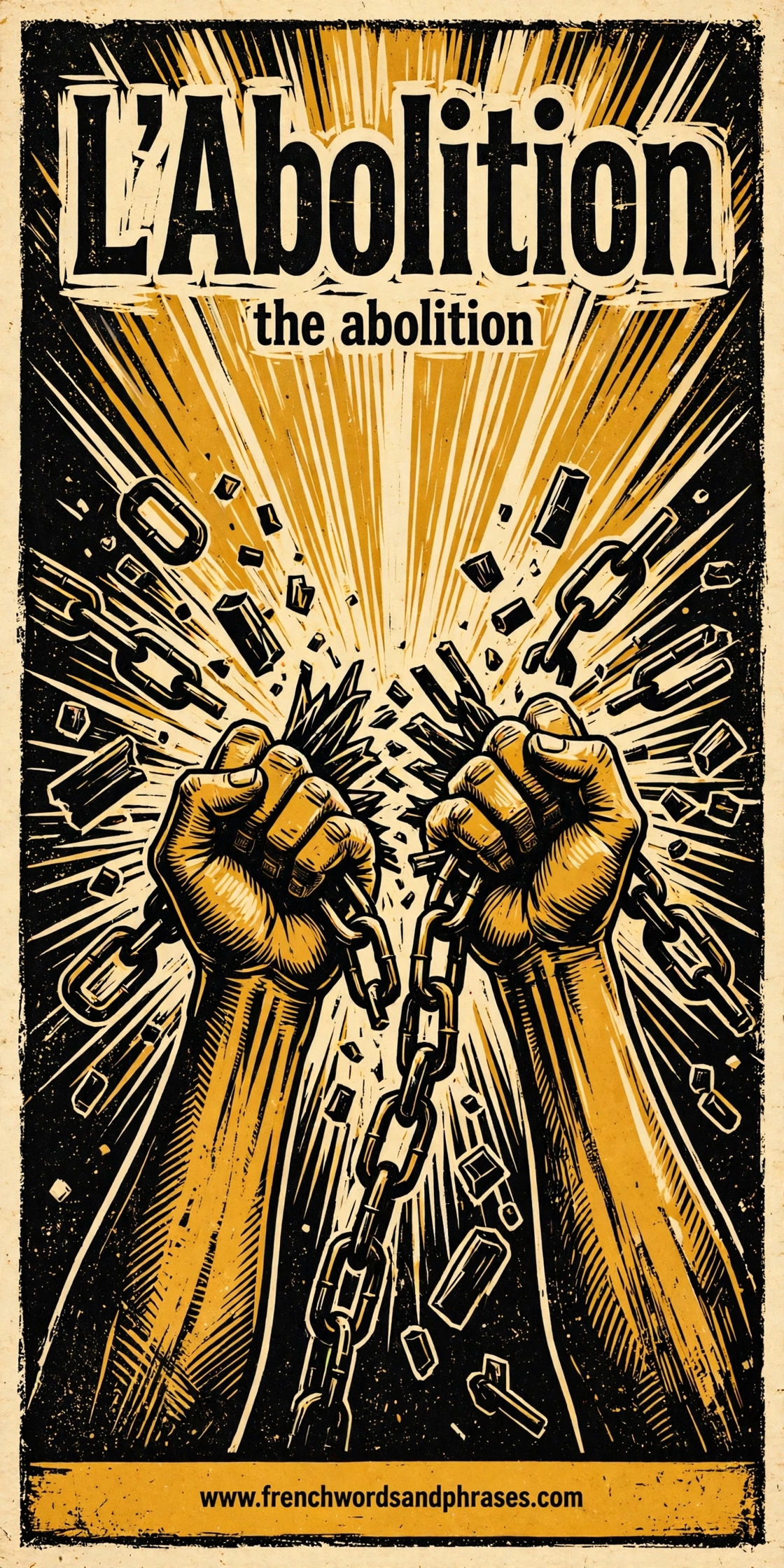
L’abolition means the abolition.
Paris, 27 April 1848: a decree is signed, and in the colonies across the ocean, chains that had held for two centuries are struck off by law. One word carries that morning down to us: l’abolition.
In this guide, you’ll learn what abolition means in English, how to use it with its articles, how to form its plural, and how it appears in everyday French. Explore French examples, English translations, and practice quizzes.
Understanding the French Noun Abolition
Abolition is a feminine French noun, learned with its article: l’abolition, une abolition — la becomes l’ before the vowel. It is the noun of the verb abolir, and it belongs to the language of law, history and great public debates: institutions end by it.
It means the abolition — the official, legal ending of an institution or practice. In French history the word carries two towering dates: l’abolition de l’esclavage, the abolition of slavery, voted in 1848 under Victor Schœlcher, and l’abolition de la peine de mort, the abolition of the death penalty, carried by Robert Badinter in 1981. Each 10 May, France commemorates the first of them as a national day.
Gender: Feminine
Definite article: l’ — l’abolition (the abolition)
Indefinite article: une — une abolition (an abolition)
Plural: les abolitions
Great dates: 1848 — slavery; 1981 — the death penalty
English equivalents: The abolition; the legal ending of an institution.
One important usage detail: abolition is almost never used alone — it travels with its object, joined by de: l’abolition de l’esclavage, l’abolition de la peine de mort, l’abolition d’un impôt. To say what was abolished is half the word’s meaning; an abolition without its de-phrase sounds unfinished to a French ear.
Experience the Word
Abolition is more than an ending. Other words close things — a door, a meeting, a shop. Abolition closes an injustice, by law, in daylight, with signatures: the moment a society declares that something it long tolerated will be tolerated no more.
Imagine the decree read aloud in a Caribbean port in 1848: the words travel from the official’s mouth to the crowd, and a legal sentence becomes, in the same breath, a family’s freedom.
You have not just learned a legal term. You have learned the word for the day an injustice becomes illegal.
How to Use Abolition in French: Complete Guide
Let’s explore how abolition works in French, beginning with its articles — then with the two great dates the word carries.
Abolition with the Definite Article (L’, Les)
Used for a specific, historic ending — the abolition everyone means.
| Form | French |
|---|---|
| Feminine singular | l’abolition |
| Plural | les abolitions |
Example
L’abolition de l’esclavage date de 1848.
The abolition of slavery dates from 1848.
Abolition with the Indefinite Article (Une, Des)
Used for an abolition in general — une abolition, one more institution brought to an end.
| Form | French |
|---|---|
| Feminine singular | une abolition |
| Plural | des abolitions |
Example
Le ministre propose une abolition de cette taxe.
The minister is proposing an abolition of this tax.
Words of Freedom: Around the Abolition
Slavery, liberty and the law — the vocabulary of the great debates.
| French | In English |
|---|---|
| l’esclavage | slavery |
| l’esclave | the enslaved person |
| la peine de mort | the death penalty |
| la liberté | freedom, liberty |
| l’égalité | equality |
| abolir | to abolish |
Example
La liberté et l’égalité ont guidé le combat pour l’abolition.
Liberty and equality guided the fight for abolition.
Quick Quiz 1
Complete the sentence:
______ de la peine de mort a été votée en 1981. (The abolition)
Reveal the answer
L’abolition
L’abolition de la peine de mort a été votée en 1981.
The abolition of the death penalty was voted through in 1981.
The Plural of Abolition
Abolition adds an -s in the plural — les abolitions, as historians compare the endings of institutions.
| Number | French |
|---|---|
| Singular | l’abolition |
| Plural | les abolitions |
Example
Les abolitions successives ont transformé la société.
The successive abolitions transformed society.
Abolition with Possessive Adjectives (Mon, Ton, Son…)
Before a vowel, the feminine takes mon, ton, son — son abolition, never « sa abolition ».
| Owner | French |
|---|---|
| my | mon abolition |
| your (tu) | ton abolition |
| his / her | son abolition |
| our | notre abolition |
| your (vous) | votre abolition |
| their | leur abolition |
Example
Le décret a proclamé son abolition définitive.
The decree proclaimed its definitive abolition.
Quick Quiz 2
Complete the sentence:
______ abolition, en 1848, a libéré les esclaves des colonies. (This)
Reveal the answer
Cette
Cette abolition, en 1848, a libéré les esclaves des colonies.
This abolition, in 1848, freed the enslaved people of the colonies.
Abolition with Demonstrative Adjectives (Cette, Ces)
Used to point at the measure under discussion: cette abolition, this abolition.
| Form | French |
|---|---|
| Feminine singular | cette abolition |
| Plural | ces abolitions |
Example
Cette abolition a été saluée dans tout le pays.
This abolition was welcomed throughout the country.
Abolition with Adjectives
Definitive, historic, gradual — the adjectives of law and history.
| Adjective | With Abolition |
|---|---|
| définitive (definitive) | une abolition définitive |
| historique (historic) | une abolition historique |
| progressive (gradual) | une abolition progressive |
| totale (total) | une abolition totale |
| récente (recent) | une abolition récente |
Example
Une abolition définitive de l’esclavage a été proclamée en 1848.
A definitive abolition of slavery was proclaimed in 1848.
Quick Quiz 3
Complete the sentence:
______ abolitions ont marqué le XIXe siècle. (These)
Reveal the answer
Ces
Ces abolitions ont marqué le XIXe siècle.
These abolitions marked the nineteenth century.
Everyday Expressions with Abolition
Commemorations, debates and history books — the abolition phrases of French life.
| Expression | In English |
|---|---|
| l’abolition de l’esclavage | the abolition of slavery |
| l’abolition de la peine de mort | the abolition of the death penalty |
| voter l’abolition | to vote through the abolition |
| le mouvement pour l’abolition | the movement for abolition |
| commémorer l’abolition | to commemorate the abolition |
Example
Le 10 mai, la France commémore l’abolition de l’esclavage.
On 10 May, France commemorates the abolition of slavery.
Words from the Same Family as Abolition
Movements, campaigners and freedom — the words that travel with abolition.
| French | In English |
|---|---|
| abolir | to abolish |
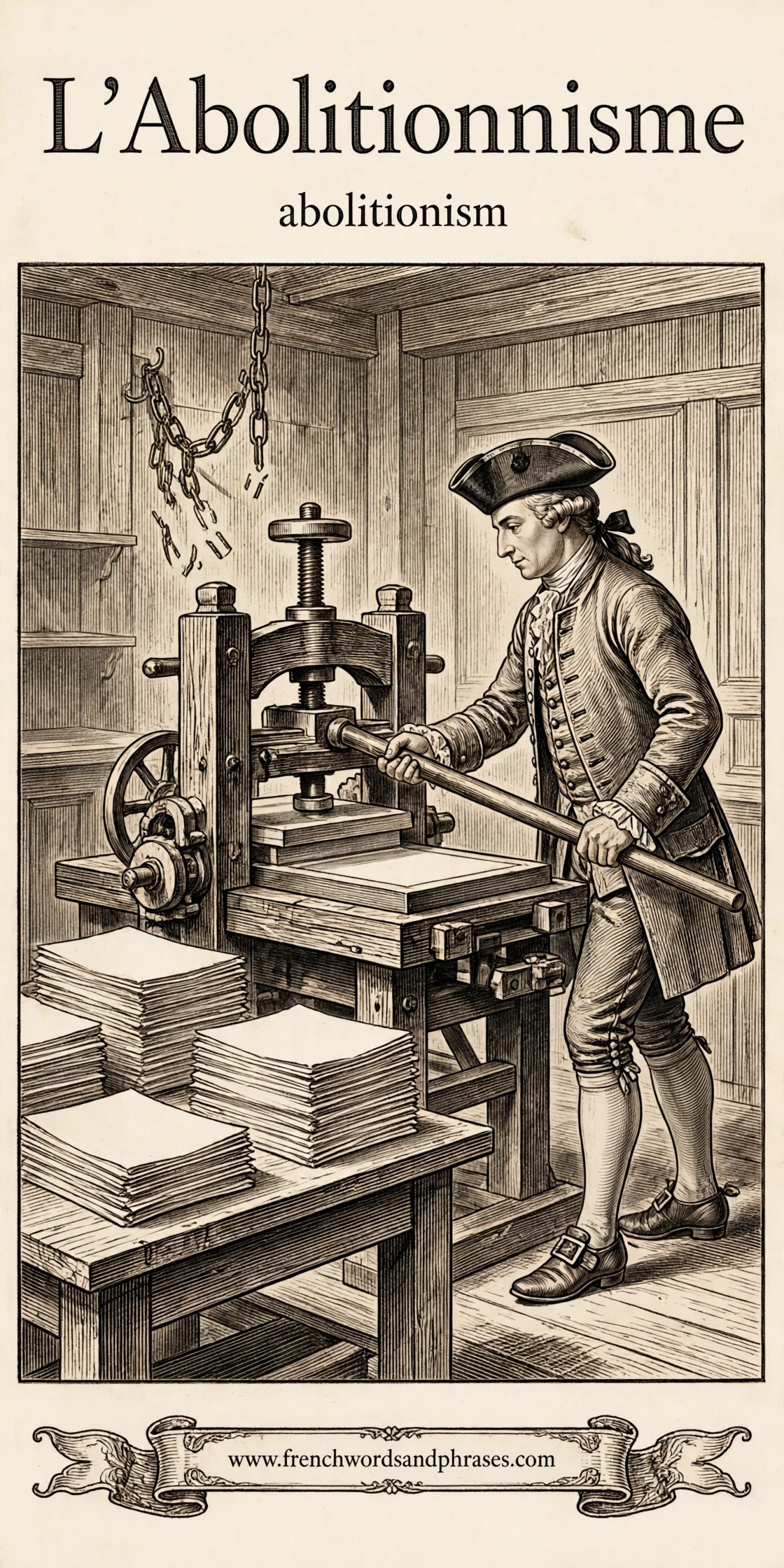
| l’abolitionnisme | abolitionism, the movement |
| un abolitionniste | an abolitionist |
| l’esclavage | slavery |
| la liberté | freedom |
| libérer | to free, to liberate |
Example
Schœlcher a consacré sa vie à abolir l’esclavage.
Schœlcher devoted his life to abolishing slavery.
Quick Quiz 4
Who carried the abolition of slavery in France in 1848?
Reveal the answer
Victor Schœlcher — the campaigner whose decree of 27 April 1848 abolished slavery in the French colonies for good.
Le décret de Schœlcher date du 27 avril 1848.
Schœlcher’s decree dates from 27 April 1848.
Abolition in Everyday French: Real-Life Examples
Now that you know the word, let’s see how abolition appears in everyday French.
Example 1 — A history class
Le cours d’aujourd’hui porte sur l’abolition de l’esclavage.
Today’s lesson is about the abolition of slavery.
Example 2 — At a memorial
Nous visitons un mémorial de l’abolition en Guadeloupe.
We are visiting a memorial to abolition in Guadeloupe.
Example 3 — A national commemoration
Le 10 mai commémore l’abolition de l’esclavage.
The 10th of May commemorates the abolition of slavery.
Example 4 — Watching a documentary
Ce documentaire raconte l’abolition de la peine de mort.
This documentary tells the story of the abolition of the death penalty.
Example 5 — A classroom debate
Les élèves débattent de l’abolition d’une vieille loi.
The pupils are debating the abolition of an old law.
Example 6 — Reading Badinter
Son discours pour l’abolition est resté célèbre.
His speech for abolition has remained famous.
Beyond Translation: The Meaning of Abolition
Some nouns are tombstones and birth certificates at once, and abolition is the clearest of them: it buries an institution and delivers a society. France needed the word twice at full strength — in 1848, when Schœlcher’s decree ended slavery in the colonies after a first abolition in 1794 had been betrayed and reversed, and in 1981, when Badinter stood before the Assembly and ended the death penalty with an argument, not an army. Between those dates the word gathered its moral weight: an abolition is never an accident or a fashion; it is a decision a nation takes about what it refuses to be.
To say abolition is to name the day the law itself changed sides.
That is why the word still works for a living: taxes, privileges, old rules — whenever French wants an ending to be official, principled and final, it reaches for abolition.
How to Remember the French Noun Abolition
Remember it this way: Abolition is the legal ending of an institution — and in France it carries two dates: 1848 for slavery, 1981 for the death penalty.
- You keep the dates — 1848, l’esclavage ; 1981, la peine de mort.
- You add the object — l’abolition de…, jamais le mot tout seul.
- You keep the verb — abolir : Schœlcher a aboli l’esclavage.
The key idea is l’abolition — 1848 slavery, 1981 the death penalty, always with de.
Test Your Knowledge of Abolition
Let’s see how much you’ve learned. Try answering these questions before revealing the answers.
Question 1
What does abolition mean?
Reveal the answer
The abolition — the official, legal ending of an institution or practice.
Question 2
Is abolition masculine or feminine?
Reveal the answer
Feminine — l’abolition, une abolition.
Question 3
Translate: The abolition of the death penalty dates from 1981.
Reveal the answer
L’abolition de la peine de mort date de 1981.
Question 4
In which year was slavery abolished in the French colonies?
Reveal the answer
1848 — by the decree of Victor Schœlcher, commemorated every 10 May.
Question 5
Complete the sentence:
______ de l’esclavage a été proclamée en 1848. (The abolition)
Reveal the answer
L’abolition
L’abolition de l’esclavage a été proclamée en 1848.
The abolition of slavery was proclaimed in 1848.
Your Final Challenge
Can You Use It?
How would you say this in French?
“The abolition of the death penalty dates from 1981.”
Reveal the answer
L’abolition de la peine de mort date de 1981.
The abolition of the death penalty dates from 1981.
A little French. A little curiosity. A richer everyday life.
LEARN FRENCH ONE WORD AT A TIME