A French Word to Live By
Translate À terme to English
/a tɛʁm/
À terme means in the long term, eventually — when the time allowed has run its course.
The young couple are hesitating over the old farmhouse with the leaking roof and the orchard behind it. The agent is honest with them: « Les travaux coûteront cher, mais à terme, cette maison vaudra le double. » The repairs will cost a lot — but in the long term, this house will be worth double.
Let’s explore how à terme works in French, beginning with the whole phrase on one card.
Understanding the French Phrase À terme
À terme is a French adverbial phrase built from à (at, by) and le terme (the term, the end of a period). A terme was originally the day a debt or a lease fell due — the phrase still carries that sense of a period running out and the result arriving.
It means in the long term, in the end, eventually: not now, but when the process has run its course. Savings grow à terme; habits show their effects à terme. The phrase asks you to lift your eyes from this week to the horizon — the outcome is coming, on its own schedule.
Type: Adverbial phrase — time and outcomes (à + terme)
Answers the need: Saying something will happen in the long run, once the process completes
Register: Neutral to slightly formal — common in speech, finance and advice
Strength: Patient — it promises a result but refuses to hurry it
One important usage detail: à terme has a technical twin in finance and medicine. Un placement à terme is a fixed-term investment; un bébé né à terme is a baby born at full term, neither early nor late. In everyday speech, though, the phrase nearly always means in the long run — à terme, tout s’arrangera, in the end, everything will work out.
Experience the Word
À terme is the phrase of gardeners and savers — people who plant things whose fruit they will not eat this season.
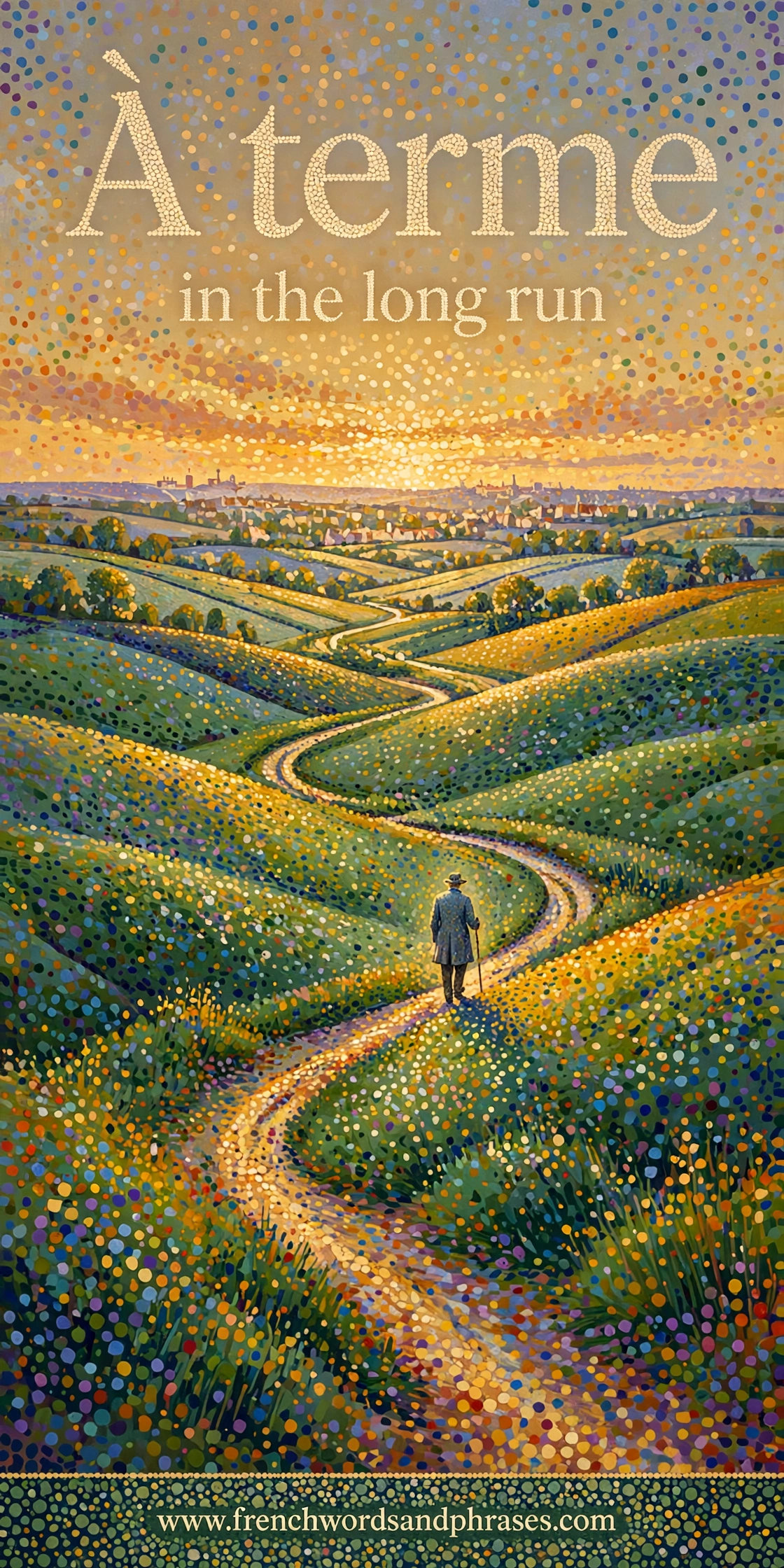
Imagine the old man planting a walnut tree at seventy. His grandson asks who will eat the nuts. He pats the soil and gives the only honest answer a planter has: à terme, quelqu’un — in the long run, somebody. The phrase holds a whole philosophy of patience in two words.
French plans in long arcs. À terme is the view from the end of the road, taken before setting out.
How to Use À terme in French: Complete Guide
Let’s explore how à terme works in French, beginning with the whole phrase on one card.
À terme at a Glance
The Whole Phrase on One Card
Real meaning, literal picture, English twin and register — à terme in five lines.
| Point | À terme |
|---|---|
| What it really means | in the long term, in the end — when the process has run its course |
| Word for word | at the term — at the end of the period allowed |
| English equivalent | in the long term / in the long run / eventually |
| Register | neutral to slightly formal |
| Use it for | plans, savings, health, habits — anything whose result takes time |
Example
À terme, cet investissement rapportera gros.
In the long term, this investment will pay off handsomely.
Word by Word: Building the Long View
Two small pieces — take them one by one and the horizon appears.
| Word | Literal meaning | Its job in the phrase |
|---|---|---|
| à | at, by | places the result at a point in time — the end of the period |
| terme | a term, an end | the finish line of a period: the due date of a loan, the end of a lease |
Example
À terme, les enfants quittent la maison.
In the end, children leave home.
Quick Quiz 1
What was a terme before it meant the long run?
Reveal the answer
The end of a fixed period — the day a debt or a lease fell due. À terme still means ‘when that period has run out’.
Le loyer se paie au terme du mois.
The rent is paid at the end of the month.
When You Say It: The Long-Term Moments
À terme fires at moments like these — wherever today’s effort is aimed at a distant result.
| Situation | Example |
|---|---|
| Saving | épargner à terme pour sa retraite — to save long-term for one’s retirement |
| Health | fumer nuit à terme à la santé — smoking harms your health in the long run |
| Property | à terme, la maison prendra de la valeur — in the long term, the house will gain value |
| Work | à terme, le projet créera des emplois — eventually, the project will create jobs |
| Comfort | à terme, tout s’arrangera — in the end, everything will work out |
Example
Ces efforts paieront à terme, sois patient.
These efforts will pay off in the long run — be patient.
Make It Yours: Horizons of Every Length
French grades its horizons — à terme is the far one, with nearer cousins for shorter waits.
| Form | French | In English |
|---|---|---|
| The far horizon | à terme | in the long term |
| Spelled out | à long terme | in the long term (explicit) |
| The middle distance | à moyen terme | in the medium term |
| The near one | à court terme | in the short term |
| At the deadline | au terme de + period | at the end of (a trial, a contract) |
| Fixed-term (finance) | un compte à terme | a fixed-term deposit account |
Example
À court terme ça coûte, à long terme ça rapporte.
In the short term it costs; in the long term it pays.
Quick Quiz 2
Which cousin of à terme means in the short term?
Reveal the answer
À court terme — court, short, pulls the horizon close; long pushes it away.
À court terme, le budget est serré.
In the short term, the budget is tight.
Everyday Expressions: Building on the Horizon
À terme slots into these everyday frames — each one ready to use as it stands.
| Frame | In English |
|---|---|
| à terme | in the long term, eventually |
| à long terme | in the long term |
| à court terme | in the short term |
| à moyen terme | in the medium term |
| au terme de | at the end of (a period) |
Example
Au terme de l’essai, elle a signé le contrat.
At the end of the trial period, she signed the contract.
Close Cousins: The Other Waiting Words
French separates its kinds of ‘later’ with care — à terme is the patient, process-driven one.
| Expression | The difference |
|---|---|
| à terme | in the long term — the result of a process running its course |
| à la longue | in the long run — with a flavour of wear and endurance |
| finalement | finally, in the end — the wait is over, relief included |
| un jour | one day — vague hope, no process implied |
| à venir | to come, upcoming — simply in the future |
Example
À la longue, ce bruit fatigue tout le monde.
In the long run, this noise wears everyone out.
Quick Quiz 3
Saving a little every month for retirement: à terme or à la dernière minute?
Reveal the answer
À terme — the whole point is the long process; nothing here is last-minute.
Il épargne à terme depuis ses vingt ans.
He has been saving long-term since he was twenty.
À terme and Its Neighbours
The horizon shelf around the phrase — near, middle and far.
| French | In English |
|---|---|
| à court terme | in the short term |
| à moyen terme | in the medium term |
| à long terme | in the long term |
| à la longue | in the long run |
| finalement | finally, in the end |
| l’échéance | the deadline, the due date |
Example
L’échéance approche, mais à terme nous serons prêts.
The deadline is approaching, but in the long run we will be ready.
Watch Out: The Traps Around À terme
The traps: a baby born à terme, and a word that also means a term of school.
| Trap | The truth |
|---|---|
| the maternity trap | un bébé né à terme is a full-term baby — medicine uses the old due-date sense, not ‘eventually’ |
| terme is also a school term | un terme can be a school term or a word in a contract — context decides which end is meant |
| not ‘at term’ in English | English keeps the phrase only in finance and medicine; for everyday use, say in the long term |
| no plural, no fuss | à terme never changes its shape, wherever it stands in the sentence |
Example
Le bébé est né à terme, et à terme il ira à l’école du village.
The baby was born at full term, and in time he will go to the village school.
Quick Quiz 4
True or false: un bébé né à terme means a baby who will be born eventually.
Reveal the answer
False — it means a baby born at full term, on the due date, neither early nor late.
Né à terme et en pleine forme, le bébé fait la fierté des parents.
Born at full term and in fine form, the baby is the parents’ pride.
À terme in Everyday French: Real-Life Examples
Now that you know the word, let’s see how à terme appears in everyday French.
Example 1 — The farmhouse
À terme, cette maison vaudra le double.
In the long term, this house will be worth double.
Example 2 — Saving
Elle met un peu d’argent de côté à terme.
She puts a little money aside for the long term.
Example 3 — Health advice
Le manque de sommeil nuit à terme à la mémoire.
Lack of sleep harms the memory in the long run.
Example 4 — At work
À terme, l’équipe comptera dix personnes.
Eventually, the team will number ten people.
Example 5 — Comforting
Ne t’inquiète pas, à terme tout s’arrangera.
Don’t worry — in the end, everything will work out.
Example 6 — The garden
Il plante des arbres à terme, pour ses petits-enfants.
He plants trees for the long term, for his grandchildren.
Beyond Translation: The Meaning of À terme
English eventually sounds like a sigh — things will happen when they happen. French à terme keeps the old machinery visible: every loan, lease and pregnancy once had its terme, its appointed end, and the phrase still trusts that appointment.
À terme is patience with a date attached — not someday, but at the end of the process, as agreed.
That is why bankers, doctors and grandmothers planting walnut trees all reach for the same two words: each is counting on an ending that completes something.
How to Remember the French Phrase À terme
Remember it this way: À terme is the walnut tree planted at seventy — the result arrives when the period has run its course.
- You remember the due date — a terme was the day the debt fell due; à terme is when the waiting ends.
- You grade the horizon — court for short, moyen for medium, long for the far view.
- You keep the medical twin apart — né à terme is a full-term baby, not an eventual one.
The key idea is à terme means in the long term, eventually — when the process has run its course.
Test Your Knowledge of À terme
Let’s see how much you’ve learned. Try answering these questions before revealing the answers.
Question 1
What does à terme mean?
Reveal the answer
In the long term, eventually — when the process has run its course.
Question 2
What is the literal, word-for-word meaning?
Reveal the answer
At the term — at the end of the period allowed, the old due-date sense.
Question 3
How do you say ‘In the long term, this house will be worth double’?
Reveal the answer
À terme, cette maison vaudra le double — the phrase loves the front of the sentence.
Question 4
What is the difference between à terme and à court terme?
Reveal the answer
The length of the horizon — à court terme is the short term; à terme looks to the end of the process, the long view.
Question 5
Complete the sentence:
À ______, ces efforts paieront. (In the long run, these efforts will pay off.)
Reveal the answer
terme
À terme, ces efforts paieront.
In the long run, these efforts will pay off.
Your Final Challenge
Can You Use It?
How would you say this in French?
“The repairs will cost a lot, but in the long term this house will be worth double.”
Reveal the answer
Les travaux coûteront cher, mais à terme, cette maison vaudra le double.
The repairs will cost a lot, but in the long term this house will be worth double.
A little French. A little curiosity. A richer everyday life.
LEARN FRENCH ONE WORD AT A TIME