A French Word to Live By
Translate À temps plein to English
/a tɑ̃ plɛ̃/
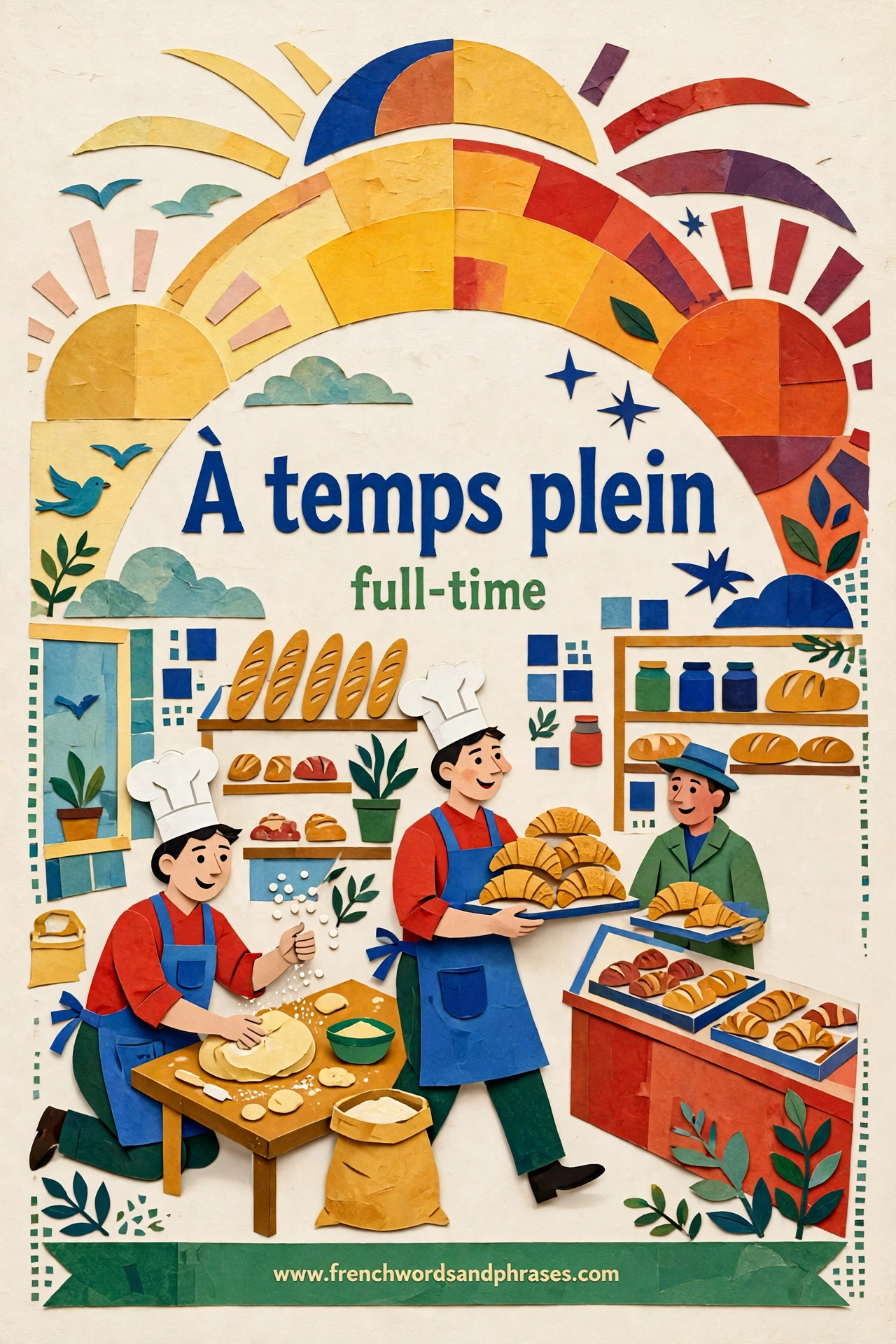
À temps plein means full-time — working the whole standard schedule.
After two years of mornings only, the little printing shop in the old town offers Sophie the whole week: Monday to Friday, holidays, the full contract. She signs with a flourish and phones her mother from the pavement outside: « Ça y est, je suis à temps plein ! » That’s it — she is full-time.
Let’s explore how à temps plein works in French, beginning with the whole phrase on one card.
Understanding the French Phrase À temps plein
À temps plein is a French adverbial phrase built from à temps (on a schedule) and plein (full). It is the standard language of employment and study: the complete, unreduced working week or course load.
It means full-time: all the standard hours, the whole schedule with nothing trimmed away. Plein is the full glass, the full tank — the time is filled to the brim. A post à temps plein, studies à temps plein, even a parent au foyer can joke about un travail à temps plein, a full-time job at home.
Type: Adverbial phrase — work and study (à temps + plein)
Answers the need: Describing a job or course done for the full standard hours
Register: Neutral — the standard term in contracts, adverts and conversation
Strength: Complete — it promises the whole schedule, nothing held back
One important usage detail: like its twin, the phrase is invariable — des postes à temps plein, une formation à temps plein. The noun for the arrangement is un temps plein. And plein has a working cousin: à plein temps says the same thing and is just as common in speech.
Experience the Word
À temps plein is the phrase of the full glass — the week poured to the brim, with the security and the tiredness that come with it.
Imagine the apprentice signing his first real contract. The words à temps plein sit on the page like a door opening: a salary every month, holidays with dates, a place in the team’s rota. Adulthood, in France, often arrives wearing exactly this phrase.
Full is not a complaint in this phrase; it is a status. À temps plein means the whole week believes in you.
How to Use À temps plein in French: Complete Guide
Let’s explore how à temps plein works in French, beginning with the whole phrase on one card.
À temps plein at a Glance
The Whole Phrase on One Card
Real meaning, literal picture, English twin and register — à temps plein in five lines.
| Point | À temps plein |
|---|---|
| What it really means | full-time — the whole standard working or studying schedule |
| Word for word | at full time |
| English equivalent | full-time |
| Register | neutral — contracts, job adverts and everyday speech |
| Use it for | jobs, contracts, studies and commitments that fill the week |
Example
Il travaille à temps plein dans une imprimerie.
He works full-time in a printing works.
Word by Word: Filling the Week
Three small pieces — take them one by one and the glass fills to the brim.
| Word | Literal meaning | Its job in the phrase |
|---|---|---|
| à | at, on | sets the arrangement — on this kind of schedule |
| temps | time | the working hours being filled |
| plein | full | the filler — all of the time, filled to the top, none left over |
Example
Un emploi à temps plein, c’est ce qu’il lui fallait.
A full-time job is what he needed.
Quick Quiz 1
What picture does plein give the phrase?
Reveal the answer
A container filled to the brim — plein is full, like a full glass or a full tank; the week’s time is completely filled.
Elle fait ses études à temps plein.
She is studying full-time.
When You Say It: The Full-Time Moments
À temps plein fires at moments like these — wherever the whole schedule is signed up for.
| Situation | Example |
|---|---|
| Job adverts | poste à temps plein, CDI — a full-time post, permanent contract |
| Promotion | passer à temps plein — to move up to full-time hours |
| Students | étudier à temps plein — to study full-time |
| Parents, joking | être parent, c’est un travail à temps plein — being a parent is a full-time job |
| Contracts | un contrat à temps plein — a full-time contract |
Example
Elle est passée à temps plein au printemps.
She moved to full-time in the spring.
Make It Yours: The Whole Week, Every Way
The phrase has a twin, a noun form, and a family of full-things around it.
| Form | French | In English |
|---|---|---|
| The arrangement | un temps plein | full-time hours (as a noun) |
| The twin form | à plein temps | full-time — equally common in speech |
| Working it | travailler à temps plein | to work full-time |
| A full-time post | un poste à temps plein | a full-time post |
| Moving up | passer à temps plein | to switch to full-time |
| At full speed — cousin | à plein régime | at full tilt, flat out |
Example
Il cherche un temps plein dans la région.
He is looking for full-time work in the area.
Quick Quiz 2
Which is the accepted twin of à temps plein — à plein temps or à temps complet?
Reveal the answer
À plein temps — the two word orders are both standard French. À temps complet is a word-for-word import and sounds translated.
Elle travaille à plein temps depuis janvier.
She has worked full-time since January.
Everyday Expressions: Building on the Full Week
À temps plein slots into these everyday frames — each one ready to use as it stands.
| Frame | In English |
|---|---|
| travailler à temps plein | to work full-time |
| un temps plein | full-time hours, a full-time arrangement |
| à plein temps | full-time (twin form) |
| un travail à temps plein | a full-time job |
| des études à temps plein | full-time studies |
Example
Être grand-parent, c’est presque un travail à temps plein.
Being a grandparent is almost a full-time job.
Close Cousins: The Other Work Schedules
French lays out the whole spectrum — à temps plein is the full measure at the top of it.
| Expression | The difference |
|---|---|
| à temps plein | full-time — the whole standard week |
| à temps partiel | part-time — a regular reduced schedule |
| à mi-temps | half-time — exactly half the hours |
| en heures supplémentaires | on overtime — hours beyond the full week |
| à plein régime | at full tilt — full speed, not full hours |
Example
Elle est à temps plein, lui à temps partiel : ils se relaient.
She is full-time, he is part-time: they take turns.
Quick Quiz 3
A post is advertised Monday to Friday, thirty-five hours. À temps plein or à temps partiel?
Reveal the answer
À temps plein — the whole standard week is on the table.
L’offre précise : CDI à temps plein, 35 heures.
The offer states: permanent contract, full-time, 35 hours.
À temps plein and Its Neighbours
The contract shelf around the phrase — fullness in all its forms.
| French | In English |
|---|---|
| à temps partiel | part-time |
| à mi-temps | half-time |
| un CDI | a permanent contract |
| un CDD | a fixed-term contract |
| les heures supplémentaires | overtime |
| à plein régime | at full tilt |
Example
Son CDI à temps plein commence lundi.
His full-time permanent contract starts on Monday.
Watch Out: The Traps Around À temps plein
The traps: an invariable phrase, and a plein that must not wander off to the stomach.
| Trap | The truth |
|---|---|
| no agreement, ever | à temps plein never changes: des semaines à temps plein, une activité à temps plein — plein keeps its form inside the set phrase |
| plein has other lives | le ventre plein is a full stomach and faire le plein is to fill the tank — in à temps plein, plein fills the schedule only |
| not ‘in full time’ | English full-time is one compound word; do not unpack it back into French piece by piece |
| the noun drops the à | the arrangement itself is un temps plein — the à belongs to the adverbial use |
Example
Après le plein d’essence, direction le bureau : elle travaille à temps plein.
After filling up with petrol, off to the office: she works full-time.
Quick Quiz 4
True or false: in des études à temps plein, plein should agree and become pleines.
Reveal the answer
False — the set phrase à temps plein is invariable, whatever it follows.
Elle suit des études à temps plein à Lyon.
She is doing full-time studies in Lyon.
À temps plein in Everyday French: Real-Life Examples
Now that you know the word, let’s see how à temps plein appears in everyday French.
Example 1 — The new contract
Elle a signé un temps plein en septembre.
She signed a full-time contract in September.
Example 2 — Job hunting
Il cherche un poste à temps plein dans le bâtiment.
He is looking for a full-time post in construction.
Example 3 — Studying
Elle fait sa licence à temps plein.
She is doing her degree full-time.
Example 4 — The joke
Trois enfants, c’est un travail à temps plein !
Three children — that’s a full-time job!
Example 5 — Moving up
Il est passé de mi-temps à temps plein.
He went from half-time to full-time.
Example 6 — The advert
Poste à temps plein, à pourvoir immédiatement.
Full-time post, to start immediately.
Beyond Translation: The Meaning of À temps plein
English full-time is a label on a contract. French à temps plein keeps the picture alive: time, filled — plein, the word for a full glass, a full moon, a full house. The week is a container, and this phrase pours it to the top.
À temps plein is a promise measured in hours: all of them, every week, with your name on the rota.
That fullness cuts both ways, and French speakers know it — which is why the same phrase, turned into a joke, describes new parenthood better than any contract ever could.
How to Remember the French Phrase À temps plein
Remember it this way: À temps plein is the glass filled to the brim — plein means full, and the whole week is poured in.
- You picture the full glass — plein is full to the brim; nothing of the schedule is left empty.
- You keep the phrase frozen — à temps plein never agrees, and its twin à plein temps says the same thing.
- You set it against its family — plein at the top, partiel the share, mi-temps the half.
The key idea is à temps plein means full-time — the whole standard schedule, filled to the brim.
Test Your Knowledge of À temps plein
Let’s see how much you’ve learned. Try answering these questions before revealing the answers.
Question 1
What does à temps plein mean?
Reveal the answer
Full-time — the whole standard working or studying schedule.
Question 2
What is the literal, word-for-word meaning?
Reveal the answer
At full time — plein means full, filled to the brim.
Question 3
How do you say ‘He works full-time’?
Reveal the answer
Il travaille à temps plein — the phrase follows the verb and never changes.
Question 4
What is the difference between à temps plein and à plein temps?
Reveal the answer
None in meaning — both are standard French for full-time; only the word order differs.
Question 5
Complete the sentence:
Elle étudie à temps ______. (She is studying full-time.)
Reveal the answer
plein
Elle étudie à temps plein.
She is studying full-time.
Your Final Challenge
Can You Use It?
How would you say this in French?
“After two years of mornings only, she has signed a full-time contract at the little printing shop.”
Reveal the answer
Après deux ans de matinées seulement, elle a signé un contrat à temps plein à la petite imprimerie.
After two years of mornings only, she has signed a full-time contract at the little printing shop.
A little French. A little curiosity. A richer everyday life.
LEARN FRENCH ONE WORD AT A TIME