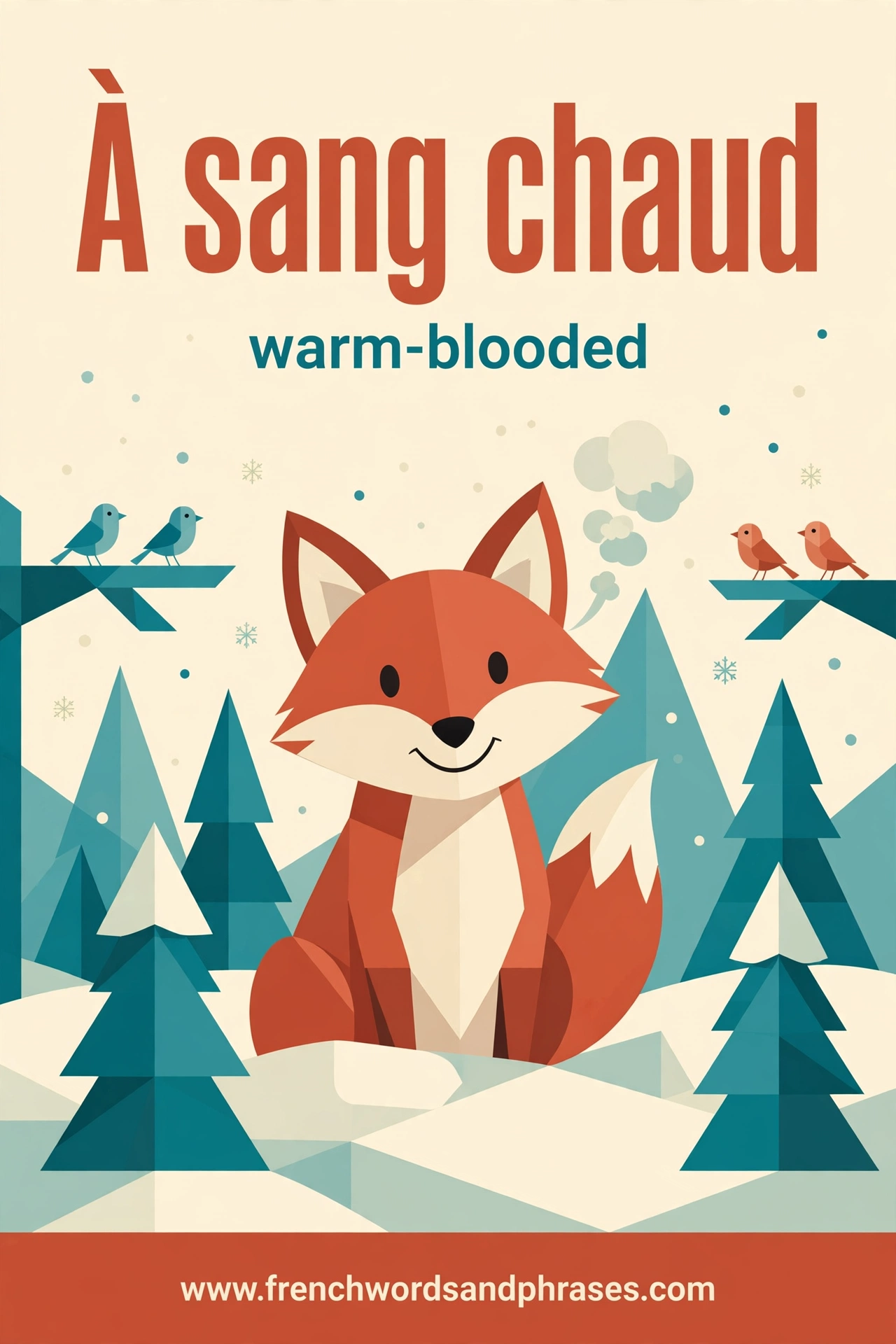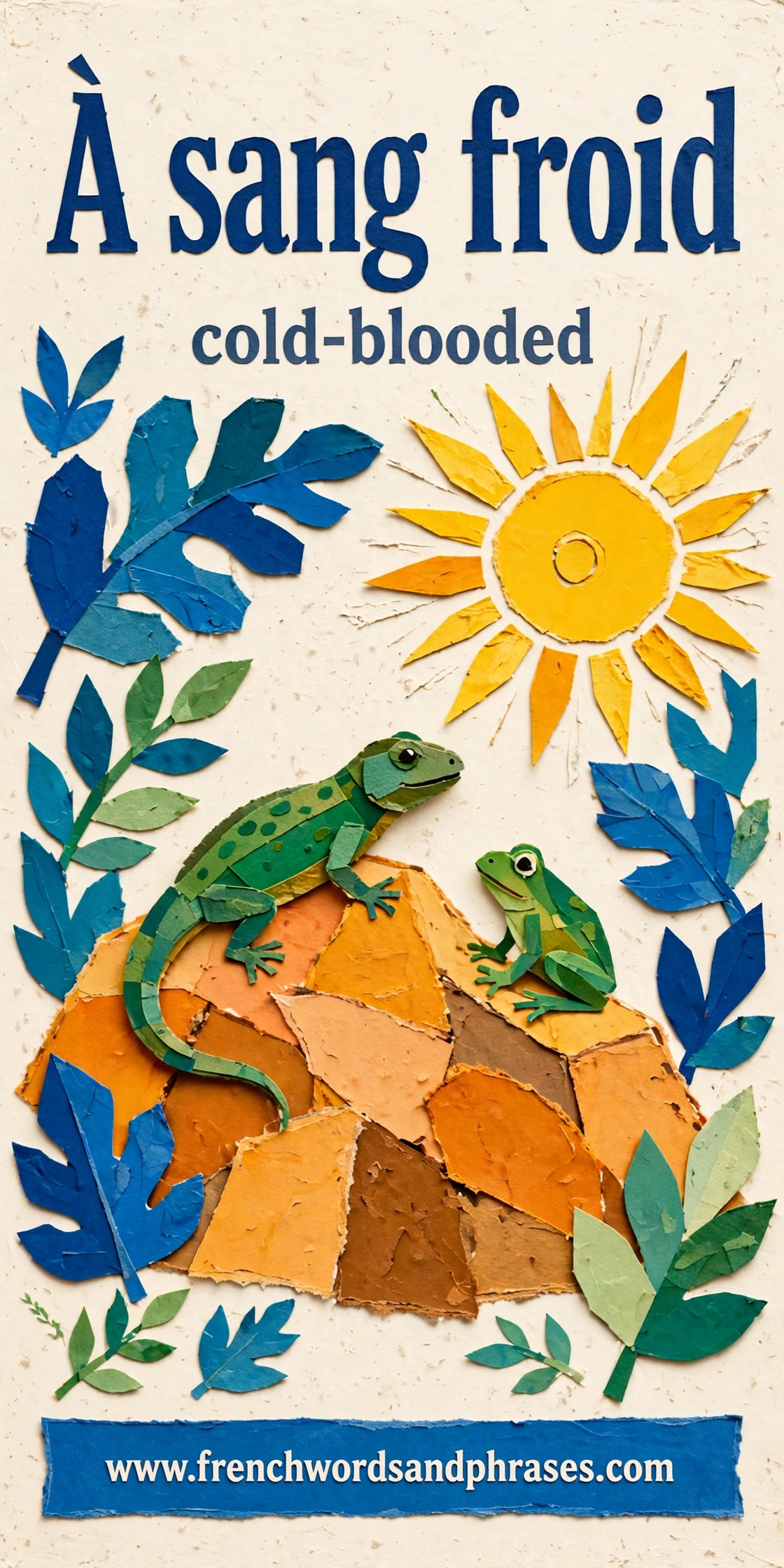
A French Word to Live By
Translate À sang froid to English
/a sɑ̃ fʁwa/
À sang froid means cold-blooded — taking body temperature from the surroundings.
First sun on the stone wall behind the house. A lizard lies flat against the warm rock, perfectly still, charging itself like a battery. An hour ago, in the cold shade, it could barely move. The schoolbook label for a life run by the weather: « un animal à sang froid. »
Let’s explore how à sang froid works in French, beginning with the whole phrase on one card.
Understanding the French Phrase À sang froid
À sang froid is a French descriptive phrase built from le sang (blood) and froid (cold). In zoology it labels animals — reptiles, amphibians, fish and insects — whose body temperature rises and falls with the world around them.
It means cold-blooded. The lizard, the frog, the trout and the bee do not burn fuel to hold a steady temperature: they warm up in the sun and cool down in the shade. The picture in the words is the mirror of à sang chaud — where the warm-blooded animal carries a furnace, the cold-blooded one borrows its heat from the day itself.
Type: Descriptive phrase — zoology (à + noun + adjective)
Answers the need: Saying an animal is cold-blooded — reptiles, amphibians, fish, insects
Register: Neutral — schoolbooks, nature documentaries, everyday science
Strength: Precise — a scientific category; not (in this form) a judgement of character
One important usage detail: keep the phrase in its zoology form — un animal à sang froid. Written together as one word, le sang-froid means composure, and de sang-froid means deliberately, in cold blood: un crime commis de sang-froid. The adjective froid agrees with le sang, so it stays masculine: une grenouille à sang froid.
Experience the Word
À sang froid is the body as a solar panel — no furnace, no fuel bill, just patience and sunshine.
Imagine the snake at dawn, too cold to strike, spread along the path to catch the first warmth; by noon it is lightning. The warm-blooded fox pays for its freedom with constant meals; the snake pays for its economy with its mornings. The phrase holds that whole bargain in three words.
French sorts the animal kingdom by one question. Do you make your warmth, or do you borrow it?
How to Use À sang froid in French: Complete Guide
Let’s explore how à sang froid works in French, beginning with the whole phrase on one card.
À sang froid at a Glance
The Whole Phrase on One Card
Real meaning, literal picture, English twin and register — à sang froid in five lines.
| Point | À sang froid |
|---|---|
| What it really means | cold-blooded — the body follows the temperature around it |
| Word for word | with cold blood |
| English equivalent | cold-blooded |
| Register | neutral — science, school, documentaries |
| Use it for | reptiles, amphibians, fish and insects — lizards, frogs, trout, bees |
Example
Le lézard est un animal à sang froid.
The lizard is a cold-blooded animal.
Word by Word: Building the Chill
Three small pieces — take them one by one and the borrowed warmth makes sense.
| Word | Literal meaning | Its job in the phrase |
|---|---|---|
| à | with, having | the little word that pins a quality onto the animal |
| sang | blood | the body’s inner river — masculine, le sang |
| froid | cold | agrees with sang, not with the animal — always froid here |
Example
Les serpents sont à sang froid, comme les lézards.
Snakes are cold-blooded, like lizards.
Quick Quiz 1
A frog is une grenouille, a feminine noun. Is she à sang froid or à sang froide?
Reveal the answer
À sang froid — froid agrees with le sang, which is masculine, whatever the animal’s own gender.
La grenouille est un animal à sang froid.
The frog is a cold-blooded animal.
When You Say It: The Cold-Blooded Moments
À sang froid fires at moments like these — in lessons, documentaries and sunny gardens.
| Situation | Example |
|---|---|
| In a science lesson | les reptiles sont à sang froid — reptiles are cold-blooded |
| In the garden | le lézard, à sang froid, se réchauffe au soleil — the cold-blooded lizard warms itself in the sun |
| Comparing animals | le chien est à sang chaud, le serpent à sang froid — the dog is warm-blooded, the snake cold-blooded |
| By the river | la truite, un poisson à sang froid — the trout, a cold-blooded fish |
| On a cold morning | à sang froid, il attend le soleil pour bouger — cold-blooded, it waits for the sun to move |
Example
À sang froid, la couleuvre ne chasse que lorsqu’elle est réchauffée.
Cold-blooded, the grass snake only hunts once it has warmed up.
Make It Yours: The Phrase in Its Frames
The phrase itself never changes — what changes is the frame you hang it on.
| Form | French | In English |
|---|---|---|
| The label | un animal à sang froid | a cold-blooded animal |
| Being | être à sang froid | to be cold-blooded |
| The group | les animaux à sang froid | cold-blooded animals |
| The contrast | à sang froid ou à sang chaud ? | cold-blooded or warm-blooded? |
| Warming up | se réchauffer au soleil | to warm up in the sun |
| The temperature | la température du corps suit celle de l’air | the body temperature follows the air’s |
Example
Les animaux à sang froid se réchauffent au soleil le matin.
Cold-blooded animals warm themselves in the sun in the morning.
Quick Quiz 2
Which animals are à sang froid — the trout and the frog, or the sparrow and the fox?
Reveal the answer
The trout and the frog — fish and amphibians follow the temperature around them. The sparrow and the fox are à sang chaud.
La truite est à sang froid, le moineau à sang chaud.
The trout is cold-blooded, the sparrow warm-blooded.
Everyday Expressions: Building on the Cold Blood
À sang froid slots into these everyday frames — each one ready to use as it stands.
| Frame | In English |
|---|---|
| un animal à sang froid | a cold-blooded animal |
| les animaux à sang froid | cold-blooded animals |
| être à sang froid | to be cold-blooded |
| se réchauffer au soleil | to warm up in the sun |
| à sang froid ou à sang chaud | cold-blooded or warm-blooded |
Example
Un animal à sang froid dépense très peu d’énergie.
A cold-blooded animal uses very little energy.
Close Cousins: The Other Sang Phrases
French has a whole shelf of sang phrases — this one is zoology; its cousins run to temperament, composure and crime.
| Expression | The difference |
|---|---|
| à sang froid | cold-blooded — the zoology label for reptiles, amphibians, fish, insects |
| à sang chaud | warm-blooded — mammals and birds, holding a steady temperature |
| le sang-froid | composure, cool-headedness — written as one word, a quality of calm people |
| de sang-froid | in cold blood — deliberately and calmly, for a crime or a hard decision |
| garder son sang-froid | to keep your cool — to stay calm under pressure |
Example
Il a répondu de sang-froid, sans lever la voix.
He answered in cold blood, without raising his voice.
Quick Quiz 3
A pilot stays perfectly calm during an emergency. Do you praise his sang froid or his sang-froid?
Reveal the answer
His sang-froid — one word, meaning composure. À sang froid, with the à, is the lizard’s zoology label.
Le pilote a gardé un sang-froid remarquable.
The pilot kept a remarkable cool.
À sang froid and Its Neighbours
The animal shelf around the phrase — who waits for the sun and who carries a furnace.
| French | In English |
|---|---|
| un reptile | a reptile — always à sang froid |
| un amphibien | an amphibian — frog, toad, newt |
| un poisson | a fish — à sang froid |
| la température corporelle | body temperature |
| se réchauffer | to warm up |
| un animal à sang chaud | a warm-blooded animal |
Example
Le crapaud, un amphibien à sang froid, passe l’hiver caché.
The toad, a cold-blooded amphibian, spends the winter hidden.
Watch Out: The Traps Around À sang froid
The traps: an adjective that refuses to agree, a hyphen that changes the meaning, and cold blood that is not cruelty.
| Trap | The truth |
|---|---|
| froid never agrees with the animal | une tortue à sang froid — froid belongs to le sang, masculine, and stays put |
| the hyphen trap | le sang-froid (one word) is composure; de sang-froid is ‘in cold blood’; à sang froid (after à) is the animal label |
| not a character judgement | in zoology the phrase is neutral — a lizard is not heartless, it is economical |
| not for cold rooms or cold hands | cold hands are des mains froides — à sang froid is only for whole animals |
Example
La tortue est à sang froid, mais elle n’a rien d’un monstre.
The tortoise is cold-blooded, but it is no monster.
Quick Quiz 4
True or false: calling a snake à sang froid accuses it of cruelty.
Reveal the answer
False — in zoology the phrase is a plain scientific label: the snake’s temperature follows its surroundings. Cruelty would be de sang-froid territory, and even that means calm deliberation.
Le serpent, à sang froid, dort encore dans la fraîcheur du matin.
The snake, cold-blooded, is still asleep in the cool of the morning.
À sang froid in Everyday French: Real-Life Examples
Now that you know the word, let’s see how à sang froid appears in everyday French.
Example 1 — In the classroom
Les reptiles sont des animaux à sang froid.
Reptiles are cold-blooded animals.
Example 2 — In the garden
Le lézard, à sang froid, se réchauffe sur la pierre chaude.
The lizard, cold-blooded, warms itself on the hot stone.
Example 3 — By the pond
La grenouille est à sang froid, comme le crapaud.
The frog is cold-blooded, like the toad.
Example 4 — The documentary
À sang froid, ce crocodile peut rester des heures sans bouger.
Cold-blooded, this crocodile can stay motionless for hours.
Example 5 — The contrast
Le serpent est à sang froid, le renard à sang chaud.
The snake is cold-blooded, the fox warm-blooded.
Example 6 — A cold morning
À sang froid, l’abeille attend le soleil pour s’envoler.
Cold-blooded, the bee waits for the sun before flying off.
Beyond Translation: The Meaning of À sang froid
The pair à sang chaud / à sang froid quietly corrects itself as you learn it: the cold-blooded animal’s blood is not cold on a hot day — it is exactly as warm as the day. What the phrase really sorts is who pays for heat and who borrows it.
À sang froid is the economics of survival — spend nothing on warmth, and spend your mornings waiting instead.
French keeps the old blood picture because it is memorable, and quietly teaches the truer one — dependence on the sun — every time the lizard appears on the wall.
How to Remember the French Phrase À sang froid
Remember it this way: À sang froid is the animal that borrows its warmth — the body follows the weather, sun in, heat up.
- You picture the lizard on the wall — flat against the warm stone at noon, stiff in the shade at dawn.
- You keep froid masculine — it agrees with le sang, never with the animal: une grenouille à sang froid.
- You watch the hyphen — le sang-froid is composure; à sang froid is the zoology label.
The key idea is à sang froid means cold-blooded — the body takes its temperature from the world.
Test Your Knowledge of À sang froid
Let’s see how much you’ve learned. Try answering these questions before revealing the answers.
Question 1
What does à sang froid mean?
Reveal the answer
Cold-blooded — the animal’s body temperature rises and falls with its surroundings.
Question 2
Which animals are à sang froid?
Reveal the answer
Reptiles, amphibians, fish and insects — lizards, frogs, trout and bees.
Question 3
Why does froid stay masculine for a female animal?
Reveal the answer
Because it agrees with le sang — blood is masculine, so une tortue is à sang froid, never froide.
Question 4
What does le sang-froid mean?
Reveal the answer
Composure — calm under pressure. Written as one word, it leaves zoology behind.
Question 5
Complete the sentence:
Le serpent est un animal à sang ______. (The snake is a cold-blooded animal.)
Reveal the answer
froid
Le serpent est un animal à sang froid.
The snake is a cold-blooded animal.
Your Final Challenge
Can You Use It?
How would you say this in French?
“The lizard warms itself in the sun because it is cold-blooded.”
Reveal the answer
Le lézard se réchauffe au soleil parce qu’il est à sang froid.
The lizard warms itself in the sun because it is cold-blooded.
A little French. A little curiosity. A richer everyday life.
LEARN FRENCH ONE WORD AT A TIME