A French Word to Live By
Translate À savoir to English
/a sa.vwaʁ/
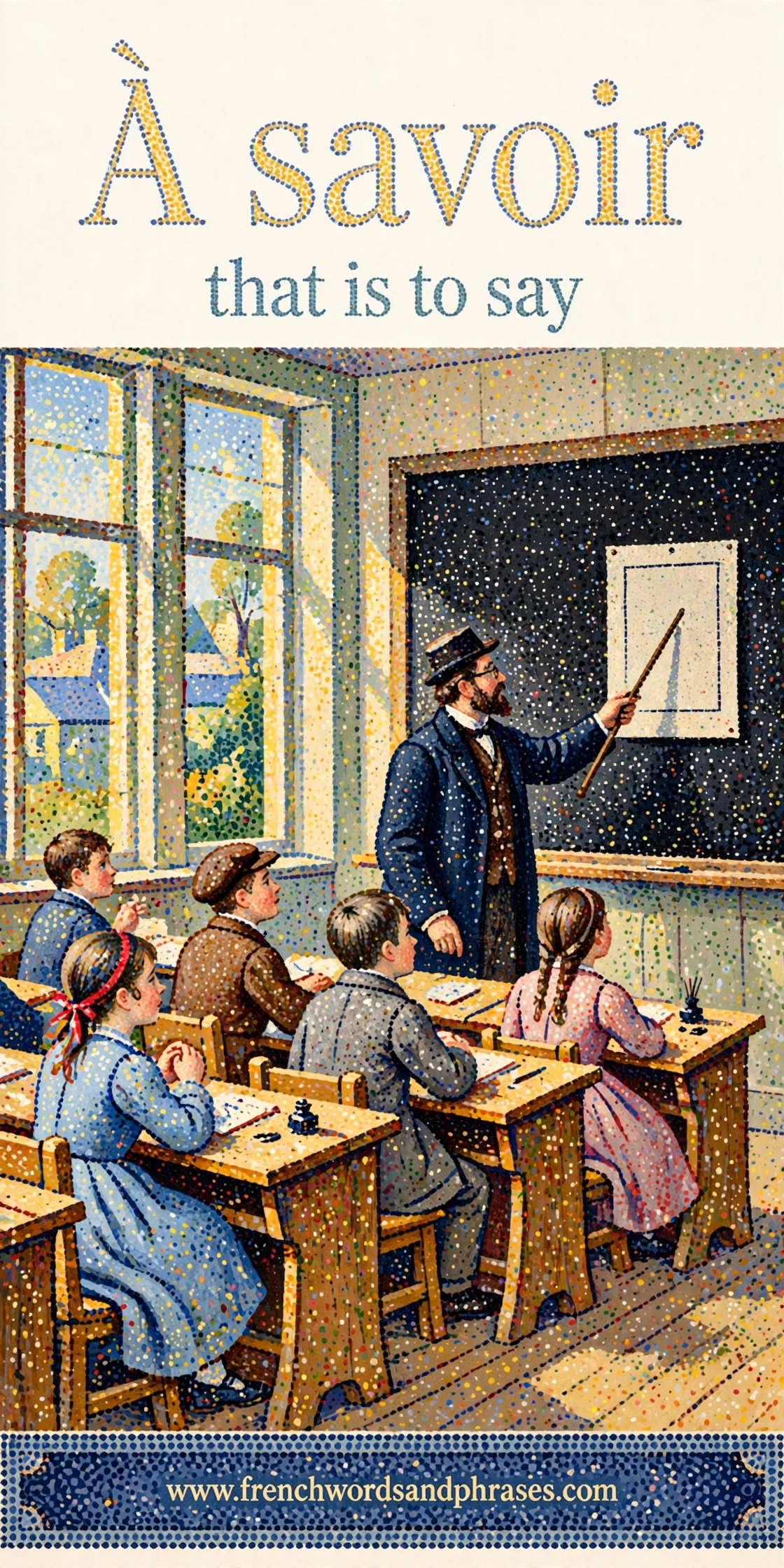
À savoir means namely — that is to say, specifically.
The invitation lands in everyone’s inbox on Monday morning: « La réunion aura lieu jeudi, à savoir le 14, à dix heures précises. » No one has to guess which Thursday, or count days on their fingers — the little phrase has already done the pinning-down. Two words, and the vague becomes exact.
Let’s explore how à savoir works in French, beginning with the whole phrase on one card.
Understanding the French Phrase À savoir
À savoir is a French linking phrase built from à and savoir (to know). It introduces the precise detail that a general statement has been promising — the names, the dates, the list. English does the same job with namely, that is to say, or a colon.
It means namely, that is to say, specifically. You make a broad claim first — trois pays, two conditions, one decision — and à savoir opens the door to the exact contents. It is the written French of contracts, notices, recipes and careful letters, though it slips into speech whenever someone wants to sound precise.
Type: Linking phrase — written French (à + infinitive)
Answers the need: Naming the exact details behind a general statement
Register: Formal to neutral — writing, notices, careful speech
Strength: Precise — it promises a list or a specification, and delivers it
One important usage detail: à savoir is followed directly by the detail it announces, often after a comma or a colon — il reste deux choses à faire, à savoir… Do not confuse it with the question c’est-à-dire or with à savoir si, which means ‘whether / the question of whether’: reste à savoir si elle viendra, it remains to be seen whether she will come.
Experience the Word
À savoir is the moment a sentence stops waving its arms and points at the thing itself.
Imagine the lawyer’s letter, the exam rubric, the recipe that finally stops saying ‘the spices’ and names them: cumin, paprika, a bay leaf. That naming is the pleasure of the phrase — the reader feels the ground firm up under the sentence.
French loves this small ceremony of precision. First the category, then à savoir, then the truth in a list.
How to Use À savoir in French: Complete Guide
Let’s explore how à savoir works in French, beginning with the whole phrase on one card.
À savoir at a Glance
The Whole Phrase on One Card
Real meaning, literal picture, English twin and register — à savoir in five lines.
| Point | À savoir |
|---|---|
| What it really means | namely — the exact details are about to follow |
| Word for word | to know — as in, here is what there is to know |
| English equivalent | namely / that is to say / specifically |
| Register | formal to neutral — mostly written, careful speech |
| Use it for | introducing lists, names, dates, conditions and specifications |
Example
Trois pays participent, à savoir la France, la Belgique et le Canada.
Three countries are taking part, namely France, Belgium and Canada.
Word by Word: Building the Precision
Two small pieces — take them one by one and the general statement sharpens into a list.
| Word | Literal meaning | Its job in the phrase |
|---|---|---|
| à | to | points forward — what follows is the detail |
| savoir | to know | the verb of knowledge: here is the thing to be known |
Example
Un seul document manque, à savoir votre passeport.
Only one document is missing, namely your passport.
Quick Quiz 1
What does à savoir promise the reader — a question, or a specification?
Reveal the answer
A specification — the exact names, dates or items behind the general words just used.
Deux invités manquent, à savoir Marc et Léa.
Two guests are missing, namely Marc and Léa.
When You Say It: The Pinning-Down Moments
À savoir fires at moments like these — wherever a general statement owes the reader its details.
| Situation | Example |
|---|---|
| In a notice | les pièces à fournir, à savoir une photo et un justificatif — the documents to provide, namely a photo and proof of address |
| In a recipe | les épices, à savoir le cumin et le paprika — the spices, namely cumin and paprika |
| In a contract | deux conditions, à savoir l’âge et le domicile — two conditions, namely age and residence |
| In a letter | un seul point reste, à savoir la date — one point remains, namely the date |
| In careful speech | il a tout vendu, à savoir la maison et le jardin — he sold everything, namely the house and the garden |
Example
Le dossier demande trois pièces, à savoir une photo, un passeport et un justificatif.
The application asks for three documents, namely a photo, a passport and proof of address.
Make It Yours: The Phrase in Its Frames
À savoir never changes — the frame around it does the work.
| Form | French | In English |
|---|---|---|
| The classic frame | …, à savoir … | …, namely … |
| After a number | trois raisons, à savoir… | three reasons, namely… |
| The only one | un seul absent, à savoir Paul | only one person absent, namely Paul |
| The question form | reste à savoir si… | it remains to be seen whether… |
| Things to know | à savoir avant de partir | things to know before leaving |
| In a title | Tout ce qu’il faut savoir | Everything you need to know |
Example
Reste à savoir si le train partira à l’heure.
It remains to be seen whether the train will leave on time.
Quick Quiz 2
What changes in reste à savoir si elle viendra — is something being named, or questioned?
Reveal the answer
Questioned — with si after it, à savoir means ‘whether’: it remains to be seen whether she will come. The naming sense has the detail directly after it, no si.
Reste à savoir si elle acceptera.
It remains to be seen whether she will accept.
Everyday Expressions: Building on the Precision
À savoir slots into these everyday frames — each one ready to use as it stands.
| Frame | In English |
|---|---|
| à savoir + list | namely + the exact items |
| reste à savoir si | it remains to be seen whether |
| à savoir avant de… | to know before… (in guides and titles) |
| tout ce qu’il faut savoir | everything you need to know |
| faire savoir | to let someone know, to make known |
Example
Voici tout ce qu’il faut savoir avant de signer.
Here is everything you need to know before signing.
Close Cousins: The Other Pinning-Down Phrases
French has a whole shelf of specifying phrases — à savoir is the list-maker; its cousins explain, correct or give examples.
| Expression | The difference |
|---|---|
| à savoir | namely — introduces the exact contents of what was just announced |
| c’est-à-dire | that is to say — explains or rephrases, in speech and writing alike |
| notamment | in particular, notably — picks one item out of a group without listing all |
| par exemple | for example — gives one illustration, not the full contents |
| en l’occurrence | in this case — points at the specific instance under discussion |
Example
Il parle trois langues, notamment l’espagnol, qu’il a appris enfant.
He speaks three languages, in particular Spanish, which he learnt as a child.
Quick Quiz 3
You want to give ONE example, not the full list. À savoir or par exemple?
Reveal the answer
Par exemple — à savoir promises the complete contents; par exemple offers a single illustration.
Certains fruits, par exemple la mangue, voyagent mal.
Some fruits, for example the mango, travel badly.
À savoir and Its Neighbours
The precision shelf around the phrase — from naming to knowing.
| French | In English |
|---|---|
| c’est-à-dire | that is to say, i.e. |
| notamment | in particular, notably |
| faire savoir | to let know, to inform |
| le savoir | knowledge — the noun form |
| un savoir-faire | know-how, expertise |
| reste à savoir | it remains to be seen |
Example
Son savoir-faire est connu, c’est-à-dire reconnu dans tout le métier.
His know-how is known — that is to say, recognised throughout the trade.
Watch Out: The Traps Around À savoir
The traps: a si that flips the meaning, a cousin that explains instead of listing, and precision used where a plain word would do.
| Trap | The truth |
|---|---|
| the si flip | à savoir si means ‘whether’ — reste à savoir si… is a question hanging open, not a list beginning |
| à savoir vs c’est-à-dire | c’est-à-dire rephrases the same idea; à savoir unpacks it into its exact parts |
| no verb after it | à savoir is followed by nouns or details, not a full conjugated clause — the list, not a new sentence |
| too grand for tiny details | in casual chat, a plain colon or c’est-à-dire often sounds lighter; à savoir carries a written, official flavour |
Example
Reste à savoir si le dossier, à savoir les trois pièces, arrivera à temps.
It remains to be seen whether the file — namely the three documents — will arrive in time.
Quick Quiz 4
True or false: à savoir and c’est-à-dire do exactly the same job.
Reveal the answer
False — c’est-à-dire rephrases; à savoir unpacks a general word into its exact contents, usually a list.
Il a deux passions, à savoir la voile et la photographie.
He has two passions, namely sailing and photography.
À savoir in Everyday French: Real-Life Examples
Now that you know the word, let’s see how à savoir appears in everyday French.
Example 1 — The application
Il faut trois documents, à savoir une photo, un passeport et un justificatif.
Three documents are needed, namely a photo, a passport and proof of address.
Example 2 — The invitation
La réunion aura lieu jeudi, à savoir le 14, à dix heures.
The meeting will take place on Thursday, namely the 14th, at ten o’clock.
Example 3 — The recipe
Ajoutez les épices, à savoir le cumin, le paprika et une feuille de laurier.
Add the spices, namely cumin, paprika and a bay leaf.
Example 4 — The contract
Deux conditions sont exigées, à savoir l’âge et le domicile.
Two conditions are required, namely age and residence.
Example 5 — The open question
Reste à savoir si elle viendra demain.
It remains to be seen whether she will come tomorrow.
Example 6 — The guidebook
Voici ce qu’il faut savoir, à savoir les horaires et les prix.
Here is what you need to know, namely the times and the prices.
Beyond Translation: The Meaning of À savoir
English namely has gone a little stiff and legal; French à savoir is still alive in every notice, rubric and recipe. Both do the same courteous thing: they refuse to leave the reader with a foggy general word.
À savoir is a promise kept inside the sentence — you said ‘three things’, and here, exactly, they are.
Learn to spot it and formal French opens up: behind every à savoir, a list is waiting to be read.
How to Remember the French Phrase À savoir
Remember it this way: À savoir is the sentence opening its hand — the general word first, then the exact contents, named.
- You picture the colon — à savoir does in words what ‘:’ does in punctuation: here comes the list.
- You listen for the si — à savoir si flips it into ‘whether’, a question, not a list.
- You keep it written — in chat, c’est-à-dire is lighter; à savoir wears a tie.
The key idea is à savoir means namely — it introduces the exact details behind a general statement.
Test Your Knowledge of À savoir
Let’s see how much you’ve learned. Try answering these questions before revealing the answers.
Question 1
What does à savoir mean?
Reveal the answer
Namely, that is to say — it introduces the exact details behind a general statement.
Question 2
What usually follows à savoir?
Reveal the answer
The exact contents — a list of names, dates, items or conditions, often after a comma or a colon.
Question 3
What does reste à savoir si elle viendra mean?
Reveal the answer
It remains to be seen whether she will come — with si, à savoir becomes a question of whether.
Question 4
How is à savoir different from par exemple?
Reveal the answer
À savoir gives the full contents; par exemple gives one illustration out of several possible.
Question 5
Complete the sentence:
Trois pays participent, à ______ la France, la Belgique et le Canada. (Three countries are taking part, namely France, Belgium and Canada.)
Reveal the answer
savoir
Trois pays participent, à savoir la France, la Belgique et le Canada.
Three countries are taking part, namely France, Belgium and Canada.
Your Final Challenge
Can You Use It?
How would you say this in French?
“Two documents are missing, namely a photo and a passport.”
Reveal the answer
Deux documents manquent, à savoir une photo et un passeport.
Two documents are missing, namely a photo and a passport.
A little French. A little curiosity. A richer everyday life.
LEARN FRENCH ONE WORD AT A TIME