A French Word to Live By
Translate À sang chaud to English
/a sɑ̃ ʃo/
À sang chaud means warm-blooded — keeping a steady body temperature from within.
Winter in the Alps. The marmot is deep asleep underground, but the chamois on the ridge is awake, grazing, steam rising from its back in the cold air. Its body holds its own warmth whatever the mountain does. The French schoolbooks have a label for that: « un animal à sang chaud. »
Let’s explore how à sang chaud works in French, beginning with the whole phrase on one card.
Understanding the French Phrase À sang chaud
À sang chaud is a French descriptive phrase built from le sang (blood) and chaud (warm, hot). In zoology it labels animals — mammals and birds — whose bodies hold a steady internal temperature whatever the weather does outside.
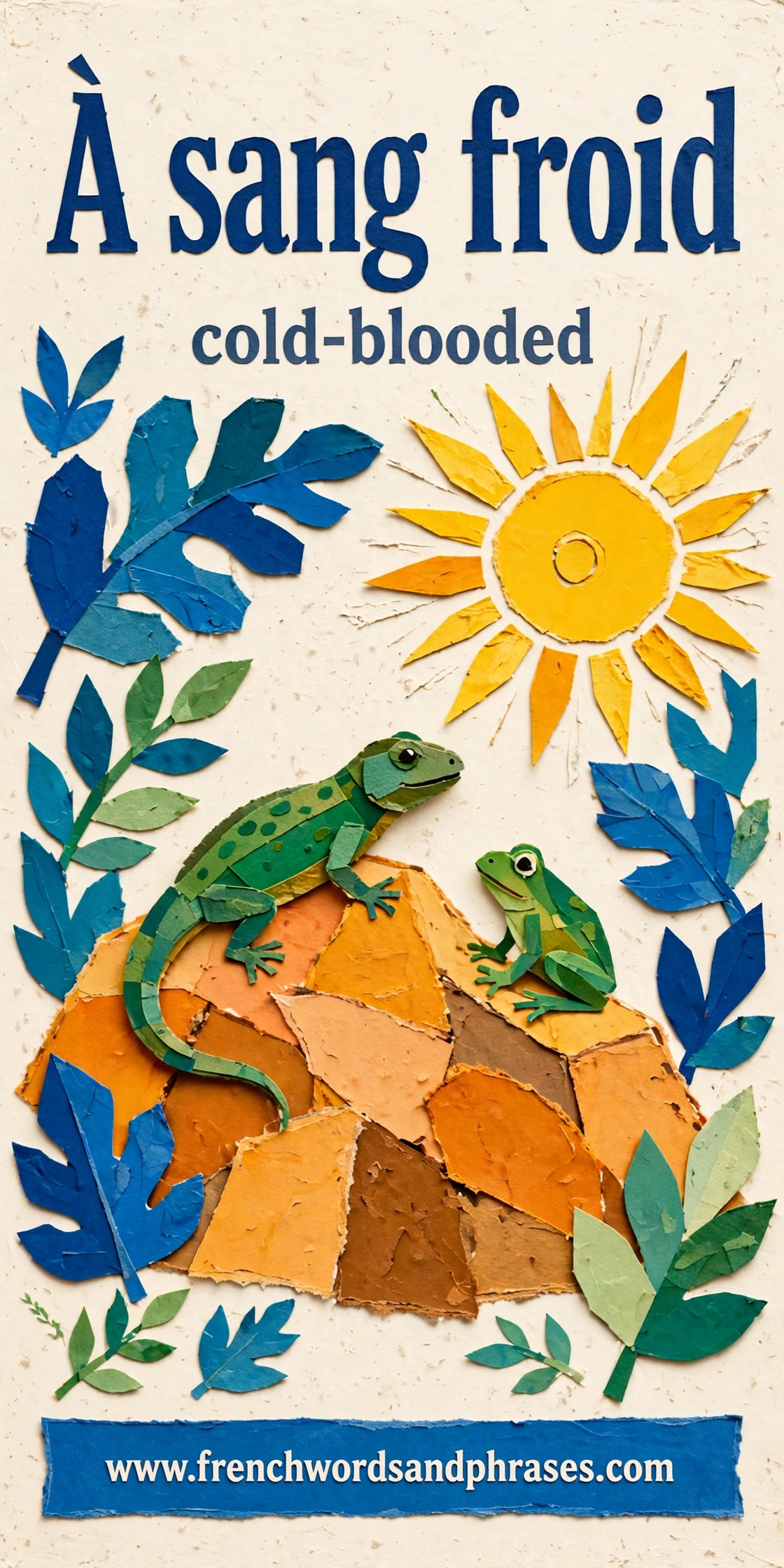
It means warm-blooded. A dog, a sparrow, a whale and you: all à sang chaud, running an internal heating system that keeps the body at one steady temperature day and night. The picture in the words is simple and ancient — the blood itself feels warm. Its mirror image is à sang froid, the cold-blooded world of lizards and frogs.
Type: Descriptive phrase — zoology (à + noun + adjective)
Answers the need: Saying an animal is warm-blooded — mammals and birds
Register: Neutral — schoolbooks, nature documentaries, everyday science
Strength: Precise — a scientific category, not a compliment or an insult
One important usage detail: à sang chaud describes the animal, and the adjective chaud agrees with sang, not with the animal — une souris à sang chaud, a warm-blooded mouse, keeps chaud in its masculine form because le sang is masculine. Do not confuse it with avoir le sang chaud, which describes a hot-tempered person.
Experience the Word
À sang chaud is the body as a house with the heating left on — costly, constant, and worth it.
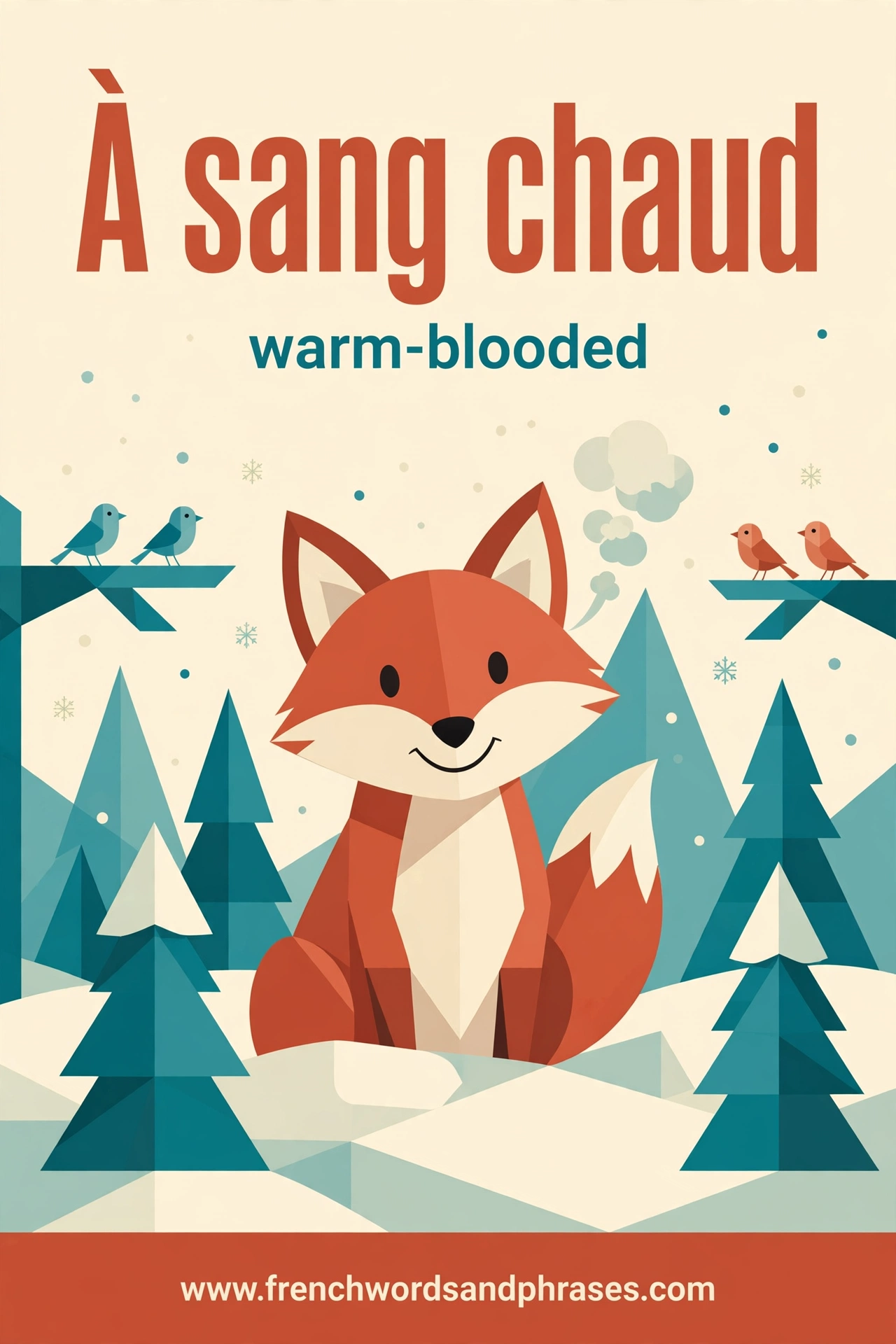
Imagine the lizard and the fox on the same winter morning. The lizard waits, stiff, for the sun to switch it on. The fox is already running, its warmth made from within, breakfast paid for by a furnace that never goes out. That difference is the whole phrase.
French names the two great strategies of animal life with one pair of phrases. Warm blood buys freedom from the weather — at the price of constant fuel.
How to Use À sang chaud in French: Complete Guide
Let’s explore how à sang chaud works in French, beginning with the whole phrase on one card.
À sang chaud at a Glance
The Whole Phrase on One Card
Real meaning, literal picture, English twin and register — à sang chaud in five lines.
| Point | À sang chaud |
|---|---|
| What it really means | warm-blooded — the body holds a steady temperature from within |
| Word for word | with warm blood |
| English equivalent | warm-blooded |
| Register | neutral — science, school, documentaries |
| Use it for | mammals and birds — dogs, sparrows, whales, humans |
Example
Le renard est un animal à sang chaud.
The fox is a warm-blooded animal.
Word by Word: Building the Warmth
Three small pieces — take them one by one and the internal furnace lights itself.
| Word | Literal meaning | Its job in the phrase |
|---|---|---|
| à | with, having | the little word that pins a quality onto the animal |
| sang | blood | the body’s inner river — masculine, le sang |
| chaud | warm, hot | agrees with sang, not with the animal — always chaud here |
Example
Les oiseaux sont à sang chaud, comme les mammifères.
Birds are warm-blooded, like mammals.
Quick Quiz 1
A mouse is une souris, a feminine noun. Is she à sang chaud or à sang chaude?
Reveal the answer
À sang chaud — chaud agrees with le sang, which is masculine, whatever the animal’s own gender.
La souris est un petit animal à sang chaud.
The mouse is a small warm-blooded animal.
When You Say It: The Warm-Blooded Moments
À sang chaud fires at moments like these — in lessons, documentaries and winter observations.
| Situation | Example |
|---|---|
| In a science lesson | les mammifères sont à sang chaud — mammals are warm-blooded |
| In a documentary | malgré le froid, cet animal à sang chaud reste actif — despite the cold, this warm-blooded animal stays active |
| Comparing animals | le chien est à sang chaud, le lézard à sang froid — the dog is warm-blooded, the lizard cold-blooded |
| About humans | l’être humain est un animal à sang chaud — the human being is a warm-blooded animal |
| In winter | grâce à son sang chaud, il traverse l’hiver — thanks to its warm blood, it gets through the winter |
Example
Contrairement au lézard, le hérisson est à sang chaud.
Unlike the lizard, the hedgehog is warm-blooded.
Make It Yours: The Phrase in Its Frames
The phrase itself never changes — what changes is the frame you hang it on.
| Form | French | In English |
|---|---|---|
| The label | un animal à sang chaud | a warm-blooded animal |
| Being | être à sang chaud | to be warm-blooded |
| The group | les animaux à sang chaud | warm-blooded animals |
| The contrast | à sang chaud ou à sang froid ? | warm-blooded or cold-blooded? |
| The temperature | garder une température constante | to keep a constant temperature |
| About us | nous sommes à sang chaud | we are warm-blooded |
Example
Les animaux à sang chaud gardent la même température jour et nuit.
Warm-blooded animals keep the same temperature day and night.
Quick Quiz 2
Which groups of animals are à sang chaud — mammals and birds, or reptiles and fish?
Reveal the answer
Mammals and birds — they hold a steady body temperature from within. Reptiles and fish are à sang froid.
Le moineau, comme le chat, est à sang chaud.
The sparrow, like the cat, is warm-blooded.
Everyday Expressions: Building on the Warm Blood
À sang chaud slots into these everyday frames — each one ready to use as it stands.
| Frame | In English |
|---|---|
| un animal à sang chaud | a warm-blooded animal |
| les animaux à sang chaud | warm-blooded animals |
| être à sang chaud | to be warm-blooded |
| à sang chaud ou à sang froid | warm-blooded or cold-blooded |
| maintenir sa température | to maintain one’s temperature |
Example
Un animal à sang chaud doit manger souvent pour garder sa température.
A warm-blooded animal must eat often to keep its temperature.
Close Cousins: The Other Temperature Words
French has a whole shelf of temperature phrases — this one is zoology; its cousins shade into temperament and tactics.
| Expression | The difference |
|---|---|
| à sang chaud | warm-blooded — the zoology label for mammals and birds |
| à sang froid | cold-blooded — reptiles, amphibians, fish; the body follows the weather |
| avoir le sang chaud | to be hot-tempered, quick to anger — about people, not body temperature |
| garder son sang-froid | to keep your cool, stay calm — sang-froid written as one word is composure |
| de sang-froid | in cold blood, deliberately — for a crime committed calmly |
Example
Il a le sang chaud, mais au travail il garde son sang-froid.
He is hot-tempered, but at work he keeps his cool.
Quick Quiz 3
Your colleague explodes at every small problem. Is he à sang chaud?
Reveal the answer
Not with this phrase — à sang chaud is the zoology label. For the temper, say il a le sang chaud, he is hot-blooded.
Attention, il a le sang chaud, il s’énerve vite.
Careful, he is hot-tempered, he gets annoyed quickly.
À sang chaud and Its Neighbours
The animal shelf around the phrase — who runs a furnace and who waits for the sun.
| French | In English |
|---|---|
| un mammifère | a mammal — always à sang chaud |
| un oiseau | a bird — also à sang chaud |
| un reptile | a reptile — à sang froid |
| la température corporelle | body temperature |
| hiberner | to hibernate — the warm-blooded winter sleep |
| un animal à sang froid | a cold-blooded animal |
Example
La marmotte, un mammifère à sang chaud, hiberne tout l’hiver.
The marmot, a warm-blooded mammal, hibernates all winter.
Watch Out: The Traps Around À sang chaud
The traps: an adjective that refuses to agree, a temper that sneaks in, and one word that changes meaning with a hyphen.
| Trap | The truth |
|---|---|
| chaud never agrees with the animal | une baleine à sang chaud — chaud belongs to le sang, masculine, and stays put |
| the temper trap | avoir le sang chaud means hot-tempered — do not use à sang chaud for an angry person |
| sang-froid is a different word | le sang-froid, written together, is composure — garder son sang-froid is to keep your cool, not a temperature |
| not for food or rooms | a warm room is une pièce chaude — à sang chaud is only for living bodies |
Example
La baleine est à sang chaud, même dans les mers glacées.
The whale is warm-blooded, even in icy seas.
Quick Quiz 4
True or false: le sang-froid is the opposite of à sang chaud.
Reveal the answer
False — le sang-froid is composure, calm under pressure. The zoology opposite of à sang chaud is à sang froid, two words after à.
Elle a gardé son sang-froid pendant toute la crise.
She kept her cool throughout the crisis.
À sang chaud in Everyday French: Real-Life Examples
Now that you know the word, let’s see how à sang chaud appears in everyday French.
Example 1 — In the classroom
Les mammifères sont des animaux à sang chaud.
Mammals are warm-blooded animals.
Example 2 — At the zoo
Le panda est à sang chaud, comme tous les mammifères.
The panda is warm-blooded, like all mammals.
Example 3 — Winter on the farm
À sang chaud, la chèvre reste active même en hiver.
Warm-blooded, the goat stays active even in winter.
Example 4 — The documentary
Cet oiseau à sang chaud traverse l’océan sans se reposer.
This warm-blooded bird crosses the ocean without resting.
Example 5 — The contrast
Le chien est à sang chaud, le serpent à sang froid.
The dog is warm-blooded, the snake cold-blooded.
Example 6 — About ourselves
Nous sommes à sang chaud : notre température reste stable.
We are warm-blooded: our temperature stays steady.
Beyond Translation: The Meaning of À sang chaud
English and French built this idea from the same picture — blood with a temperature — but the older picture is slightly wrong, and both languages keep it anyway: what matters is not that the blood is warm, but that the body holds it steady.
À sang chaud is less about heat than about independence — the animal carries its climate with it.
That is why the pair à sang chaud / à sang froid survives every modern textbook term: two short phrases, and the whole animal kingdom sorts itself.
How to Remember the French Phrase À sang chaud
Remember it this way: À sang chaud is the animal with its own heating — the blood stays warm whatever the weather does.
- You picture the furnace — warm-blooded animals make their own heat and hold it steady, day and night.
- You keep chaud masculine — it agrees with le sang, never with the animal: une souris à sang chaud.
- You separate the temper — avoir le sang chaud is a hot head, not a warm body.
The key idea is à sang chaud means warm-blooded — the body holds its temperature from within.
Test Your Knowledge of À sang chaud
Let’s see how much you’ve learned. Try answering these questions before revealing the answers.
Question 1
What does à sang chaud mean?
Reveal the answer
Warm-blooded — the animal holds a steady body temperature from within, whatever the weather.
Question 2
Which animals are à sang chaud?
Reveal the answer
Mammals and birds — from the mouse to the whale, and us.
Question 3
Why does chaud stay masculine for a female animal?
Reveal the answer
Because it agrees with le sang — blood is masculine, so une souris is à sang chaud, never chaude.
Question 4
What does avoir le sang chaud mean?
Reveal the answer
To be hot-tempered — quick to anger. A person, not a body temperature.
Question 5
Complete the sentence:
Le chat est un animal à sang ______. (The cat is a warm-blooded animal.)
Reveal the answer
chaud
Le chat est un animal à sang chaud.
The cat is a warm-blooded animal.
Your Final Challenge
Can You Use It?
How would you say this in French?
“The fox is a warm-blooded animal.”
Reveal the answer
Le renard est un animal à sang chaud.
The fox is a warm-blooded animal.
A little French. A little curiosity. A richer everyday life.
LEARN FRENCH ONE WORD AT A TIME