A French Word to Live By
Translate Historique to English
/istɔʁik/
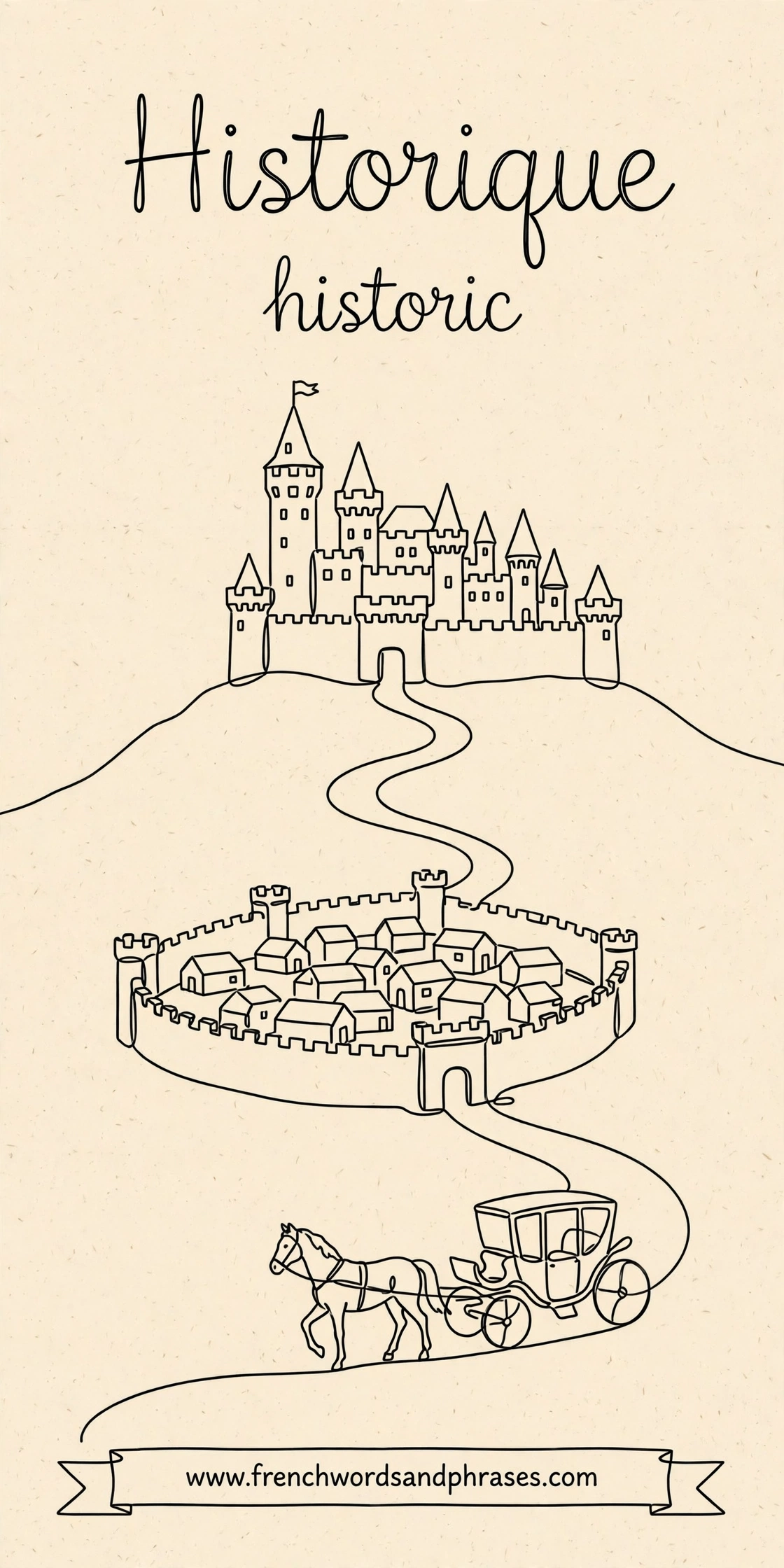
Historique means historic.
The guide stops the little group in front of a plain stone house and lowers her voice: this is where the treaty was signed, this is the balcony from which the republic was proclaimed. The street looks ordinary; the stones are anything but. French marks such places with one word: historique.
In this guide, you’ll learn what historique means in English, why it never changes between masculine and feminine, where it stands in the sentence, and how it differs from ancien, its older neighbour. Explore French examples, English translations, and practice quizzes.
Understanding the French Adjective Historique
Historique is a French adjective of quality — the adjective of places and moments marked by history. It already ends in -e, so masculine and feminine are identical: only the plural adds an s. Le centre historique, une ville historique — one form does almost all the work.
It means historic — connected with important events and the long memory of a place. It describes centres (le centre historique, the historic centre), monuments, quarters and whole towns protected for their past. A town can be ancienne simply by being old; it is historique when history happened there.
Type: Adjective of quality — connection with history
Answers the question: What is the place like? — historic
Changes form: Only in the plural — historique / historiques, the same for masculine and feminine
English equivalents: Historic; historical.
One important usage detail: historique stands AFTER the noun — le centre historique, un monument historique. And un monument historique is also an official title in France: a listed, protected building, guarded by law.
Experience the Word
Historique is the adjective of the plaque on the wall — the house where a treaty was signed, the bridge an army crossed, the square where a king was crowned, all still standing in the middle of an ordinary Tuesday.
Imagine walking to buy bread through streets where every third building carries a date in stone: 1587, 1643, 1789. The baker’s shop is in a house older than your country. History here is not a subject; it is the address.
You have not just described an old place. You have described a place where history actually happened.
How to Use Historique in French: Complete Guide
Let’s explore how historique works in French, beginning with the whole word on one card.
Historique at a Glance
Before the details, here is the whole word on one card.
The Whole Word on One Card
Meaning, type, position and forms — historique in four lines.
| Point | Historique |
|---|---|
| Meaning | historic |
| Type | adjective of quality — connection with history |
| Usual position | after the noun — le centre historique |
| Form | historique for everyone — historiques in the plural |
Example
C’est un centre historique.
It’s a historic centre.
The Four Forms of Historique
Here is one of the easiest agreements in French: historique already ends in -e, so the feminine changes nothing. Only the plural adds an s.
| Form | Historique | Example |
|---|---|---|
| Masculine singular | historique | un centre historique — a historic centre |
| Feminine singular | historique | une ville historique — a historic town |
| Masculine plural | historiques | des monuments historiques — historic monuments |
| Feminine plural | historiques | des villes historiques — historic towns |
Example
Un centre historique et des villes historiques.
A historic centre and historic towns.
Quick Quiz 1
Does historique change for a feminine noun?
Reveal the answer
No
Un centre historique, une ville historique — the form is identical.
A historic centre, a historic town.
The Feminine of Historique: Nothing Changes
Most adjectives build their feminine by adding an e. Historique was born with one, so the feminine has nothing to add — a small holiday for learners.
| Situation | Example |
|---|---|
| Masculine | un monument historique — a historic monument |
| Feminine | une place historique — identical |
| Why | historique already ends in -e, so the feminine adds nothing |
| The plural | add s — des rues historiques, historic streets |
Example
C’est une place historique, au cœur de la ville.
It’s a historic square, in the heart of the town.
Where Historique Goes: After the Noun
Historique follows the noun it describes, like most French adjectives, and it sits comfortably after être. Adverbs slide in front of it without moving it.
| Pattern | Example |
|---|---|
| After the noun | le centre historique — the historic centre |
| After être | cette ville est historique — this town is historic |
| With an adverb | un lieu très historique — a very historic place |
| Before the noun | un historique centre — not in everyday French |
Example
Le centre historique attire les visiteurs.
The historic centre attracts visitors.
Quick Quiz 2
How do you say ‘the historic centre’ — le historique centre or le centre historique?
Reveal the answer
le centre historique
Historique stands after the noun.
The historic centre.
More Historic: Comparing with Historique
Historique compares the regular way, with plus, moins and aussi — and the superlative keeps the same single form: le plus historique, la plus historique.
| Degree | Example |
|---|---|
| As historic as | aussi historique que — as historic as |
| More historic | plus historique — more historic |
| Less historic | moins historique — less historic |
| The most historic (masc.) | le plus historique — le plus historique des centres |
| The most historic (fem.) | la plus historique — la plus historique des villes |
Example
Cette ville est plus historique que sa voisine.
This town is more historic than its neighbour.
Everyday Expressions with Historique
Historique is the word of guided tours and blue plaques — and of one official title that protects France’s treasures.
| Expression | In English |
|---|---|
| le centre historique | the historic centre |
| un monument historique | a listed historic monument — officially protected |
| le cœur historique | the historic heart of a town |
| un événement historique | a historic event |
| une visite historique | a historical tour, a guided walk through the past |
| classé monument historique | listed as a historic monument |
Example
Le château est classé monument historique.
The castle is listed as a historic monument.
Quick Quiz 3
What does classé monument historique mean?
Reveal the answer
Listed as a historic monument
The building is officially protected by law.
Listed as a historic monument.
Historique and Its Neighbours
Historique shares its past with ancien and médiéval; at the other end, moderne and sans histoire describe places the centuries passed by.
| French | In English |
|---|---|
| ancien | old, historic — age first, events second |
| médiéval | medieval — of the Middle Ages |
| célèbre | famous — known, but not necessarily historic |
| légendaire | legendary — history mixed with story |
| moderne | modern — the opposite in spirit |
| sans histoire | uneventful, without a past — literally, without history |
Example
C’est une ville historique, célèbre et un peu légendaire.
It’s a historic town, famous and a little legendary.
Watch Out: The Traps Around Historique
The traps here are a silent h that vanishes in speech, and the difference between old and historic.
| Trap | The truth |
|---|---|
| The silent h | historique begins with a mute h — l’histoire, un lieu historique, pronounced as if the h were not there |
| ancien vs historique | ancien = old in age; historique = marked by events. A town is historique when history happened there |
| historical vs historic | French uses one word for both — un roman historique is a historical novel |
| Agreement | do not add a second e — une ville historique, never ‘historiquée’ |
Example
Cette ville ancienne est aussi une ville historique.
This old town is also a historic town.
Quick Quiz 4
How do you say ‘a historic town’?
Reveal the answer
une ville historique
Historique follows the noun and does not change.
A historic town.
Historique in Everyday French: Real-Life Examples
Now that you know the word, let’s see how historique appears in everyday French.
Example 1 — The centre
Le centre historique est interdit aux voitures.
The historic centre is closed to cars.
Example 2 — A town
C’est une ville historique, célèbre dans tout le pays.
It’s a historic town, famous across the country.
Example 3 — A monument
Ce château est un monument historique protégé.
This castle is a protected historic monument.
Example 4 — A tour
Nous suivons une visite historique du vieux quartier.
We’re taking a historical tour of the old quarter.
Example 5 — Streets
Les rues historiques sont étroites et pavées.
The historic streets are narrow and cobbled.
Example 6 — A contrast
Le quartier historique touche les quartiers modernes.
The historic quarter touches the modern districts.
Beyond Translation: The Meaning of Historique
English argues about historic versus historical; French settles it with one word. Historique covers the monument, the novel and the day everything changed — anything the long memory of a place has touched.
Ancien says a town is old; historique says the past left its signature there.
And in France the word carries legal weight: classé monument historique means the state itself stands guard over the building, so that the stones the treaty was signed in will still be there for the next treaty of tourists.
How to Remember the French Adjective Historique
Remember it this way: Historique is the signature-of-the-past adjective — one form for him and her, an s for the plural, its place behind the noun, and a silent h at its head.
- You see one form for everyone — le centre historique, une ville historique.
- You add only an s in the plural — des monuments historiques.
- You separate it from ancien — historique is where history happened, ancien is simply old.
The key idea is historique never changes except in the plural, stands after the noun, and means history happened here.
Test Your Knowledge of Historique
Let’s see how much you’ve learned. Try answering these questions before revealing the answers.
Question 1
What does historique mean?
Reveal the answer
Historic — connected with important events and the past.
Question 2
What is the feminine of historique?
Reveal the answer
historique — identical. The word already ends in -e.
Question 3
Translate: the historic centre.
Reveal the answer
Le centre historique.
Question 4
Complete the sentence:
Les monuments ______ sont protégés par la loi.
Reveal the answer
historiques
Les monuments historiques sont protégés par la loi.
Historic monuments are protected by law.
Question 5
How is historique different from ancien?
Reveal the answer
Ancien means old in age; historique means history happened there.
Your Final Challenge
Can You Use It?
How would you say this in French?
“The historic centre is full of old streets and protected monuments.”
Reveal the answer
Le centre historique est plein de rues anciennes et de monuments protégés.
The historic centre is full of old streets and protected monuments.
A little French. A little curiosity. A richer everyday life.
LEARN FRENCH ONE WORD AT A TIME