A French Word to Live By
Translate Vert to English
/vɛʁ/
Vert means green.
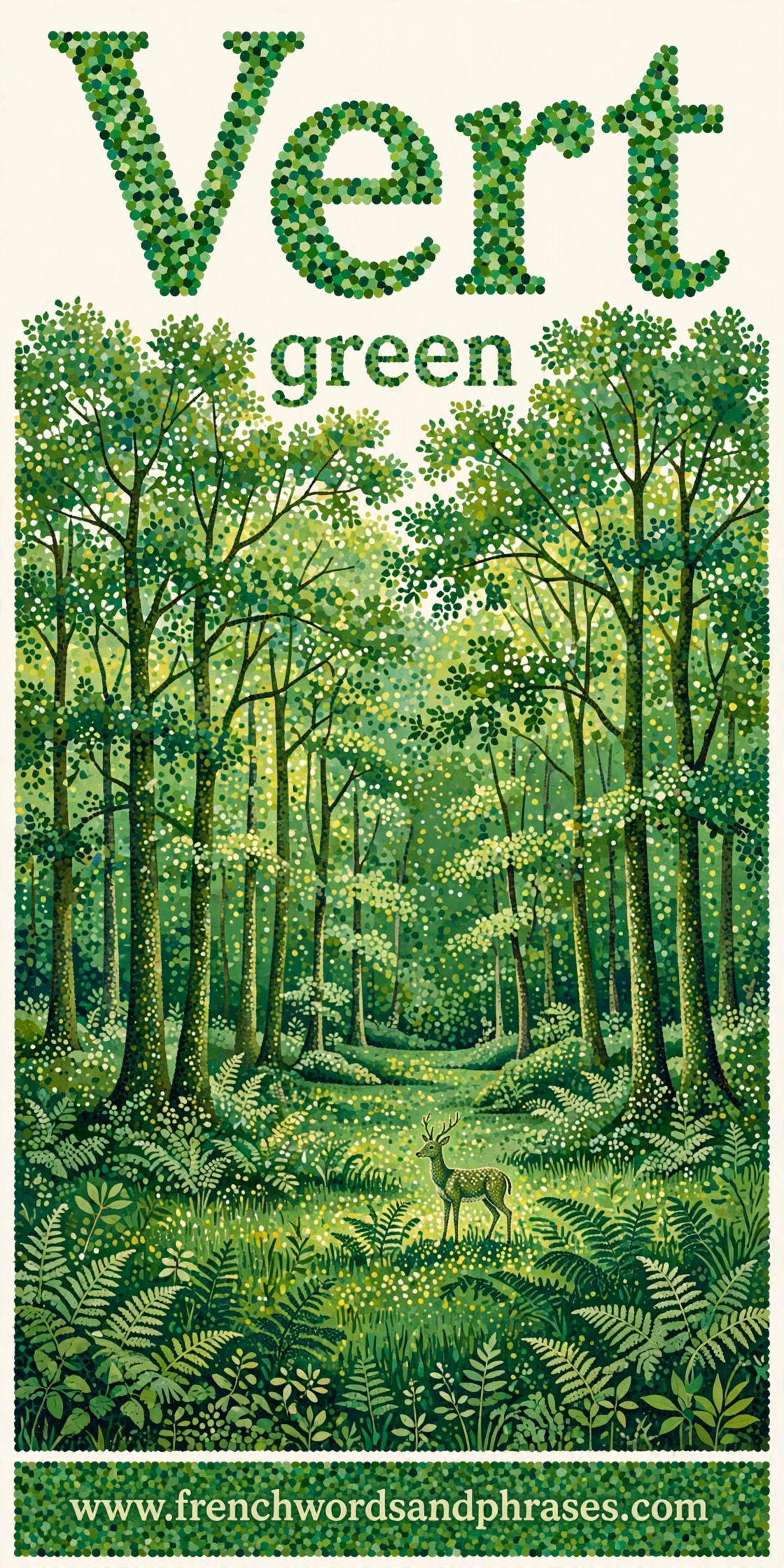
From the hill above the town, the whole valley is a patchwork: chestnut woods on the slopes, gardens behind every house, a park running like a green river between the streets. After the grey of winter, the town has put its colour back on. French calls this colour — and a town full of it — vert.
In this guide, you’ll learn what vert means in English, why its feminine verte doubles the t, where colour words stand in the sentence, and how a vert town is a leafy one. Explore French examples, English translations, and practice quizzes.
Understanding the French Adjective Vert
Vert is a French adjective of quality — the colour adjective, and the word for a leafy, planted place. Its feminine is irregular: verte, with a double t. The four forms are vert, verte, verts, vertes. Une ville verte is both green in colour and green in spirit.
It means green — the colour of leaves, grass and parks. It describes districts (un quartier vert, a leafy neighbourhood), spaces (les espaces verts, green spaces), fruit that is not ripe yet, and a town’s whole character: une ville verte is a town full of trees and gardens.
Type: Adjective of quality — colour, and leafiness
Answers the question: What is the place like? — green
Changes form: Yes — vert, verte, verts, vertes (the feminine doubles the t)
English equivalents: Green; leafy; unripe (of fruit).
One important usage detail: vert, like all colour adjectives, stands AFTER the noun — un parc vert, une ville verte. For a town, vert almost always means leafy and planted: un quartier vert is a district of trees and gardens, not a district painted green.
Experience the Word
Vert is the adjective of the town seen from above in June — tree-lined avenues, a park at every corner, gardens spilling over walls, and not a street without its line of shade.
Imagine a mayor who plants a tree for every child born in the town. Twenty years later the avenues are vaults of green, the squares are cool in August, and visitors say the town’s name the way you say the name of a garden.
You have not just named a colour. You have described a town that breathes.
How to Use Vert in French: Complete Guide
Let’s explore how vert works in French, beginning with the whole word on one card.
Vert at a Glance
Before the details, here is the whole word on one card.
The Whole Word on One Card
Meaning, type, position and forms — vert in four lines.
| Point | Vert |
|---|---|
| Meaning | green |
| Type | adjective of quality — colour and leafiness |
| Usual position | after the noun — une ville verte |
| Form | vert / verte / verts / vertes |
Example
C’est une ville verte.
It’s a green, leafy town.
The Four Forms of Vert
Vert agrees with the noun it describes — and its feminine is one of the famous irregular ones: verte, with a double t and a clear, open sound.
| Form | Vert | Example |
|---|---|---|
| Masculine singular | vert | un parc vert — a green park |
| Feminine singular | verte | une ville verte — a green town |
| Masculine plural | verts | des quartiers verts — leafy districts |
| Feminine plural | vertes | des collines vertes — green hills |
Example
Le parc est vert et les collines sont vertes.
The park is green and the hills are green.
Quick Quiz 1
Which form of vert goes with ville (feminine)?
Reveal the answer
verte
Une ville verte.
A green, leafy town.
Verte: The Feminine Doubles the T
The feminine of vert does not just add an e — it doubles the t: verte. The sound changes too, from /vɛʁ/ to a bright /vɛʁt/ with the t clearly sounded.
| Situation | Example |
|---|---|
| The rule | double the t and add -e — vert → verte |
| The sound | the t is silent in vert, sounded in verte |
| Masculine plural | verts — des espaces verts |
| Feminine plural | vertes — des vallées vertes |
Example
La vallée est verte au printemps.
The valley is green in spring.
Where Vert Goes: After the Noun
Colour adjectives follow the noun in French, and vert is no exception — it trails behind parks, towns and hills, with adverbs sliding in front of it.
| Pattern | Example |
|---|---|
| After the noun | une ville verte — a green town |
| After être | ce parc est vert — this park is green |
| With an adverb | un quartier très vert — a very leafy district |
| Before the noun | une verte ville — not in everyday French |
Example
Notre quartier est très vert, plein de jardins.
Our district is very green, full of gardens.
Quick Quiz 2
Where does vert stand — before or after the noun?
Reveal the answer
After
Un parc vert, une ville verte.
A green park, a green town.
More Green: Comparing with Vert
Vert compares the regular way, with plus, moins and aussi — and the superlative agrees as usual: le plus vert, la plus verte.
| Degree | Example |
|---|---|
| As green as | aussi vert que — as green as |
| More green | plus vert — greener, leafier |
| Less green | moins vert — less green |
| The most green (masc.) | le plus vert — le plus vert des quartiers |
| The most green (fem.) | la plus verte — la plus verte des villes |
Example
Cette ville est plus verte que la capitale.
This town is greener than the capital.
Everyday Expressions with Vert
Vert runs from the park bench to the town hall: it colours the map of every French town and half its politics.
| Expression | In English |
|---|---|
| les espaces verts | green spaces — parks and planted areas |
| un quartier vert | a leafy neighbourhood |
| se mettre au vert | to go to the countryside to rest — literally, to put yourself in the green |
| un fruit vert | an unripe fruit |
| la ceinture verte | the green belt around a city |
| donner le feu vert | to give the green light |
Example
Après le travail, ils se mettent au vert à la campagne.
After work, they head off to rest in the countryside.
Quick Quiz 3
What does se mettre au vert mean?
Reveal the answer
To rest in the countryside
Se mettre au vert is to escape to the green for a break.
To take a break in the country.
Vert and Its Neighbours
Vert shares the landscape with verdoyant and boisé; at the other end, bétonné and pollué describe the town that paved its gardens over.
| French | In English |
|---|---|
| verdoyant | verdant, lush green — the literary neighbour |
| boisé | wooded, tree-covered |
| fleuri | flowery, full of flowers |
| feuillu | leafy — of a tree in full leaf |
| bétonné | concreted over — the sad opposite |
| pollué | polluted — green’s other enemy |
Example
Le quartier est boisé et fleuri, jamais bétonné.
The district is wooded and flowery, never concreted over.
Watch Out: The Traps Around Vert
The traps here are a doubled t that learners forget, and a noun hiding inside the colour.
| Trap | The truth |
|---|---|
| The feminine | verte doubles the t — une ville verte, never ‘vertte’ or plain ‘verte’ without the double t |
| le vert | le vert is also a noun: the colour green itself — j’aime le vert |
| Not painted | un quartier vert is leafy, not painted green — the green is trees and gardens |
| Unripe fruit | un fruit vert is unripe, whatever its colour — une banane verte |
Example
J’aime le vert de cette vallée verte.
I love the green of this green valley.
Quick Quiz 4
How do you say ‘a leafy neighbourhood’?
Reveal the answer
un quartier vert
Vert follows the noun and agrees with it.
A leafy neighbourhood.
Vert in Everyday French: Real-Life Examples
Now that you know the word, let’s see how vert appears in everyday French.
Example 1 — A town
C’est une ville verte, avec des parcs partout.
It’s a green town, with parks everywhere.
Example 2 — A district
Notre quartier est vert et tranquille.
Our district is green and quiet.
Example 3 — Green spaces
La ville crée de nouveaux espaces verts.
The town is creating new green spaces.
Example 4 — The hills
Les collines sont vertes après la pluie.
The hills are green after the rain.
Example 5 — A weekend
Ce week-end, on se met au vert.
This weekend, we’re heading to the countryside to rest.
Example 6 — A contrast
Le centre est bétonné, mais la banlieue est verte.
The centre is concreted over, but the suburbs are green.
Beyond Translation: The Meaning of Vert
English says green for the meaning of vert — but for a French town, vert is less a colour than a promise: trees in the streets, parks in the plan, gardens behind the walls. A ville verte is a town that has decided to keep breathing.
In French, vert is the colour of a place that still has room for life.
That is why tired city-dwellers se mettent au vert — they put themselves into the green — and why the town’s espaces verts are counted and protected like treasures.
How to Remember the French Adjective Vert
Remember it this way: Vert is the breathing adjective — a feminine verte with a doubled t, its place behind the noun, and for a town it means leafy, not painted.
- You double the t in the feminine — une ville verte.
- You think trees, not paint — un quartier vert is a leafy district.
- You escape into it — se mettre au vert, to rest in the countryside.
The key idea is vert means green and leafy, its feminine verte doubles the t, and it stands after the noun.
Test Your Knowledge of Vert
Let’s see how much you’ve learned. Try answering these questions before revealing the answers.
Question 1
What does vert mean?
Reveal the answer
Green — and for a town, leafy and full of trees.
Question 2
What is the feminine of vert?
Reveal the answer
verte — the t doubles: une ville verte.
Question 3
Translate: green spaces.
Reveal the answer
Les espaces verts.
Question 4
Complete the sentence:
Les collines sont ______ au printemps.
Reveal the answer
vertes
Les collines sont vertes au printemps.
The hills are green in spring.
Question 5
What does un quartier vert describe?
Reveal the answer
A leafy neighbourhood — full of trees and gardens, not painted green.
Your Final Challenge
Can You Use It?
How would you say this in French?
“It’s a green town: every street has trees and gardens.”
Reveal the answer
C’est une ville verte : chaque rue a des arbres et des jardins.
It’s a green town: every street has trees and gardens.
A little French. A little curiosity. A richer everyday life.
LEARN FRENCH ONE WORD AT A TIME