A French Word to Live By
Translate Moderne to English
/mɔdɛʁn/
Moderne means modern.
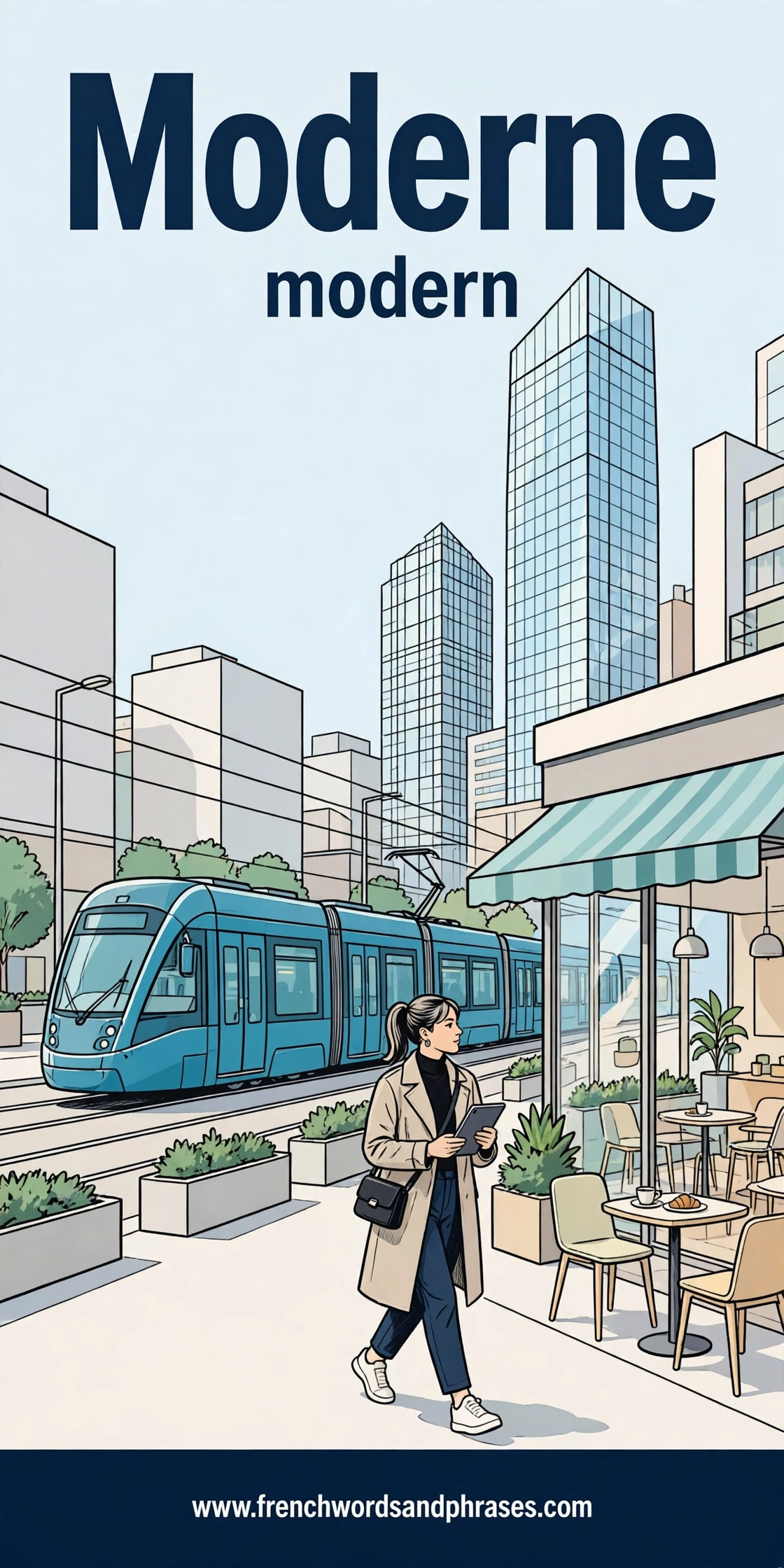
A new district rising at the edge of the old town: glass towers beside a tram line, a library of light and wood, cafés where everyone works on a laptop. Cross one bridge and you are in the Middle Ages; cross back and you are in tomorrow. French calls the new side moderne.
In this guide, you’ll learn what moderne means in English, why it never changes between masculine and feminine, where it stands in the sentence, and how it faces its great opposite, ancien. Explore French examples, English translations, and practice quizzes.
Understanding the French Adjective Moderne
Moderne is a French adjective of quality — the adjective of the new and the now. It already ends in -e, so masculine and feminine are identical: only the plural adds an s. Un quartier moderne, une ville moderne — one form does almost all the work.
It means modern — built, designed or thought in the style of today. It describes districts (un quartier moderne, a modern district), buildings, stations and whole towns that have rebuilt themselves. It is the natural opposite of ancien, and French towns often wear both at once.
Type: Adjective of quality — newness and design
Answers the question: What is the place like? — modern
Changes form: Only in the plural — moderne / modernes, the same for masculine and feminine
English equivalents: Modern; up-to-date; contemporary.
One important usage detail: moderne stands AFTER the noun — un quartier moderne, une gare moderne. Watch the false friend in reverse: English speakers sometimes want moderne to mean fashionable, but French for that is plutôt à la mode — moderne is about the era, not the trend.
Experience the Word
Moderne is the adjective of the new station on the first morning — white lines, glass, silence, and trains that glide instead of clatter, while the old town watches from across the river.
Imagine a town that rebuilt its centre after the war with straight avenues and bright façades, then spent fifty years learning to love them. Today the schoolchildren draw the towers on their notebooks: what was shocking is now simply home.
You have not just described something new. You have described a place turned towards its future.
How to Use Moderne in French: Complete Guide
Let’s explore how moderne works in French, beginning with the whole word on one card.
Moderne at a Glance
Before the details, here is the whole word on one card.
The Whole Word on One Card
Meaning, type, position and forms — moderne in four lines.
| Point | Moderne |
|---|---|
| Meaning | modern |
| Type | adjective of quality — newness and design |
| Usual position | after the noun — un quartier moderne |
| Form | moderne for everyone — modernes in the plural |
Example
C’est un quartier moderne.
It’s a modern district.
The Four Forms of Moderne
Here is one of the easiest agreements in French: moderne already ends in -e, so the feminine changes nothing. Only the plural adds an s.
| Form | Moderne | Example |
|---|---|---|
| Masculine singular | moderne | un bâtiment moderne — a modern building |
| Feminine singular | moderne | une gare moderne — a modern station |
| Masculine plural | modernes | des bâtiments modernes — modern buildings |
| Feminine plural | modernes | des villes modernes — modern cities |
Example
Un bâtiment moderne et des villes modernes.
A modern building and modern cities.
Quick Quiz 1
Does moderne change for a feminine noun?
Reveal the answer
No
Un quartier moderne, une ville moderne — the form is identical.
A modern district, a modern city.
The Feminine of Moderne: Nothing Changes
Most adjectives build their feminine by adding an e. Moderne was born with one, so the feminine has nothing to add — a small holiday for learners.
| Situation | Example |
|---|---|
| Masculine | un centre moderne — a modern centre |
| Feminine | une ville moderne — identical |
| Why | moderne already ends in -e, so the feminine adds nothing |
| The plural | add s — des gares modernes, modern stations |
Example
Elle habite une ville moderne et dynamique.
She lives in a modern, dynamic city.
Where Moderne Goes: After the Noun
Moderne follows the noun it describes, like most French adjectives, and it sits comfortably after être. Adverbs slide in front of it without moving it.
| Pattern | Example |
|---|---|
| After the noun | un quartier moderne — a modern district |
| After être | cette gare est moderne — this station is modern |
| With an adverb | un centre très moderne — a very modern centre |
| Before the noun | un moderne quartier — not in everyday French |
Example
La nouvelle gare est moderne et lumineuse.
The new station is modern and bright.
Quick Quiz 2
How do you say ‘a modern district’ — un moderne quartier or un quartier moderne?
Reveal the answer
un quartier moderne
Moderne stands after the noun.
A modern district.
More Modern: Comparing with Moderne
Moderne compares the regular way, with plus, moins and aussi — and the superlative keeps the same single form: le plus moderne, la plus moderne.
| Degree | Example |
|---|---|
| As modern as | aussi moderne que — as modern as |
| More modern | plus moderne — more modern |
| Less modern | moins moderne — less modern |
| The most modern (masc.) | le plus moderne — le plus moderne des quartiers |
| The most modern (fem.) | la plus moderne — la plus moderne des villes |
Example
Ce quartier est plus moderne que le centre historique.
This district is more modern than the historic centre.
Everyday Expressions with Moderne
Moderne is the word of inaugurations and new tram lines — the adjective French towns use when they unveil their future.
| Expression | In English |
|---|---|
| un quartier moderne | a modern district |
| une ville moderne | a modern city |
| l’art moderne | modern art |
| les temps modernes | modern times |
| un équipement moderne | modern facilities, up-to-date equipment |
| tout moderne | brand new and fully modern — a selling point in adverts |
Example
L’appartement est tout moderne, près de la gare.
The flat is fully modern, near the station.
Quick Quiz 3
What does les temps modernes mean?
Reveal the answer
Modern times
Les temps modernes is the name of our own era.
Modern times.
Moderne and Its Neighbours
Moderne shares its newness with nouveau and récent; across the river stand ancien and historique, and French towns are proud of both banks.
| French | In English |
|---|---|
| nouveau | new — the thing itself is new |
| récent | recent — built or done not long ago |
| contemporain | contemporary — of our time, in art and architecture |
| à la mode | fashionable — about trends, not eras |
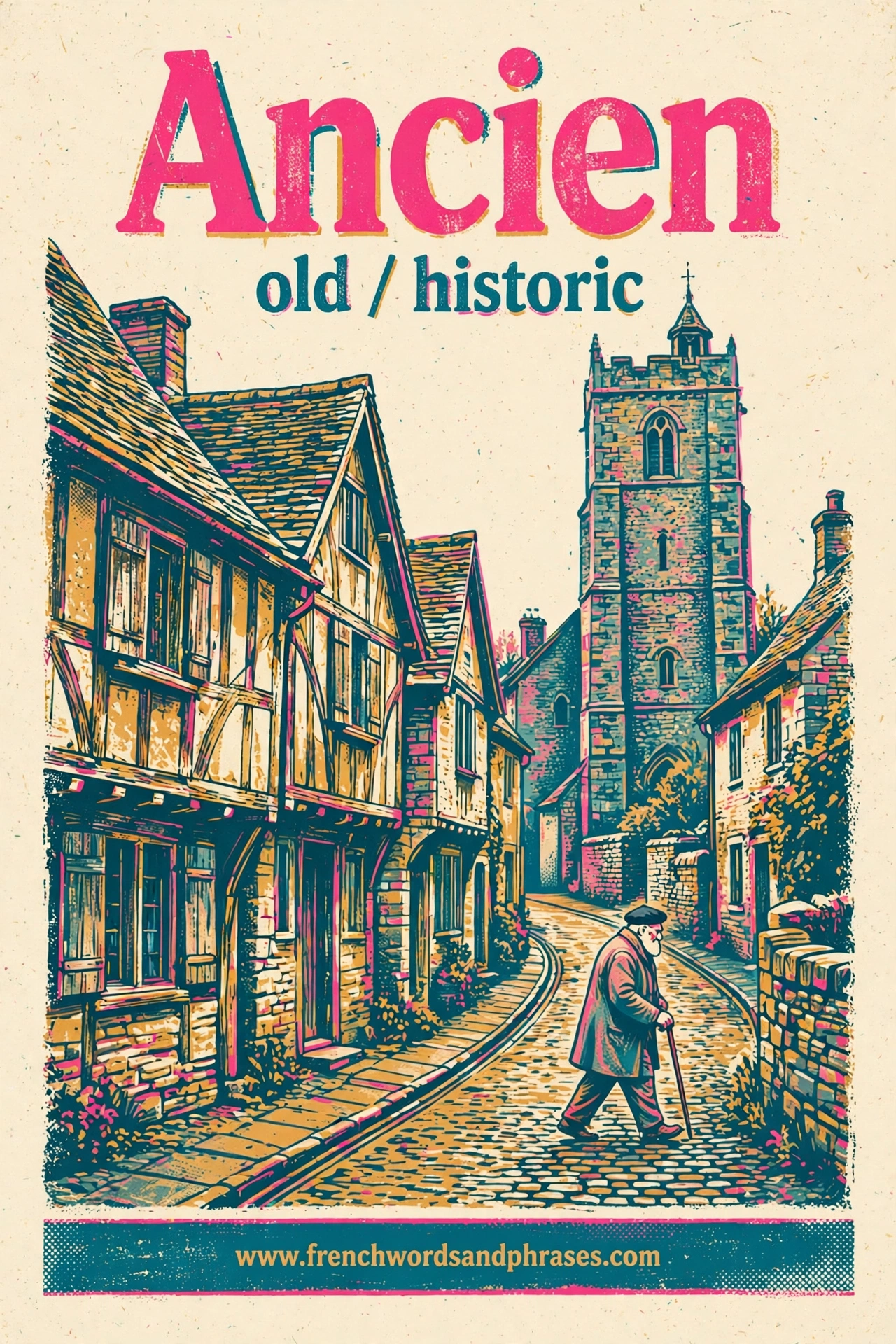
| ancien | old, historic — the great opposite |
| vieux | old — the plain, sometimes unkind opposite |
Example
La ville a un centre ancien et des quartiers modernes.
The town has an old centre and modern districts.
Watch Out: The Traps Around Moderne
The traps here are a false friend about fashion, and a spelling that English speakers love to shorten.
| Trap | The truth |
|---|---|
| Not fashionable | moderne means of our era; fashionable is à la mode |
| Spelling | moderne keeps its final -e for everyone — never ‘modern’ in French |
| nouveau is different | un nouveau quartier is a district that did not exist before; un quartier moderne is modern in style |
| Agreement | do not add a second e — une ville moderne, never ‘modernée’ |
Example
Ce quartier moderne n’est pas nouveau : il date des années soixante.
This modern district isn’t new: it dates from the sixties.
Quick Quiz 4
How do you say ‘a modern city’?
Reveal the answer
une ville moderne
Moderne follows the noun and does not change.
A modern city.
Moderne in Everyday French: Real-Life Examples
Now that you know the word, let’s see how moderne appears in everyday French.
Example 1 — A district
Nous visitons un quartier moderne, près du port.
We’re visiting a modern district, near the port.
Example 2 — A station
La gare est moderne, avec de grands écrans.
The station is modern, with big screens.
Example 3 — A city
C’est une ville moderne, bien organisée.
It’s a modern city, well organised.
Example 4 — Buildings
Les bâtiments modernes entourent la place.
Modern buildings surround the square.
Example 5 — A flat
Je cherche un appartement moderne et lumineux.
I’m looking for a modern, bright flat.
Example 6 — A contrast
Le centre est ancien, mais les faubourgs sont modernes.
The centre is old, but the suburbs are modern.
Beyond Translation: The Meaning of Moderne
English says modern for the meaning of moderne — the same Latin root, modo, meaning ‘just now’. A moderne town is a town of just now: glass, light, straight lines and new materials, set down beside the stones of its past.
Moderne is the adjective of a town looking forward.
And French holds the balance beautifully: the same traveller photographs the moderne station in the morning and the ancien centre in the afternoon, and loves the town for having both.
How to Remember the French Adjective Moderne
Remember it this way: Moderne is the just-now adjective — one form for him and her, an s for the plural, its place behind the noun, and ancien waiting across the river.
- You see one form for everyone — un quartier moderne, une ville moderne.
- You add only an s in the plural — des villes modernes.
- You keep it for eras, not trends — fashionable is à la mode, not moderne.
The key idea is moderne never changes except in the plural, stands after the noun, and is the opposite of ancien.
Test Your Knowledge of Moderne
Let’s see how much you’ve learned. Try answering these questions before revealing the answers.
Question 1
What does moderne mean?
Reveal the answer
Modern — of our era, built or designed today.
Question 2
What is the feminine of moderne?
Reveal the answer
moderne — identical. The word already ends in -e.
Question 3
Translate: a modern district.
Reveal the answer
Un quartier moderne.
Question 4
Complete the sentence:
Les bâtiments ______ entourent la place.
Reveal the answer
modernes
Les bâtiments modernes entourent la place.
Modern buildings surround the square.
Question 5
What is the great opposite of moderne?
Reveal the answer
ancien — old, historic. French towns often have both.
Your Final Challenge
Can You Use It?
How would you say this in French?
“The town has an old centre and a modern district near the station.”
Reveal the answer
La ville a un centre ancien et un quartier moderne près de la gare.
The town has an old centre and a modern district near the station.
A little French. A little curiosity. A richer everyday life.
LEARN FRENCH ONE WORD AT A TIME