A French Word to Live By
Translate Japonais to English
/ʒa.pɔ.nɛ/
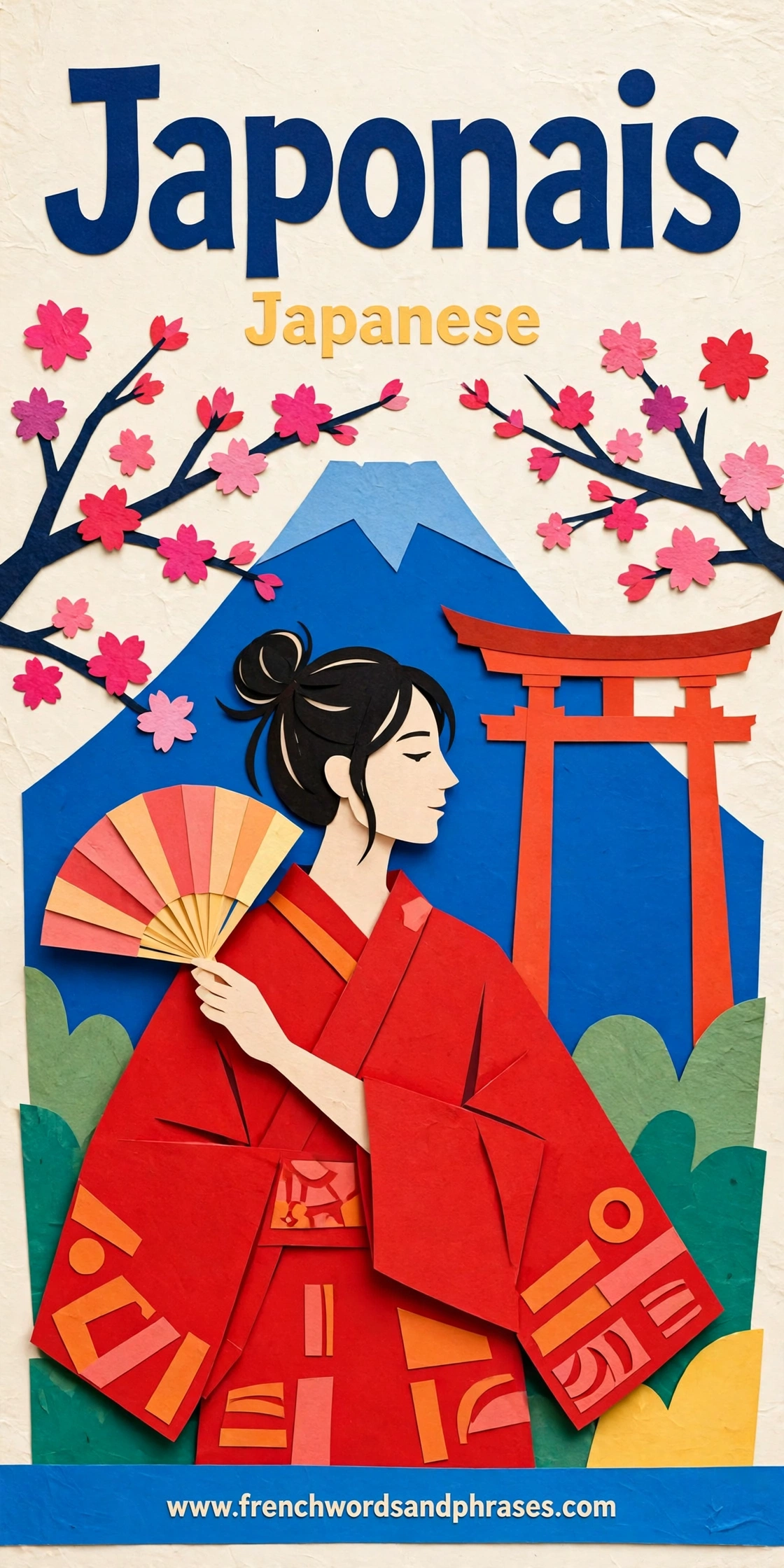
Japonais means Japanese.
A quiet garden at dawn, raked gravel curving around three dark stones, a maple turning red over still water. Nothing is loud here, nothing is wasted; every object has earned its place. The French word for this art of serene precision, and for the country that created it, is japonais.
In this guide, you’ll learn what japonais means in English, how its feminine is formed on the -ais pattern, why the language and the person are written differently, and what a jardin japonais promises a visitor. Explore French examples, English translations, and practice quizzes.
Understanding the French Adjective Japonais
Japonais is a French adjective of nationality — the adjective of Japan. It has two distinct forms: masculine japonais and feminine japonaise, on the same -ais / -aise pattern as français and chinois. As an adjective it stays lower-case: un jardin japonais, une estampe japonaise.
It means Japanese — of or from Japan. It describes people (un architecte japonais, a Japanese architect; une pianiste japonaise, a Japanese pianist), food (la cuisine japonaise), arts (un manga japonais, une cérémonie japonaise) and the language: le japonais, the Japanese language, written with its three scripts.
Type: Adjective of nationality — Japan
Answers the question: From where? — Japanese, of Japan
Feminine: japonaise — the -ais ending becomes -aise
Changes form: Yes — japonais / japonaise / japonaises; the masculine plural is also japonais
English equivalents: Japanese.
One important usage detail: for a PERSON, japonais becomes a noun with a capital letter — un Japonais, une Japonaise. The adjective stays lower-case (un roman japonais), and so does the language: le japonais, with a small j — il étudie le japonais, he is studying Japanese.
Experience the Word
Japonais is the adjective of the tea ceremony and the bullet train — of an island country that holds the most ancient rituals and the newest machines in the same calm hand.
Imagine a French baker in Kyoto at five in the morning, learning to fold a croissant dough beside a master who has made the same gesture for fifty years. Neither speaks much. The work itself is the conversation, and it is, on both sides, perfectly japonais in its patience.
You have not just named an island nation. You have evoked an art of doing everything completely, and quietly.
How to Use Japonais in French: Complete Guide
Let’s explore how japonais works in French, beginning with the whole word on one card.
Japonais at a Glance
Before the details, here is the whole word on one card.
The Whole Word on One Card
Meaning, type, position and forms — japonais in four lines.
| Point | Japonais |
|---|---|
| Meaning | Japanese |
| Type | adjective of nationality — Japan |
| Usual position | after the noun — un jardin japonais |
| Form | japonais / japonaise / japonais / japonaises |
Example
C’est un jardin japonais magnifique.
It’s a magnificent Japanese garden.
The Four Forms of Japonais
Japonais agrees with the noun it describes. The masculine already ends in -s, so its plural changes nothing; the feminine trades -ais for -aise and adds an s in the plural.
| Form | Japonais | Example |
|---|---|---|
| Masculine singular | japonais | un architecte japonais — a Japanese architect |
| Feminine singular | japonaise | une pianiste japonaise — a Japanese pianist |
| Masculine plural | japonais | des mangas japonais — Japanese comics |
| Feminine plural | japonaises | des estampes japonaises — Japanese prints |
Example
J’adore les mangas japonais et les estampes japonaises anciennes.
I love Japanese comics and old Japanese prints.
Quick Quiz 1
Which form of japonais goes with cuisine (feminine)?
Reveal the answer
japonaise
La cuisine japonaise est légère et précise.
Japanese cooking is light and precise.
Japonaise: The Feminine in -aise
Nationality adjectives in -ais build their feminine in -aise: japonais becomes japonaise, and the final sound, silent in the masculine, is heard at last.
| Situation | Example |
|---|---|
| The rule | -ais becomes -aise — japonais → japonaise |
| The sound | the feminine ends in a clear /z/: /ʒa.pɔ.nɛz/ |
| Masculine plural | japonais — unchanged, the s is already there |
| Feminine plural | japonaises — des traditions japonaises |
Example
Cette tradition japonaise existe depuis des siècles.
This Japanese tradition has existed for centuries.
Where Japonais Goes: After the Noun
Japonais follows the noun, like every nationality adjective — and it also names the language with le, and the people with a capital letter.
| Pattern | Example |
|---|---|
| After the noun | un roman japonais — a Japanese novel |
| After être | elle est japonaise — she is Japanese |
| The language (noun) | le japonais — il parle japonais, he speaks Japanese |
| As a noun (person) | un Japonais, une Japonaise — with a capital letter |
Example
Il est japonais et il parle japonais à la maison.
He is Japanese and he speaks Japanese at home.
Quick Quiz 2
How do you write ‘a Japanese woman’ as a noun — une japonaise or une Japonaise?
Reveal the answer
une Japonaise
For a person, the word is a noun and takes a capital letter.
A Japanese woman.
More Japanese: Comparing with Japonais
Japonais compares the regular way, with plus, moins and aussi — useful for gardens, films and dishes that carry more or less of Japan in them.
| Degree | Example |
|---|---|
| As Japanese as | aussi japonais que — as Japanese as |
| More Japanese | plus japonais — more Japanese |
| Less Japanese | moins japonais — less Japanese |
| The most Japanese (masc.) | le plus japonais — le plus japonais des jardins |
| The most Japanese (fem.) | la plus japonaise — la plus japonaise des cérémonies |
Example
Ce jardin est plus japonais que l’autre, avec ses pierres et son eau calme.
This garden is more Japanese than the other one, with its stones and its calm water.
Everyday Expressions with Japonais
Japonais appears wherever Japan meets French daily life — in the garden, at the sushi bar, and in the bookshop’s manga aisle.
| Expression | In English |
|---|---|
| un jardin japonais | a Japanese garden |
| la cuisine japonaise | Japanese cooking |
| un manga japonais | a Japanese comic |
| le japonais | the Japanese language |
| un Japonais / une Japonaise | a Japanese man / a Japanese woman (nouns, capital letter) |
| une estampe japonaise | a Japanese print, a woodblock print |
Example
Nous mangeons dans un restaurant japonais ce soir.
We’re eating in a Japanese restaurant tonight.
Quick Quiz 3
What is the French for ‘the Japanese language’?
Reveal the answer
le japonais
Languages stay lower-case; only people take the capital.
The Japanese language.
Japonais and Its Neighbours
Japonais belongs to the East Asian family of French nationalities — with chinois, its -ais twin, and coréen, which builds its feminine quite differently.
| French | In English |
|---|---|
| chinois | Chinese — of China, across the sea |
| coréen | Korean — of Korea, Japan’s closest neighbour |
| le Japon | Japan — the country itself (a masculine noun) |
| Tokyo | the capital of Japan |
| un manga | a Japanese comic — a word the whole world borrowed |
| un sushi | the famous Japanese dish of rice and fish |
Example
Le Japon est célèbre pour ses jardins japonais et ses trains rapides.
Japan is famous for its Japanese gardens and its fast trains.
Watch Out: The Traps Around Japonais
The traps here are the capital letter, the unchanging masculine plural, and the country’s own name, which needs its article.
| Trap | The truth |
|---|---|
| The capital letter | adjective lower-case (un film japonais) — person capitalised (un Japonais) |
| Masculine plural | des japonais — never add another s, the word already ends in one |
| The country | le Japon — Japan is masculine and takes le |
| The language | le japonais, lower-case — elle apprend le japonais |
Example
Une Japonaise de Tokyo m’apprend le japonais le samedi.
A Japanese woman from Tokyo teaches me Japanese on Saturdays.
Quick Quiz 4
How do you say ‘Japanese gardens’?
Reveal the answer
des jardins japonais
Masculine plural: japonais does not change.
Japanese gardens.
Japonais in Everyday French: Real-Life Examples
Now that you know the word, let’s see how japonais appears in everyday French.
Example 1 — In the garden
Ce jardin japonais est calme et magnifique.
This Japanese garden is calm and magnificent.
Example 2 — At the restaurant
La cuisine japonaise est légère et délicieuse.
Japanese cooking is light and delicious.
Example 3 — A teacher
Notre professeur japonais vient d’Osaka.
Our Japanese teacher comes from Osaka.
Example 4 — The language
Elle étudie le japonais à l’université.
She studies Japanese at university.
Example 5 — Reading
Les enfants adorent les mangas japonais.
Children love Japanese comics.
Example 6 — Art
Cette estampe japonaise date du dix-neuvième siècle.
This Japanese print dates from the nineteenth century.
Beyond Translation: The Meaning of Japonais
English says Japanese for the meaning of japonais — and the two languages borrowed from Japan in opposite directions: English took the words (sushi, manga, tsunami) while French took the taste, filling its gardens, kitchens and bookshops with things japonais.
In French, japonais is less a label of origin than a promise of precision.
A jardin japonais promises calm; a couteau japonais promises a perfect edge. The adjective itself has become a compliment — and it still obeys the humble -ais / -aise rule it shares with français and chinois.
How to Remember the French Adjective Japonais
Remember it this way: Japonais is the adjective of Japan — the masculine hides its s, the feminine sounds it, and the person takes a capital while the language does not.
- You change -ais into -aise for the feminine — japonais becomes japonaise.
- You give the person a capital — un Japonais, une Japonaise — but the language stays small: le japonais.
- You name the country with its article — le Japon, masculine, never just ‘Japon’ after a preposition like au: au Japon.
The key idea is japonais becomes japonaise, the person is un Japonais with a capital, and le japonais is the language.
Test Your Knowledge of Japonais
Let’s see how much you’ve learned. Try answering these questions before revealing the answers.
Question 1
What does japonais mean?
Reveal the answer
Japanese — of or from Japan.
Question 2
What is the feminine of japonais?
Reveal the answer
japonaise — the -ais ending becomes -aise.
Question 3
Translate: a Japanese garden.
Reveal the answer
Un jardin japonais.
Question 4
Complete the sentence:
La cuisine ______ est célèbre dans le monde entier.
Reveal the answer
japonaise
La cuisine japonaise est célèbre dans le monde entier.
Japanese cooking is famous all over the world.
Question 5
How do you say ‘a Japanese man’ as a noun?
Reveal the answer
Un Japonais — with a capital letter, because it names a person.
Your Final Challenge
Can You Use It?
How would you say this in French?
“Our Japanese teacher shows us a magnificent Japanese garden in Kyoto.”
Reveal the answer
Notre professeur japonais nous montre un magnifique jardin japonais à Kyoto.
Our Japanese teacher shows us a magnificent Japanese garden in Kyoto.
A little French. A little curiosity. A richer everyday life.
LEARN FRENCH ONE WORD AT A TIME