A French Word to Live By
Translate Tunisien to English
/tynizjɛ̃/
Tunisien means Tunisian.
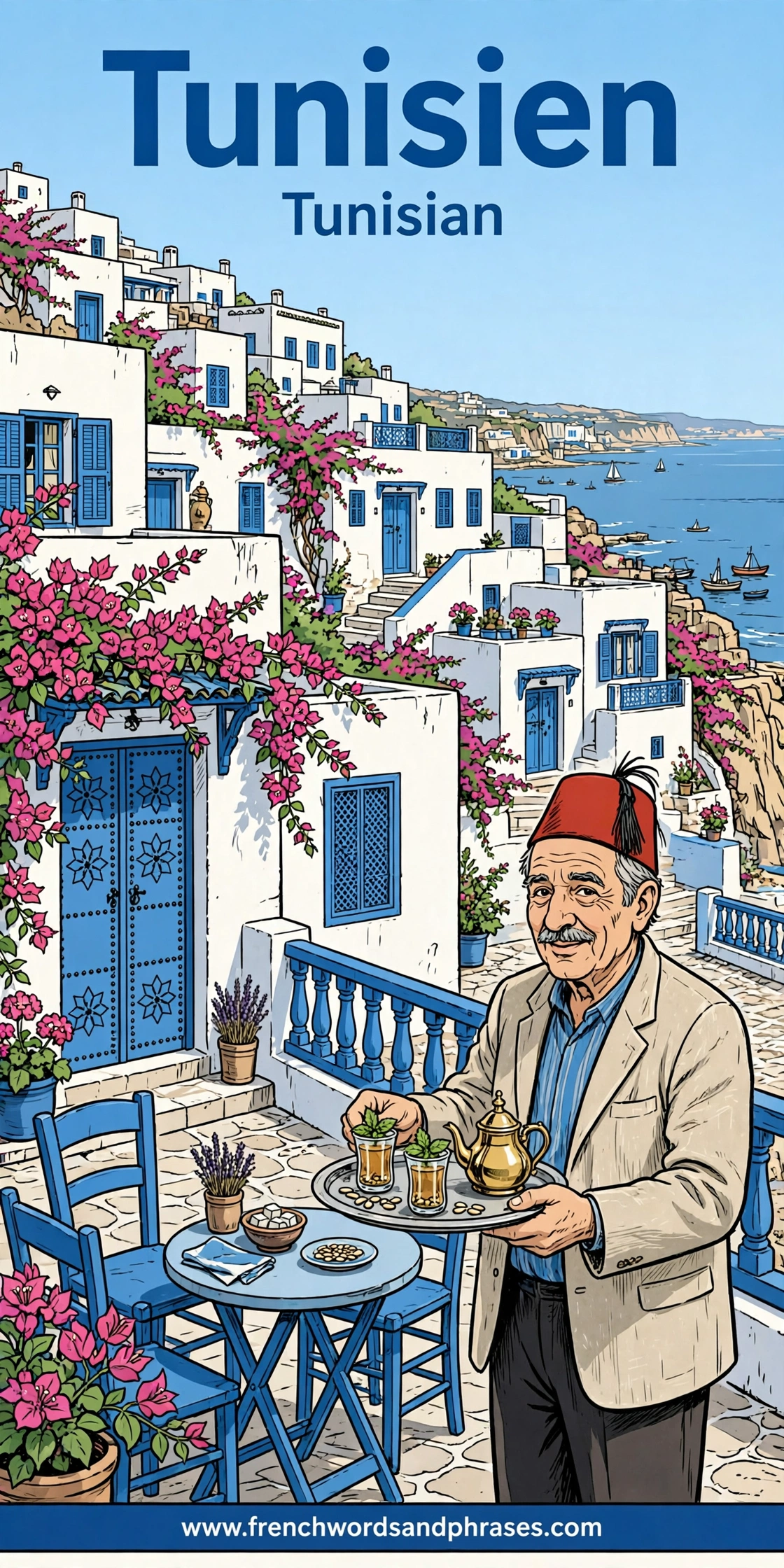
A whitewashed lane in Sidi Bou Saïd: every door and shutter is painted the same impossible blue, jasmine spills over the walls, and below the hill the Mediterranean does its best to match the doors. Small, bright and perfumed — French calls it tunisien.
In this guide, you’ll learn what tunisien means in English, how its feminine doubles the n, where it stands in the sentence, and why a Tunisian takes a capital letter while his olive oil does not. Explore French examples, English translations, and practice quizzes.
Understanding the French Adjective Tunisien
Tunisien is a French nationality adjective — the adjective of Tunisia. Masculine: tunisien; feminine: tunisienne, with a double n. It agrees with the noun it describes: un village tunisien, une plage tunisienne, des portes tunisiennes.
It means Tunisian — from Tunisia, or in the Tunisian way. It describes people (un artisan tunisien, a Tunisian craftsman), produce (l’huile d’olive tunisienne, Tunisian olive oil) and places (une plage tunisienne, a Tunisian beach). The country itself is la Tunisie, and the people are les Tunisiens.
Type: Nationality adjective — Tunisia
Answers the question: Where is it from? — Tunisian
Masculine: tunisien
Feminine: tunisienne
Changes form: Yes — tunisien, tunisienne, tunisiens, tunisiennes
English equivalents: Tunisian.
One important usage detail: the adjective stays lower-case — une plage tunisienne — but the people take a capital letter: un Tunisien, une Tunisienne, a Tunisian man, a Tunisian woman. Watch the feminine: adjectives in -ien double the n before the final e — tunisien, tunisienne.
Experience the Word
Tunisien is the adjective of the smallest country in the Maghreb — of blue doors and white villages, of jasmine worn behind the ear, of Roman ruins standing in olive groves.
Imagine an evening in Tunis: the medina’s stalls closing one by one, families strolling the avenue under the lights, and somewhere a café terrace where the mint tea arrives with pine nuts floating on top. A small country with an enormous welcome.
You have not just named a country. You have named the blue of its doors.
How to Use Tunisien in French: Complete Guide
Let’s explore how tunisien works in French, beginning with the whole word on one card.
Tunisien at a Glance
Before the details, here is the whole word on one card.
The Whole Word on One Card
Meaning, type, position and forms — tunisien in four lines.
| Point | Tunisien |
|---|---|
| Meaning | Tunisian |
| Type | nationality adjective — Tunisia (la Tunisie) |
| Usual position | after the noun — un village tunisien |
| Form | tunisien / tunisienne / tunisiens / tunisiennes |
Example
C’est un village tunisien.
It’s a Tunisian village.
The Four Forms of Tunisien
Tunisien agrees with the noun it describes. The feminine doubles the n and ends in -ienne; the plurals add an s.
| Form | Tunisien | Example |
|---|---|---|
| Masculine singular | tunisien | un port tunisien — a Tunisian port |
| Feminine singular | tunisienne | une plage tunisienne — a Tunisian beach |
| Masculine plural | tunisiens | des artisans tunisiens — Tunisian craftsmen |
| Feminine plural | tunisiennes | des portes tunisiennes — Tunisian doors |
Example
Un artisan tunisien peint des portes tunisiennes.
A Tunisian craftsman paints Tunisian doors.
Quick Quiz 1
Which form of tunisien goes with plage (feminine)?
Reveal the answer
tunisienne
Une plage tunisienne.
A Tunisian beach.
Tunisienne: The Feminine Doubles the N
Adjectives in -ien build their feminine in -ienne: the n doubles, the nasal vowel opens, and the n is pronounced. Algérien, canadien and italien follow exactly the same pattern.
| Situation | Example |
|---|---|
| The rule | -ien becomes -ienne — tunisien → tunisienne |
| The spelling | double the n before the final e |
| Masculine plural | tunisiens — des villages tunisiens |
| Feminine plural | tunisiennes — des plages tunisiennes |
Example
Elle nage sur une plage tunisienne magnifique.
She is swimming at a magnificent Tunisian beach.
Where Tunisien Goes: After the Noun
Nationality adjectives follow the noun in French, always — and they stay lower-case, even though English writes Tunisian with a capital T.
| Pattern | Example |
|---|---|
| After the noun | un jasmin tunisien — Tunisian jasmine |
| After être | il est tunisien — he is Tunisian |
| With a capital (people) | un Tunisien — a Tunisian man |
| Before the noun | un tunisien village — not in French |
Example
Ce village tunisien est célèbre pour ses portes bleues.
This Tunisian village is famous for its blue doors.
Quick Quiz 2
Which is correct — une tunisienne or une Tunisienne for a woman from Tunisia?
Reveal the answer
une Tunisienne
The people take a capital letter; the adjective stays small.
Une Tunisienne — a Tunisian woman.
The Noun: Un Tunisien, Une Tunisienne
Used as a noun with a capital letter, tunisien names the people themselves — the inhabitants of la Tunisie, between the Mediterranean and the Sahara.
| Use | Example |
|---|---|
| A man | un Tunisien — a Tunisian man |
| A woman | une Tunisienne — a Tunisian woman |
| The people | les Tunisiens — the Tunisians |
| The country | la Tunisie — Tunisia |
Example
Une Tunisienne nous a fait visiter la médina.
A Tunisian woman showed us around the medina.
Everyday Expressions with Tunisien
Tunisien appears wherever Tunisia shows its colours — blue doors, jasmine, olive oil and the white villages of the coast.
| Expression | In English |
|---|---|
| la cuisine tunisienne | Tunisian cuisine |
| l’huile d’olive tunisienne | Tunisian olive oil |
| une plage tunisienne | a Tunisian beach |
| le jasmin tunisien | Tunisian jasmine — the country’s flower |
| un village tunisien | a Tunisian village |
| les portes tunisiennes | Tunisian doors — famously blue |
Example
L’huile d’olive tunisienne est exportée dans le monde entier.
Tunisian olive oil is exported all over the world.
Quick Quiz 3
What does les Tunisiens mean?
Reveal the answer
The Tunisians
Les Tunisiens aiment le jasmin et la mer.
The Tunisians love jasmine and the sea.
Tunisien and Its Neighbours
Around tunisien stand the other peoples of the Maghreb — and Italy, just across the strait of Sicily to the north.
| French | In English |
|---|---|
| algérien | Algerian — from Algeria, to the west |
| libyen | Libyan — from Libya, to the east |
| marocain | Moroccan — from Morocco |
| italien | Italian — across the sea |
| maltais | Maltese — from Malta, the island neighbour |
| maghrébin | Maghrebi — of the Maghreb as a whole |
Example
Les cuisines tunisienne et algérienne se ressemblent.
Tunisian and Algerian cuisines resemble each other.
Watch Out: The Traps Around Tunisien
The traps here are the doubled n that learners forget, and the capital letter that belongs to people only.
| Trap | The truth |
|---|---|
| The capital | adjective lower-case (un village tunisien), people capitalised (un Tunisien) |
| The double n | the feminine is tunisienne — never ‘tunisiene’ |
| The country | Tunisia is la Tunisie — je vais en Tunisie, I am going to Tunisia |
| City or country? | Tunis is the capital city; la Tunisie is the country |
Example
Elle est tunisienne, elle vient de Tunisie.
She is Tunisian, she comes from Tunisia.
Quick Quiz 4
How do you say ‘a Tunisian beach’?
Reveal the answer
une plage tunisienne
Tunisien follows the noun and agrees with it, doubling the n.
A Tunisian beach.
Tunisien in Everyday French: Real-Life Examples
Now that you know the word, let’s see how tunisien appears in everyday French.
Example 1 — Travel
Nous avons visité un village tunisien aux portes bleues.
We visited a Tunisian village with blue doors.
Example 2 — Food
La cuisine tunisienne est épicée et parfumée.
Tunisian cuisine is spicy and fragrant.
Example 3 — People
Mon ami est tunisien, il vient de Sousse.
My friend is Tunisian, he comes from Sousse.
Example 4 — A woman
C’est une médecin tunisienne très compétente.
She is a very competent Tunisian doctor.
Example 5 — The sea
Les plages tunisiennes attirent les visiteurs en été.
Tunisian beaches attract visitors in summer.
Example 6 — Produce
L’huile d’olive tunisienne est douce et fruitée.
Tunisian olive oil is mild and fruity.
Beyond Translation: The Meaning of Tunisien
English says Tunisian for the meaning of tunisien — but French draws a line English does not: the adjective stays modestly lower-case, while the person rises to a capital, un Tunisien.
In French, it is the people who carry the capital letter, not the description.
And watch the feminine at work: tunisien ends in a nasal hum, but tunisienne doubles its n and rings clear — the signature of every nationality adjective in -ien.
How to Remember the French Adjective Tunisien
Remember it this way: Tunisien is Tunisia’s adjective — tunisienne for the feminine with its double n, a capital letter only for the people, and its place behind the noun.
- You double the n for the feminine — tunisien, tunisienne, like algérien and canadien.
- You capitalise the people, never the adjective — un Tunisien, un village tunisien.
- You keep it after the noun — un port tunisien, une plage tunisienne.
The key idea is tunisien / tunisienne — double the n in the feminine; capital letter for the people (un Tunisien).
Test Your Knowledge of Tunisien
Let’s see how much you’ve learned. Try answering these questions before revealing the answers.
Question 1
What does tunisien mean?
Reveal the answer
Tunisian — from Tunisia.
Question 2
What is the feminine of tunisien?
Reveal the answer
tunisienne — -ien becomes -ienne, with a double n.
Question 3
Translate: a Tunisian village.
Reveal the answer
Un village tunisien.
Question 4
Complete the sentence:
C’est une plage ______ .
Reveal the answer
tunisienne
C’est une plage tunisienne.
It’s a Tunisian beach.
Question 5
How do you write ‘a Tunisian woman’?
Reveal the answer
une Tunisienne — the people take a capital letter.
Your Final Challenge
Can You Use It?
How would you say this in French?
“This Tunisian village is famous for its blue doors.”
Reveal the answer
Ce village tunisien est célèbre pour ses portes bleues.
This Tunisian village is famous for its blue doors.
A little French. A little curiosity. A richer everyday life.
LEARN FRENCH ONE WORD AT A TIME