A French Word to Live By
Translate Marocain to English
/maʁɔkɛ̃/
Marocain means Moroccan.
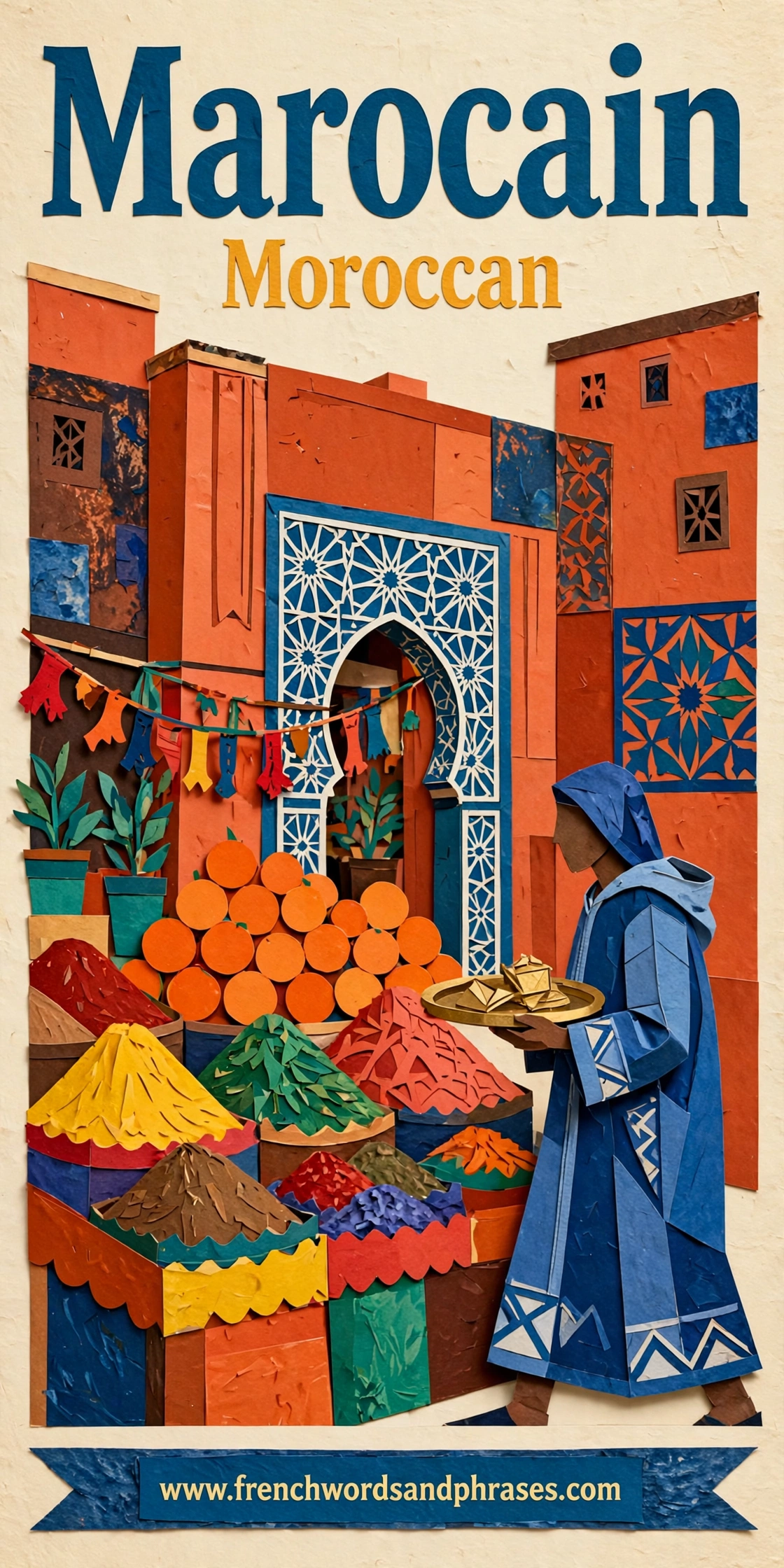
Evening in a Marrakech medina: lanterns of pierced copper glow in a souk alley, mint tea is poured from a great height into small painted glasses, and the air smells of saffron and cedar. Colour, scent and ceremony — French calls it all marocain.
In this guide, you’ll learn what marocain means in English, how its feminine turns the nasal sound into a clear -aine, where it stands in the sentence, and why a Moroccan takes a capital letter while his carpet does not. Explore French examples, English translations, and practice quizzes.
Understanding the French Adjective Marocain
Marocain is a French nationality adjective — the adjective of Morocco. Masculine: marocain; feminine: marocaine. It agrees with the noun it describes: un tapis marocain, une cuisine marocaine, des lanternes marocaines.
It means Moroccan — from Morocco, or in the Moroccan way. It describes people (un commerçant marocain, a Moroccan merchant), food (la cuisine marocaine, Moroccan cuisine) and crafts (un tapis marocain, a Moroccan carpet). The country itself is le Maroc, and the people are les Marocains.
Type: Nationality adjective — Morocco
Answers the question: Where is it from? — Moroccan
Masculine: marocain
Feminine: marocaine
Changes form: Yes — marocain, marocaine, marocains, marocaines
English equivalents: Moroccan.
One important usage detail: the adjective stays lower-case — une cuisine marocaine — but the people take a capital letter: un Marocain, une Marocaine, a Moroccan man, a Moroccan woman. Watch the feminine: marocain ends in a nasal sound, and marocaine wakes it up — the n is heard, /ma.ʁɔ.kɛn/.
Experience the Word
Marocain is the adjective of the souk and the desert gate — of carpets unrolled in the sun, of oranges piled like small suns, of doors painted the blue of a winter sky.
Imagine arriving in Fès at dawn: the call to prayer over the rooftops, donkeys carrying mint and pottery through alleys a thousand years old, and a shopkeeper already pouring your first glass of tea. Hospitality here is not a custom; it is a craft.
You have not just named a country. You have named a feast for every sense at once.
How to Use Marocain in French: Complete Guide
Let’s explore how marocain works in French, beginning with the whole word on one card.
Marocain at a Glance
Before the details, here is the whole word on one card.
The Whole Word on One Card
Meaning, type, position and forms — marocain in four lines.
| Point | Marocain |
|---|---|
| Meaning | Moroccan |
| Type | nationality adjective — Morocco (le Maroc) |
| Usual position | after the noun — un tapis marocain |
| Form | marocain / marocaine / marocains / marocaines |
Example
C’est un tapis marocain.
It’s a Moroccan carpet.
The Four Forms of Marocain
Marocain agrees with the noun it describes. The feminine replaces the nasal ending with a clear -aine, and the plurals add an s.
| Form | Marocain | Example |
|---|---|---|
| Masculine singular | marocain | un souk marocain — a Moroccan souk |
| Feminine singular | marocaine | une médina marocaine — a Moroccan medina |
| Masculine plural | marocains | des tapis marocains — Moroccan carpets |
| Feminine plural | marocaines | des lanternes marocaines — Moroccan lanterns |
Example
Un artisan marocain vend des lanternes marocaines.
A Moroccan craftsman sells Moroccan lanterns.
Quick Quiz 1
Which form of marocain goes with cuisine (feminine)?
Reveal the answer
marocaine
La cuisine marocaine.
Moroccan cuisine.
Marocaine: The Feminine in -aine
Adjectives in -ain build their feminine in -aine: the nasal vowel of marocain opens up and the n steps forward and is pronounced. Américain and mexicain follow exactly the same pattern.
| Situation | Example |
|---|---|
| The rule | -ain becomes -aine — marocain → marocaine |
| The sound | the n is heard: marocaine ends in /ɛn/ |
| Masculine plural | marocains — des artisans marocains |
| Feminine plural | marocaines — des villes marocaines |
Example
Elle prépare un couscous dans une cuisine marocaine.
She is preparing a couscous in a Moroccan kitchen.
Where Marocain Goes: After the Noun
Nationality adjectives follow the noun in French, always — and they stay lower-case, even though English writes Moroccan with a capital M.
| Pattern | Example |
|---|---|
| After the noun | un thé marocain — a Moroccan tea |
| After être | il est marocain — he is Moroccan |
| With a capital (people) | un Marocain — a Moroccan man |
| Before the noun | un marocain tapis — not in French |
Example
Ce restaurant marocain sert un excellent couscous.
This Moroccan restaurant serves an excellent couscous.
Quick Quiz 2
Which is correct — une marocaine or une Marocaine for a woman from Morocco?
Reveal the answer
une Marocaine
The people take a capital letter; the adjective stays small.
Une Marocaine — a Moroccan woman.
The Noun: Un Marocain, Une Marocaine
Used as a noun with a capital letter, marocain names the people themselves — the inhabitants of le Maroc, from Tangier to the gates of the Sahara.
| Use | Example |
|---|---|
| A man | un Marocain — a Moroccan man |
| A woman | une Marocaine — a Moroccan woman |
| The people | les Marocains — the Moroccans |
| The country | le Maroc — Morocco |
Example
Une Marocaine nous a offert du thé à la menthe.
A Moroccan woman offered us mint tea.
Everyday Expressions with Marocain
Marocain appears wherever Morocco exports its crafts and flavours — carpets, lanterns, tea and one of the world’s great cuisines.
| Expression | In English |
|---|---|
| la cuisine marocaine | Moroccan cuisine |
| un tapis marocain | a Moroccan carpet |
| le thé marocain | Moroccan tea — mint tea poured from high up |
| une lanterne marocaine | a Moroccan lantern |
| une médina marocaine | a Moroccan old town |
| les souks marocains | the Moroccan markets |
Example
Nous avons acheté un tapis marocain au souk.
We bought a Moroccan carpet at the souk.
Quick Quiz 3
What does les Marocains mean?
Reveal the answer
The Moroccans
Les Marocains sont fiers de leur cuisine.
The Moroccans are proud of their cuisine.
Marocain and Its Neighbours
Around marocain stand the other peoples of the Maghreb and the far side of the strait — Spain, fourteen kilometres away across the water.
| French | In English |
|---|---|
| algérien | Algerian — from Algeria, to the east |
| tunisien | Tunisian — from Tunisia |
| mauritanien | Mauritanian — from Mauritania, to the south |
| espagnol | Spanish — across the strait |
| sahraoui | Sahrawi — from the Western Sahara |
| maghrébin | Maghrebi — of the Maghreb as a whole |
Example
Les cuisines marocaine, algérienne et tunisienne sont cousines.
Moroccan, Algerian and Tunisian cuisines are cousins.
Watch Out: The Traps Around Marocain
The traps here are the capital letter, and the nasal ending that changes its sound completely in the feminine.
| Trap | The truth |
|---|---|
| The capital | adjective lower-case (un tapis marocain), people capitalised (un Marocain) |
| The feminine sound | marocain is nasal; marocaine is not — the n is pronounced |
| The country | Morocco is le Maroc — je vais au Maroc, I am going to Morocco |
| Maghreb or Morocco? | maghrébin covers the whole region; marocain is Morocco only |
Example
Elle est marocaine, elle vient du Maroc.
She is Moroccan, she comes from Morocco.
Quick Quiz 4
How do you say ‘Moroccan cuisine’?
Reveal the answer
la cuisine marocaine
Marocain follows the noun and agrees with it.
Moroccan cuisine.
Marocain in Everyday French: Real-Life Examples
Now that you know the word, let’s see how marocain appears in everyday French.
Example 1 — Food
La cuisine marocaine est parfumée et généreuse.
Moroccan cuisine is fragrant and generous.
Example 2 — At the market
Nous avons acheté un tapis marocain au souk.
We bought a Moroccan carpet at the souk.
Example 3 — People
Mon collègue est marocain, il vient de Casablanca.
My colleague is Moroccan, he comes from Casablanca.
Example 4 — A woman
C’est une architecte marocaine très respectée.
She is a highly respected Moroccan architect.
Example 5 — Tea
Le thé marocain se verse de très haut.
Moroccan tea is poured from high up.
Example 6 — Travel
Les médinas marocaines sont pleines de couleurs.
Moroccan medinas are full of colour.
Beyond Translation: The Meaning of Marocain
English says Moroccan for the meaning of marocain — but French draws a line English does not: the adjective stays modestly lower-case, while the person rises to a capital, un Marocain.
In French, it is the people who carry the capital letter, not the description.
Listen for the feminine, too: marocain hums through the nose, but marocaine rings clear — one letter added, and the whole end of the word wakes up.
How to Remember the French Adjective Marocain
Remember it this way: Marocain is Morocco’s adjective — marocaine for the feminine with its n awake, a capital letter only for the people, and its place behind the noun.
- You turn -ain into -aine — marocain, marocaine, and the n steps out and is heard.
- You capitalise the people, never the adjective — un Marocain, un tapis marocain.
- You keep it after the noun — un souk marocain, une cuisine marocaine.
The key idea is marocain / marocaine — capital letter for the people (un Marocain), small letter for the adjective.
Test Your Knowledge of Marocain
Let’s see how much you’ve learned. Try answering these questions before revealing the answers.
Question 1
What does marocain mean?
Reveal the answer
Moroccan — from Morocco.
Question 2
What is the feminine of marocain?
Reveal the answer
marocaine — -ain becomes -aine, and the n is pronounced.
Question 3
Translate: a Moroccan carpet.
Reveal the answer
Un tapis marocain.
Question 4
Complete the sentence:
La cuisine ______ est célèbre.
Reveal the answer
marocaine
La cuisine marocaine est célèbre.
Moroccan cuisine is famous.
Question 5
How do you write ‘a Moroccan woman’?
Reveal the answer
une Marocaine — the people take a capital letter.
Your Final Challenge
Can You Use It?
How would you say this in French?
“This Moroccan restaurant serves a wonderful couscous.”
Reveal the answer
Ce restaurant marocain sert un couscous merveilleux.
This Moroccan restaurant serves a wonderful couscous.
A little French. A little curiosity. A richer everyday life.
LEARN FRENCH ONE WORD AT A TIME