A French Word to Live By
How to Conjugate Cheviller in French
/ʃə.vi.je/
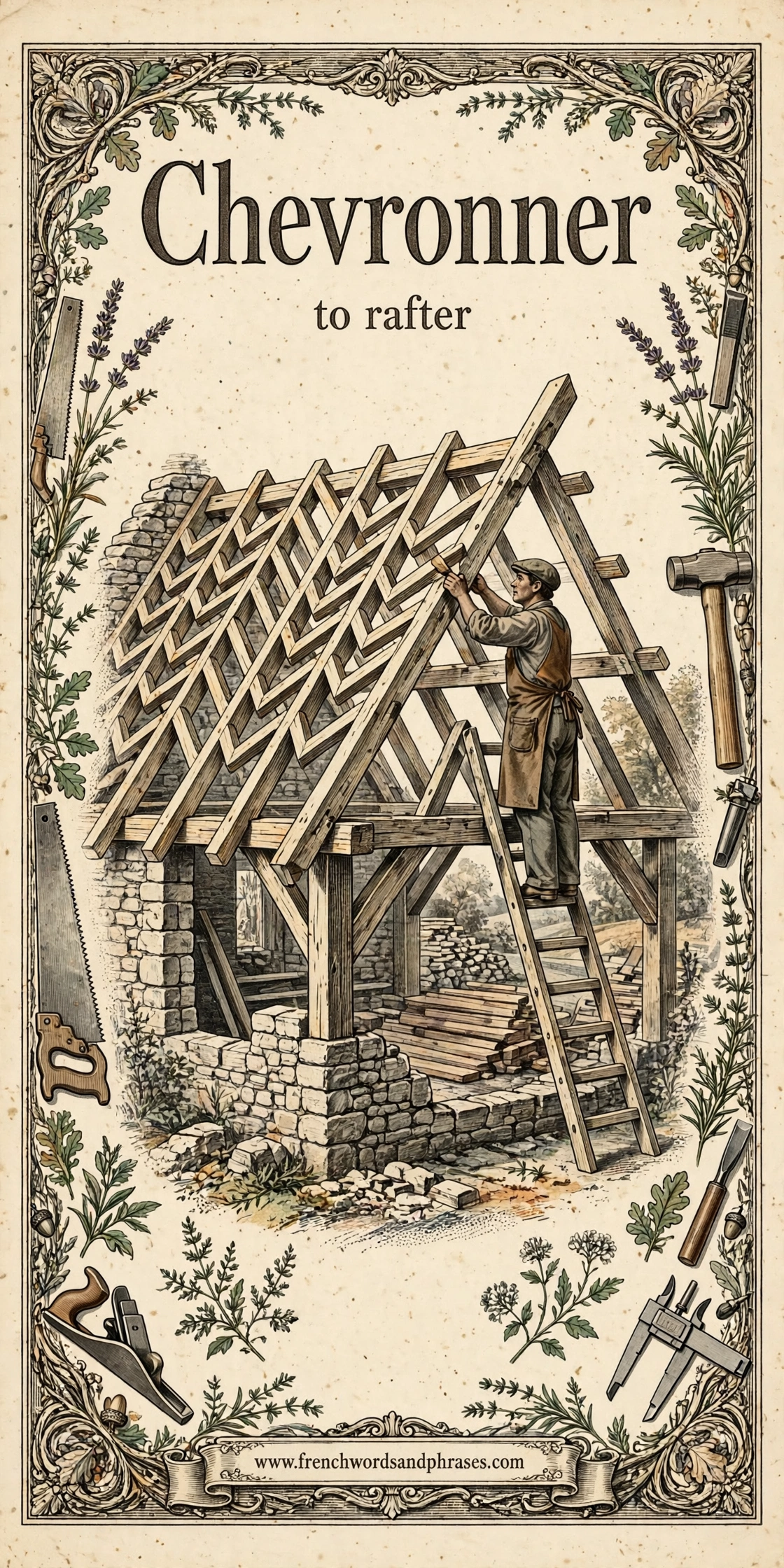
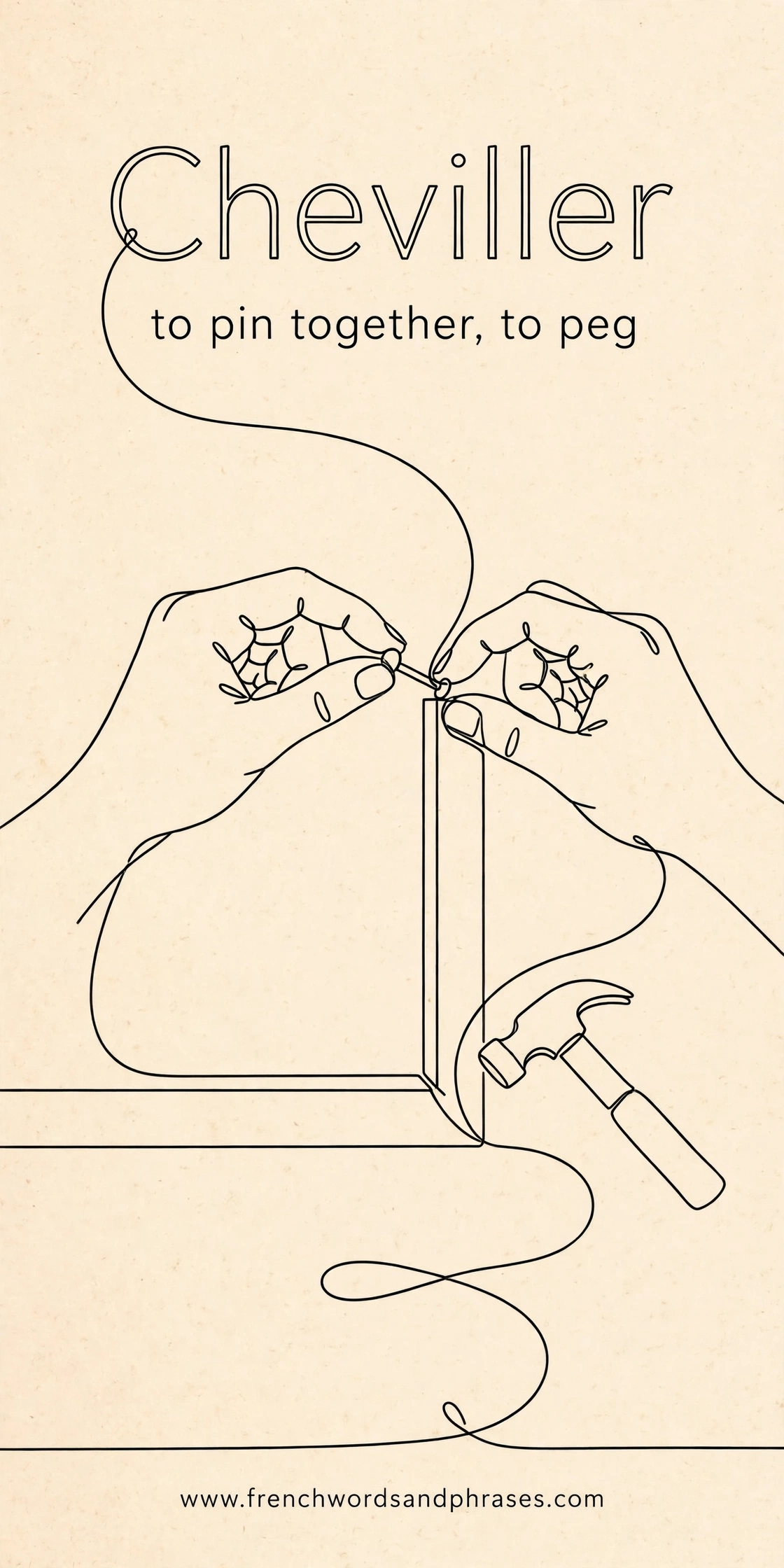
Cheviller means to pin together, to peg — to join timbers with stout wooden pegs, the chevilles, instead of nails or screws.
A cathedral roof-frame going up without a single nail, a ship’s planks fastened with oak pegs, a barn door that has swung on wooden pins for three hundred years — cheviller is the carpenter’s ancient verb of pegging: wood joined to wood, by wood.
In this guide, you’ll learn how to conjugate cheviller in all the major French tenses and moods. Explore complete conjugation tables, French examples, English translations, and practice quizzes.
Understanding the French Verb Cheviller
Cheviller is a regular French verb belonging to the first group of verbs, those ending in-er.
It means to pin together, to peg. It is a word of traditional carpentry, shipbuilding and restoration, where pegged joints are prized because they move with the wood and can be knocked out and renewed; everyday French is likelier to say visser or clouer for screws and nails. Where cheviller appears — old frames, boats, heritage work — it signals the old craft done properly.
Verb classification: First group (-er)
Auxiliary verb: Avoir
Past participle: chevillé
Present participle: chevillant
English equivalents: To pin together, to peg, to dowel; cheviller une poutre — to peg a beam; cheviller deux planches — to pin two boards together; cheviller une charpente — to peg a roof-frame; une cheville — a peg, a dowel (and also an ankle).
One important detail: the tool gives the verb its name — une cheville is a peg or dowel, and cheviller is to fasten with those pegs. The same cheville is also your ankle, the peg that fastens leg to foot, and French keeps the image in an expression: avoir l’âme chevillée au corps, to have one’s soul pegged to one’s body — to cling stubbornly to life. In poetry a cheville is a padding word slipped in to fill a line, so cheviller can also mean to pad a verse. The verb itself is a regular -er: je cheville, nous chevillerons — mind the double l throughout.
Experience the Word
Cheviller is the verb of the joint without iron — two timbers, one oak peg driven home, and a frame that can stand for centuries.
Imagine the restoration of a medieval barn. The carpenter bores the mortise and tenon, aligns them by eye, and drives the cheville with three blows of the mallet — no nail, no screw, nothing that can rust. The frame creaks, settles, and locks: chevillé, exactly as it was locked six hundred years ago.
Iron rusts and splits the oak. Pegged — chevillée — the joint simply outlives everyone in the yard.
How to Conjugate Cheviller: Complete French Conjugation Guide
Let’s explore every major conjugation of cheviller, beginning with the indicative mood.
How to Conjugate Cheviller in the Indicative Mood
The indicative mood is used to express facts, observations, actions, and events.
How to Conjugate Cheviller in the Present Tense (Présent)
Used for actions happening now, habitual actions, and general truths.
| Subject | Conjugation |
|---|---|
| je | cheville |
| tu | chevilles |
| il / elle | cheville |
| nous | chevillons |
| vous | chevillez |
| ils / elles | chevillent |
Example
Le charpentier cheville les poutres sans un seul clou.
The carpenter pegs the beams without a single nail.
Quick Quiz 1
Complete the sentence:
Nous ______ le plancher de la grange demain.
Reveal the answer
chevillerons
Nous chevillerons le plancher de la grange demain.
We will peg the barn floor tomorrow.
How to Conjugate Cheviller in the Passé Composé
Used for completed actions in the past. Cheviller takes the auxiliary verb avoir.
| Subject | Conjugation |
|---|---|
| j’ | ai chevillé |
| tu | as chevillé |
| il / elle | a chevillé |
| nous | avons chevillé |
| vous | avez chevillé |
| ils / elles | ont chevillé |
Example
Ils ont chevillé toute la charpente à l’ancienne.
They pegged the whole frame in the old way.
How to Conjugate Cheviller in the Imparfait (Imperfect Tense)
Used for habitual past actions, descriptions, and ongoing situations in the past.
| Subject | Conjugation |
|---|---|
| je | chevillais |
| tu | chevillais |
| il / elle | chevillait |
| nous | chevillions |
| vous | chevilliez |
| ils / elles | chevillaient |
Example
Autrefois, on chevillait les bateaux avec des chevilles de chêne.
In the old days, boats were pegged together with oak pegs.
Quick Quiz 2
Choose the correct form:
They pegged the frame in the old way.
Ils ______ la charpente à l’ancienne. (ont chevillé / sont chevillés)
Reveal the answer
ont chevillé
Ils ont chevillé la charpente à l’ancienne.
Cheviller takes avoir.
How to Conjugate Cheviller in the Plus-que-parfait
Used to describe an action that had already been completed before another past event.
| Subject | Conjugation |
|---|---|
| j’ | avais chevillé |
| tu | avais chevillé |
| il / elle | avait chevillé |
| nous | avions chevillé |
| vous | aviez chevillé |
| ils / elles | avaient chevillé |
Example
Elle avait chevillé les deux planches avant le collage.
She had pinned the two boards together before the gluing.
How to Conjugate Cheviller in the Passé Simple
Primarily used in formal writing, literature, and historical narratives. It is rarely used in everyday conversation.
| Subject | Conjugation |
|---|---|
| je | chevillai |
| tu | chevillas |
| il / elle | chevilla |
| nous | chevillâmes |
| vous | chevillâtes |
| ils / elles | chevillèrent |
Example
Les artisans chevillèrent la porte du donjon.
The craftsmen pegged the door of the keep.
How to Conjugate Cheviller in the Passé Antérieur
A literary tense used to express an action completed immediately before another past action, generally in the passé simple.
| Subject | Conjugation |
|---|---|
| j’ | eus chevillé |
| tu | eus chevillé |
| il / elle | eut chevillé |
| nous | eûmes chevillé |
| vous | eûtes chevillé |
| ils / elles | eurent chevillé |
Example
Quand il eut chevillé la dernière poutre, la charpente tint debout toute seule.
When he had pegged the last beam, the frame stood up all by itself.
How to Conjugate Cheviller in the Future Tense (Futur Simple)
Used to describe actions that will take place in the future.
| Subject | Conjugation |
|---|---|
| je | chevillerai |
| tu | chevilleras |
| il / elle | chevillera |
| nous | chevillerons |
| vous | chevillerez |
| ils / elles | chevilleront |
Example
Demain, nous chevillerons le plancher de la grange.
Tomorrow, we will peg the floor of the barn.
How to Conjugate Cheviller in the Futur Antérieur (Future Perfect)
Used for an action that will have been completed before a particular point in the future.
| Subject | Conjugation |
|---|---|
| j’ | aurai chevillé |
| tu | auras chevillé |
| il / elle | aura chevillé |
| nous | aurons chevillé |
| vous | aurez chevillé |
| ils / elles | auront chevillé |
Example
À la fin du jour, ils auront chevillé toutes les fermes du toit.
By the end of the day, they will have pegged all the trusses of the roof.
How to Conjugate Cheviller in the Near Future (Futur Proche)
Used to describe something that is going to happen soon. Formed with aller + infinitive.
| Subject | Conjugation |
|---|---|
| je | vais cheviller |
| tu | vas cheviller |
| il / elle | va cheviller |
| nous | allons cheviller |
| vous | allez cheviller |
| ils / elles | vont cheviller |
Example
Il va cheviller cette étagère, elle ne bougera plus.
He is going to peg this shelf, it will not move again.
How to Conjugate Cheviller in the Conditional Mood
The conditional mood expresses what would happen under certain circumstances. It is also frequently used to make polite requests or express wishes.
How to Conjugate Cheviller in the Present Conditional
| Subject | Conjugation |
|---|---|
| je | chevillerais |
| tu | chevillerais |
| il / elle | chevillerait |
| nous | chevillerions |
| vous | chevilleriez |
| ils / elles | chevilleraient |
Example
Avec des chevilles de hêtre, on chevillerait plus solidement.
With beech pegs, we would peg more solidly.
How to Conjugate Cheviller in the Past Conditional
| Subject | Conjugation |
|---|---|
| j’ | aurais chevillé |
| tu | aurais chevillé |
| il / elle | aurait chevillé |
| nous | aurions chevillé |
| vous | auriez chevillé |
| ils / elles | auraient chevillé |
Example
Ils auraient chevillé la porte si le bois avait été sec.
They would have pegged the door if the wood had been dry.
Cheviller in the Literary Past Conditional Form
This less common literary form uses the imperfect subjunctive of avoir.
| Subject | Conjugation |
|---|---|
| j’ | eusse chevillé |
| tu | eusses chevillé |
| il / elle | eût chevillé |
| nous | eussions chevillé |
| vous | eussiez chevillé |
| ils / elles | eussent chevillé |
Example
Le charpentier eût chevillé la poutre sans attendre le fer.
The carpenter would have pegged the beam without waiting for iron.
How to Conjugate Cheviller in the Subjunctive Mood
The subjunctive is used to express wishes, emotions, doubts, necessity, and uncertainty. It frequently follows expressions such as il faut que (it is necessary that) or bien que (although).
How to Conjugate Cheviller in the Present Subjunctive
| Subject | Conjugation |
|---|---|
| que je | cheville |
| que tu | chevilles |
| qu’il / qu’elle | cheville |
| que nous | chevillions |
| que vous | chevilliez |
| qu’ils / qu’elles | chevillent |
Example
Il faut que tu chevilles chaque tenon avant la colle.
You must peg each tenon before the glue.
Quick Quiz 3
Complete the sentence using the subjunctive:
Le maître voulait que l’apprenti ______ à l’ancienne.
Reveal the answer
chevillât
Le maître voulait que l’apprenti chevillât à l’ancienne.
The master wanted the apprentice to peg in the old way.
How to Conjugate Cheviller in the Imperfect Subjunctive
A literary tense, rarely encountered in modern spoken French.
| Subject | Conjugation |
|---|---|
| que je | chevillasse |
| que tu | chevillasses |
| qu’il / qu’elle | chevillât |
| que nous | chevillassions |
| que vous | chevillassiez |
| qu’ils / qu’elles | chevillassent |
Example
Le maître voulait que l’apprenti chevillât à l’ancienne.
The master wanted the apprentice to peg in the old way.
How to Conjugate Cheviller in the Pluperfect Subjunctive
A literary construction used to express an action completed before another past action.
| Subject | Conjugation |
|---|---|
| que j’ | eusse chevillé |
| que tu | eusses chevillé |
| qu’il / qu’elle | eût chevillé |
| que nous | eussions chevillé |
| que vous | eussiez chevillé |
| qu’ils / qu’elles | eussent chevillé |
Example
On vérifia qu’il eût chevillé toutes les poutres.
They checked that he had pegged all the beams.
How to Conjugate Cheviller in the Past Subjunctive
| Subject | Conjugation |
|---|---|
| que j’ | aie chevillé |
| que tu | aies chevillé |
| qu’il / qu’elle | ait chevillé |
| que nous | ayons chevillé |
| que vous | ayez chevillé |
| qu’ils / qu’elles | aient chevillé |
Example
Je suis content qu’ils aient chevillé la charpente à temps.
I am glad they pegged the frame in time.
How to Conjugate Cheviller in the Imperative
The imperative is used to give commands, instructions, invitations, or suggestions. Subject pronouns are omitted.
How to Conjugate Cheviller in the Present Imperative
| Person | Conjugation |
|---|---|
| (tu) | cheville |
| (nous) | chevillons |
| (vous) | chevillez |
Example
Cheville bien les planches, sinon tout bougera !
Peg the boards well, otherwise everything will move!
Quick Quiz 4
How would you say Peg the boards well (tu form)?
Reveal the answer
Cheville bien les planches !
French Participles of Cheviller
Participles are verb forms that can be used in compound tenses and other grammatical constructions.
Present Participle of Cheviller
chevillant
En chevillant les poutres, il chante de vieilles chansons.
While pegging the beams, he sings old songs.
Past Participle of Cheviller
chevillé
Chevillée à l’ancienne, la charpente a trois cents ans.
Pegged in the old way, the frame is three hundred years old.
Cheviller in Everyday French: Real-Life Examples
Now that you know the conjugations, let’s see how cheviller appears in everyday French.
Example 1 — Present
Le charpentier cheville les poutres.
The carpenter pegs the beams.
Example 2 — Passé composé
Ils ont chevillé la charpente à l’ancienne.
They pegged the frame in the old way.
Example 3 — Imparfait
On chevillait les bateaux avec du chêne.
Boats were pegged together with oak.
Example 4 — Future
Nous chevillerons le plancher de la grange.
We will peg the barn floor.
Example 5 — Conditional
On chevillerait plus solidement avec du hêtre.
We would peg more solidly with beech.
Example 6 — Imperative
Cheville bien les planches !
Peg the boards well!
Beyond Translation: The Meaning of Cheviller
Une cheville descends from the Latin clavicula, a little key or pin — the same little pin that names the clavicle in anatomy and, in French, the ankle.
The body and the barn are joined the same way.
Your ankle is the peg between leg and foot; the carpenter’s cheville is the peg between beam and beam. Cheviller is simply the verb of driving that pin home — in a roof-frame, in a boat, or, in the old expression, in a soul that refuses to leave its body.
How to Remember the French Verb Cheviller
Remember it this way: Cheviller is about the oak peg driven home — no nail, no rust, three hundred years.
- Une cheville is a peg (and your ankle): cheviller is to fasten with pegs instead of nails — wood joined by wood.
- Look for it in old carpentry and boatbuilding: cheviller une charpente, une poutre, deux planches.
- Regular -er with a double l everywhere: je cheville, nous chevillerons, past participle chevillé.
The key idea is the oak peg driven home — no nail, no rust, three hundred years.
Test Your Knowledge of Cheviller
Let’s see how much you’ve learned. Try answering these questions before revealing the answers.
Question 1
What is une cheville, in both its everyday senses?
Reveal the answer
A peg or dowel — and an ankle: the pin that joins wood, and the pin that joins leg to foot.
Question 2
How do you say The carpenter pegs the beams in French?
Reveal the answer
Le charpentier cheville les poutres.
Question 3
Translate: They pegged the whole frame in the old way.
Reveal the answer
Ils ont chevillé toute la charpente à l’ancienne.
Question 4
What is the past participle of cheviller?
Reveal the answer
Chevillé.
Question 5
Complete the sentence:
Il faut que tu ______ chaque tenon avant la colle.
Reveal the answer
chevilles
Il faut que tu chevilles chaque tenon avant la colle.
You must peg each tenon before the glue.
Your Final Challenge
Can You Use It?
How would you say this in French?
He pegs the last beam, and the barn remembers its three hundred years.
Reveal the answer
Il cheville la dernière poutre, et la grange se souvient de ses trois cents ans.
He pegs the last beam, and the barn remembers its three hundred years.
A little French. A little curiosity. A richer everyday life.
LEARN FRENCH ONE WORD AT A TIME