A French Word to Live By
How to Conjugate Chausser in French
/ʃo.se/
Chausser means to put on shoes — above all to put shoes on someone else, and to state the shoe size a person takes.
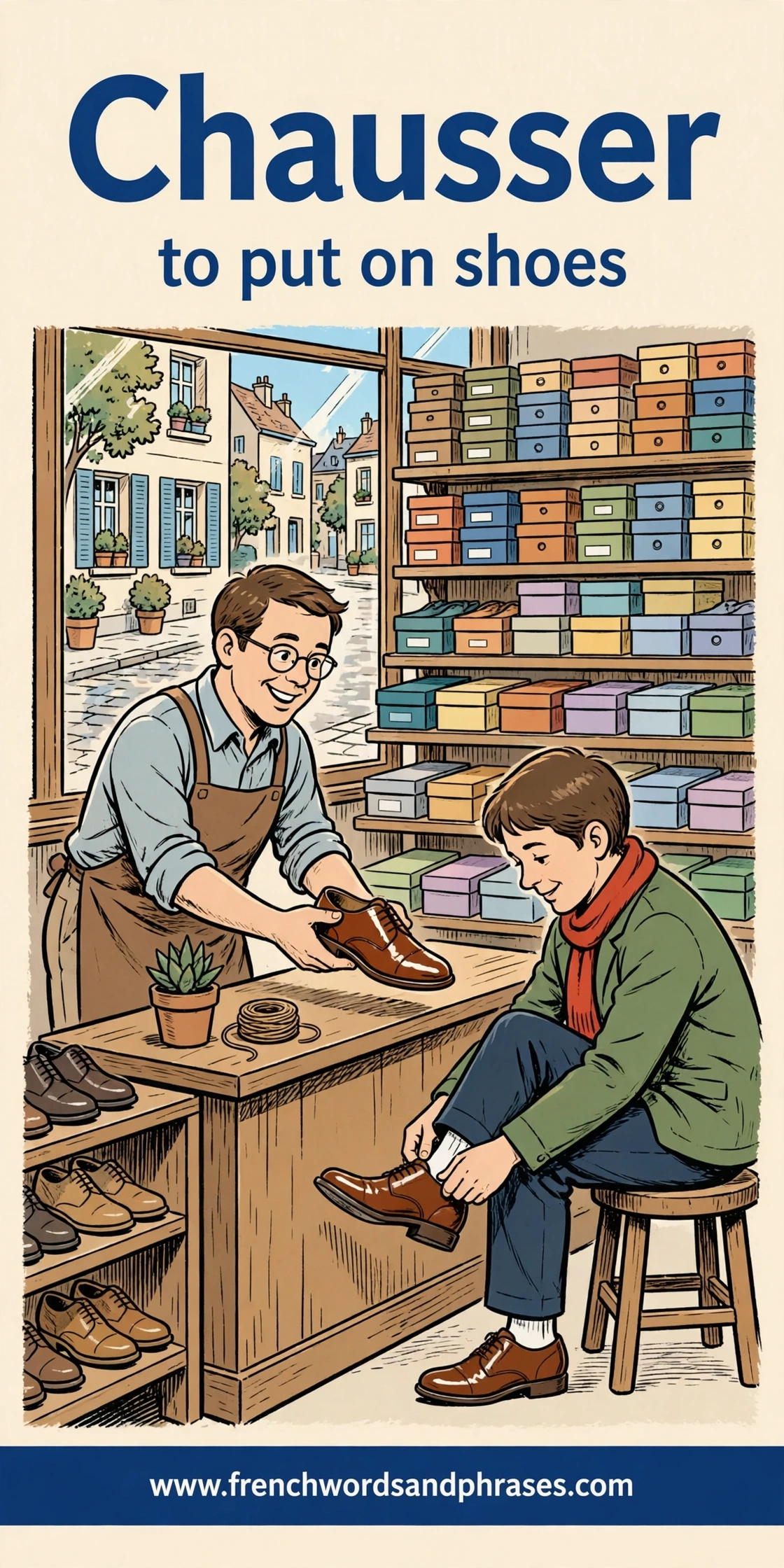
A mother kneeling at the door with a pair of small boots, a shoe-shop assistant sliding a heel into place, a number called out across the shop — chausser is the verb of shoes going onto feet: somebody else’s feet, most often, or your size, stated like a fact of identity.
In this guide, you’ll learn how to conjugate chausser in all the major French tenses and moods. Explore complete conjugation tables, French examples, English translations, and practice quizzes.
Understanding the French Verb Chausser
Chausser is a regular French verb belonging to the first group of verbs, those ending in-er.
It means to put on shoes. Beyond children and shoe sizes, chausser serves for anything feet or legs are fitted into: chausser les skis, chausser les étriers (to slip one’s feet into the stirrups), and in the passive adjective bien chaussé — well shod — of anyone properly equipped for the ground ahead.
Verb classification: First group (-er)
Auxiliary verb: Avoir
Past participle: chaussé
Present participle: chaussant
English equivalents: To put shoes on, to shoe; chausser un enfant — to put a child’s shoes on; chausser du 42 — to take a size 42 (shoe); chausser les skis — to clip on one’s skis; bien chaussé — well shod.
One important detail: chausser is transitive — you chaussez somebody else, above all a child: elle chausse son fils. Its second great use takes no person at all but a size: je chausse du quarante-trois — I take a size 43; the size construction is how every French shoe shop begins. For putting on your own shoes, French turns reflexive: se chausser. The double s never changes, and the family is everywhere: une chaussure (a shoe), un chausson (a slipper, a ballet shoe), une chaussette (a sock).
Experience the Word
Chausser is the verb of the kneeling adult and the wriggling foot — shoes, in French, are first of all something you do for someone else.
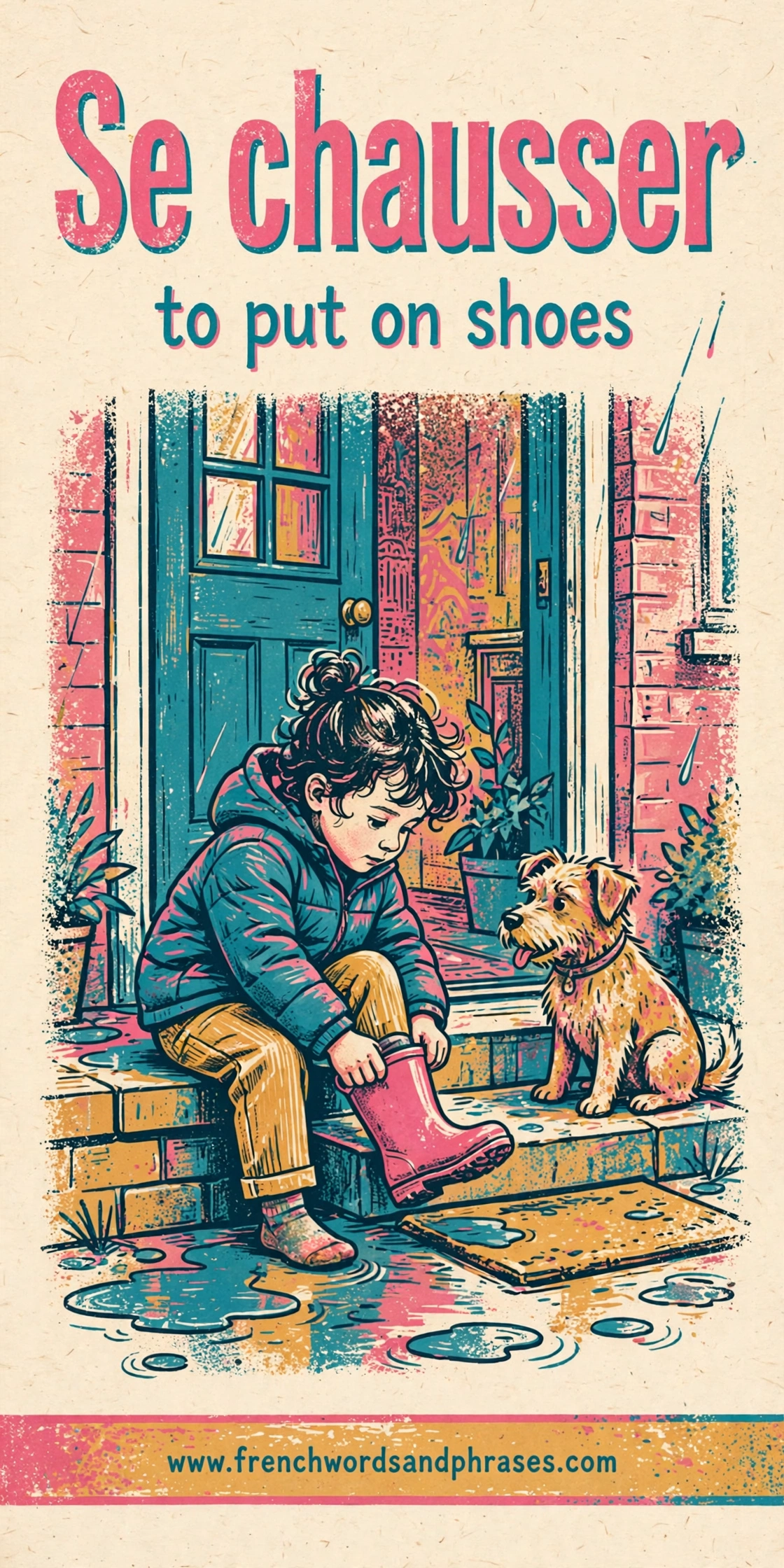
Imagine the door of a flat at eight in the morning. Coats are on, bags are packed, and everything waits on one small person sitting on the step, legs stretched out like royalty, while his mother chausse — one boot, then the other — and the day can finally start.
The boots were his, the feet were his. She has shod him — chaussé — and the morning moves again.
How to Conjugate Chausser: Complete French Conjugation Guide
Let’s explore every major conjugation of chausser, beginning with the indicative mood.
How to Conjugate Chausser in the Indicative Mood
The indicative mood is used to express facts, observations, actions, and events.
How to Conjugate Chausser in the Present Tense (Présent)
Used for actions happening now, habitual actions, and general truths.
| Subject | Conjugation |
|---|---|
| je | chausse |
| tu | chausses |
| il / elle | chausse |
| nous | chaussons |
| vous | chaussez |
| ils / elles | chaussent |
Example
Elle chausse son fils avant l’école.
She puts her son’s shoes on before school.
Quick Quiz 1
Complete the sentence:
Nous ______ les enfants avant l’école.
Reveal the answer
chaussons
Nous chaussons les enfants avant l’école.
We put the children’s shoes on before school.
How to Conjugate Chausser in the Passé Composé
Used for completed actions in the past. Chausser takes the auxiliary verb avoir.
| Subject | Conjugation |
|---|---|
| j’ | ai chaussé |
| tu | as chaussé |
| il / elle | a chaussé |
| nous | avons chaussé |
| vous | avez chaussé |
| ils / elles | ont chaussé |
Example
Le vendeur a chaussé l’enfant avec des bottes neuves.
The shop assistant put new boots on the child.
How to Conjugate Chausser in the Imparfait (Imperfect Tense)
Used for habitual past actions, descriptions, and ongoing situations in the past.
| Subject | Conjugation |
|---|---|
| je | chaussais |
| tu | chaussais |
| il / elle | chaussait |
| nous | chaussions |
| vous | chaussiez |
| ils / elles | chaussaient |
Example
Chaque matin, elle chaussait les jumeaux avant la maternelle.
Every morning, she used to put the twins’ shoes on before nursery school.
Quick Quiz 2
Choose the correct form:
She put the child’s shoes on.
Elle ______ l’enfant. (a chaussé / s’est chaussée)
Reveal the answer
a chaussé
Elle a chaussé l’enfant.
Someone else’s shoes: plain chausser with avoir. Se chausser is for her own shoes.
How to Conjugate Chausser in the Plus-que-parfait
Used to describe an action that had already been completed before another past event.
| Subject | Conjugation |
|---|---|
| j’ | avais chaussé |
| tu | avais chaussé |
| il / elle | avait chaussé |
| nous | avions chaussé |
| vous | aviez chaussé |
| ils / elles | avaient chaussé |
Example
Elle avait chaussé le petit avant l’arrivée du taxi.
She had put the little one’s shoes on before the taxi arrived.
How to Conjugate Chausser in the Passé Simple
Primarily used in formal writing, literature, and historical narratives. It is rarely used in everyday conversation.
| Subject | Conjugation |
|---|---|
| je | chaussai |
| tu | chaussas |
| il / elle | chaussa |
| nous | chaussâmes |
| vous | chaussâtes |
| ils / elles | chaussèrent |
Example
La mère chaussa l’enfant et l’envoya jouer dehors.
The mother put the child’s shoes on and sent him out to play.
How to Conjugate Chausser in the Passé Antérieur
A literary tense used to express an action completed immediately before another past action, generally in the passé simple.
| Subject | Conjugation |
|---|---|
| j’ | eus chaussé |
| tu | eus chaussé |
| il / elle | eut chaussé |
| nous | eûmes chaussé |
| vous | eûtes chaussé |
| ils / elles | eurent chaussé |
Example
Quand elle eut chaussé les deux enfants, ils partirent pour l’école.
When she had put both children’s shoes on, they left for school.
How to Conjugate Chausser in the Future Tense (Futur Simple)
Used to describe actions that will take place in the future.
| Subject | Conjugation |
|---|---|
| je | chausserai |
| tu | chausseras |
| il / elle | chaussera |
| nous | chausserons |
| vous | chausserez |
| ils / elles | chausseront |
Example
Tu chausseras ton frère pendant que je prépare les sacs.
You will put your brother’s shoes on while I get the bags ready.
How to Conjugate Chausser in the Futur Antérieur (Future Perfect)
Used for an action that will have been completed before a particular point in the future.
| Subject | Conjugation |
|---|---|
| j’ | aurai chaussé |
| tu | auras chaussé |
| il / elle | aura chaussé |
| nous | aurons chaussé |
| vous | aurez chaussé |
| ils / elles | auront chaussé |
Example
À huit heures, elle aura chaussé tous les enfants de la colonie.
By eight o’clock, she will have put shoes on all the children at the holiday camp.
How to Conjugate Chausser in the Near Future (Futur Proche)
Used to describe something that is going to happen soon. Formed with aller + infinitive.
| Subject | Conjugation |
|---|---|
| je | vais chausser |
| tu | vas chausser |
| il / elle | va chausser |
| nous | allons chausser |
| vous | allez chausser |
| ils / elles | vont chausser |
Example
Je vais chausser le petit, il veut sortir.
I am going to put the little one’s shoes on, he wants to go out.
How to Conjugate Chausser in the Conditional Mood
The conditional mood expresses what would happen under certain circumstances. It is also frequently used to make polite requests or express wishes.
How to Conjugate Chausser in the Present Conditional
| Subject | Conjugation |
|---|---|
| je | chausserais |
| tu | chausserais |
| il / elle | chausserait |
| nous | chausserions |
| vous | chausseriez |
| ils / elles | chausseraient |
Example
Avec des scratchs, elle chausserait son fils plus vite.
With Velcro straps, she would put her son’s shoes on faster.
How to Conjugate Chausser in the Past Conditional
| Subject | Conjugation |
|---|---|
| j’ | aurais chaussé |
| tu | aurais chaussé |
| il / elle | aurait chaussé |
| nous | aurions chaussé |
| vous | auriez chaussé |
| ils / elles | auraient chaussé |
Example
Tu aurais chaussé l’enfant si tu avais trouvé ses bottes.
You would have put the child’s shoes on if you had found his boots.
Chausser in the Literary Past Conditional Form
This less common literary form uses the imperfect subjunctive of avoir.
| Subject | Conjugation |
|---|---|
| j’ | eusse chaussé |
| tu | eusses chaussé |
| il / elle | eût chaussé |
| nous | eussions chaussé |
| vous | eussiez chaussé |
| ils / elles | eussent chaussé |
Example
Elle eût chaussé le bébé sans ce coup de téléphone.
She would have put the baby’s shoes on if not for that phone call.
How to Conjugate Chausser in the Subjunctive Mood
The subjunctive is used to express wishes, emotions, doubts, necessity, and uncertainty. It frequently follows expressions such as il faut que (it is necessary that) or bien que (although).
How to Conjugate Chausser in the Present Subjunctive
| Subject | Conjugation |
|---|---|
| que je | chausse |
| que tu | chausses |
| qu’il / qu’elle | chausse |
| que nous | chaussions |
| que vous | chaussiez |
| qu’ils / qu’elles | chaussent |
Example
Il faut que tu chausses ton petit frère.
You must put your little brother’s shoes on.
Quick Quiz 3
Complete the sentence using the subjunctive:
Il faut que vous ______ le petit.
Reveal the answer
chaussiez
Il faut que vous chaussiez le petit.
You must put the little one’s shoes on.
How to Conjugate Chausser in the Imperfect Subjunctive
A literary tense, rarely encountered in modern spoken French.
| Subject | Conjugation |
|---|---|
| que je | chaussasse |
| que tu | chaussasses |
| qu’il / qu’elle | chaussât |
| que nous | chaussassions |
| que vous | chaussassiez |
| qu’ils / qu’elles | chaussassent |
Example
Je voulais qu’elle chaussât l’enfant avant la photo.
I wanted her to put the child’s shoes on before the photo.
How to Conjugate Chausser in the Pluperfect Subjunctive
A literary construction used to express an action completed before another past action.
| Subject | Conjugation |
|---|---|
| que j’ | eusse chaussé |
| que tu | eusses chaussé |
| qu’il / qu’elle | eût chaussé |
| que nous | eussions chaussé |
| que vous | eussiez chaussé |
| qu’ils / qu’elles | eussent chaussé |
Example
On disait qu’il eût chaussé tous les enfants en cinq minutes.
People said he had put shoes on all the children in five minutes.
How to Conjugate Chausser in the Past Subjunctive
| Subject | Conjugation |
|---|---|
| que j’ | aie chaussé |
| que tu | aies chaussé |
| qu’il / qu’elle | ait chaussé |
| que nous | ayons chaussé |
| que vous | ayez chaussé |
| qu’ils / qu’elles | aient chaussé |
Example
Je suis content que tu aies chaussé la petite.
I am glad you put the little girl’s shoes on.
How to Conjugate Chausser in the Imperative
The imperative is used to give commands, instructions, invitations, or suggestions. Subject pronouns are omitted.
How to Conjugate Chausser in the Present Imperative
| Person | Conjugation |
|---|---|
| (tu) | chausse |
| (nous) | chaussons |
| (vous) | chaussez |
Example
Chausse ton frère, s’il te plaît !
Put your brother’s shoes on, please!
Quick Quiz 4
How would you say Put your brother’s shoes on (tu form)?
Reveal the answer
Chausse ton frère !
French Participles of Chausser
Participles are verb forms that can be used in compound tenses and other grammatical constructions.
Present Participle of Chausser
chaussant
En chaussant l’enfant, elle remarqua un trou dans sa chaussette.
While putting the child’s shoes on, she noticed a hole in his sock.
Past Participle of Chausser
chaussé
Bien chaussé, l’enfant partit pour l’école.
Well shod, the child set off for school.
Chausser in Everyday French: Real-Life Examples
Now that you know the conjugations, let’s see how chausser appears in everyday French.
Example 1 — Present
Elle chausse son fils avant l’école.
She puts her son’s shoes on before school.
Example 2 — Passé composé
Le vendeur a chaussé l’enfant de bottes neuves.
The shop assistant fitted the child with new boots.
Example 3 — Imparfait
Elle chaussait les jumeaux chaque matin.
She used to put the twins’ shoes on every morning.
Example 4 — Future
Tu chausseras ton frère.
You will put your brother’s shoes on.
Example 5 — Conditional
Elle chausserait son fils plus vite avec des scratchs.
She would put her son’s shoes on faster with Velcro straps.
Example 6 — Imperative
Chausse ton petit frère !
Put your little brother’s shoes on!
Beyond Translation: The Meaning of Chausser
One verb, and a whole wardrobe beneath it: une chaussure is the shoe, un chausson the slipper, une chaussette the sock, and chausser du 42 is practically a line of your identity card.
In French, your shoe size is something you do.
You do not have a size, you chaussez it — the verb turns a measurement into an action, and the shoe shop into a small theatre of fitting, kneeling and trying on.
How to Remember the French Verb Chausser
Remember it this way: Chausser is about the kneeling mother, the child’s boots, and je chausse du 43.
- Chausser is for someone else’s feet: elle chausse son fils — for your own, se chausser.
- Je chausse du 43 — the size construction every shoe shop starts with.
- Regular -er with avoir: je chausse, nous chaussons, past participle chaussé.
The key idea is the kneeling mother, the child’s boots, and je chausse du 43.
Test Your Knowledge of Chausser
Let’s see how much you’ve learned. Try answering these questions before revealing the answers.
Question 1
How do you say I take a size 42 shoe in French?
Reveal the answer
Je chausse du 42 — chausser du + the size is the shoe-shop formula.
Question 2
How do you say She puts her son’s shoes on in French?
Reveal the answer
Elle chausse son fils.
Question 3
Translate: The shop assistant put new boots on the child.
Reveal the answer
Le vendeur a chaussé l’enfant avec des bottes neuves.
Question 4
What is the past participle of chausser?
Reveal the answer
Chaussé.
Question 5
Complete the sentence:
Il faut que tu ______ ton petit frère.
Reveal the answer
chausses
Il faut que tu chausses ton petit frère.
You must put your little brother’s shoes on.
Your Final Challenge
Can You Use It?
How would you say this in French?
She puts the little one’s shoes on, ties the laces, and the day can begin.
Reveal the answer
Elle chausse le petit, noue les lacets, et la journée peut commencer.
She puts the little one’s shoes on, ties the laces, and the day can begin.
A little French. A little curiosity. A richer everyday life.
LEARN FRENCH ONE WORD AT A TIME