A French Word to Live By
How to Conjugate Châtrer in French
/ʃa.tʁe/
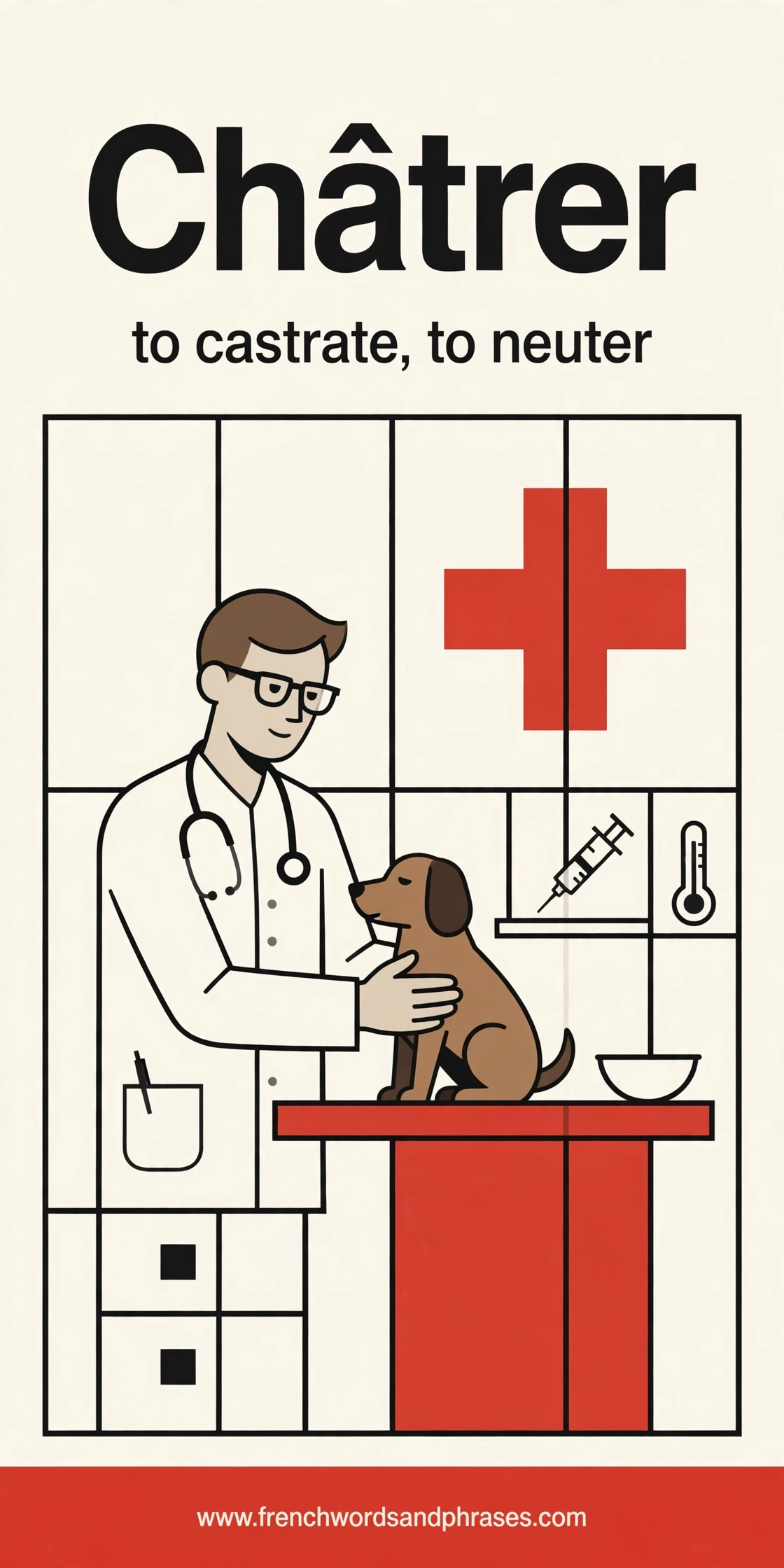
Châtrer means to castrate, to neuter — to remove an animal’s power to reproduce, and, figuratively, to cut the life out of a text.
The farmyard in spring: piglets, lambs and a young bull, and the vet’s visit that will make them calmer, fatter and easier to keep. Châtrer is the plain old farming word for that operation — and French also uses it, with a wince, for books that censorship has cut to pieces.
In this guide, you’ll learn how to conjugate châtrer in all the major French tenses and moods. Explore complete conjugation tables, French examples, English translations, and practice quizzes.
Understanding the French Verb Châtrer
Châtrer is a regular French verb belonging to the first group of verbs, those ending in-er.
It means to castrate, to neuter. It is the standard verb in farming and veterinary French for neutering male animals — cats, dogs, bulls, stallions, piglets — and in agriculture for cutting the male flowers of maize; figuratively it is the critic’s word for editions and films weakened by timid cutting.
Verb classification: First group (-er)
Auxiliary verb: Avoir
Past participle: châtré
Present participle: châtrant
English equivalents: To castrate, to neuter, to geld; châtrer un chat — to neuter a cat; châtrer un étalon — to geld a stallion; châtrer le maïs — to detassel maize, removing its male flowers; châtrer un texte — to bowdlerize a text, to cut it into blandness.
One important detail: châtrer keeps its circumflex on the â, the mark of a lost Latin s — it is the older French twin of castrer, and the two divide the work: vets and farmers châtrent livestock and household pets, while castrer sounds more clinical. Beyond the farm, the verb works on plants: châtrer le maïs is to remove the maize’s male flowers so it cannot pollinate itself. And its figurative sense is famous: châtrer un texte, to castrate a text — to censor it until nothing strong remains. Regular conjugation: je châtre, nous châtrons, past participle châtré.
Experience the Word
Châtrer is the verb of removal with a purpose — the farmer removes fertility to gain calm, the censor removes force and gains nothing.
Imagine the refuge on a Saturday morning. A queue of tomcats in baskets, a kind vet, a ten-minute operation each — et les voilà châtrés, sleepy, indignant, and ready for quiet lives as house cats instead of street fighters.
The cats will never know what changed. They have been châtrés — neutered — and the neighbourhood will sleep better for it.
How to Conjugate Châtrer: Complete French Conjugation Guide
Let’s explore every major conjugation of châtrer, beginning with the indicative mood.
How to Conjugate Châtrer in the Indicative Mood
The indicative mood is used to express facts, observations, actions, and events.
How to Conjugate Châtrer in the Present Tense (Présent)
Used for actions happening now, habitual actions, and general truths.
| Subject | Conjugation |
|---|---|
| je | châtre |
| tu | châtres |
| il / elle | châtre |
| nous | châtrons |
| vous | châtrez |
| ils / elles | châtrent |
Example
Le vétérinaire châtre les chats du refuge.
The vet neuters the cats at the shelter.
Quick Quiz 1
Complete the sentence:
Nous ______ les porcelets demain matin.
Reveal the answer
châtrerons
Nous châtrerons les porcelets demain matin.
We will castrate the piglets tomorrow morning.
How to Conjugate Châtrer in the Passé Composé
Used for completed actions in the past. Châtrer takes the auxiliary verb avoir.
| Subject | Conjugation |
|---|---|
| j’ | ai châtré |
| tu | as châtré |
| il / elle | a châtré |
| nous | avons châtré |
| vous | avez châtré |
| ils / elles | ont châtré |
Example
Ils ont châtré le taureau au printemps.
They castrated the bull in spring.
How to Conjugate Châtrer in the Imparfait (Imperfect Tense)
Used for habitual past actions, descriptions, and ongoing situations in the past.
| Subject | Conjugation |
|---|---|
| je | châtrais |
| tu | châtrais |
| il / elle | châtrait |
| nous | châtrions |
| vous | châtriez |
| ils / elles | châtraient |
Example
Autrefois, on châtrait les bœufs pour les rendre dociles.
In the old days, oxen were castrated to make them docile.
Quick Quiz 2
Choose the correct form:
They castrated the bull.
Ils ______ le taureau. (ont châtré / sont châtré)
Reveal the answer
ont châtré
Ils ont châtré le taureau.
Châtrer takes avoir.
How to Conjugate Châtrer in the Plus-que-parfait
Used to describe an action that had already been completed before another past event.
| Subject | Conjugation |
|---|---|
| j’ | avais châtré |
| tu | avais châtré |
| il / elle | avait châtré |
| nous | avions châtré |
| vous | aviez châtré |
| ils / elles | avaient châtré |
Example
Le fermier avait châtré les porcelets avant l’été.
The farmer had castrated the piglets before summer.
How to Conjugate Châtrer in the Passé Simple
Primarily used in formal writing, literature, and historical narratives. It is rarely used in everyday conversation.
| Subject | Conjugation |
|---|---|
| je | châtrai |
| tu | châtras |
| il / elle | châtra |
| nous | châtrâmes |
| vous | châtrâtes |
| ils / elles | châtrèrent |
Example
Le maréchal châtra l’étalon devenu dangereux.
The farrier gelded the stallion that had become dangerous.
How to Conjugate Châtrer in the Passé Antérieur
A literary tense used to express an action completed immediately before another past action, generally in the passé simple.
| Subject | Conjugation |
|---|---|
| j’ | eus châtré |
| tu | eus châtré |
| il / elle | eut châtré |
| nous | eûmes châtré |
| vous | eûtes châtré |
| ils / elles | eurent châtré |
Example
Quand on eut châtré le chat, il devint beaucoup plus calme.
When the cat had been neutered, it became much calmer.
How to Conjugate Châtrer in the Future Tense (Futur Simple)
Used to describe actions that will take place in the future.
| Subject | Conjugation |
|---|---|
| je | châtrerai |
| tu | châtreras |
| il / elle | châtrera |
| nous | châtrerons |
| vous | châtrerez |
| ils / elles | châtreront |
Example
Demain, le vétérinaire châtrera le jeune chien.
Tomorrow, the vet will neuter the young dog.
How to Conjugate Châtrer in the Futur Antérieur (Future Perfect)
Used for an action that will have been completed before a particular point in the future.
| Subject | Conjugation |
|---|---|
| j’ | aurai châtré |
| tu | auras châtré |
| il / elle | aura châtré |
| nous | aurons châtré |
| vous | aurez châtré |
| ils / elles | auront châtré |
Example
À la fin de la semaine, ils auront châtré tous les agneaux.
By the end of the week, they will have castrated all the lambs.
How to Conjugate Châtrer in the Near Future (Futur Proche)
Used to describe something that is going to happen soon. Formed with aller + infinitive.
| Subject | Conjugation |
|---|---|
| je | vais châtrer |
| tu | vas châtrer |
| il / elle | va châtrer |
| nous | allons châtrer |
| vous | allez châtrer |
| ils / elles | vont châtrer |
Example
Le fermier va châtrer les porcelets demain matin.
The farmer is going to castrate the piglets tomorrow morning.
How to Conjugate Châtrer in the Conditional Mood
The conditional mood expresses what would happen under certain circumstances. It is also frequently used to make polite requests or express wishes.
How to Conjugate Châtrer in the Present Conditional
| Subject | Conjugation |
|---|---|
| je | châtrerais |
| tu | châtrerais |
| il / elle | châtrerait |
| nous | châtrerions |
| vous | châtreriez |
| ils / elles | châtreraient |
Example
Un bon éleveur châtrerait les mâles au bon âge.
A good breeder would castrate the males at the right age.
How to Conjugate Châtrer in the Past Conditional
| Subject | Conjugation |
|---|---|
| j’ | aurais châtré |
| tu | aurais châtré |
| il / elle | aurait châtré |
| nous | aurions châtré |
| vous | auriez châtré |
| ils / elles | auraient châtré |
Example
Il aurait châtré l’étalon si celui-ci avait été agressif.
He would have gelded the stallion if it had been aggressive.
Châtrer in the Literary Past Conditional Form
This less common literary form uses the imperfect subjunctive of avoir.
| Subject | Conjugation |
|---|---|
| j’ | eusse châtré |
| tu | eusses châtré |
| il / elle | eût châtré |
| nous | eussions châtré |
| vous | eussiez châtré |
| ils / elles | eussent châtré |
Example
Le seigneur eût châtré le taureau avant les labours.
The lord would have castrated the bull before the ploughing.
How to Conjugate Châtrer in the Subjunctive Mood
The subjunctive is used to express wishes, emotions, doubts, necessity, and uncertainty. It frequently follows expressions such as il faut que (it is necessary that) or bien que (although).
How to Conjugate Châtrer in the Present Subjunctive
| Subject | Conjugation |
|---|---|
| que je | châtre |
| que tu | châtres |
| qu’il / qu’elle | châtre |
| que nous | châtrions |
| que vous | châtriez |
| qu’ils / qu’elles | châtrent |
Example
Il faut que le vétérinaire châtre ce chat errant.
The vet must neuter this stray cat.
Quick Quiz 3
Complete the sentence using the subjunctive:
Il faut que vous ______ le maïs avant la floraison.
Reveal the answer
châtriez
Il faut que vous châtriez le maïs avant la floraison.
You must detassel the maize before it flowers.
How to Conjugate Châtrer in the Imperfect Subjunctive
A literary tense, rarely encountered in modern spoken French.
| Subject | Conjugation |
|---|---|
| que je | châtrasse |
| que tu | châtrasses |
| qu’il / qu’elle | châtrât |
| que nous | châtrassions |
| que vous | châtrassiez |
| qu’ils / qu’elles | châtrassent |
Example
On voulait que le fermier châtrât les bœufs avant l’hiver.
People wanted the farmer to castrate the oxen before winter.
How to Conjugate Châtrer in the Pluperfect Subjunctive
A literary construction used to express an action completed before another past action.
| Subject | Conjugation |
|---|---|
| que j’ | eusse châtré |
| que tu | eusses châtré |
| qu’il / qu’elle | eût châtré |
| que nous | eussions châtré |
| que vous | eussiez châtré |
| qu’ils / qu’elles | eussent châtré |
Example
On racontait que les anciens eussent châtré les taureaux pour les atteler.
People said the old farmers had castrated the bulls to yoke them.
How to Conjugate Châtrer in the Past Subjunctive
| Subject | Conjugation |
|---|---|
| que j’ | aie châtré |
| que tu | aies châtré |
| qu’il / qu’elle | ait châtré |
| que nous | ayons châtré |
| que vous | ayez châtré |
| qu’ils / qu’elles | aient châtré |
Example
Je suis soulagé que le vétérinaire ait châtré le chien sans complication.
I am relieved the vet neutered the dog without complications.
How to Conjugate Châtrer in the Imperative
The imperative is used to give commands, instructions, invitations, or suggestions. Subject pronouns are omitted.
How to Conjugate Châtrer in the Present Imperative
| Person | Conjugation |
|---|---|
| (tu) | châtre |
| (nous) | châtrons |
| (vous) | châtrez |
Example
Châtre ce chat avant de le rendre à ses maîtres !
Neuter this cat before giving it back to its owners!
Quick Quiz 4
How would you say Neuter this cat (tu form)?
Reveal the answer
Châtre ce chat !
French Participles of Châtrer
Participles are verb forms that can be used in compound tenses and other grammatical constructions.
Present Participle of Châtrer
châtrant
En châtrant le maïs, les ouvriers avancent rang après rang.
Detasselling the maize, the workers move row by row.
Past Participle of Châtrer
châtré
Châtré par la censure, le roman perdit toute sa force.
Castrated by censorship, the novel lost all its force.
Châtrer in Everyday French: Real-Life Examples
Now that you know the conjugations, let’s see how châtrer appears in everyday French.
Example 1 — Present
Le vétérinaire châtre les chats.
The vet neuters the cats.
Example 2 — Passé composé
Ils ont châtré le taureau.
They castrated the bull.
Example 3 — Imparfait
On châtrait les bœufs autrefois.
Oxen were castrated in the old days.
Example 4 — Future
On châtrera le chien demain.
The dog will be neutered tomorrow.
Example 5 — Conditional
Le fermier châtrerait les porcelets au printemps.
The farmer would castrate the piglets in spring.
Example 6 — Imperative
Châtrez le maïs avant la floraison !
Detassel the maize before it flowers!
Beyond Translation: The Meaning of Châtrer
Latin castrare gave French two verbs for the price of one: the learned castrer, close to the Latin, and châtrer, worn into French shape over centuries — the same doubling that produced hôpital beside hostel.
The figurative sense cuts deepest.
Critics speak of un texte châtré, a novel castrated by caution, and the metaphor works because everyone feels what has been removed: not decoration, but generative force — the part that could have produced something new.
How to Remember the French Verb Châtrer
Remember it this way: Châtrer is about the farmer and the vet — and the censored novel cut to pieces.
- Farms and vets châtrent: cats, dogs, bulls and stallions — the plain, traditional word (castrer is its clinical twin).
- It also works on maize — châtrer le maïs, to detassel — and on books: un texte châtré, censored into blandness.
- Regular -er with a circumflex: je châtre, nous châtrons, past participle châtré.
The key idea is the farmer and the vet — and the censored novel cut to pieces.
Test Your Knowledge of Châtrer
Let’s see how much you’ve learned. Try answering these questions before revealing the answers.
Question 1
What is the difference between châtrer and castrer?
Reveal the answer
Register and age — châtrer is the older, farming-and-vet word; castrer is its more clinical twin. The meaning is the same.
Question 2
How do you say The vet neuters the cats in French?
Reveal the answer
Le vétérinaire châtre les chats.
Question 3
Translate: They castrated the bull in spring.
Reveal the answer
Ils ont châtré le taureau au printemps.
Question 4
What is the past participle of châtrer?
Reveal the answer
Châtré.
Question 5
Complete the sentence:
Il faut que le vétérinaire ______ ce chat errant.
Reveal the answer
châtre
Il faut que le vétérinaire châtre ce chat errant.
The vet must neuter this stray cat.
Your Final Challenge
Can You Use It?
How would you say this in French?
The vet neuters the shelter cat, who will soon be sleeping on a cushion instead of fighting in the street.
Reveal the answer
Le vétérinaire châtre le chat du refuge, qui dormira bientôt sur un coussin au lieu de se battre dans la rue.
The vet neuters the shelter cat, who will soon be sleeping on a cushion instead of fighting in the street.
A little French. A little curiosity. A richer everyday life.
LEARN FRENCH ONE WORD AT A TIME