A French Word to Live By
How to Conjugate Chasser in French
/ʃa.se/
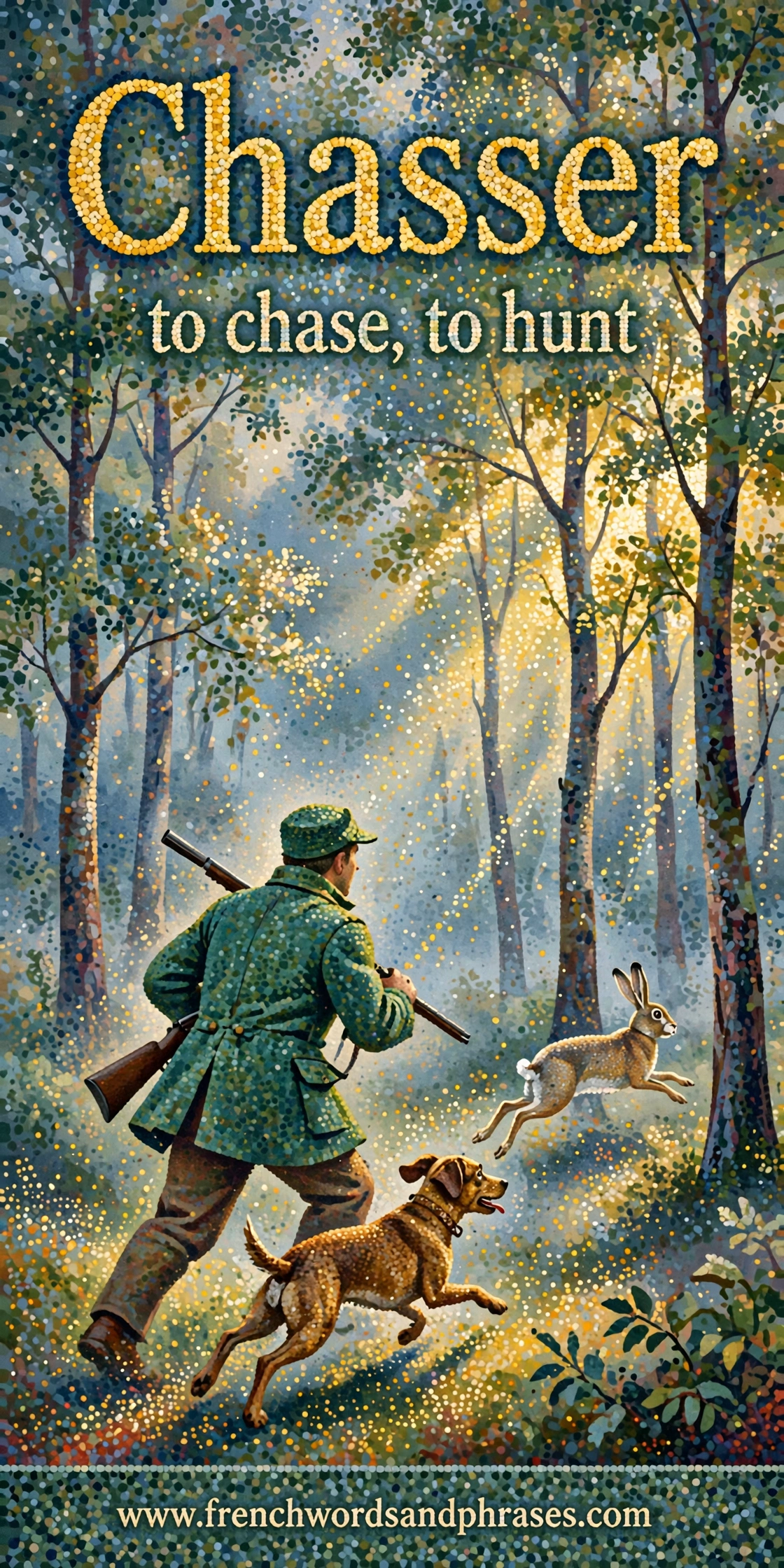
Chasser means to chase, to hunt — to pursue game through the woods, and to drive anything unwanted out of the way.
Dawn in the forest: hounds giving tongue, a stag breaking cover, the horn far behind. Chasser is the verb of the hunt — and of every lesser pursuit, from the cat after the mouse to the hand shooing flies off the table.
In this guide, you’ll learn how to conjugate chasser in all the major French tenses and moods. Explore complete conjugation tables, French examples, English translations, and practice quizzes.
Understanding the French Verb Chasser
Chasser is a regular French verb belonging to the first group of verbs, those ending in-er.
It means to chase, to hunt. It covers hunting in every form — deer, boar, partridge, butterflies — the cat’s pursuit of mice, and the figurative driving-away of clouds, worries and unwelcome people: le vent chasse les nuages, chasser les idées noires, to chase away dark thoughts.
Verb classification: First group (-er)
Auxiliary verb: Avoir
Past participle: chassé
Present participle: chassant
English equivalents: To hunt, to chase, to drive away; chasser le cerf — to hunt deer; chasser quelqu’un de quelque part — to drive someone out of a place; chasser les mouches — to shoo away the flies; la chasse — hunting, the chase; un chasseur — a hunter.
One important detail: chasser works in two directions. You chassez what you want to catch — chasser le lièvre, chasser le sanglier, with no preposition — and you chassez what you want gone, with de naming the place it must leave: chasser le renard du poulailler, chasser quelqu’un de son poste (to drive someone from their job, to sack them). The noun la chasse is hunting itself, and chasser à courre is the grand old hunt with hounds and horses. Regular throughout: je chasse, nous chassons, past participle chassé.
Experience the Word
Chasser is the verb of pursuit — something runs, something follows, and the whole world narrows to the chase.
Imagine the kitchen in August. A bluebottle circles the fruit bowl, the cat is on the table before anyone can stop him, grandmother is waving a tea towel, and the fly escapes through the window — tout le monde chasse, chacun à sa manière.
The fly is gone, the fruit is safe. It has been chassé — hunted in earnest, by an army of three.
How to Conjugate Chasser: Complete French Conjugation Guide
Let’s explore every major conjugation of chasser, beginning with the indicative mood.
How to Conjugate Chasser in the Indicative Mood
The indicative mood is used to express facts, observations, actions, and events.
How to Conjugate Chasser in the Present Tense (Présent)
Used for actions happening now, habitual actions, and general truths.
| Subject | Conjugation |
|---|---|
| je | chasse |
| tu | chasses |
| il / elle | chasse |
| nous | chassons |
| vous | chassez |
| ils / elles | chassent |
Example
Le chat chasse les souris dans la grange.
The cat hunts mice in the barn.
Quick Quiz 1
Complete the sentence:
Nous ______ la perdrix en automne.
Reveal the answer
chassons
Nous chassons la perdrix en automne.
We hunt partridge in autumn.
How to Conjugate Chasser in the Passé Composé
Used for completed actions in the past. Chasser takes the auxiliary verb avoir.
| Subject | Conjugation |
|---|---|
| j’ | ai chassé |
| tu | as chassé |
| il / elle | a chassé |
| nous | avons chassé |
| vous | avez chassé |
| ils / elles | ont chassé |
Example
Les chasseurs ont chassé le sanglier toute la journée.
The hunters chased the boar all day.
How to Conjugate Chasser in the Imparfait (Imperfect Tense)
Used for habitual past actions, descriptions, and ongoing situations in the past.
| Subject | Conjugation |
|---|---|
| je | chassais |
| tu | chassais |
| il / elle | chassait |
| nous | chassions |
| vous | chassiez |
| ils / elles | chassaient |
Example
Mon grand-père chassait le lièvre dans les champs.
My grandfather used to hunt hare in the fields.
Quick Quiz 2
Choose the correct form:
The wind drove the clouds away.
Le vent ______ les nuages. (a chassé / est chassé)
Reveal the answer
a chassé
Le vent a chassé les nuages.
Chasser takes avoir.
How to Conjugate Chasser in the Plus-que-parfait
Used to describe an action that had already been completed before another past event.
| Subject | Conjugation |
|---|---|
| j’ | avais chassé |
| tu | avais chassé |
| il / elle | avait chassé |
| nous | avions chassé |
| vous | aviez chassé |
| ils / elles | avaient chassé |
Example
Le vent avait chassé les nuages vers le nord.
The wind had driven the clouds northwards.
How to Conjugate Chasser in the Passé Simple
Primarily used in formal writing, literature, and historical narratives. It is rarely used in everyday conversation.
| Subject | Conjugation |
|---|---|
| je | chassai |
| tu | chassas |
| il / elle | chassa |
| nous | chassâmes |
| vous | chassâtes |
| ils / elles | chassèrent |
Example
Le roi chassa le cerf dans la forêt de Fontainebleau.
The king hunted the stag in the forest of Fontainebleau.
How to Conjugate Chasser in the Passé Antérieur
A literary tense used to express an action completed immediately before another past action, generally in the passé simple.
| Subject | Conjugation |
|---|---|
| j’ | eus chassé |
| tu | eus chassé |
| il / elle | eut chassé |
| nous | eûmes chassé |
| vous | eûtes chassé |
| ils / elles | eurent chassé |
Example
Quand le chien eut chassé le renard, les poules se calmèrent.
When the dog had chased the fox away, the hens calmed down.
How to Conjugate Chasser in the Future Tense (Futur Simple)
Used to describe actions that will take place in the future.
| Subject | Conjugation |
|---|---|
| je | chasserai |
| tu | chasseras |
| il / elle | chassera |
| nous | chasserons |
| vous | chasserez |
| ils / elles | chasseront |
Example
Cet automne, nous chasserons la perdrix.
This autumn, we will hunt partridge.
How to Conjugate Chasser in the Futur Antérieur (Future Perfect)
Used for an action that will have been completed before a particular point in the future.
| Subject | Conjugation |
|---|---|
| j’ | aurai chassé |
| tu | auras chassé |
| il / elle | aura chassé |
| nous | aurons chassé |
| vous | aurez chassé |
| ils / elles | auront chassé |
Example
À la tombée du jour, ils auront chassé dans tout le bois.
By nightfall, they will have hunted through the whole wood.
How to Conjugate Chasser in the Near Future (Futur Proche)
Used to describe something that is going to happen soon. Formed with aller + infinitive.
| Subject | Conjugation |
|---|---|
| je | vais chasser |
| tu | vas chasser |
| il / elle | va chasser |
| nous | allons chasser |
| vous | allez chasser |
| ils / elles | vont chasser |
Example
Le chat va chasser l’oiseau, regarde !
The cat is going to chase the bird, look!
How to Conjugate Chasser in the Conditional Mood
The conditional mood expresses what would happen under certain circumstances. It is also frequently used to make polite requests or express wishes.
How to Conjugate Chasser in the Present Conditional
| Subject | Conjugation |
|---|---|
| je | chasserais |
| tu | chasserais |
| il / elle | chasserait |
| nous | chasserions |
| vous | chasseriez |
| ils / elles | chasseraient |
Example
Sans permis, tu ne chasserais pas ici.
Without a licence, you would not hunt here.
How to Conjugate Chasser in the Past Conditional
| Subject | Conjugation |
|---|---|
| j’ | aurais chassé |
| tu | aurais chassé |
| il / elle | aurait chassé |
| nous | aurions chassé |
| vous | auriez chassé |
| ils / elles | auraient chassé |
Example
Il aurait chassé le loup si les chiens l’avaient trouvé.
He would have hunted the wolf if the dogs had found it.
Chasser in the Literary Past Conditional Form
This less common literary form uses the imperfect subjunctive of avoir.
| Subject | Conjugation |
|---|---|
| j’ | eusse chassé |
| tu | eusses chassé |
| il / elle | eût chassé |
| nous | eussions chassé |
| vous | eussiez chassé |
| ils / elles | eussent chassé |
Example
Le seigneur eût chassé le braconnier de ses terres.
The lord would have driven the poacher off his lands.
How to Conjugate Chasser in the Subjunctive Mood
The subjunctive is used to express wishes, emotions, doubts, necessity, and uncertainty. It frequently follows expressions such as il faut que (it is necessary that) or bien que (although).
How to Conjugate Chasser in the Present Subjunctive
| Subject | Conjugation |
|---|---|
| que je | chasse |
| que tu | chasses |
| qu’il / qu’elle | chasse |
| que nous | chassions |
| que vous | chassiez |
| qu’ils / qu’elles | chassent |
Example
Il est interdit que vous chassiez dans la réserve.
You are forbidden to hunt in the reserve.
Quick Quiz 3
Complete the sentence using the subjunctive:
Il ne faut pas que tu ______ dans le jardin du voisin.
Reveal the answer
chasses
Il ne faut pas que tu chasses dans le jardin du voisin.
You must not hunt in the neighbour’s garden.
How to Conjugate Chasser in the Imperfect Subjunctive
A literary tense, rarely encountered in modern spoken French.
| Subject | Conjugation |
|---|---|
| que je | chassasse |
| que tu | chassasses |
| qu’il / qu’elle | chassât |
| que nous | chassassions |
| que vous | chassassiez |
| qu’ils / qu’elles | chassassent |
Example
Le fermier ne voulait pas que le renard chassât dans son poulailler.
The farmer did not want the fox hunting in his henhouse.
How to Conjugate Chasser in the Pluperfect Subjunctive
A literary construction used to express an action completed before another past action.
| Subject | Conjugation |
|---|---|
| que j’ | eusse chassé |
| que tu | eusses chassé |
| qu’il / qu’elle | eût chassé |
| que nous | eussions chassé |
| que vous | eussiez chassé |
| qu’ils / qu’elles | eussent chassé |
Example
On racontait que le roi eût chassé le cerf blanc.
People said the king had hunted the white stag.
How to Conjugate Chasser in the Past Subjunctive
| Subject | Conjugation |
|---|---|
| que j’ | aie chassé |
| que tu | aies chassé |
| qu’il / qu’elle | ait chassé |
| que nous | ayons chassé |
| que vous | ayez chassé |
| qu’ils / qu’elles | aient chassé |
Example
Je suis étonné qu’il ait chassé toute la journée sans rien prendre.
I am amazed he hunted all day without catching anything.
How to Conjugate Chasser in the Imperative
The imperative is used to give commands, instructions, invitations, or suggestions. Subject pronouns are omitted.
How to Conjugate Chasser in the Present Imperative
| Person | Conjugation |
|---|---|
| (tu) | chasse |
| (nous) | chassons |
| (vous) | chassez |
Example
Chasse les mouches de la table !
Shoo the flies off the table!
Quick Quiz 4
How would you say Shoo the flies off the table (tu form)?
Reveal the answer
Chasse les mouches de la table !
French Participles of Chasser
Participles are verb forms that can be used in compound tenses and other grammatical constructions.
Present Participle of Chasser
chassant
En chassant le papillon, le chat a renversé le vase.
While chasing the butterfly, the cat knocked over the vase.
Past Participle of Chasser
chassé
Chassé de son village, le vieil homme partit vers le sud.
Driven from his village, the old man set off southwards.
Chasser in Everyday French: Real-Life Examples
Now that you know the conjugations, let’s see how chasser appears in everyday French.
Example 1 — Present
Le chat chasse les souris.
The cat hunts mice.
Example 2 — Passé composé
Ils ont chassé le cerf.
They hunted the stag.
Example 3 — Imparfait
Nous chassions la perdrix en automne.
We used to hunt partridge in autumn.
Example 4 — Future
Tu chasseras les mouches de la cuisine.
You will shoo the flies out of the kitchen.
Example 5 — Conditional
Je chasserais le sanglier avec un bon chien.
I would hunt boar with a good dog.
Example 6 — Imperative
Chasse ce chien du jardin !
Chase that dog out of the garden!
Beyond Translation: The Meaning of Chasser
English borrowed this verb twice: chase came from chasser itself, and catch from its Norman twin — both go back to Latin captiare, to try to seize.
Chassez le naturel, il revient au galop.
So runs the famous proverb: drive nature out, and it gallops back. Learn chasser and you hold both halves of the idea — the pursuit of what you want, and the banishing of what you do not.
How to Remember the French Verb Chasser
Remember it this way: Chasser is about the hunter in the woods — and shooing flies off the table.
- Two directions: chasser le cerf (pursue it) and chasser quelqu’un de la maison (drive them out — de marks the place left).
- La chasse is hunting itself; un chasseur is the hunter.
- Regular -er: je chasse, nous chassons, past participle chassé.
The key idea is the hunter in the woods — and shooing flies off the table.
Test Your Knowledge of Chasser
Let’s see how much you’ve learned. Try answering these questions before revealing the answers.
Question 1
Which preposition appears when chasser means to drive someone out?
Reveal the answer
De — chasser quelqu’un de son poste, to drive someone from their job.
Question 2
How do you say The cat hunts mice in French?
Reveal the answer
Le chat chasse les souris.
Question 3
Translate: They hunted the stag.
Reveal the answer
Ils ont chassé le cerf.
Question 4
What is the past participle of chasser?
Reveal the answer
Chassé.
Question 5
Complete the sentence:
Il est interdit que vous ______ dans la réserve.
Reveal the answer
chassiez
Il est interdit que vous chassiez dans la réserve.
You are forbidden to hunt in the reserve.
Your Final Challenge
Can You Use It?
How would you say this in French?
The cat hunts the shadows in the garden, certain that one of them will end up running.
Reveal the answer
Le chat chasse les ombres du jardin, certain que l’une d’elles finira par courir.
The cat hunts the shadows in the garden, certain that one of them will end up running.
A little French. A little curiosity. A richer everyday life.
LEARN FRENCH ONE WORD AT A TIME