A French Word to Live By
How to Conjugate Se charger in French
/sə ʃaʁ.ʒe/
Se charger means to take charge of — to lift a task onto your own shoulders and say: leave it to me.
A colleague drowning in files at six in the evening, a family move, a neighbour’s dog to feed during the holidays — se charger de is the moment someone steps forward, raises a hand, and takes a burden onto themselves.
In this guide, you’ll learn how to conjugate se charger in all the major French tenses and moods. Explore complete conjugation tables, French examples, English translations, and practice quizzes.
Understanding the French Verb Se charger
Se charger is a regular French verb belonging to the first group of verbs, those ending in-er.
It means to take charge of. This is the everyday workhorse of French helpfulness — at home, at work, among friends. Je m’en charge covers shopping, bookings, phone calls, children and crises; it promises not just willingness but ownership: the task is now mine, and you can stop thinking about it.
Verb classification: First group (-er), reflexive
Auxiliary verb: Être
Past participle: chargé
Present participle: chargeant
English equivalents: To take charge of, to see to, to take care of; se charger de quelque chose — to take charge of something; se charger de faire quelque chose — to take it upon oneself to do something; je m’en charge — leave it to me, I’ll take care of it; se charger des courses — to do the shopping; se charger des enfants — to look after the children.
One important detail: se charger de is the reflexive twin of charger quelqu’un de — instead of being entrusted with a task, you entrust yourself with it. Its crown jewel is the formula je m’en charge, where en replaces the task: leave it to me, I’ll handle it. The -ger spelling rule survives intact — nous nous chargeons, en nous chargeant — and, being reflexive, every compound tense takes être with the participle agreeing: elle s’est chargée des billets. It is followed by de plus a noun, or de plus an infinitive: se charger des enfants, se charger de réserver.
Experience the Word
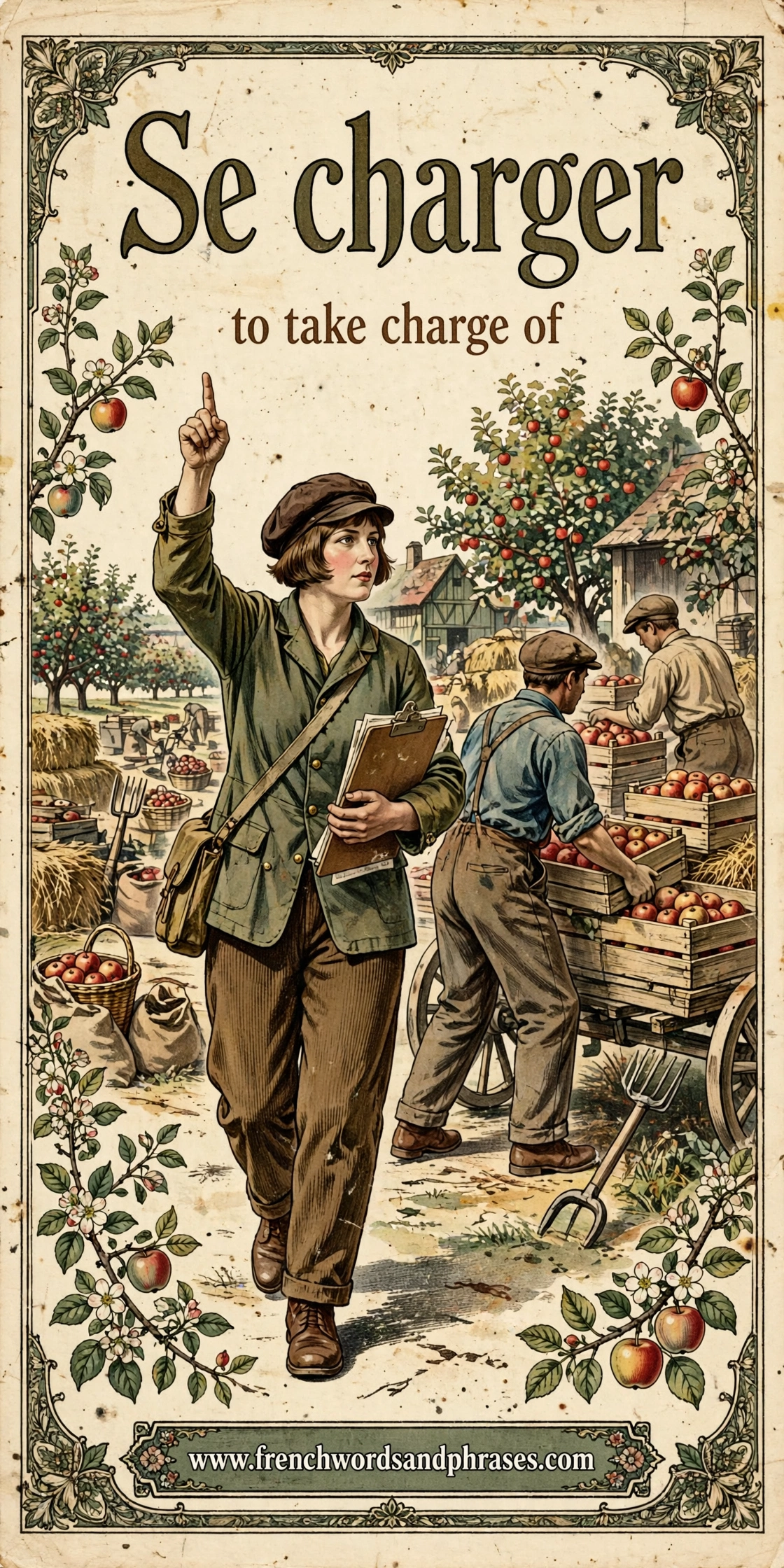
Se charger is the verb of the raised hand — the load nobody wanted, taken on by somebody, willingly.
Imagine an office on a Friday evening. A client file lands on the desk at six o’clock and the whole room goes quiet — until Karim raises a hand: « Je m’en charge. » Shoulders drop, coats come off hooks, and the weekend is saved by three small words.
Nobody ordered him. He took charge — il s’est chargé du dossier — and the burden changed shoulders.
How to Conjugate Se charger: Complete French Conjugation Guide
Let’s explore every major conjugation of se charger, beginning with the indicative mood.
How to Conjugate Se charger in the Indicative Mood
The indicative mood is used to express facts, observations, actions, and events.
How to Conjugate Se charger in the Present Tense (Présent)
Used for actions happening now, habitual actions, and general truths.
| Subject | Conjugation |
|---|---|
| je | me charge |
| tu | te charges |
| il / elle | se charge |
| nous | nous chargeons |
| vous | vous chargez |
| ils / elles | se chargent |
Example
Je me charge des billets, ne t’inquiète pas.
I’ll take care of the tickets, do not worry.
Quick Quiz 1
Complete the sentence:
Nous nous ______ des courses ce week-end.
Reveal the answer
chargeons
Nous nous chargeons des courses ce week-end.
We are taking care of the shopping this weekend — the e keeps the g soft.
How to Conjugate Se charger in the Passé Composé
Used for completed actions in the past. Se charger takes the auxiliary verb être.
| Subject | Conjugation |
|---|---|
| je | me suis chargé / me suis chargée |
| tu | t’es chargé / t’es chargée |
| il / elle | s’est chargé / s’est chargée |
| nous | nous sommes chargés / nous sommes chargées |
| vous | vous êtes chargés / vous êtes chargées / vous êtes chargé / vous êtes chargée |
| ils / elles | se sont chargés / se sont chargées |
Example
Elle s’est chargée de toute l’organisation.
She took charge of the whole organisation.
How to Conjugate Se charger in the Imparfait (Imperfect Tense)
Used for habitual past actions, descriptions, and ongoing situations in the past.
| Subject | Conjugation |
|---|---|
| je | me chargeais |
| tu | te chargeais |
| il / elle | se chargeait |
| nous | nous chargions |
| vous | vous chargiez |
| ils / elles | se chargeaient |
Example
Chaque été, il se chargeait des enfants pendant les vacances.
Every summer, he used to look after the children during the holidays.
Quick Quiz 2
Choose the correct form:
She took charge of the organisation.
Elle ______ de l’organisation. (s’est chargée / a chargé)
Reveal the answer
s’est chargée
Elle s’est chargée de l’organisation.
Se charger is reflexive, takes être, and the participle agrees: chargée.
How to Conjugate Se charger in the Plus-que-parfait
Used to describe an action that had already been completed before another past event.
| Subject | Conjugation |
|---|---|
| je | m’étais chargé / m’étais chargée |
| tu | t’étais chargé / t’étais chargée |
| il / elle | s’était chargé / s’était chargée |
| nous | nous étions chargés / nous étions chargées |
| vous | vous étiez chargés / vous étiez chargées / vous étiez chargé / vous étiez chargée |
| ils / elles | s’étaient chargés / s’étaient chargées |
Example
Ils s’étaient chargés des courses avant notre arrivée.
They had taken care of the shopping before we arrived.
How to Conjugate Se charger in the Passé Simple
Primarily used in formal writing, literature, and historical narratives. It is rarely used in everyday conversation.
| Subject | Conjugation |
|---|---|
| je | me chargeai |
| tu | te chargeas |
| il / elle | se chargea |
| nous | nous chargeâmes |
| vous | vous chargeâtes |
| ils / elles | se chargeèrent |
Example
Sans hésiter, elle se chargea du dossier le plus difficile.
Without hesitating, she took charge of the hardest file.
How to Conjugate Se charger in the Passé Antérieur
A literary tense used to express an action completed immediately before another past action, generally in the passé simple.
| Subject | Conjugation |
|---|---|
| je | me fus chargé / me fus chargée |
| tu | te fus chargé / te fus chargée |
| il / elle | se fut chargé / se fut chargée |
| nous | nous fûmes chargés / nous fûmes chargées |
| vous | vous fûtes chargés / vous fûtes chargées / vous fûtes chargé / vous fûtes chargée |
| ils / elles | se furent chargés / se furent chargées |
Example
Dès qu’il se fut chargé de l’affaire, tout s’accéléra.
As soon as he had taken charge of the matter, everything speeded up.
How to Conjugate Se charger in the Future Tense (Futur Simple)
Used to describe actions that will take place in the future.
| Subject | Conjugation |
|---|---|
| je | me chargerai |
| tu | te chargeras |
| il / elle | se chargera |
| nous | nous chargerons |
| vous | vous chargerez |
| ils / elles | se chargeront |
Example
Ne t’en fais pas, je me chargerai des réservations.
Do not worry, I will take care of the bookings.
How to Conjugate Se charger in the Futur Antérieur (Future Perfect)
Used for an action that will have been completed before a particular point in the future.
| Subject | Conjugation |
|---|---|
| je | me serai chargé / me serai chargée |
| tu | te seras chargé / te seras chargée |
| il / elle | se sera chargé / se sera chargée |
| nous | nous serons chargés / nous serons chargées |
| vous | vous serez chargés / vous serez chargées / vous serez chargé / vous serez chargée |
| ils / elles | se seront chargés / se seront chargées |
Example
À ton retour, nous nous serons chargés de tout.
By the time you get back, we will have taken care of everything.
How to Conjugate Se charger in the Near Future (Futur Proche)
Used to describe something that is going to happen soon. Formed with aller + infinitive.
| Subject | Conjugation |
|---|---|
| je | vais me charger |
| tu | vas te charger |
| il / elle | va se charger |
| nous | allons nous charger |
| vous | allez vous charger |
| ils / elles | vont se charger |
Example
Tu vas te charger du gâteau, d’accord ?
You are going to take care of the cake, all right?
How to Conjugate Se charger in the Conditional Mood
The conditional mood expresses what would happen under certain circumstances. It is also frequently used to make polite requests or express wishes.
How to Conjugate Se charger in the Present Conditional
| Subject | Conjugation |
|---|---|
| je | me chargerais |
| tu | te chargerais |
| il / elle | se chargerait |
| nous | nous chargerions |
| vous | vous chargeriez |
| ils / elles | se chargeraient |
Example
Avec plus de temps, je me chargerais volontiers de la cuisine.
With more time, I would gladly take charge of the cooking.
How to Conjugate Se charger in the Past Conditional
| Subject | Conjugation |
|---|---|
| je | me serais chargé / me serais chargée |
| tu | te serais chargé / te serais chargée |
| il / elle | se serait chargé / se serait chargée |
| nous | nous serions chargés / nous serions chargées |
| vous | vous seriez chargés / vous seriez chargées / vous seriez chargé / vous seriez chargée |
| ils / elles | se seraient chargés / se seraient chargées |
Example
Elle se serait chargée des enfants si on le lui avait demandé.
She would have looked after the children if she had been asked.
Se charger in the Literary Past Conditional Form
This less common literary form uses the imperfect subjunctive of être.
| Subject | Conjugation |
|---|---|
| je | me fusse chargé / me fusse chargée |
| tu | te fusses chargé / te fusses chargée |
| il / elle | se fût chargé / se fût chargée |
| nous | nous fussions chargés / nous fussions chargées |
| vous | vous fussiez chargés / vous fussiez chargées / vous fussiez chargé / vous fussiez chargée |
| ils / elles | se fussent chargés / se fussent chargées |
Example
Il se fût chargé de la mission sans l’intervention du directeur.
He would have taken charge of the mission without the director’s intervention.
How to Conjugate Se charger in the Subjunctive Mood
The subjunctive is used to express wishes, emotions, doubts, necessity, and uncertainty. It frequently follows expressions such as il faut que (it is necessary that) or bien que (although).
How to Conjugate Se charger in the Present Subjunctive
| Subject | Conjugation |
|---|---|
| que je | me charge |
| que tu | te charges |
| qu’il / qu’elle | se charge |
| que nous | nous chargions |
| que vous | vous chargiez |
| qu’ils / qu’elles | se chargent |
Example
Il faut que quelqu’un se charge des invitations.
Someone must take care of the invitations.
Quick Quiz 3
Complete the sentence using the subjunctive:
Il faut que tu te ______ des billets.
Reveal the answer
charges
Il faut que tu te charges des billets.
You must take care of the tickets.
How to Conjugate Se charger in the Imperfect Subjunctive
A literary tense, rarely encountered in modern spoken French.
| Subject | Conjugation |
|---|---|
| que je | me chargasse |
| que tu | te chargasses |
| qu’il / qu’elle | se chargât |
| que nous | nous chargassions |
| que vous | vous chargassiez |
| qu’ils / qu’elles | se chargassent |
Example
Je doutais qu’elle se chargeât seule de tout le déménagement.
I doubted she would take charge of the whole move on her own.
How to Conjugate Se charger in the Pluperfect Subjunctive
A literary construction used to express an action completed before another past action.
| Subject | Conjugation |
|---|---|
| que je | me fusse chargé / me fusse chargée |
| que tu | te fusses chargé / te fusses chargée |
| qu’il / qu’elle | se fût chargé / se fût chargée |
| que nous | nous fussions chargés / nous fussions chargées |
| que vous | vous fussiez chargés / vous fussiez chargées / vous fussiez chargé / vous fussiez chargée |
| qu’ils / qu’elles | se fussent chargés / se fussent chargées |
Example
On admirait qu’ils se fussent chargés des orphelins pendant la guerre.
People admired that they had taken the orphans into their care during the war.
How to Conjugate Se charger in the Past Subjunctive
| Subject | Conjugation |
|---|---|
| que je | me sois chargé / me sois chargée |
| que tu | te sois chargé / te sois chargée |
| qu’il / qu’elle | se soit chargé / se soit chargée |
| que nous | nous soyons chargés / nous soyons chargées |
| que vous | vous soyez chargés / vous soyez chargées / vous soyez chargé / vous soyez chargée |
| qu’ils / qu’elles | se soient chargés / se soient chargées |
Example
Je suis reconnaissant qu’il se soit chargé des démarches.
I am grateful he took care of the paperwork.
How to Conjugate Se charger in the Imperative
The imperative is used to give commands, instructions, invitations, or suggestions. Subject pronouns are omitted.
How to Conjugate Se charger in the Present Imperative
| Person | Conjugation |
|---|---|
| (tu) | charge-toi |
| (nous) | chargeons-nous |
| (vous) | chargez-vous |
Example
Charge-toi des courses, je m’occupe du reste !
Take care of the shopping, I’ll handle the rest!
Quick Quiz 4
How would you say Take care of the shopping (tu form)?
Reveal the answer
Charge-toi des courses !
French Participles of Se charger
Participles are verb forms that can be used in compound tenses and other grammatical constructions.
Present Participle of Se charger
chargeant
En se chargeant de tout, elle finit épuisée.
By taking charge of everything, she ends up exhausted.
Past Participle of Se charger
chargé
Chargée des invitations, elle a passé la soirée au téléphone.
In charge of the invitations, she spent the evening on the phone.
Se charger in Everyday French: Real-Life Examples
Now that you know the conjugations, let’s see how se charger appears in everyday French.
Example 1 — Present
Je me charge des billets.
I’ll take care of the tickets.
Example 2 — Passé composé
Elle s’est chargée de l’organisation.
She took charge of the organisation.
Example 3 — Imparfait
Il se chargeait des enfants chaque été.
He used to look after the children every summer.
Example 4 — Future
Je me chargerai des réservations.
I will take care of the bookings.
Example 5 — Conditional
Je me chargerais volontiers de la cuisine.
I would gladly take charge of the cooking.
Example 6 — Imperative
Charge-toi des courses !
Take care of the shopping!
Beyond Translation: The Meaning of Se charger
Charger lays a load on someone else’s back; se charger lifts it onto your own.
Je m’en charge — three words that end a crisis.
The little word en swallows the whole task — the shopping, the booking, the problem — and the reflexive pronoun does the rest: the burden has a new owner, and everyone else in the room can breathe again.
How to Remember the French Verb Se charger
Remember it this way: Se charger is about a hand raised in the office — je m’en charge.
- The formula to keep for life: je m’en charge — leave it to me. The en swallows the task whole.
- Always reflexive, always être: elle s’est chargée des billets — and the participle agrees with the subject.
- The -ger e survives: nous nous chargeons, en nous chargeant — and the construction is se charger de + noun or infinitive.
The key idea is a hand raised in the office — je m’en charge.
Test Your Knowledge of Se charger
Let’s see how much you’ve learned. Try answering these questions before revealing the answers.
Question 1
How do you say Leave it to me in French, using se charger?
Reveal the answer
Je m’en charge — literally, I take charge of it myself.
Question 2
How do you say She took charge of the whole organisation in French?
Reveal the answer
Elle s’est chargée de toute l’organisation.
Question 3
Translate: I will take care of the bookings.
Reveal the answer
Je me chargerai des réservations.
Question 4
What is the past participle of se charger?
Reveal the answer
Chargé — agreeing: chargée, chargés, chargées.
Question 5
Complete the sentence:
Il faut que quelqu’un se ______ des invitations.
Reveal the answer
charge
Il faut que quelqu’un se charge des invitations.
Someone must take care of the invitations.
Your Final Challenge
Can You Use It?
How would you say this in French?
She takes charge of everything, a smile on her lips, and the whole house stays standing.
Reveal the answer
Elle se charge de tout, un sourire aux lèvres, et la maison entière tient debout.
She takes charge of everything, a smile on her lips, and the whole house stays standing.
A little French. A little curiosity. A richer everyday life.
LEARN FRENCH ONE WORD AT A TIME