A French Word to Live By
How to Conjugate Charcuter in French
/ʃaʁ.ky.te/
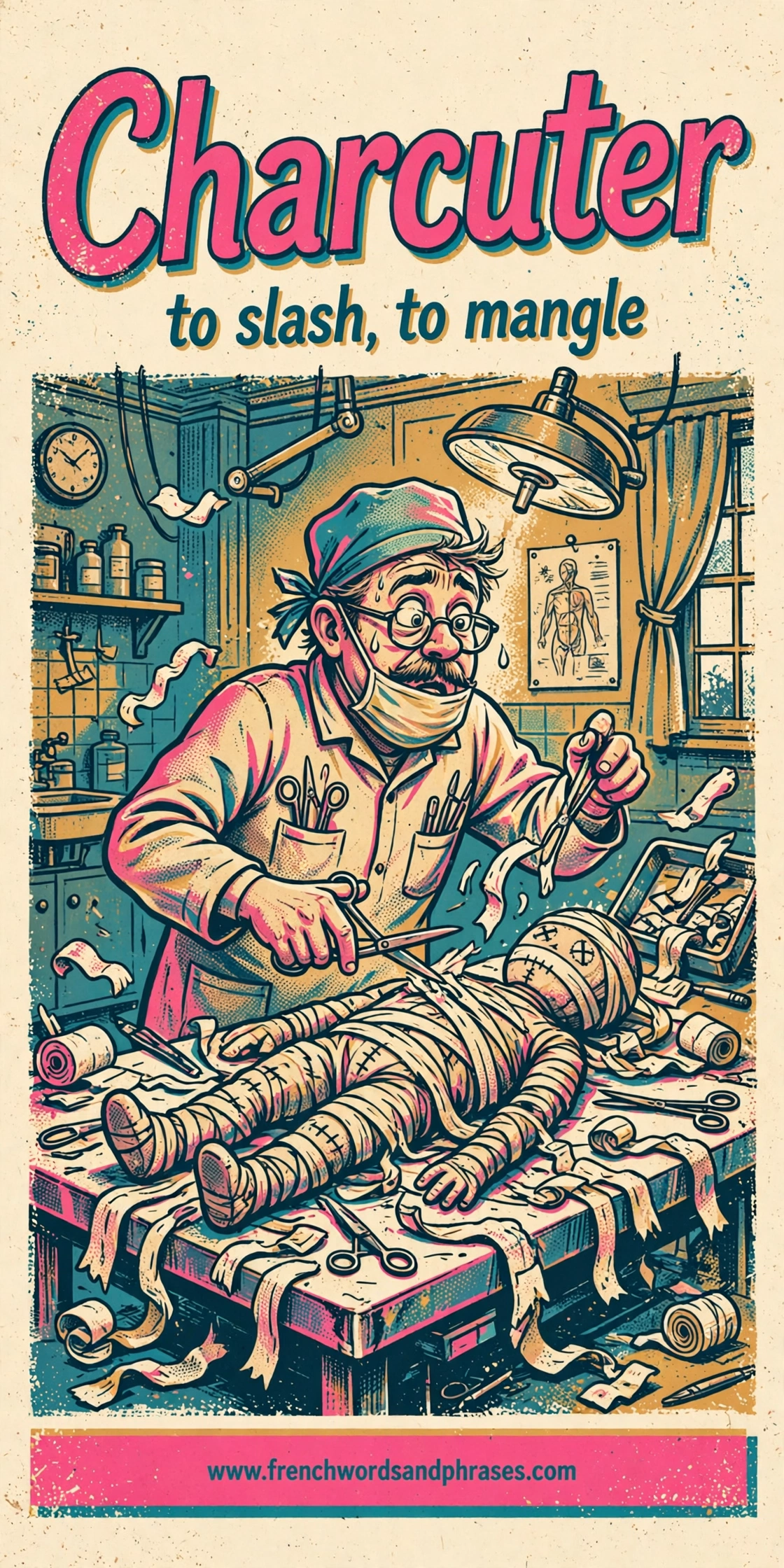
Charcuter means to slash, to mangle — to cut something up roughly and badly, the way a clumsy butcher hacks at meat.
A surgeon in a hurry, a film editor hacking a story to pieces, a cook ruining a roast with a blunt knife — charcuter is the verb of the heavy-handed cut: whatever it touches comes out mangled, and somebody always complains.
In this guide, you’ll learn how to conjugate charcuter in all the major French tenses and moods. Explore complete conjugation tables, French examples, English translations, and practice quizzes.
Understanding the French Verb Charcuter
Charcuter is a regular French verb belonging to the first group of verbs, those ending in-er.
It means to slash, to mangle. Everyday French uses it mostly as a complaint: a botched operation, a mutilated article, a film destroyed in the cutting room, a disastrous haircut. Charcuter always says the cutting was rough, hurried and damaging — the opposite of découper, to carve neatly.
Verb classification: First group (-er)
Auxiliary verb: Avoir
Past participle: charcuté
Present participle: charcutant
English equivalents: To slash, to mangle, to hack up; charcuter la viande — to hack up the meat; charcuter un texte — to hack a text to pieces; charcuter un film — to mangle a film in the editing; se faire charcuter — to be butchered (fam., of an operation); un charcutier — a pork butcher.
One important detail: charcuter comes from la charcuterie, the pork butcher’s trade — from old French chair cuite, cooked flesh. A real charcutier is an artist; the verb keeps his knife but loses his art, and it is familiar in tone whenever it is aimed at people: se faire charcuter par un chirurgien, to be butchered by a surgeon, charcuter un texte, to hack a text about. With actual meat on the block it is merely descriptive. The verb itself is a regular -er.
Experience the Word
Charcuter is the verb of the blunt knife — the cut that destroys what it was supposed to divide.
Imagine a young writer opening the parcel from her editor. Page after page comes back crossed out, reordered, amputated: il a charcuté son roman — whole chapters gone, sentences beheaded — and she stands in the kitchen holding the remains of two years’ work.
The book is shorter, certainly. It has been mangled — charcuté — and it will take another year to heal.
How to Conjugate Charcuter: Complete French Conjugation Guide
Let’s explore every major conjugation of charcuter, beginning with the indicative mood.
How to Conjugate Charcuter in the Indicative Mood
The indicative mood is used to express facts, observations, actions, and events.
How to Conjugate Charcuter in the Present Tense (Présent)
Used for actions happening now, habitual actions, and general truths.
| Subject | Conjugation |
|---|---|
| je | charcute |
| tu | charcutes |
| il / elle | charcute |
| nous | charcutons |
| vous | charcutez |
| ils / elles | charcutent |
Example
Ce chirurgien charcute tous ses patients, dit-on.
That surgeon butchers all his patients, so they say.
Quick Quiz 1
Complete the sentence:
Ce monteur ______ tous les films qu’on lui confie.
Reveal the answer
charcute
Ce monteur charcute tous les films qu’on lui confie.
That editor mangles every film entrusted to him.
How to Conjugate Charcuter in the Passé Composé
Used for completed actions in the past. Charcuter takes the auxiliary verb avoir.
| Subject | Conjugation |
|---|---|
| j’ | ai charcuté |
| tu | as charcuté |
| il / elle | a charcuté |
| nous | avons charcuté |
| vous | avez charcuté |
| ils / elles | ont charcuté |
Example
L’éditeur a charcuté mon roman sans pitié.
The editor hacked my novel to pieces without mercy.
How to Conjugate Charcuter in the Imparfait (Imperfect Tense)
Used for habitual past actions, descriptions, and ongoing situations in the past.
| Subject | Conjugation |
|---|---|
| je | charcutais |
| tu | charcutais |
| il / elle | charcutait |
| nous | charcutions |
| vous | charcutiez |
| ils / elles | charcutaient |
Example
Avec son vieux couteau, il charcutait le poulet au lieu de le découper.
With his old knife, he used to hack the chicken up instead of carving it.
Quick Quiz 2
Choose the correct form:
The editor hacked my novel to pieces.
L’éditeur ______ mon roman. (a charcuté / est charcuté)
Reveal the answer
a charcuté
L’éditeur a charcuté mon roman.
Charcuter takes avoir.
How to Conjugate Charcuter in the Plus-que-parfait
Used to describe an action that had already been completed before another past event.
| Subject | Conjugation |
|---|---|
| j’ | avais charcuté |
| tu | avais charcuté |
| il / elle | avait charcuté |
| nous | avions charcuté |
| vous | aviez charcuté |
| ils / elles | avaient charcuté |
Example
Le monteur avait charcuté le film avant sa sortie.
The editor had mangled the film before its release.
How to Conjugate Charcuter in the Passé Simple
Primarily used in formal writing, literature, and historical narratives. It is rarely used in everyday conversation.
| Subject | Conjugation |
|---|---|
| je | charcutai |
| tu | charcutas |
| il / elle | charcuta |
| nous | charcutâmes |
| vous | charcutâtes |
| ils / elles | charcutèrent |
Example
Le boucher charcuta la pièce de bœuf en quelques coups.
The butcher hacked the piece of beef up in a few blows.
How to Conjugate Charcuter in the Passé Antérieur
A literary tense used to express an action completed immediately before another past action, generally in the passé simple.
| Subject | Conjugation |
|---|---|
| j’ | eus charcuté |
| tu | eus charcuté |
| il / elle | eut charcuté |
| nous | eûmes charcuté |
| vous | eûtes charcuté |
| ils / elles | eurent charcuté |
Example
Quand il eut charcuté la viande, il ne restait que des morceaux informes.
When he had hacked the meat up, only shapeless pieces remained.
How to Conjugate Charcuter in the Future Tense (Futur Simple)
Used to describe actions that will take place in the future.
| Subject | Conjugation |
|---|---|
| je | charcuterai |
| tu | charcuteras |
| il / elle | charcutera |
| nous | charcuterons |
| vous | charcuterez |
| ils / elles | charcuteront |
Example
Si tu utilises ce couteau, tu charcuteras le rôti.
If you use that knife, you will mangle the roast.
How to Conjugate Charcuter in the Futur Antérieur (Future Perfect)
Used for an action that will have been completed before a particular point in the future.
| Subject | Conjugation |
|---|---|
| j’ | aurai charcuté |
| tu | auras charcuté |
| il / elle | aura charcuté |
| nous | aurons charcuté |
| vous | aurez charcuté |
| ils / elles | auront charcuté |
Example
À la fin du montage, ils auront charcuté la moitié du film.
By the end of editing, they will have cut half the film to pieces.
How to Conjugate Charcuter in the Near Future (Futur Proche)
Used to describe something that is going to happen soon. Formed with aller + infinitive.
| Subject | Conjugation |
|---|---|
| je | vais charcuter |
| tu | vas charcuter |
| il / elle | va charcuter |
| nous | allons charcuter |
| vous | allez charcuter |
| ils / elles | vont charcuter |
Example
Pose ce couteau, tu vas charcuter le pain !
Put that knife down, you are going to hack the bread to pieces!
How to Conjugate Charcuter in the Conditional Mood
The conditional mood expresses what would happen under certain circumstances. It is also frequently used to make polite requests or express wishes.
How to Conjugate Charcuter in the Present Conditional
| Subject | Conjugation |
|---|---|
| je | charcuterais |
| tu | charcuterais |
| il / elle | charcuterait |
| nous | charcuterions |
| vous | charcuteriez |
| ils / elles | charcuteraient |
Example
Un vrai boucher ne charcuterait jamais une belle pièce.
A real butcher would never hack up a fine cut.
How to Conjugate Charcuter in the Past Conditional
| Subject | Conjugation |
|---|---|
| j’ | aurais charcuté |
| tu | aurais charcuté |
| il / elle | aurait charcuté |
| nous | aurions charcuté |
| vous | auriez charcuté |
| ils / elles | auraient charcuté |
Example
Le chirurgien aurait charcuté l’opération sans son assistante.
The surgeon would have botched the operation without his assistant.
Charcuter in the Literary Past Conditional Form
This less common literary form uses the imperfect subjunctive of avoir.
| Subject | Conjugation |
|---|---|
| j’ | eusse charcuté |
| tu | eusses charcuté |
| il / elle | eût charcuté |
| nous | eussions charcuté |
| vous | eussiez charcuté |
| ils / elles | eussent charcuté |
Example
Il eût charcuté le texte sans l’œil de son éditeur.
He would have hacked the text to pieces without his editor’s eye.
How to Conjugate Charcuter in the Subjunctive Mood
The subjunctive is used to express wishes, emotions, doubts, necessity, and uncertainty. It frequently follows expressions such as il faut que (it is necessary that) or bien que (although).
How to Conjugate Charcuter in the Present Subjunctive
| Subject | Conjugation |
|---|---|
| que je | charcute |
| que tu | charcutes |
| qu’il / qu’elle | charcute |
| que nous | charcutions |
| que vous | charcutiez |
| qu’ils / qu’elles | charcutent |
Example
Je ne veux pas que ce coiffeur me charcute les cheveux.
I do not want that hairdresser to butcher my hair.
Quick Quiz 3
Complete the sentence using the subjunctive:
Je ne veux pas que ce coiffeur me ______ les cheveux.
Reveal the answer
charcute
Je ne veux pas que ce coiffeur me charcute les cheveux.
I do not want that hairdresser to butcher my hair.
How to Conjugate Charcuter in the Imperfect Subjunctive
A literary tense, rarely encountered in modern spoken French.
| Subject | Conjugation |
|---|---|
| que je | charcutasse |
| que tu | charcutasses |
| qu’il / qu’elle | charcutât |
| que nous | charcutassions |
| que vous | charcutassiez |
| qu’ils / qu’elles | charcutassent |
Example
Elle craignait que le chirurgien ne charcutât son genou.
She feared the surgeon might butcher her knee.
How to Conjugate Charcuter in the Pluperfect Subjunctive
A literary construction used to express an action completed before another past action.
| Subject | Conjugation |
|---|---|
| que j’ | eusse charcuté |
| que tu | eusses charcuté |
| qu’il / qu’elle | eût charcuté |
| que nous | eussions charcuté |
| que vous | eussiez charcuté |
| qu’ils / qu’elles | eussent charcuté |
Example
On disait que le monteur eût charcuté le film par vengeance.
It was said the editor had mangled the film out of revenge.
How to Conjugate Charcuter in the Past Subjunctive
| Subject | Conjugation |
|---|---|
| que j’ | aie charcuté |
| que tu | aies charcuté |
| qu’il / qu’elle | ait charcuté |
| que nous | ayons charcuté |
| que vous | ayez charcuté |
| qu’ils / qu’elles | aient charcuté |
Example
Dommage que l’éditeur ait charcuté ton article !
A shame the editor hacked your article to pieces!
How to Conjugate Charcuter in the Imperative
The imperative is used to give commands, instructions, invitations, or suggestions. Subject pronouns are omitted.
How to Conjugate Charcuter in the Present Imperative
| Person | Conjugation |
|---|---|
| (tu) | charcute |
| (nous) | charcutons |
| (vous) | charcutez |
Example
Ne charcute pas le rôti, découpe-le proprement !
Do not hack the roast up, carve it properly!
Quick Quiz 4
How would you say Do not hack the roast up (tu form)?
Reveal the answer
Ne charcute pas le rôti !
French Participles of Charcuter
Participles are verb forms that can be used in compound tenses and other grammatical constructions.
Present Participle of Charcuter
charcutant
En charcutant le texte, il en a perdu le fil.
By hacking the text about, he lost its thread.
Past Participle of Charcuter
charcuté
Charcuté par un apprenti, le jambon était méconnaissable.
Hacked up by an apprentice, the ham was unrecognisable.
Charcuter in Everyday French: Real-Life Examples
Now that you know the conjugations, let’s see how charcuter appears in everyday French.
Example 1 — Present
Ce chirurgien charcute ses patients, paraît-il.
That surgeon butchers his patients, apparently.
Example 2 — Passé composé
L’éditeur a charcuté mon article.
The editor hacked my article to pieces.
Example 3 — Imparfait
Il charcutait le poulet avec un vieux couteau.
He used to hack the chicken up with an old knife.
Example 4 — Future
Tu charcuteras le rôti avec ce couteau.
You will mangle the roast with that knife.
Example 5 — Conditional
Un vrai professionnel ne charcuterait jamais ce texte.
A real professional would never hack this text up.
Example 6 — Imperative
Ne charcute pas le pain !
Do not hack the bread to pieces!
Beyond Translation: The Meaning of Charcuter
Chair is flesh and cuite is cooked: charcuterie began as the honourable art of turning pork into pâtés, hams and sausages.
The verb kept the knife and lost the art.
A charcutier prepares meat with respect; to charcuter is to attack it — and by extension any text, film, operation or head of hair that falls into clumsy hands comes out charcuté.
How to Remember the French Verb Charcuter
Remember it this way: Charcuter is about the butcher’s knife in clumsy hands.
- Picture a bad butcher with a blunt knife: charcuter is cutting that destroys — meat, texts, films, hair.
- In complaints it is familiar in tone: se faire charcuter is to be butchered, by a surgeon or a hairdresser.
- Regular -er: je charcute, nous charcutons, past participle charcuté.
The key idea is the butcher’s knife in clumsy hands.
Test Your Knowledge of Charcuter
Let’s see how much you’ve learned. Try answering these questions before revealing the answers.
Question 1
Where does charcuter come from, and what trade does it borrow its knife from?
Reveal the answer
La charcuterie — the pork butcher’s trade (chair cuite, cooked flesh); the verb is that trade done badly.
Question 2
How do you say The editor hacked my article to pieces in French?
Reveal the answer
L’éditeur a charcuté mon article.
Question 3
Translate: If you use that knife, you will mangle the roast.
Reveal the answer
Si tu utilises ce couteau, tu charcuteras le rôti.
Question 4
What is the past participle of charcuter?
Reveal the answer
Charcuté.
Question 5
Complete the sentence:
Je ne veux pas que ce coiffeur me ______ les cheveux.
Reveal the answer
charcute
Je ne veux pas que ce coiffeur me charcute les cheveux.
I do not want that hairdresser to butcher my hair.
Your Final Challenge
Can You Use It?
How would you say this in French?
The editor hacked the manuscript to pieces, but the story itself survived.
Reveal the answer
L’éditeur a charcuté le manuscrit, mais l’histoire, elle, a survécu.
The editor hacked the manuscript to pieces, but the story itself survived.
A little French. A little curiosity. A richer everyday life.
LEARN FRENCH ONE WORD AT A TIME