A French Word to Live By
How to Conjugate Chaptaliser in French
/ʃap.ta.li.ze/
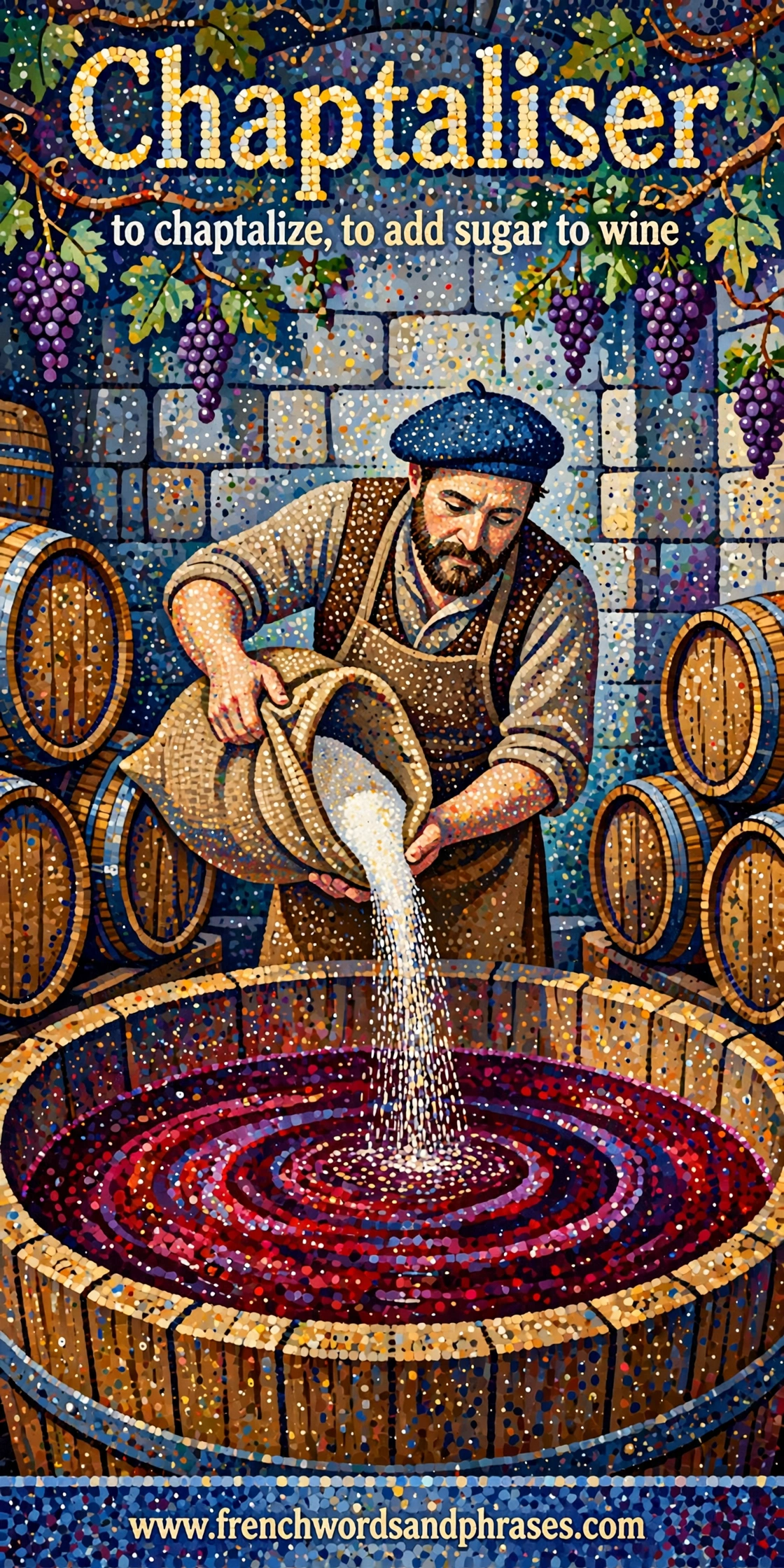
Chaptaliser means to chaptalize, to add sugar to wine — to stir sugar into the grape must before fermentation, so the finished wine gains a little more alcohol.
A cool September in the Loire valley, grapes short on sun and short on sugar, and a winemaker reaching thoughtfully for the sugar sack — chaptaliser is the cellar technique that rescues a thin vintage: sugar in the must today, a degree more in the glass next year.
In this guide, you’ll learn how to conjugate chaptaliser in all the major French tenses and moods. Explore complete conjugation tables, French examples, English translations, and practice quizzes.
Understanding the French Verb Chaptaliser
Chaptaliser is a regular French verb belonging to the first group of verbs, those ending in-er.
It means to chaptalize, to add sugar to wine. This is a winemaker’s technical term: you will meet it on cellar tours, in wine law and in arguments about climate, not at the dinner table. Northern vineyards in cool years chaptalise; southern ones, ripening under a hotter sun, almost never need to — and as summers warm, the verb is heard less and less.
Verb classification: First group (-er)
Auxiliary verb: Avoir
Past participle: chaptalisé
Present participle: chaptalisant
English equivalents: To chaptalize, to add sugar to (wine must); chaptaliser un moût — to add sugar to a must; la chaptalisation — chaptalization; un vin chaptalisé — a chaptalized wine; chaptaliser dans les limites légales — to chaptalize within the legal limits.
One important detail: chaptaliser carries a man’s name — Jean-Antoine Chaptal, chemist and minister under Napoleon, who promoted the method around 1800. And the method has a strict rule: the sugar goes into the unfermented must, le moût, never into finished wine, and it is not there to sweeten — fermentation turns it into alcohol, raising the wine by a degree or so. In France the practice is declared, measured and tightly regulated, and in warm regions and warm years it is unnecessary or forbidden. The verb itself is a regular -er, with an s that sounds like a z: chaptaliser, /ʃap.ta.li.ze/.
Experience the Word
Chaptaliser is the verb of the rescued vintage — a weighed sack of sugar standing between a cold September and a drinkable wine.
Imagine a Burgundy cellar in a cold year. The must tastes thin and green; the refractometer confirms it. The winemaker weighs the sugar, declares it, and stirs it into the vat — il chaptalise le moût — knowing the yeast will turn every gram of it into warmth and strength.
The wine will not be sweet. It will simply be wine — chaptalisé, saved by a degree.
How to Conjugate Chaptaliser: Complete French Conjugation Guide
Let’s explore every major conjugation of chaptaliser, beginning with the indicative mood.
How to Conjugate Chaptaliser in the Indicative Mood
The indicative mood is used to express facts, observations, actions, and events.
How to Conjugate Chaptaliser in the Present Tense (Présent)
Used for actions happening now, habitual actions, and general truths.
| Subject | Conjugation |
|---|---|
| je | chaptalise |
| tu | chaptalises |
| il / elle | chaptalise |
| nous | chaptalisons |
| vous | chaptalisez |
| ils / elles | chaptalisent |
Example
En année fraîche, le vigneron chaptalise le moût.
In a cool year, the winemaker adds sugar to the must.
Quick Quiz 1
Complete the sentence:
En année froide, nous ______ le moût.
Reveal the answer
chaptalisons
En année froide, nous chaptalisons le moût.
In a cold year, we add sugar to the must.
How to Conjugate Chaptaliser in the Passé Composé
Used for completed actions in the past. Chaptaliser takes the auxiliary verb avoir.
| Subject | Conjugation |
|---|---|
| j’ | ai chaptalisé |
| tu | as chaptalisé |
| il / elle | a chaptalisé |
| nous | avons chaptalisé |
| vous | avez chaptalisé |
| ils / elles | ont chaptalisé |
Example
Ils ont chaptalisé le pinot noir en 2011.
They chaptalized the pinot noir in 2011.
How to Conjugate Chaptaliser in the Imparfait (Imperfect Tense)
Used for habitual past actions, descriptions, and ongoing situations in the past.
| Subject | Conjugation |
|---|---|
| je | chaptalisais |
| tu | chaptalisais |
| il / elle | chaptalisait |
| nous | chaptalisions |
| vous | chaptalisiez |
| ils / elles | chaptalisaient |
Example
Autrefois, on chaptalisait presque chaque année dans le nord.
In the old days, people chaptalized almost every year in the north.
Quick Quiz 2
Choose the correct form:
They chaptalized three vats.
Ils ______ trois cuves. (ont chaptalisé / sont chaptalisés)
Reveal the answer
ont chaptalisé
Ils ont chaptalisé trois cuves.
Chaptaliser takes avoir.
How to Conjugate Chaptaliser in the Plus-que-parfait
Used to describe an action that had already been completed before another past event.
| Subject | Conjugation |
|---|---|
| j’ | avais chaptalisé |
| tu | avais chaptalisé |
| il / elle | avait chaptalisé |
| nous | avions chaptalisé |
| vous | aviez chaptalisé |
| ils / elles | avaient chaptalisé |
Example
Elle avait chaptalisé la cuve avant la fermentation.
She had added sugar to the vat before fermentation.
How to Conjugate Chaptaliser in the Passé Simple
Primarily used in formal writing, literature, and historical narratives. It is rarely used in everyday conversation.
| Subject | Conjugation |
|---|---|
| je | chaptalisai |
| tu | chaptalisas |
| il / elle | chaptalisa |
| nous | chaptalisâmes |
| vous | chaptalisâtes |
| ils / elles | chaptalisèrent |
Example
Le domaine chaptalisa exceptionnellement cette année-là.
The estate chaptalized exceptionally that year.
How to Conjugate Chaptaliser in the Passé Antérieur
A literary tense used to express an action completed immediately before another past action, generally in the passé simple.
| Subject | Conjugation |
|---|---|
| j’ | eus chaptalisé |
| tu | eus chaptalisé |
| il / elle | eut chaptalisé |
| nous | eûmes chaptalisé |
| vous | eûtes chaptalisé |
| ils / elles | eurent chaptalisé |
Example
Quand il eut chaptalisé le moût, la fermentation repartit.
When he had added sugar to the must, fermentation started again.
How to Conjugate Chaptaliser in the Future Tense (Futur Simple)
Used to describe actions that will take place in the future.
| Subject | Conjugation |
|---|---|
| je | chaptaliserai |
| tu | chaptaliseras |
| il / elle | chaptalisera |
| nous | chaptaliserons |
| vous | chaptaliserez |
| ils / elles | chaptaliseront |
Example
Si le raisin manque de sucre, nous chaptaliserons.
If the grapes lack sugar, we will add sugar.
How to Conjugate Chaptaliser in the Futur Antérieur (Future Perfect)
Used for an action that will have been completed before a particular point in the future.
| Subject | Conjugation |
|---|---|
| j’ | aurai chaptalisé |
| tu | auras chaptalisé |
| il / elle | aura chaptalisé |
| nous | aurons chaptalisé |
| vous | aurez chaptalisé |
| ils / elles | auront chaptalisé |
Example
À la fin des vendanges, ils auront chaptalisé trois cuves.
By the end of the harvest, they will have chaptalized three vats.
How to Conjugate Chaptaliser in the Near Future (Futur Proche)
Used to describe something that is going to happen soon. Formed with aller + infinitive.
| Subject | Conjugation |
|---|---|
| je | vais chaptaliser |
| tu | vas chaptaliser |
| il / elle | va chaptaliser |
| nous | allons chaptaliser |
| vous | allez chaptaliser |
| ils / elles | vont chaptaliser |
Example
Le chai va chaptaliser le moût de chardonnay.
The winery is going to add sugar to the chardonnay must.
How to Conjugate Chaptaliser in the Conditional Mood
The conditional mood expresses what would happen under certain circumstances. It is also frequently used to make polite requests or express wishes.
How to Conjugate Chaptaliser in the Present Conditional
| Subject | Conjugation |
|---|---|
| je | chaptaliserais |
| tu | chaptaliserais |
| il / elle | chaptaliserait |
| nous | chaptaliserions |
| vous | chaptaliseriez |
| ils / elles | chaptaliseraient |
Example
Avec un meilleur été, on ne chaptaliserait jamais ici.
With a better summer, one would never chaptalize here.
How to Conjugate Chaptaliser in the Past Conditional
| Subject | Conjugation |
|---|---|
| j’ | aurais chaptalisé |
| tu | aurais chaptalisé |
| il / elle | aurait chaptalisé |
| nous | aurions chaptalisé |
| vous | auriez chaptalisé |
| ils / elles | auraient chaptalisé |
Example
Sans la pluie de septembre, ils n’auraient pas chaptalisé.
Without the September rain, they would not have chaptalized.
Chaptaliser in the Literary Past Conditional Form
This less common literary form uses the imperfect subjunctive of avoir.
| Subject | Conjugation |
|---|---|
| j’ | eusse chaptalisé |
| tu | eusses chaptalisé |
| il / elle | eût chaptalisé |
| nous | eussions chaptalisé |
| vous | eussiez chaptalisé |
| ils / elles | eussent chaptalisé |
Example
Le vigneron eût chaptalisé sa cuve sans les nouvelles règles.
The winemaker would have chaptalized his vat were it not for the new rules.
How to Conjugate Chaptaliser in the Subjunctive Mood
The subjunctive is used to express wishes, emotions, doubts, necessity, and uncertainty. It frequently follows expressions such as il faut que (it is necessary that) or bien que (although).
How to Conjugate Chaptaliser in the Present Subjunctive
| Subject | Conjugation |
|---|---|
| que je | chaptalise |
| que tu | chaptalises |
| qu’il / qu’elle | chaptalise |
| que nous | chaptalisions |
| que vous | chaptalisiez |
| qu’ils / qu’elles | chaptalisent |
Example
La loi permet qu’on chaptalise dans certaines limites.
The law allows sugar to be added within certain limits.
Quick Quiz 3
Complete the sentence using the subjunctive:
La loi permet qu’on ______ dans certaines limites.
Reveal the answer
chaptalise
La loi permet qu’on chaptalise dans certaines limites.
The law allows sugar to be added within certain limits.
How to Conjugate Chaptaliser in the Imperfect Subjunctive
A literary tense, rarely encountered in modern spoken French.
| Subject | Conjugation |
|---|---|
| que je | chaptalisasse |
| que tu | chaptalisasses |
| qu’il / qu’elle | chaptalisât |
| que nous | chaptalisassions |
| que vous | chaptalisassiez |
| qu’ils / qu’elles | chaptalisassent |
Example
Il refusait qu’on chaptalisât ses cuvées.
He refused to let anyone add sugar to his vats.
How to Conjugate Chaptaliser in the Pluperfect Subjunctive
A literary construction used to express an action completed before another past action.
| Subject | Conjugation |
|---|---|
| que j’ | eusse chaptalisé |
| que tu | eusses chaptalisé |
| qu’il / qu’elle | eût chaptalisé |
| nous | eussions chaptalisé |
| vous | eussiez chaptalisé |
| qu’ils / qu’elles | eussent chaptalisé |
Example
On racontait que le domaine eût chaptalisé au-delà des limites.
It was rumoured the estate had chaptalized beyond the limits.
How to Conjugate Chaptaliser in the Past Subjunctive
| Subject | Conjugation |
|---|---|
| que j’ | aie chaptalisé |
| que tu | aies chaptalisé |
| qu’il / qu’elle | ait chaptalisé |
| que nous | ayons chaptalisé |
| que vous | ayez chaptalisé |
| qu’ils / qu’elles | aient chaptalisé |
Example
Je suis surpris qu’ils aient chaptalisé cette année.
I am surprised they added sugar this year.
How to Conjugate Chaptaliser in the Imperative
The imperative is used to give commands, instructions, invitations, or suggestions. Subject pronouns are omitted.
How to Conjugate Chaptaliser in the Present Imperative
| Person | Conjugation |
|---|---|
| (tu) | chaptalise |
| (nous) | chaptalisons |
| (vous) | chaptalisez |
Example
Ne chaptalisez jamais un moût déjà riche !
Never add sugar to an already rich must!
Quick Quiz 4
How would you say Add sugar with moderation (tu form)?
Reveal the answer
Chaptalise avec mesure !
French Participles of Chaptaliser
Participles are verb forms that can be used in compound tenses and other grammatical constructions.
Present Participle of Chaptaliser
chaptalisant
En chaptalisant avec mesure, on sauve un millésime difficile.
By chaptalizing with moderation, one saves a difficult vintage.
Past Participle of Chaptaliser
chaptalisé
Chaptalisé avec soin, le vin a gagné un degré.
Carefully chaptalized, the wine gained one degree of alcohol.
Chaptaliser in Everyday French: Real-Life Examples
Now that you know the conjugations, let’s see how chaptaliser appears in everyday French.
Example 1 — Present
Le vigneron chaptalise le moût en année fraîche.
The winemaker adds sugar to the must in a cool year.
Example 2 — Passé composé
Ils ont chaptalisé trois cuves cette année.
They chaptalized three vats this year.
Example 3 — Imparfait
On chaptalisait souvent dans le nord.
People often chaptalized in the north.
Example 4 — Future
Nous chaptaliserons si le sucre manque.
We will add sugar if the sugar is lacking.
Example 5 — Conditional
Sans la pluie, on ne chaptaliserait pas.
Without the rain, one would not chaptalize.
Example 6 — Imperative
Chaptalisez avec mesure !
Add sugar with moderation!
Beyond Translation: The Meaning of Chaptaliser
Few verbs carry their inventor in their pocket: chaptaliser is Jean-Antoine Chaptal’s surname set to work in the cellar.
The sugar is not for sweetness.
It vanishes into fermentation and returns as alcohol — which is why the practice is a question of law and climate rather than taste, and why English, needing the same word, simply borrowed it back as chaptalization.
How to Remember the French Verb Chaptaliser
Remember it this way: Chaptaliser is about Chaptal’s sugar sack in a cold vintage.
- A man’s name in the cellar: Chaptal, Napoleon’s minister — chaptaliser is his method, adding sugar to the must.
- Sugar goes into the must before fermentation, never into finished wine — and it becomes alcohol, not sweetness.
- Regular -er: je chaptalise, nous chaptalisons, past participle chaptalisé.
The key idea is Chaptal’s sugar sack in a cold vintage.
Test Your Knowledge of Chaptaliser
Let’s see how much you’ve learned. Try answering these questions before revealing the answers.
Question 1
Who was Chaptal, and what does his verb add to the wine?
Reveal the answer
Jean-Antoine Chaptal, Napoleon’s minister — his method adds sugar to the unfermented must, which fermentation turns into alcohol.
Question 2
How do you say They chaptalized three vats this year in French?
Reveal the answer
Ils ont chaptalisé trois cuves cette année.
Question 3
Translate: In a cool year, the winemaker adds sugar to the must.
Reveal the answer
En année fraîche, le vigneron chaptalise le moût.
Question 4
What is the past participle of chaptaliser?
Reveal the answer
Chaptalisé.
Question 5
Complete the sentence:
La loi permet qu’on ______ dans certaines limites.
Reveal the answer
chaptalise
La loi permet qu’on chaptalise dans certaines limites.
The law allows sugar to be added within certain limits.
Your Final Challenge
Can You Use It?
How would you say this in French?
The winemaker adds sugar to the must one September evening, and the wine will gain a degree from it.
Reveal the answer
Le vigneron chaptalise le moût un soir de septembre, et le vin y gagnera un degré.
The winemaker adds sugar to the must one September evening, and the wine will gain a degree from it.
A little French. A little curiosity. A richer everyday life.
LEARN FRENCH ONE WORD AT A TIME