A French Word to Live By
How to Conjugate Chaparder in French
/ʃa.paʁ.de/
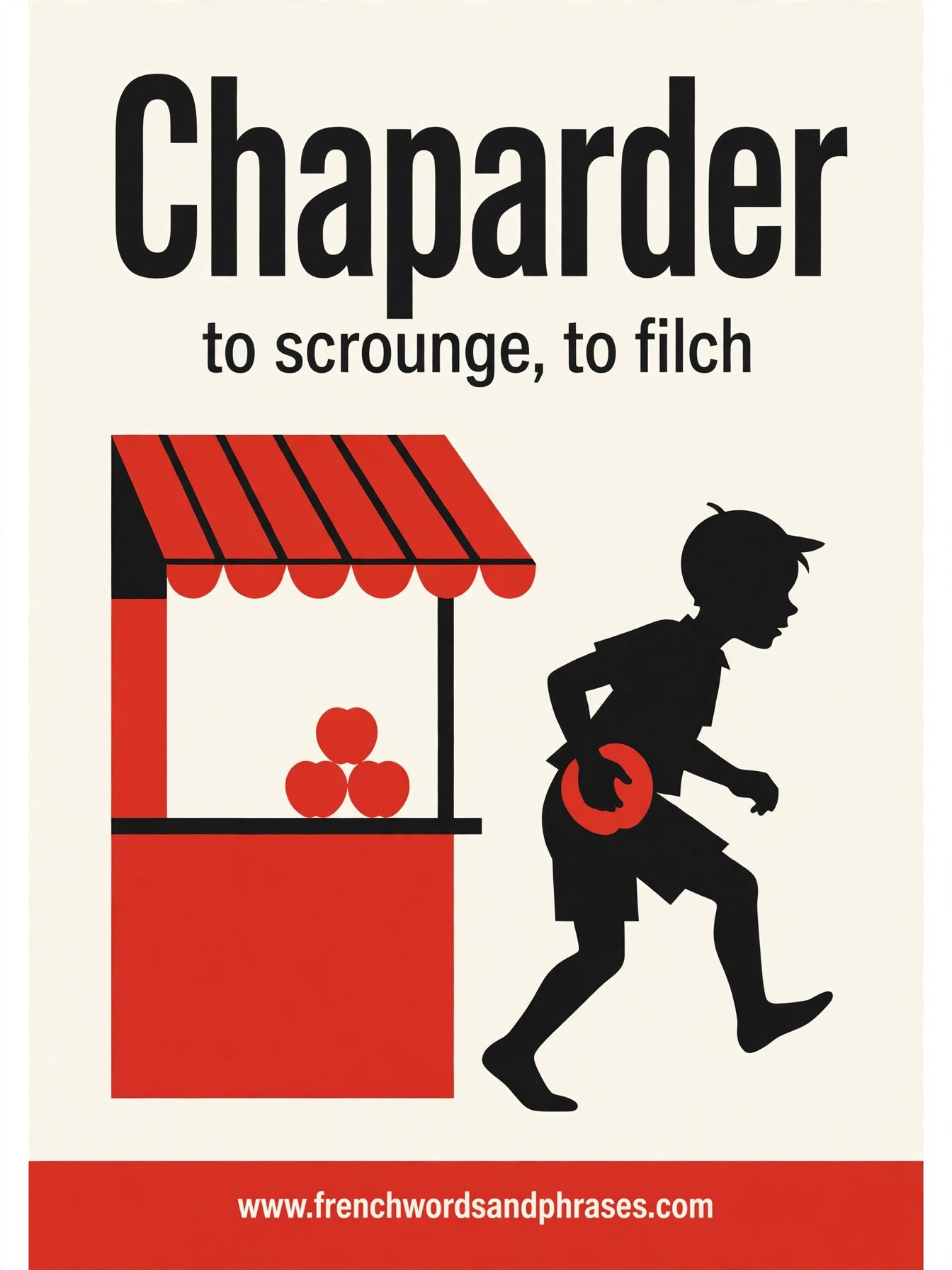
Chaparder means to scrounge, to filch — to pinch small things on the sly: a cherry, a biscuit, a cake from the kitchen when nobody is looking.
A hand drifting towards the neighbour’s cherry tree, a cat timing its leap for the fish on the counter, a child vanishing a biscuit before dinner — chaparder is the light-hearted verb of petty pilfering, theft reduced to a snack and a grin.
In this guide, you’ll learn how to conjugate chaparder in all the major French tenses and moods. Explore complete conjugation tables, French examples, English translations, and practice quizzes.
Understanding the French Verb Chaparder
Chaparder is a regular French verb belonging to the first group of verbs, those ending in-er.
It means to scrounge, to filch. It is commonly used of children filching fruit, cakes and sweets, of animals snatching food, and jokingly of adults helping themselves to what was not offered. Its scale is everything: a bank cannot be chapardé, but a croissant can. The agent noun, un chapardeur, une chapardeuse, is used with the same indulgent smile.
Verb classification: First group (-er)
Auxiliary verb: Avoir
Past participle: chapardé
Present participle: chapardant
English equivalents: To filch, to pinch, to scrounge, to nick (informal); chaparder des cerises — to filch cherries; chaparder un gâteau — to pinch a cake; se faire prendre en chapardant — to get caught filching; un chapardeur — a petty pilferer.
One important detail: chaparder is a familiar, playful word — it never describes a real crime. One chaparder des cerises, un biscuit, une part de tarte: small, edible, low-stakes things, taken on the sly and usually forgiven with a smile. For actual stealing, French uses voler; chaparder is what children, cats and foxes do, and the word itself is half a compliment to their cheek. The verb is perfectly regular: je chaparde, nous chapardons, past participle chapardé.
Experience the Word
Chaparder is stealing shrunk to a treat — the crime is real, the loot is a cherry, and the punishment is usually laughter.
Imagine the garden wall in June. The neighbour’s cherries are ripe, the branch hangs over your side, and the ladder appears as if by magic. The boy chaparde méthodiquement, one pocket, then the other — until the neighbour leans out of the window and asks him to leave some for the birds.
He has not burgled or robbed. He has chapardé — filched, cheerfully, at the scale of a pocket.
How to Conjugate Chaparder: Complete French Conjugation Guide
Let’s explore every major conjugation of chaparder, beginning with the indicative mood.
How to Conjugate Chaparder in the Indicative Mood
The indicative mood is used to express facts, observations, actions, and events.
How to Conjugate Chaparder in the Present Tense (Présent)
Used for actions happening now, habitual actions, and general truths.
| Subject | Conjugation |
|---|---|
| je | chaparde |
| tu | chapardes |
| il / elle | chaparde |
| nous | chapardons |
| vous | chapardez |
| ils / elles | chapardent |
Example
Les enfants chapardent les cerises du voisin.
The children filch the neighbour’s cherries.
Quick Quiz 1
Complete the sentence:
Nous ______ des pommes sur le chemin de l’école.
Reveal the answer
chapardons
Nous chapardons des pommes sur le chemin de l’école.
We filch apples on the way to school.
How to Conjugate Chaparder in the Passé Composé
Used for completed actions in the past. Chaparder takes the auxiliary verb avoir.
| Subject | Conjugation |
|---|---|
| j’ | ai chapardé |
| tu | as chapardé |
| il / elle | a chapardé |
| nous | avons chapardé |
| vous | avez chapardé |
| ils / elles | ont chapardé |
Example
Il a chapardé un gâteau dans la cuisine.
He pinched a cake from the kitchen.
How to Conjugate Chaparder in the Imparfait (Imperfect Tense)
Used for habitual past actions, descriptions, and ongoing situations in the past.
| Subject | Conjugation |
|---|---|
| je | chapardais |
| tu | chapardais |
| il / elle | chapardait |
| nous | chapardions |
| vous | chapardiez |
| ils / elles | chapardaient |
Example
Nous chapardions des pommes sur le chemin de l’école.
We used to filch apples on the way to school.
Quick Quiz 2
Choose the correct form:
He pinched a cake from the kitchen.
Il ______ un gâteau dans la cuisine. (a chapardé / est chapardé)
Reveal the answer
a chapardé
Il a chapardé un gâteau dans la cuisine.
Chaparder takes avoir.
How to Conjugate Chaparder in the Plus-que-parfait
Used to describe an action that had already been completed before another past event.
| Subject | Conjugation |
|---|---|
| j’ | avais chapardé |
| tu | avais chapardé |
| il / elle | avait chapardé |
| nous | avions chapardé |
| vous | aviez chapardé |
| ils / elles | avaient chapardé |
Example
Elle avait chapardé les clés du cellier pour ouvrir la confiture.
She had pinched the cellar keys to get at the jam.
How to Conjugate Chaparder in the Passé Simple
Primarily used in formal writing, literature, and historical narratives. It is rarely used in everyday conversation.
| Subject | Conjugation |
|---|---|
| je | chapardai |
| tu | chapardas |
| il / elle | chaparda |
| nous | chapardâmes |
| vous | chapardâtes |
| ils / elles | chapardèrent |
Example
Le renard chaparda une poule à la tombée de la nuit.
The fox made off with a hen at nightfall.
How to Conjugate Chaparder in the Passé Antérieur
A literary tense used to express an action completed immediately before another past action, generally in the passé simple.
| Subject | Conjugation |
|---|---|
| j’ | eus chapardé |
| tu | eus chapardé |
| il / elle | eut chapardé |
| nous | eûmes chapardé |
| vous | eûtes chapardé |
| ils / elles | eurent chapardé |
Example
Dès qu’il eut chapardé les bonbons, il disparut dans le jardin.
As soon as he had filched the sweets, he vanished into the garden.
How to Conjugate Chaparder in the Future Tense (Futur Simple)
Used to describe actions that will take place in the future.
| Subject | Conjugation |
|---|---|
| je | chaparderai |
| tu | chaparderas |
| il / elle | chapardera |
| nous | chaparderons |
| vous | chaparderez |
| ils / elles | chaparderont |
Example
Si tu laisses la boîte ouverte, les enfants chaparderont tous les biscuits.
If you leave the tin open, the children will filch all the biscuits.
How to Conjugate Chaparder in the Futur Antérieur (Future Perfect)
Used for an action that will have been completed before a particular point in the future.
| Subject | Conjugation |
|---|---|
| j’ | aurai chapardé |
| tu | auras chapardé |
| il / elle | aura chapardé |
| nous | aurons chapardé |
| vous | aurez chapardé |
| ils / elles | auront chapardé |
Example
À la fin de la récréation, ils auront chapardé la moitié des billes de la classe.
By the end of break, they will have pinched half the class’s marbles.
How to Conjugate Chaparder in the Near Future (Futur Proche)
Used to describe something that is going to happen soon. Formed with aller + infinitive.
| Subject | Conjugation |
|---|---|
| je | vais chaparder |
| tu | vas chaparder |
| il / elle | va chaparder |
| nous | allons chaparder |
| vous | allez chaparder |
| ils / elles | vont chaparder |
Example
Attention, le chat va chaparder le poisson !
Careful, the cat is going to make off with the fish!
How to Conjugate Chaparder in the Conditional Mood
The conditional mood expresses what would happen under certain circumstances. It is also frequently used to make polite requests or express wishes.
How to Conjugate Chaparder in the Present Conditional
| Subject | Conjugation |
|---|---|
| je | chaparderais |
| tu | chaparderais |
| il / elle | chaparderait |
| nous | chaparderions |
| vous | chaparderiez |
| ils / elles | chaparderaient |
Example
Un enfant sage ne chaparderait pas les bonbons des autres.
A well-behaved child would not filch other children’s sweets.
How to Conjugate Chaparder in the Past Conditional
| Subject | Conjugation |
|---|---|
| j’ | aurais chapardé |
| tu | aurais chapardé |
| il / elle | aurait chapardé |
| nous | aurions chapardé |
| vous | auriez chapardé |
| ils / elles | auraient chapardé |
Example
Elle aurait chapardé un croissant si la boulangère avait tourné le dos.
She would have pinched a croissant if the baker had turned her back.
Chaparder in the Literary Past Conditional Form
This less common literary form uses the imperfect subjunctive of avoir.
| Subject | Conjugation |
|---|---|
| j’ | eusse chapardé |
| tu | eusses chapardé |
| il / elle | eût chapardé |
| nous | eussions chapardé |
| vous | eussiez chapardé |
| ils / elles | eussent chapardé |
Example
Il eût chapardé les cerises du jardin sans le moindre remords.
He would have filched the garden cherries without the slightest remorse.
How to Conjugate Chaparder in the Subjunctive Mood
The subjunctive is used to express wishes, emotions, doubts, necessity, and uncertainty. It frequently follows expressions such as il faut que (it is necessary that) or bien que (although).
How to Conjugate Chaparder in the Present Subjunctive
| Subject | Conjugation |
|---|---|
| que je | chaparde |
| que tu | chapardes |
| qu’il / qu’elle | chaparde |
| que nous | chapardions |
| que vous | chapardiez |
| qu’ils / qu’elles | chapardent |
Example
Je ne crois pas qu’ils chapardent quoi que ce soit de précieux.
I do not think they filch anything of value.
Quick Quiz 3
Complete the sentence using the subjunctive:
Je ne crois pas que tu ______ les bonbons de ta sœur.
Reveal the answer
chapardes
Je ne crois pas que tu chapardes les bonbons de ta sœur.
I do not think you filch your sister’s sweets.
How to Conjugate Chaparder in the Imperfect Subjunctive
A literary tense, rarely encountered in modern spoken French.
| Subject | Conjugation |
|---|---|
| que je | chapardasse |
| que tu | chapardasses |
| qu’il / qu’elle | chapardât |
| que nous | chapardassions |
| que vous | chapardassiez |
| qu’ils / qu’elles | chapardassent |
Example
On riait qu’il chapardât des crayons à l’école.
People laughed that he filched pencils at school.
How to Conjugate Chaparder in the Pluperfect Subjunctive
A literary construction used to express an action completed before another past action.
| Subject | Conjugation |
|---|---|
| que j’ | eusse chapardé |
| que tu | eusses chapardé |
| qu’il / qu’elle | eût chapardé |
| que nous | eussions chapardé |
| que vous | eussiez chapardé |
| qu’ils / qu’elles | eussent chapardé |
Example
On racontait qu’il eût chapardé le goûter de son frère.
People said he had pinched his brother’s snack.
How to Conjugate Chaparder in the Past Subjunctive
| Subject | Conjugation |
|---|---|
| que j’ | aie chapardé |
| que tu | aies chapardé |
| qu’il / qu’elle | ait chapardé |
| que nous | ayons chapardé |
| que vous | ayez chapardé |
| qu’ils / qu’elles | aient chapardé |
Example
Il est possible qu’elle ait chapardé une part de tarte.
It is possible she pinched a slice of tart.
How to Conjugate Chaparder in the Imperative
The imperative is used to give commands, instructions, invitations, or suggestions. Subject pronouns are omitted.
How to Conjugate Chaparder in the Present Imperative
| Person | Conjugation |
|---|---|
| (tu) | chaparde |
| (nous) | chapardons |
| (vous) | chapardez |
Example
Ne chaparde pas les affaires de ton frère !
Don’t pinch your brother’s things!
Quick Quiz 4
How would you say Don’t pinch your brother’s things (tu form)?
Reveal the answer
Ne chaparde pas les affaires de ton frère !
French Participles of Chaparder
Participles are verb forms that can be used in compound tenses and other grammatical constructions.
Present Participle of Chaparder
chapardant
En chapardant des fraises, il s’est fait prendre par le jardinier.
Filching strawberries, he got caught by the gardener.
Past Participle of Chaparder
chapardé
Chapardées dans le verger, les pommes avaient un goût d’aventure.
Filched from the orchard, the apples tasted of adventure.
Chaparder in Everyday French: Real-Life Examples
Now that you know the conjugations, let’s see how chaparder appears in everyday French.
Example 1 — Present
Les enfants chapardent les cerises du voisin.
The children filch the neighbour’s cherries.
Example 2 — Passé composé
Il a chapardé un gâteau dans la cuisine.
He pinched a cake from the kitchen.
Example 3 — Imparfait
Nous chapardions des pommes sur le chemin de l’école.
We used to filch apples on the way to school.
Example 4 — Future
Les enfants chaparderont tous les biscuits si la boîte reste ouverte.
The children will filch all the biscuits if the tin stays open.
Example 5 — Conditional
Elle chaparderait un croissant si la boulangère tournait le dos.
She would pinch a croissant if the baker turned her back.
Example 6 — Imperative
Ne chaparde pas les affaires de ton frère !
Don’t pinch your brother’s things!
Beyond Translation: The Meaning of Chaparder
English filch and pinch are the close cousins — petty, sly, small-scale — and chaparder belongs to that same indulgent family, far from the courtroom language of voler.
The word forgives as it accuses.
Call a child un petit chapardeur and you are scolding and smiling in the same breath. French keeps the verb for the orchard, the kitchen and the schoolbag — everywhere the loot fits in a pocket and the crime fits in a story.
How to Remember the French Verb Chaparder
Remember it this way: Chaparder is about the boy at the garden wall, pockets full of the neighbour’s cherries.
- Familiar and playful: chaparder is pinching cherries and biscuits, never real crime — that is voler.
- Its typical thieves are children, cats and foxes; its typical loot fits in a pocket.
- Regular -er: je chaparde, nous chapardons, past participle chapardé.
The key idea is the boy at the garden wall, pockets full of the neighbour’s cherries.
Test Your Knowledge of Chaparder
Let’s see how much you’ve learned. Try answering these questions before revealing the answers.
Question 1
Why could a bank never be the object of chaparder?
Reveal the answer
Scale — chaparder is familiar and playful, for petty pilfering of small things; real theft is voler.
Question 2
How do you say The children filch the neighbour’s cherries in French?
Reveal the answer
Les enfants chapardent les cerises du voisin.
Question 3
Translate: He pinched a cake from the kitchen.
Reveal the answer
Il a chapardé un gâteau dans la cuisine.
Question 4
What is the past participle of chaparder?
Reveal the answer
Chapardé.
Question 5
Complete the sentence:
En ______ des fraises, il s’est fait prendre par le jardinier.
Reveal the answer
chapardant
En chapardant des fraises, il s’est fait prendre par le jardinier.
Filching strawberries, he got caught by the gardener.
Your Final Challenge
Can You Use It?
How would you say this in French?
He filches one cherry, then two, then the whole branch seems to lean his way.
Reveal the answer
Il chaparde une cerise, puis deux, puis la branche entière semble pencher de son côté.
He filches one cherry, then two, then the whole branch seems to lean his way.
A little French. A little curiosity. A richer everyday life.
LEARN FRENCH ONE WORD AT A TIME