A French Word to Live By
How to Conjugate Se chamailler in French
/sə ʃa.ma.je/
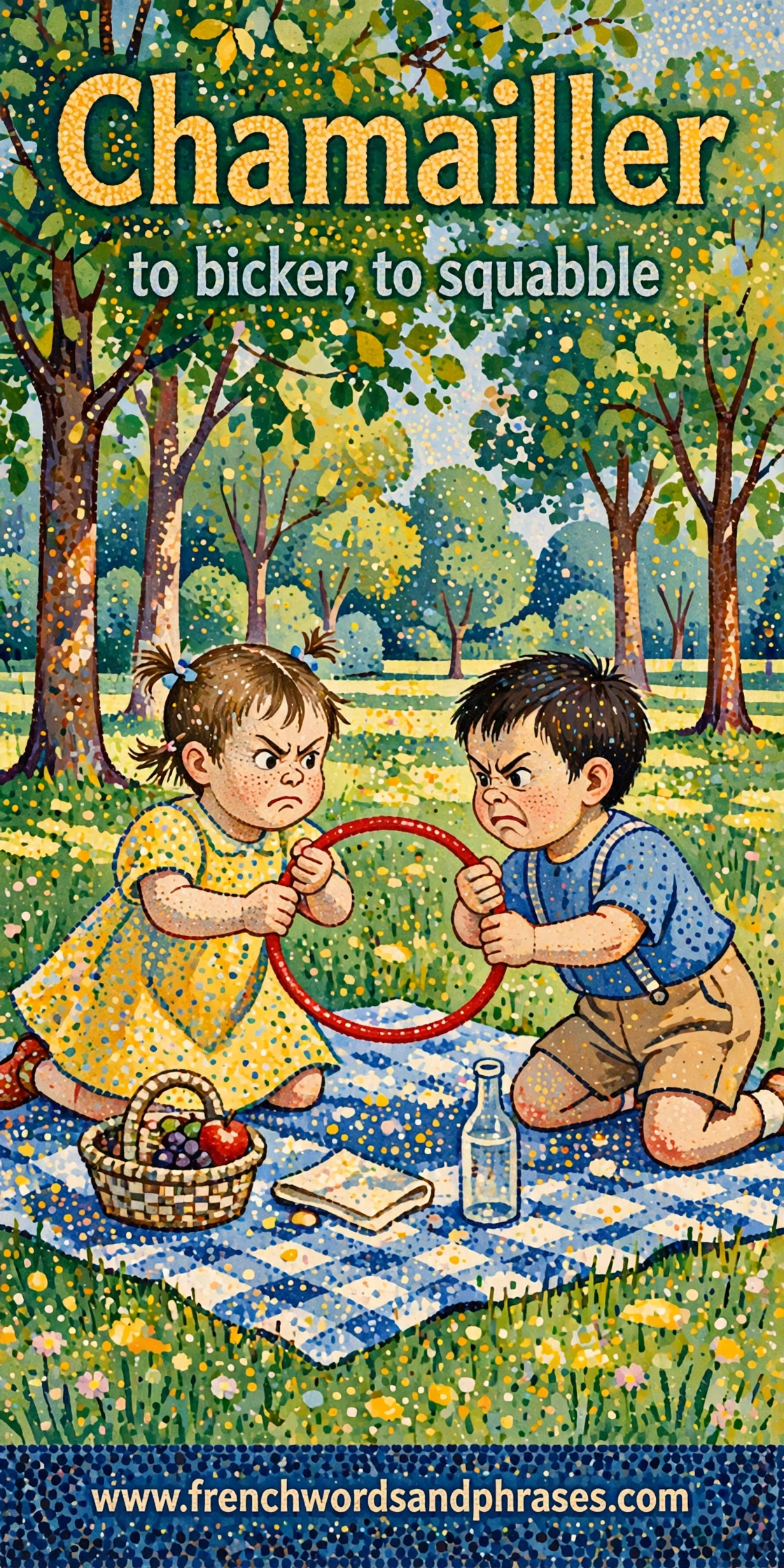
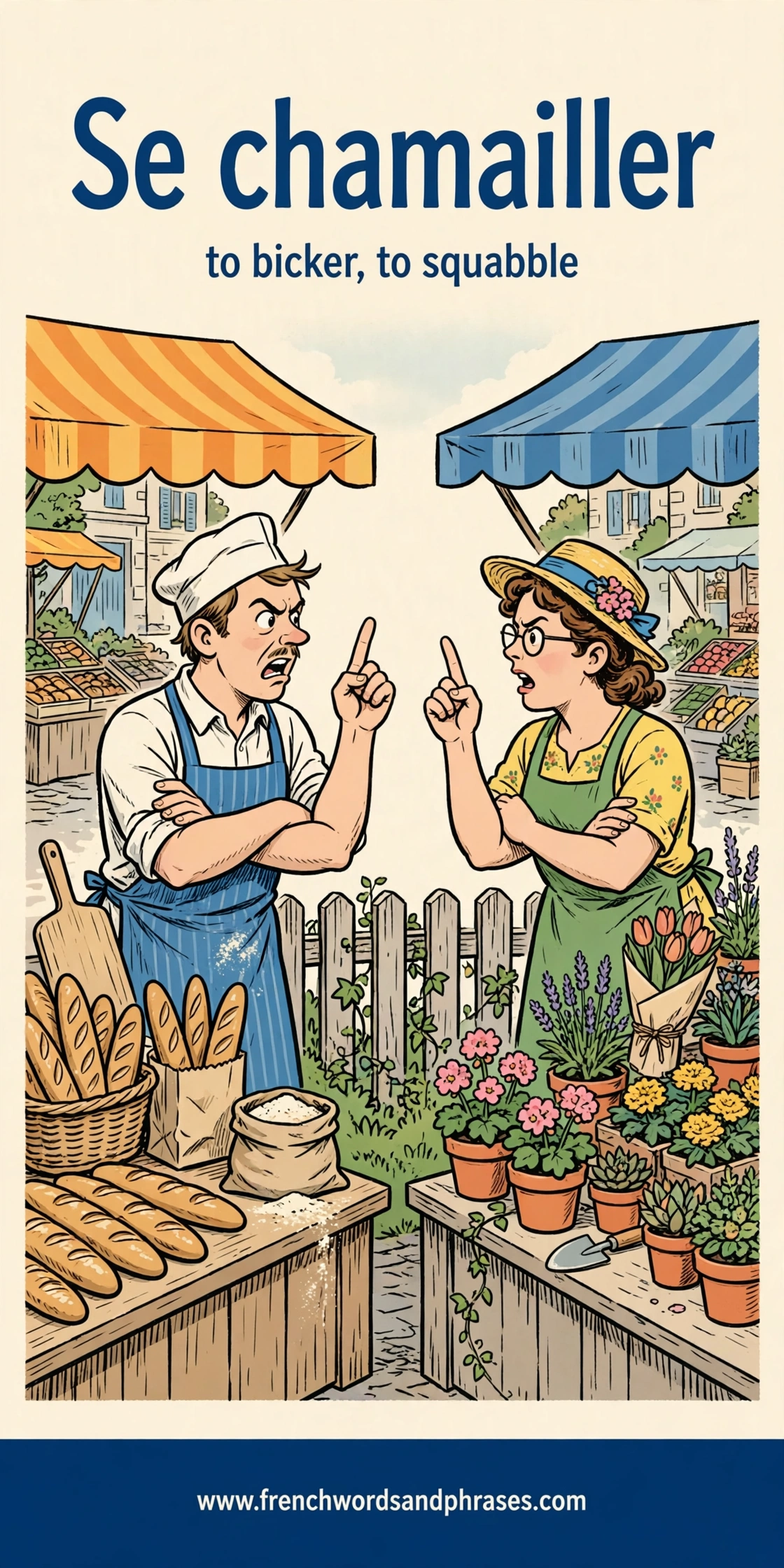
Se chamailler means to bicker, to squabble — two people trading small, sharp words over almost nothing, and usually making up just as fast.
A couple and a parking space, two sisters and one dress, old neighbours and a hedge that grows six inches too far — se chamailler is the everyday reflexive verb of the tiff: two people, one tiny subject, and a quarrel that rarely survives the hour.
In this guide, you’ll learn how to conjugate se chamailler in all the major French tenses and moods. Explore complete conjugation tables, French examples, English translations, and practice quizzes.
Understanding the French Verb Se chamailler
Se chamailler is a regular French verb belonging to the first group of verbs, those ending in-er.
It means to bicker, to squabble. It is the form French actually reaches for: couples, sisters, colleagues and neighbours se chamaillent over menus, parking spaces, inheritances and hedges — and the word itself forgives them in advance, because a chamaillerie is never the end of a friendship.
Verb classification: First group (-er), reflexive
Auxiliary verb: Être
Past participle: chamaillé
Present participle: chamaillant
English equivalents: To bicker, to squabble (with each other); se chamailler avec quelqu’un — to bicker with someone; se chamailler pour un rien — to squabble over nothing; se chamailler comme des enfants — to bicker like children.
One important detail: se chamailler is a reciprocal reflexive — the two subjects bicker with each other — so it takes être in every compound tense and the participle agrees: elles se sont chamaillées, ils se sont chamaillés. The partner is introduced by avec (elle s’est chamaillée avec sa sœur) and the subject of the quarrel by pour (se chamailler pour un rien). In the tu imperative the pronoun follows the verb — ne te chamaille pas ! — and the quarrel it names is always a small one: this is the verb of tiffs, not feuds.
Experience the Word
Se chamailler takes two — it is the quarrel as a duet, sharp for a minute and forgotten by lunch.
Imagine two sisters home for Christmas. One dress, two shoulders: voices rise over the wardrobe, doors are closed a little too firmly — elles se chamaillent. An hour later they are in the kitchen together, laughing, and one of them is wearing the dress.
The dress was never the point. They were bickering — se chamaillant — the way sisters do.
How to Conjugate Se chamailler: Complete French Conjugation Guide
Let’s explore every major conjugation of se chamailler, beginning with the indicative mood.
How to Conjugate Se chamailler in the Indicative Mood
The indicative mood is used to express facts, observations, actions, and events.
How to Conjugate Se chamailler in the Present Tense (Présent)
Used for actions happening now, habitual actions, and general truths.
| Subject | Conjugation |
|---|---|
| je | me chamaille |
| tu | te chamailles |
| il / elle | se chamaille |
| nous | nous chamaillons |
| vous | vous chamaillez |
| ils / elles | se chamaillent |
Example
Ils se chamaillent pour un rien, puis ils rient ensemble.
They bicker over nothing, then they laugh together.
Quick Quiz 1
Complete the sentence:
Nous nous ______ pour des détails, c’est ridicule.
Reveal the answer
chamaillons
Nous nous chamaillons pour des détails, c’est ridicule.
We bicker over details — it’s ridiculous.
How to Conjugate Se chamailler in the Passé Composé
Used for completed actions in the past. Se chamailler takes the auxiliary verb être.
| Subject | Conjugation |
|---|---|
| je | me suis chamaillé / me suis chamaillée |
| tu | t’es chamaillé / t’es chamaillée |
| il / elle | s’est chamaillé / s’est chamaillée |
| nous | nous sommes chamaillés / nous sommes chamaillées |
| vous | vous êtes chamaillés / vous êtes chamaillées / vous êtes chamaillé / vous êtes chamaillée |
| ils / elles | se sont chamaillés / se sont chamaillées |
Example
Elles se sont chamaillées pour la place de parking.
They bickered over the parking space.
How to Conjugate Se chamailler in the Imparfait (Imperfect Tense)
Used for habitual past actions, descriptions, and ongoing situations in the past.
| Subject | Conjugation |
|---|---|
| je | me chamaillais |
| tu | te chamaillais |
| il / elle | se chamaillait |
| nous | nous chamaillions |
| vous | vous chamailliez |
| ils / elles | se chamaillaient |
Example
Nous nous chamaillions souvent, mais sans méchanceté.
We used to bicker often, but without malice.
Quick Quiz 2
Choose the correct form:
They (f.) bickered over a dress.
Elles ______ pour une robe. (se sont chamaillées / ont chamaillé)
Reveal the answer
se sont chamaillées
Elles se sont chamaillées pour une robe.
Se chamailler is reflexive, takes être, and the participle agrees: chamaillées.
How to Conjugate Se chamailler in the Plus-que-parfait
Used to describe an action that had already been completed before another past event.
| Subject | Conjugation |
|---|---|
| je | m’étais chamaillé / m’étais chamaillée |
| tu | t’étais chamaillé / t’étais chamaillée |
| il / elle | s’était chamaillé / s’était chamaillée |
| nous | nous étions chamaillés / nous étions chamaillées |
| vous | vous étiez chamaillés / vous étiez chamaillées / vous étiez chamaillé / vous étiez chamaillée |
| ils / elles | s’étaient chamaillés / s’étaient chamaillées |
Example
Ils s’étaient chamaillés avant même l’arrivée des invités.
They had bickered even before the guests arrived.
How to Conjugate Se chamailler in the Passé Simple
Primarily used in formal writing, literature, and historical narratives. It is rarely used in everyday conversation.
| Subject | Conjugation |
|---|---|
| je | me chamaillai |
| tu | te chamaillas |
| il / elle | se chamailla |
| nous | nous chamaillâmes |
| vous | vous chamaillâtes |
| ils / elles | se chamaillèrent |
Example
Les deux sœurs se chamaillèrent pour une robe, puis s’embrassèrent.
The two sisters squabbled over a dress, then hugged each other.
How to Conjugate Se chamailler in the Passé Antérieur
A literary tense used to express an action completed immediately before another past action, generally in the passé simple.
| Subject | Conjugation |
|---|---|
| je | me fus chamaillé / me fus chamaillée |
| tu | te fus chamaillé / te fus chamaillée |
| il / elle | se fut chamaillé / se fut chamaillée |
| nous | nous fûmes chamaillés / nous fûmes chamaillées |
| vous | vous fûtes chamaillés / vous fûtes chamaillées / vous fûtes chamaillé / vous fûtes chamaillée |
| ils / elles | se furent chamaillés / se furent chamaillées |
Example
Dès qu’ils se furent chamaillés, ils regrettèrent leurs paroles.
As soon as they had squabbled, they regretted their words.
How to Conjugate Se chamailler in the Future Tense (Futur Simple)
Used to describe actions that will take place in the future.
| Subject | Conjugation |
|---|---|
| je | me chamaillerai |
| tu | te chamailleras |
| il / elle | se chamaillera |
| nous | nous chamaillerons |
| vous | vous chamaillerez |
| ils / elles | se chamailleront |
Example
Ce soir, ils se chamailleront encore pour le programme télé.
Tonight, they will bicker again over the TV schedule.
How to Conjugate Se chamailler in the Futur Antérieur (Future Perfect)
Used for an action that will have been completed before a particular point in the future.
| Subject | Conjugation |
|---|---|
| je | me serai chamaillé / me serai chamaillée |
| tu | te seras chamaillé / te seras chamaillée |
| il / elle | se sera chamaillé / se sera chamaillée |
| nous | nous serons chamaillés / nous serons chamaillées |
| vous | vous serez chamaillés / vous serez chamaillées / vous serez chamaillé / vous serez chamaillée |
| ils / elles | se seront chamaillés / se seront chamaillées |
Example
À Noël, ils se seront chamaillés dix fois pour le menu.
By Christmas, they will have bickered ten times over the menu.
How to Conjugate Se chamailler in the Near Future (Futur Proche)
Used to describe something that is going to happen soon. Formed with aller + infinitive.
| Subject | Conjugation |
|---|---|
| je | vais me chamailler |
| tu | vas te chamailler |
| il / elle | va se chamailler |
| nous | allons nous chamailler |
| vous | allez vous chamailler |
| ils / elles | vont se chamailler |
Example
Attention, ils vont se chamailler pour la dernière part de tarte.
Careful — they are going to squabble over the last slice of pie.
How to Conjugate Se chamailler in the Conditional Mood
The conditional mood expresses what would happen under certain circumstances. It is also frequently used to make polite requests or express wishes.
How to Conjugate Se chamailler in the Present Conditional
| Subject | Conjugation |
|---|---|
| je | me chamaillerais |
| tu | te chamaillerais |
| il / elle | se chamaillerait |
| nous | nous chamaillerions |
| vous | vous chamailleriez |
| ils / elles | se chamailleraient |
Example
Sans les enfants, ils se chamailleraient pour la maison de vacances.
Without the children, they would squabble over the holiday house.
How to Conjugate Se chamailler in the Past Conditional
| Subject | Conjugation |
|---|---|
| je | me serais chamaillé / me serais chamaillée |
| tu | te serais chamaillé / te serais chamaillée |
| il / elle | se serait chamaillé / se serait chamaillée |
| nous | nous serions chamaillés / nous serions chamaillées |
| vous | vous seriez chamaillés / vous seriez chamaillées / vous seriez chamaillé / vous seriez chamaillée |
| ils / elles | se seraient chamaillés / se seraient chamaillées |
Example
Elles se seraient chamaillées si on ne les avait pas séparées.
They would have bickered if they had not been separated.
Se chamailler in the Literary Past Conditional Form
This less common literary form uses the imperfect subjunctive of être.
| Subject | Conjugation |
|---|---|
| je | me fusse chamaillé / me fusse chamaillée |
| tu | te fusses chamaillé / te fusses chamaillée |
| il / elle | se fût chamaillé / se fût chamaillée |
| nous | nous fussions chamaillés / nous fussions chamaillées |
| vous | vous fussiez chamaillés / vous fussiez chamaillées / vous fussiez chamaillé / vous fussiez chamaillée |
| ils / elles | se fussent chamaillés / se fussent chamaillées |
Example
Les deux rois se fussent chamaillés pour une frontière de pacotille.
The two kings would have squabbled over a worthless border.
How to Conjugate Se chamailler in the Subjunctive Mood
The subjunctive is used to express wishes, emotions, doubts, necessity, and uncertainty. It frequently follows expressions such as il faut que (it is necessary that) or bien que (although).
How to Conjugate Se chamailler in the Present Subjunctive
| Subject | Conjugation |
|---|---|
| que je | me chamaille |
| que tu | te chamailles |
| qu’il / qu’elle | se chamaille |
| que nous | nous chamaillions |
| que vous | vous chamailliez |
| qu’ils / qu’elles | se chamaillent |
Example
Je ne veux pas que vous vous chamailliez devant les enfants.
I do not want you bickering in front of the children.
Quick Quiz 3
Complete the sentence using the subjunctive:
Je ne veux pas que tu te ______ avec ton frère.
Reveal the answer
chamailles
Je ne veux pas que tu te chamailles avec ton frère.
I do not want you bickering with your brother.
How to Conjugate Se chamailler in the Imperfect Subjunctive
A literary tense, rarely encountered in modern spoken French.
| Subject | Conjugation |
|---|---|
| que je | me chamaillasse |
| que tu | te chamaillasses |
| qu’il / qu’elle | se chamaillât |
| que nous | nous chamaillassions |
| que vous | vous chamaillassiez |
| qu’ils / qu’elles | se chamaillassent |
Example
Il était inévitable qu’ils se chamaillassent pour des détails.
It was inevitable that they would bicker over details.
How to Conjugate Se chamailler in the Pluperfect Subjunctive
A literary construction used to express an action completed before another past action.
| Subject | Conjugation |
|---|---|
| que je | me fusse chamaillé / me fusse chamaillée |
| que tu | te fusses chamaillé / te fusses chamaillée |
| qu’il / qu’elle | se fût chamaillé / se fût chamaillée |
| que nous | nous fussions chamaillés / nous fussions chamaillées |
| que vous | vous fussiez chamaillés / vous fussiez chamaillées / vous fussiez chamaillé / vous fussiez chamaillée |
| qu’ils / qu’elles | se fussent chamaillés / se fussent chamaillées |
Example
On disait qu’ils se fussent chamaillés dès le premier jour.
People said they had bickered from the very first day.
How to Conjugate Se chamailler in the Past Subjunctive
| Subject | Conjugation |
|---|---|
| que je | me sois chamaillé / me sois chamaillée |
| que tu | te sois chamaillé / te sois chamaillée |
| qu’il / qu’elle | se soit chamaillé / se soit chamaillée |
| que nous | nous soyons chamaillés / nous soyons chamaillées |
| que vous | vous soyez chamaillés / vous soyez chamaillées / vous soyez chamaillé / vous soyez chamaillée |
| qu’ils / qu’elles | se soient chamaillés / se soient chamaillées |
Example
Je suis triste qu’elles se soient chamaillées pour une histoire d’argent.
I am sad they squabbled over a money matter.
How to Conjugate Se chamailler in the Imperative
The imperative is used to give commands, instructions, invitations, or suggestions. Subject pronouns are omitted.
How to Conjugate Se chamailler in the Present Imperative
| Person | Conjugation |
|---|---|
| (tu) | chamaille-toi |
| (nous) | chamaillons-nous |
| (vous) | chamaillez-vous |
Example
Ne vous chamaillez pas pour un héritage, parlez-vous !
Do not squabble over an inheritance — talk to each other!
Quick Quiz 4
How would you say Do not bicker with your sister (tu form)?
Reveal the answer
Ne te chamaille pas avec ta sœur !
French Participles of Se chamailler
Participles are verb forms that can be used in compound tenses and other grammatical constructions.
Present Participle of Se chamailler
chamaillant
En se chamaillant pour des riens, ils oublient l’essentiel.
By bickering over nothing, they forget what really matters.
Past Participle of Se chamailler
chamaillé
Chamaillées pour un parking, les deux voisines ne se parlent plus.
Having squabbled over a parking space, the two neighbours no longer speak to each other.
Se chamailler in Everyday French: Real-Life Examples
Now that you know the conjugations, let’s see how se chamailler appears in everyday French.
Example 1 — Present
Ils se chamaillent pour un rien.
They bicker over nothing.
Example 2 — Passé composé
Elles se sont chamaillées pour un parking.
They bickered over a parking space.
Example 3 — Imparfait
Nous nous chamaillions sans méchanceté.
We used to bicker without malice.
Example 4 — Future
Ils se chamailleront encore ce soir.
They will bicker again tonight.
Example 5 — Conditional
Elles se chamailleraient pour la robe, c’est sûr.
They would bicker over the dress, that’s certain.
Example 6 — Imperative
Ne te chamaille pas avec ta sœur !
Do not bicker with your sister!
Beyond Translation: The Meaning of Se chamailler
English bicker is the twin of se chamailler, and both languages keep the same mercy in the word: a bicker is a quarrel that does not count.
It takes two to se chamailler — and two to stop.
French grammar makes the peace as reciprocal as the quarrel: the same people who se sont chamaillés at noon se sont réconciliés by two o’clock, with the same little reflexive pronoun doing the work both times.
How to Remember the French Verb Se chamailler
Remember it this way: Se chamailler is about two sisters, one dress, friends again by lunch.
- Reciprocal and reflexive: être everywhere, and the participle agrees — elles se sont chamaillées.
- Avec for the partner, pour for the subject: se chamailler avec sa sœur, pour un rien.
- Regular -er underneath: je me chamaille, nous nous chamaillons, past participle chamaillé.
The key idea is two sisters, one dress, friends again by lunch.
Test Your Knowledge of Se chamailler
Let’s see how much you’ve learned. Try answering these questions before revealing the answers.
Question 1
Which auxiliary does se chamailler use, and why?
Reveal the answer
Être — it is a reflexive verb: elles se sont chamaillées pour un parking.
Question 2
How do you say They bicker over nothing in French?
Reveal the answer
Ils se chamaillent pour un rien.
Question 3
Translate: They bickered over the parking space.
Reveal the answer
Elles se sont chamaillées pour la place de parking.
Question 4
What is the past participle of se chamailler?
Reveal the answer
Chamaillé — agreeing: chamaillée, chamaillés, chamaillées.
Question 5
Complete the sentence:
Je ne veux pas que vous vous ______ devant les enfants.
Reveal the answer
chamailliez
Je ne veux pas que vous vous chamailliez devant les enfants.
I do not want you bickering in front of the children.
Your Final Challenge
Can You Use It?
How would you say this in French?
They bicker over the Christmas menu, like every year, and like every year, they are laughing before dessert.
Reveal the answer
Ils se chamaillent pour le menu de Noël, comme chaque année, et comme chaque année, ils rient avant le dessert.
They bicker over the Christmas menu, like every year, and like every year, they are laughing before dessert.
A little French. A little curiosity. A richer everyday life.
LEARN FRENCH ONE WORD AT A TIME