A French Word to Live By
How to Conjugate Chahuter in French
/ʃa.y.te/
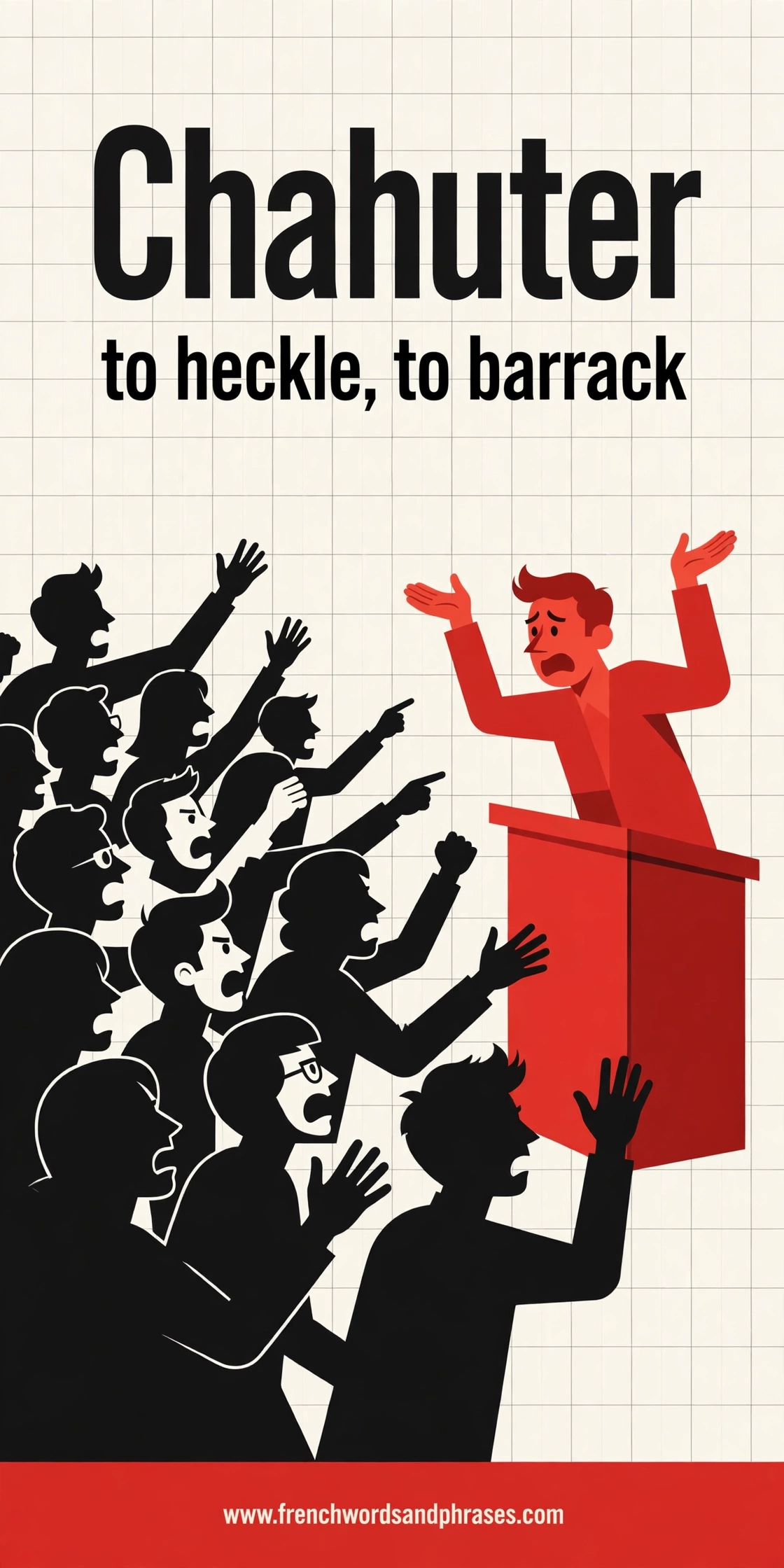
Chahuter means to heckle, to barrack — to make joyful, noisy disorder, shouting down a speaker or turning a classroom upside down.
Schoolboys drumming on desks when the substitute teacher turns his back, a crowd jeering a minister off the platform — chahuter is the verb of gleeful uproar: noise with a target, disorder as a team sport.
In this guide, you’ll learn how to conjugate chahuter in all the major French tenses and moods. Explore complete conjugation tables, French examples, English translations, and practice quizzes.
Understanding the French Verb Chahuter
Chahuter is a regular French verb belonging to the first group of verbs, those ending in-er.
It means to heckle, to barrack. It is the classic verb of French school life — chahuter le remplaçant, to torment the substitute teacher, is practically a rite of passage — and of political meetings, where chahuter un orateur can be organised sport. The tone is noisy rather than violent: a chahut is disorder with laughter in it.
Verb classification: First group (-er)
Auxiliary verb: Avoir
Past participle: chahuté
Present participle: chahutant
English equivalents: To heckle, to barrack, to make an uproar; chahuter un professeur — to heckle a teacher, to play up in class; chahuter un orateur — to barrack a speaker; le chahut — the uproar, the rowdy noise; un chahuteur — a heckler, a rowdy pupil.
One important detail: chahuter has two lives — transitive, chahuter quelqu’un, to heckle a person (un professeur, un ministre, un arbitre), and intransitive, simply to make an uproar: la classe chahute, the class is in uproar. The noun is just as common as the verb: le chahut is the din itself, and quel chahut ! is what every teacher says on opening the door. The verb is perfectly regular: je chahute, nous chahutons.
Experience the Word
Chahuter is the verb of the joyful riot — thirty voices deciding, as one, that order is over for today.
Imagine a classroom in the last week of June. The substitute teacher writes his name on the board, turns back — and the drumming starts, rulers on desks, a paper plane crosses the room. La classe chahute, perfectly organised in its disorder, and the poor man understands his afternoon.
Nobody hates him. He is simply being heckled — chahuté — because it is June and he is new.
How to Conjugate Chahuter: Complete French Conjugation Guide
Let’s explore every major conjugation of chahuter, beginning with the indicative mood.
How to Conjugate Chahuter in the Indicative Mood
The indicative mood is used to express facts, observations, actions, and events.
How to Conjugate Chahuter in the Present Tense (Présent)
Used for actions happening now, habitual actions, and general truths.
| Subject | Conjugation |
|---|---|
| je | chahute |
| tu | chahutes |
| il / elle | chahute |
| nous | chahutons |
| vous | chahutez |
| ils / elles | chahutent |
Example
Les élèves chahutent le nouveau professeur.
The pupils are heckling the new teacher.
Quick Quiz 1
Complete the sentence:
Nous ______ toujours le remplaçant en juin.
Reveal the answer
chahutons
Nous chahutons toujours le remplaçant en juin.
We always heckle the substitute teacher in June.
How to Conjugate Chahuter in the Passé Composé
Used for completed actions in the past. Chahuter takes the auxiliary verb avoir.
| Subject | Conjugation |
|---|---|
| j’ | ai chahuté |
| tu | as chahuté |
| il / elle | a chahuté |
| nous | avons chahuté |
| vous | avez chahuté |
| ils / elles | ont chahuté |
Example
Le public a chahuté le ministre pendant son discours.
The audience barracked the minister during his speech.
How to Conjugate Chahuter in the Imparfait (Imperfect Tense)
Used for habitual past actions, descriptions, and ongoing situations in the past.
| Subject | Conjugation |
|---|---|
| je | chahutais |
| tu | chahutais |
| il / elle | chahutait |
| nous | chahutions |
| vous | chahutiez |
| ils / elles | chahutaient |
Example
Autrefois, les étudiants chahutaient les orateurs trop longs.
In the old days, students used to heckle speakers who went on too long.
Quick Quiz 2
Choose the correct form:
The crowd barracked the minister.
La foule ______ le ministre. (a chahuté / est chahutée)
Reveal the answer
a chahuté
La foule a chahuté le ministre.
Chahuter takes avoir.
How to Conjugate Chahuter in the Plus-que-parfait
Used to describe an action that had already been completed before another past event.
| Subject | Conjugation |
|---|---|
| j’ | avais chahuté |
| tu | avais chahuté |
| il / elle | avait chahuté |
| nous | avions chahuté |
| vous | aviez chahuté |
| ils / elles | avaient chahuté |
Example
Ils avaient chahuté le conférencier dès la première phrase.
They had heckled the lecturer from the very first sentence.
How to Conjugate Chahuter in the Passé Simple
Primarily used in formal writing, literature, and historical narratives. It is rarely used in everyday conversation.
| Subject | Conjugation |
|---|---|
| je | chahutai |
| tu | chahutas |
| il / elle | chahuta |
| nous | chahutâmes |
| vous | chahutâtes |
| ils / elles | chahutèrent |
Example
La salle chahuta l’orateur avant même la fin de son discours.
The hall barracked the speaker before he had even finished his speech.
How to Conjugate Chahuter in the Passé Antérieur
A literary tense used to express an action completed immediately before another past action, generally in the passé simple.
| Subject | Conjugation |
|---|---|
| j’ | eus chahuté |
| tu | eus chahuté |
| il / elle | eut chahuté |
| nous | eûmes chahuté |
| vous | eûtes chahuté |
| ils / elles | eurent chahuté |
Example
Quand les spectateurs eurent chahuté l’arbitre, le match reprit enfin.
When the spectators had heckled the referee, the match finally resumed.
How to Conjugate Chahuter in the Future Tense (Futur Simple)
Used to describe actions that will take place in the future.
| Subject | Conjugation |
|---|---|
| je | chahuterai |
| tu | chahuteras |
| il / elle | chahutera |
| nous | chahuterons |
| vous | chahuterez |
| ils / elles | chahuteront |
Example
Si le maire parle trop longtemps, la foule le chahutera.
If the mayor speaks too long, the crowd will barrack him.
How to Conjugate Chahuter in the Futur Antérieur (Future Perfect)
Used for an action that will have been completed before a particular point in the future.
| Subject | Conjugation |
|---|---|
| j’ | aurai chahuté |
| tu | auras chahuté |
| il / elle | aura chahuté |
| nous | aurons chahuté |
| vous | aurez chahuté |
| ils / elles | auront chahuté |
Example
À la fin du cours, les élèves auront chahuté trois professeurs.
By the end of the lesson, the pupils will have heckled three teachers.
How to Conjugate Chahuter in the Near Future (Futur Proche)
Used to describe something that is going to happen soon. Formed with aller + infinitive.
| Subject | Conjugation |
|---|---|
| je | vais chahuter |
| tu | vas chahuter |
| il / elle | va chahuter |
| nous | allons chahuter |
| vous | allez chahuter |
| ils / elles | vont chahuter |
Example
Attention, la classe va chahuter le remplaçant.
Careful, the class is going to play up with the substitute teacher.
How to Conjugate Chahuter in the Conditional Mood
The conditional mood expresses what would happen under certain circumstances. It is also frequently used to make polite requests or express wishes.
How to Conjugate Chahuter in the Present Conditional
| Subject | Conjugation |
|---|---|
| je | chahuterais |
| tu | chahuterais |
| il / elle | chahuterait |
| nous | chahuterions |
| vous | chahuteriez |
| ils / elles | chahuteraient |
Example
Sans le directeur, les élèves chahuteraient toute la journée.
Without the headmaster, the pupils would make an uproar all day.
How to Conjugate Chahuter in the Past Conditional
| Subject | Conjugation |
|---|---|
| j’ | aurais chahuté |
| tu | aurais chahuté |
| il / elle | aurait chahuté |
| nous | aurions chahuté |
| vous | auriez chahuté |
| ils / elles | auraient chahuté |
Example
Le public aurait chahuté le chanteur s’il était arrivé en retard.
The audience would have heckled the singer if he had arrived late.
Chahuter in the Literary Past Conditional Form
This less common literary form uses the imperfect subjunctive of avoir.
| Subject | Conjugation |
|---|---|
| j’ | eusse chahuté |
| tu | eusses chahuté |
| il / elle | eût chahuté |
| nous | eussions chahuté |
| vous | eussiez chahuté |
| ils / elles | eussent chahuté |
Example
La foule eût chahuté le ministre sans l’intervention des agents.
The crowd would have barracked the minister without the officers stepping in.
How to Conjugate Chahuter in the Subjunctive Mood
The subjunctive is used to express wishes, emotions, doubts, necessity, and uncertainty. It frequently follows expressions such as il faut que (it is necessary that) or bien que (although).
How to Conjugate Chahuter in the Present Subjunctive
| Subject | Conjugation |
|---|---|
| que je | chahute |
| que tu | chahutes |
| qu’il / qu’elle | chahute |
| que nous | chahutions |
| que vous | chahutiez |
| qu’ils / qu’elles | chahutent |
Example
Le professeur ne veut pas que les élèves chahutent pendant le cours.
The teacher does not want the pupils making an uproar during the lesson.
Quick Quiz 3
Complete the sentence using the subjunctive:
On craint que la salle ______ l’orateur dès son entrée.
Reveal the answer
chahute
On craint que la salle chahute l’orateur dès son entrée.
People fear the hall will barrack the speaker as soon as he comes in.
How to Conjugate Chahuter in the Imperfect Subjunctive
A literary tense, rarely encountered in modern spoken French.
| Subject | Conjugation |
|---|---|
| que je | chahutasse |
| que tu | chahutasses |
| qu’il / qu’elle | chahutât |
| que nous | chahutassions |
| que vous | chahutassiez |
| qu’ils / qu’elles | chahutassent |
Example
On craignait que la salle chahutât l’orateur dès son entrée.
It was feared the hall would barrack the speaker as soon as he came in.
How to Conjugate Chahuter in the Pluperfect Subjunctive
A literary construction used to express an action completed before another past action.
| Subject | Conjugation |
|---|---|
| que j’ | eusse chahuté |
| que tu | eusses chahuté |
| qu’il / qu’elle | eût chahuté |
| que nous | eussions chahuté |
| que vous | eussiez chahuté |
| qu’ils / qu’elles | eussent chahuté |
Example
Le journal rapporta que les étudiants eussent chahuté le recteur.
The newspaper reported that the students had heckled the rector.
How to Conjugate Chahuter in the Past Subjunctive
| Subject | Conjugation |
|---|---|
| que j’ | aie chahuté |
| que tu | aies chahuté |
| qu’il / qu’elle | ait chahuté |
| que nous | ayons chahuté |
| que vous | ayez chahuté |
| qu’ils / qu’elles | aient chahuté |
Example
Je suis surpris que le public ait chahuté un si beau concert.
I am surprised the audience heckled such a beautiful concert.
How to Conjugate Chahuter in the Imperative
The imperative is used to give commands, instructions, invitations, or suggestions. Subject pronouns are omitted.
How to Conjugate Chahuter in the Present Imperative
| Person | Conjugation |
|---|---|
| (tu) | chahute |
| (nous) | chahutons |
| (vous) | chahutez |
Example
Ne chahutez pas le remplaçant, écoutez-le !
Do not heckle the substitute teacher, listen to him!
Quick Quiz 4
How would you say Do not heckle the substitute teacher (tu form)?
Reveal the answer
Ne chahute pas le remplaçant !
French Participles of Chahuter
Participles are verb forms that can be used in compound tenses and other grammatical constructions.
Present Participle of Chahuter
chahutant
En chahutant le professeur, ils ont perdu leur sortie de vendredi.
By heckling the teacher, they lost their Friday outing.
Past Participle of Chahuter
chahuté
Chahuté par la foule, le ministre a quitté la salle.
Barracked by the crowd, the minister left the hall.
Chahuter in Everyday French: Real-Life Examples
Now that you know the conjugations, let’s see how chahuter appears in everyday French.
Example 1 — Present
Les élèves chahutent le nouveau professeur.
The pupils are heckling the new teacher.
Example 2 — Passé composé
Le public a chahuté le ministre pendant son discours.
The audience barracked the minister during his speech.
Example 3 — Imparfait
Les étudiants chahutaient les orateurs trop longs.
Students used to heckle speakers who went on too long.
Example 4 — Future
La classe va chahuter le remplaçant.
The class is going to play up with the substitute.
Example 5 — Conditional
Les élèves chahuteraient toute la journée sans le directeur.
The pupils would make an uproar all day without the headmaster.
Example 6 — Imperative
Ne chahutez pas le remplaçant !
Do not heckle the substitute teacher!
Beyond Translation: The Meaning of Chahuter
The word probably comes from le chahut, a rowdy dance of the 1830s whose name imitated its own noise — French heard the din and made a noun, then a verb.
Disorder with a grin.
A chahut is never a riot: it is the classroom turning feral for an afternoon, the meeting drowning a speaker in whistles. English barrack and heckle cover the politics; only chahuter also covers the school desk drumming.
How to Remember the French Verb Chahuter
Remember it this way: Chahuter is about the classroom drumming its desks at the substitute teacher.
- Two lives: chahuter quelqu’un (to heckle a teacher, a minister) and la classe chahute (the class is in uproar).
- The noun is everywhere: le chahut, the din — quel chahut ! — and un chahuteur, a heckler.
- Regular -er: je chahute, nous chahutons, past participle chahuté.
The key idea is the classroom drumming its desks at the substitute teacher.
Test Your Knowledge of Chahuter
Let’s see how much you’ve learned. Try answering these questions before revealing the answers.
Question 1
What is le chahut?
Reveal the answer
The uproar itself — the rowdy din of a class or crowd: quel chahut ! The verb chahuter is making it, or heckling someone with it.
Question 2
How do you say The pupils are heckling the new teacher in French?
Reveal the answer
Les élèves chahutent le nouveau professeur.
Question 3
Translate: The audience barracked the minister during his speech.
Reveal the answer
Le public a chahuté le ministre pendant son discours.
Question 4
What is the past participle of chahuter?
Reveal the answer
Chahuté.
Question 5
Complete the sentence:
Le professeur ne veut pas que les élèves ______ pendant le cours.
Reveal the answer
chahutent
Le professeur ne veut pas que les élèves chahutent pendant le cours.
The teacher does not want the pupils making an uproar during the lesson.
Your Final Challenge
Can You Use It?
How would you say this in French?
The class heckles the substitute teacher, but deep down it only wants to laugh.
Reveal the answer
La classe chahute le remplaçant, mais au fond, elle ne demande qu’à rire.
The class heckles the substitute teacher, but deep down it only wants to laugh.
A little French. A little curiosity. A richer everyday life.
LEARN FRENCH ONE WORD AT A TIME