A French Word to Live By
How to Conjugate Se chagriner in French
/sə ʃa.ɡʁi.ne/
Se chagriner means to grieve, to fret — to sorrow over something, to let worry and sadness settle on one’s own heart.
A grandmother fretting over a cough at the other end of the telephone, a candidate tormenting himself over an exam already finished — se chagriner is the verb of self-carried sorrow: nobody needs to grieve you; you grieve yourself, thoroughly, over real sorrows and imaginary ones alike.
In this guide, you’ll learn how to conjugate se chagriner in all the major French tenses and moods. Explore complete conjugation tables, French examples, English translations, and practice quizzes.
Understanding the French Verb Se chagriner
Se chagriner is a regular French verb belonging to the first group of verbs, those ending in-er.
It means to grieve, to fret. It ranges from true grief — se chagriner d’une perte, to grieve over a loss — down to everyday fretting: se chagriner pour un retard, pour une remarque, pour rien du tout. That breadth is its charm: the same verb serves the widow and the worrier, and context decides the weight.
Verb classification: First group (-er), reflexive
Auxiliary verb: Être
Past participle: chagriné
Present participle: chagrinant
English equivalents: To grieve, to fret, to worry oneself; se chagriner de quelque chose — to grieve over something; se chagriner de + infinitive — to be sorry to do something; ne te chagrine pas — do not fret, do not upset yourself; se chagriner pour rien — to fret over nothing.
One important detail: se chagriner is the felt side of chagriner — la nouvelle chagrine sa mère (the news grieves his mother), but elle se chagrine de la nouvelle (she grieves over the news). The construction is se chagriner de + noun or infinitive: il se chagrine de son absence, elle se chagrine de ne pas être venue. Being reflexive, it takes être and the participle agrees: elle s’est chagrinée, ils se sont chagrinés. The tu imperative tucks the pronoun behind: ne te chagrine pas !
Experience the Word
Se chagriner is the verb of the heart worrying itself — sorrow taken up, carried around, and examined from every side.
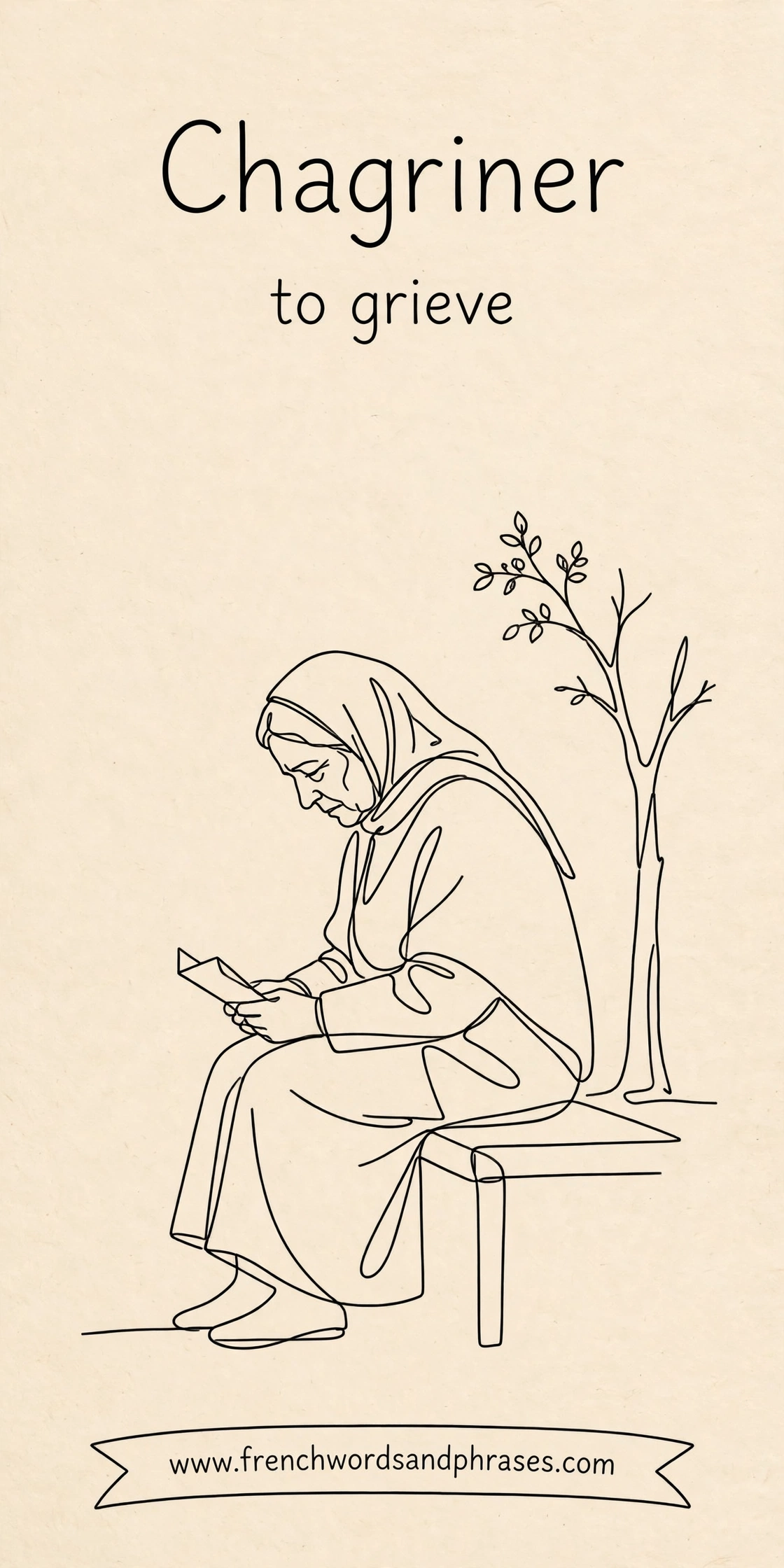
Imagine a grandmother who has heard that her grandson has a cold in a town two hours away. She telephones twice, sleeps badly, imagines fevers and hospitals — elle se chagrine, magnificently and uselessly, over a cold that will be gone by Friday.
Nothing serious has happened. She has grieved herself — chagrinée — over almost nothing, out of pure love.
How to Conjugate Se chagriner: Complete French Conjugation Guide
Let’s explore every major conjugation of se chagriner, beginning with the indicative mood.
How to Conjugate Se chagriner in the Indicative Mood
The indicative mood is used to express facts, observations, actions, and events.
How to Conjugate Se chagriner in the Present Tense (Présent)
Used for actions happening now, habitual actions, and general truths.
| Subject | Conjugation |
|---|---|
| je | me chagrine |
| tu | te chagrines |
| il / elle | se chagrine |
| nous | nous chagrinons |
| vous | vous chagrinez |
| ils / elles | se chagrinent |
Example
Elle se chagrine pour des détails sans importance.
She frets over details of no importance.
Quick Quiz 1
Complete the sentence:
Nous nous ______ de son silence.
Reveal the answer
chagrinons
Nous nous chagrinons de son silence.
We are grieving over his silence.
How to Conjugate Se chagriner in the Passé Composé
Used for completed actions in the past. Se chagriner takes the auxiliary verb être.
| Subject | Conjugation |
|---|---|
| je | me suis chagriné / me suis chagrinée |
| tu | t’es chagriné / t’es chagrinée |
| il / elle | s’est chagriné / s’est chagrinée |
| nous | nous sommes chagrinés / nous sommes chagrinées |
| vous | vous êtes chagrinés / vous êtes chagrinées / vous êtes chagriné / vous êtes chagrinée |
| ils / elles | se sont chagrinés / se sont chagrinées |
Example
Il s’est chagriné toute la soirée après la dispute.
He fretted all evening after the argument.
How to Conjugate Se chagriner in the Imparfait (Imperfect Tense)
Used for habitual past actions, descriptions, and ongoing situations in the past.
| Subject | Conjugation |
|---|---|
| je | me chagrinais |
| tu | te chagrinais |
| il / elle | se chagrinait |
| nous | nous chagrinions |
| vous | vous chagriniez |
| ils / elles | se chagrinaient |
Example
Ma grand-mère se chagrinait dès qu’un enfant toussait.
My grandmother used to fret as soon as a child coughed.
Quick Quiz 2
Choose the correct form:
She fretted all evening.
Elle ______ toute la soirée. (s’est chagrinée / a chagriné)
Reveal the answer
s’est chagrinée
Elle s’est chagrinée toute la soirée.
Se chagriner is reflexive, takes être, and the participle agrees: chagrinée.
How to Conjugate Se chagriner in the Plus-que-parfait
Used to describe an action that had already been completed before another past event.
| Subject | Conjugation |
|---|---|
| je | m’étais chagriné / m’étais chagrinée |
| tu | t’étais chagriné / t’étais chagrinée |
| il / elle | s’était chagriné / s’était chagrinée |
| nous | nous étions chagrinés / nous étions chagrinées |
| vous | vous étiez chagrinés / vous étiez chagrinées / vous étiez chagriné / vous étiez chagrinée |
| ils / elles | s’étaient chagrinés / s’étaient chagrinées |
Example
Ils s’étaient chagrinés de son silence pendant des semaines.
They had grieved over his silence for weeks.
How to Conjugate Se chagriner in the Passé Simple
Primarily used in formal writing, literature, and historical narratives. It is rarely used in everyday conversation.
| Subject | Conjugation |
|---|---|
| je | me chagrinai |
| tu | te chagrinas |
| il / elle | se chagrina |
| nous | nous chagrinâmes |
| vous | vous chagrinâtes |
| ils / elles | se chagrinèrent |
Example
Elle se chagrina longtemps de cette parole injuste.
She grieved for a long time over that unfair remark.
How to Conjugate Se chagriner in the Passé Antérieur
A literary tense used to express an action completed immediately before another past action, generally in the passé simple.
| Subject | Conjugation |
|---|---|
| je | me fus chagriné / me fus chagrinée |
| tu | te fus chagriné / te fus chagrinée |
| il / elle | se fut chagriné / se fut chagrinée |
| nous | nous fûmes chagrinés / nous fûmes chagrinées |
| vous | vous fûtes chagrinés / vous fûtes chagrinées / vous fûtes chagriné / vous fûtes chagrinée |
| ils / elles | se furent chagrinés / se furent chagrinées |
Example
Dès qu’elle se fut chagrinée pour rien, elle s’en voulut aussitôt.
As soon as she had fretted over nothing, she immediately blamed herself for it.
How to Conjugate Se chagriner in the Future Tense (Futur Simple)
Used to describe actions that will take place in the future.
| Subject | Conjugation |
|---|---|
| je | me chagrinerai |
| tu | te chagrineras |
| il / elle | se chagrinera |
| nous | nous chagrinerons |
| vous | vous chagrinerez |
| ils / elles | se chagrineront |
Example
Tu te chagrineras moins quand tu auras de ses nouvelles.
You will fret less once you have news of him.
How to Conjugate Se chagriner in the Futur Antérieur (Future Perfect)
Used for an action that will have been completed before a particular point in the future.
| Subject | Conjugation |
|---|---|
| je | me serai chagriné / me serai chagrinée |
| tu | te seras chagriné / te seras chagrinée |
| il / elle | se sera chagriné / se sera chagrinée |
| nous | nous serons chagrinés / nous serons chagrinées |
| vous | vous serez chagrinés / vous serez chagrinées / vous serez chagriné / vous serez chagrinée |
| ils / elles | se seront chagrinés / se seront chagrinées |
Example
À son retour, ils se seront chagrinés pour rien.
By the time he returns, they will have fretted over nothing.
How to Conjugate Se chagriner in the Near Future (Futur Proche)
Used to describe something that is going to happen soon. Formed with aller + infinitive.
| Subject | Conjugation |
|---|---|
| je | vais me chagriner |
| tu | vas te chagriner |
| il / elle | va se chagriner |
| nous | allons nous chagriner |
| vous | allez vous chagriner |
| ils / elles | vont se chagriner |
Example
Elle va se chagriner si tu pars sans dire au revoir.
She is going to fret if you leave without saying goodbye.
How to Conjugate Se chagriner in the Conditional Mood
The conditional mood expresses what would happen under certain circumstances. It is also frequently used to make polite requests or express wishes.
How to Conjugate Se chagriner in the Present Conditional
| Subject | Conjugation |
|---|---|
| je | me chagrinerais |
| tu | te chagrinerais |
| il / elle | se chagrinerait |
| nous | nous chagrinerions |
| vous | vous chagrineriez |
| ils / elles | se chagrineraient |
Example
Il se chagrinerait de la moindre remarque.
He would fret over the slightest remark.
How to Conjugate Se chagriner in the Past Conditional
| Subject | Conjugation |
|---|---|
| je | me serais chagriné / me serais chagrinée |
| tu | te serais chagriné / te serais chagrinée |
| il / elle | se serait chagriné / se serait chagrinée |
| nous | nous serions chagrinés / nous serions chagrinées |
| vous | vous seriez chagrinés / vous seriez chagrinées / vous seriez chagriné / vous seriez chagrinée |
| ils / elles | se seraient chagrinés / se seraient chagrinées |
Example
Elle se serait chagrinée de ne pas être invitée.
She would have grieved at not being invited.
Se chagriner in the Literary Past Conditional Form
This less common literary form uses the imperfect subjunctive of être.
| Subject | Conjugation |
|---|---|
| je | me fusse chagriné / me fusse chagrinée |
| tu | te fusses chagriné / te fusses chagrinée |
| il / elle | se fût chagriné / se fût chagrinée |
| nous | nous fussions chagrinés / nous fussions chagrinées |
| vous | vous fussiez chagrinés / vous fussiez chagrinées / vous fussiez chagriné / vous fussiez chagrinée |
| ils / elles | se fussent chagrinés / se fussent chagrinées |
Example
Il se fût chagriné de ce retard sans vos explications.
He would have fretted over this delay without your explanations.
How to Conjugate Se chagriner in the Subjunctive Mood
The subjunctive is used to express wishes, emotions, doubts, necessity, and uncertainty. It frequently follows expressions such as il faut que (it is necessary that) or bien que (although).
How to Conjugate Se chagriner in the Present Subjunctive
| Subject | Conjugation |
|---|---|
| que je | me chagrine |
| que tu | te chagrines |
| qu’il / qu’elle | se chagrine |
| que nous | nous chagrinions |
| que vous | vous chagriniez |
| qu’ils / qu’elles | se chagrinent |
Example
Il ne faut pas que tu te chagrines pour si peu.
You must not fret over so little.
Quick Quiz 3
Complete the sentence using the subjunctive:
Il ne faut pas que vous vous ______ pour ce retard.
Reveal the answer
chagriniez
Il ne faut pas que vous vous chagriniez pour ce retard.
You must not fret over this delay.
How to Conjugate Se chagriner in the Imperfect Subjunctive
A literary tense, rarely encountered in modern spoken French.
| Subject | Conjugation |
|---|---|
| que je | me chagrinasse |
| que tu | te chagrinasses |
| qu’il / qu’elle | se chagrinât |
| que nous | nous chagrinassions |
| que vous | vous chagrinassiez |
| qu’ils / qu’elles | se chagrinassent |
Example
Sa mère ne voulait pas qu’il se chagrinât de son absence.
His mother did not want him to grieve over her absence.
How to Conjugate Se chagriner in the Pluperfect Subjunctive
A literary construction used to express an action completed before another past action.
| Subject | Conjugation |
|---|---|
| que je | me fusse chagriné / me fusse chagrinée |
| que tu | te fusses chagriné / te fusses chagrinée |
| qu’il / qu’elle | se fût chagriné / se fût chagrinée |
| que nous | nous fussions chagrinés / nous fussions chagrinées |
| que vous | vous fussiez chagrinés / vous fussiez chagrinées / vous fussiez chagriné / vous fussiez chagrinée |
| qu’ils / qu’elles | se fussent chagrinés / se fussent chagrinées |
Example
On racontait qu’elle se fût chagrinée de tout, même des joies.
People said she had fretted over everything, even joys.
How to Conjugate Se chagriner in the Past Subjunctive
| Subject | Conjugation |
|---|---|
| que je | me sois chagriné / me sois chagrinée |
| que tu | te sois chagriné / te sois chagrinée |
| qu’il / qu’elle | se soit chagriné / se soit chagrinée |
| que nous | nous soyons chagrinés / nous soyons chagrinées |
| que vous | vous soyez chagrinés / vous soyez chagrinées / vous soyez chagriné / vous soyez chagrinée |
| qu’ils / qu’elles | se soient chagrinés / se soient chagrinées |
Example
Je suis étonné qu’il se soit chagriné pour une si petite chose.
I am amazed he fretted over such a small thing.
How to Conjugate Se chagriner in the Imperative
The imperative is used to give commands, instructions, invitations, or suggestions. Subject pronouns are omitted.
How to Conjugate Se chagriner in the Present Imperative
| Person | Conjugation |
|---|---|
| (tu) | chagrine-toi |
| (nous) | chagrinons-nous |
| (vous) | chagrinez-vous |
Example
Ne te chagrine pas, tout s’arrangera !
Do not fret, everything will work out!
Quick Quiz 4
How would you say Do not fret (tu form)?
Reveal the answer
Ne te chagrine pas !
French Participles of Se chagriner
Participles are verb forms that can be used in compound tenses and other grammatical constructions.
Present Participle of Se chagriner
chagrinant
En se chagrinant sans cesse, elle se rend malade.
By fretting constantly, she is making herself ill.
Past Participle of Se chagriner
chagriné
Bien chagriné de la nouvelle, il est allé se coucher tôt.
Quite grieved by the news, he went to bed early.
Se chagriner in Everyday French: Real-Life Examples
Now that you know the conjugations, let’s see how se chagriner appears in everyday French.
Example 1 — Present
Elle se chagrine pour des détails.
She frets over details.
Example 2 — Passé composé
Il s’est chagriné toute la soirée.
He fretted all evening.
Example 3 — Imparfait
Ma grand-mère se chagrinait dès qu’un enfant toussait.
My grandmother used to fret as soon as a child coughed.
Example 4 — Future
Tu te chagrineras moins avec des nouvelles fraîches.
You will fret less with fresh news.
Example 5 — Conditional
Il se chagrinerait de la moindre remarque.
He would fret over the slightest remark.
Example 6 — Imperative
Ne te chagrine pas, tout s’arrangera !
Do not fret, everything will work out!
Beyond Translation: The Meaning of Se chagriner
The reflexive turn changes everything: chagriner sends grief outward to a victim, se chagriner keeps it at home, self-administered.
The worrier’s verb, and the mourner’s too.
French makes no separate word for fret and grief here — se chagriner de la mort d’un ami and se chagriner pour un retard share one verb, because the heart uses the same machinery for both.
How to Remember the French Verb Se chagriner
Remember it this way: Se chagriner is about the grandmother fretting over a grandson’s cold.
- The felt twin: chagriner quelqu’un grieves someone else; se chagriner de quelque chose is grieving over it yourself.
- Être in every compound tense, participle agreeing: elle s’est chagrinée, ils se sont chagrinés.
- The kind command to memorise whole: ne te chagrine pas ! — do not fret.
The key idea is the grandmother fretting over a grandson’s cold.
Test Your Knowledge of Se chagriner
Let’s see how much you’ve learned. Try answering these questions before revealing the answers.
Question 1
Which auxiliary does se chagriner use, and why?
Reveal the answer
Être — it is a reflexive verb: elle s’est chagrinée de la nouvelle.
Question 2
How do you say She frets over details of no importance in French?
Reveal the answer
Elle se chagrine pour des détails sans importance.
Question 3
Translate: Do not fret, everything will work out!
Reveal the answer
Ne te chagrine pas, tout s’arrangera !
Question 4
What is the past participle of se chagriner?
Reveal the answer
Chagriné — agreeing: chagrinée, chagrinés, chagrinées.
Question 5
Complete the sentence:
Il ne faut pas que tu te ______ pour si peu.
Reveal the answer
chagrines
Il ne faut pas que tu te chagrines pour si peu.
You must not fret over so little.
Your Final Challenge
Can You Use It?
How would you say this in French?
She frets over a cold at the other end of the country, so fast does love travel.
Reveal the answer
Elle se chagrine pour un rhume à l’autre bout du pays, tant l’amour voyage vite.
She frets over a cold at the other end of the country, so fast does love travel.
A little French. A little curiosity. A richer everyday life.
LEARN FRENCH ONE WORD AT A TIME