A French Word to Live By
How to Conjugate Chagriner in French
/ʃa.ɡʁi.ne/
Chagriner means to grieve — to cause someone sorrow, to sadden and distress them.
A letter carrying bad news across a continent, a son’s silence worrying his mother for weeks — chagriner is the verb of sorrow inflicted at a distance: something happens, and far away, someone is grieved by it.
In this guide, you’ll learn how to conjugate chagriner in all the major French tenses and moods. Explore complete conjugation tables, French examples, English translations, and practice quizzes.
Understanding the French Verb Chagriner
Chagriner is a regular French verb belonging to the first group of verbs, those ending in-er.
It means to grieve. It is a slightly literary, tender word — stronger and sadder than attrister in family contexts, and the natural choice for the sorrow that news, absences and silences cause the people who love us: rien ne chagrine une mère comme le silence de ses enfants.
Verb classification: First group (-er)
Auxiliary verb: Avoir
Past participle: chagriné
Present participle: chagrinant
English equivalents: To grieve, to sadden, to distress; chagriner quelqu’un — to grieve someone; cette nouvelle me chagrine — this news grieves me; être chagriné de quelque chose — to be saddened by something; le chagrin — grief, sorrow.
One important detail: chagriner is transitive — it grieves someone: cette nouvelle chagrine sa mère, this news grieves his mother. Do not confuse it with its reflexive twin se chagriner, to grieve oneself, to fret — the sorrow felt, not caused. Note the single n: chagriner, chagriné, and the noun it comes from, le chagrin, grief. The verb is regular: je chagrine, nous chagrinons.
Experience the Word
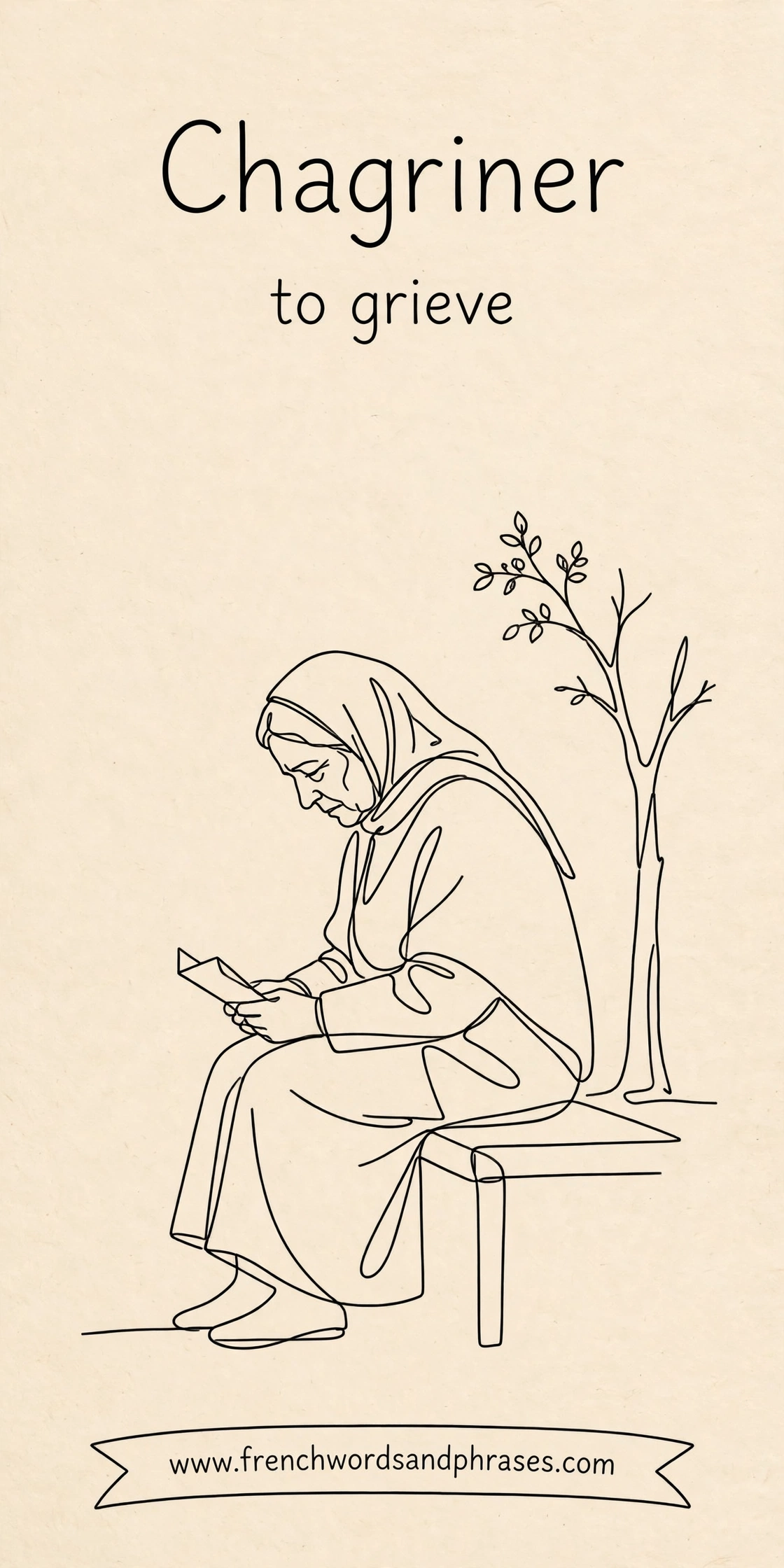
Chagriner is the verb of sorrow delivered — grief with an address, sent by a letter, a piece of news, a silence.
Imagine a mother in Lyon reading a short letter from her son in Canada. Nothing terrible — just distance, and a visit postponed again. She folds the letter slowly; la nouvelle la chagrine, and she will carry it quietly for days.
The letter meant no harm. It grieved her all the same — chagrinée par quelques lignes polies.
How to Conjugate Chagriner: Complete French Conjugation Guide
Let’s explore every major conjugation of chagriner, beginning with the indicative mood.
How to Conjugate Chagriner in the Indicative Mood
The indicative mood is used to express facts, observations, actions, and events.
How to Conjugate Chagriner in the Present Tense (Présent)
Used for actions happening now, habitual actions, and general truths.
| Subject | Conjugation |
|---|---|
| je | chagrine |
| tu | chagrines |
| il / elle | chagrine |
| nous | chagrinons |
| vous | chagrinez |
| ils / elles | chagrinent |
Example
Cette nouvelle chagrine toute la famille.
This news grieves the whole family.
Quick Quiz 1
Complete the sentence:
Nous ______ nos parents avec nos silences.
Reveal the answer
chagrinons
Nous chagrinons nos parents avec nos silences.
We grieve our parents with our silences.
How to Conjugate Chagriner in the Passé Composé
Used for completed actions in the past. Chagriner takes the auxiliary verb avoir.
| Subject | Conjugation |
|---|---|
| j’ | ai chagriné |
| tu | as chagriné |
| il / elle | a chagriné |
| nous | avons chagriné |
| vous | avez chagriné |
| ils / elles | ont chagriné |
Example
Son départ a chagriné ses grands-parents.
His departure grieved his grandparents.
How to Conjugate Chagriner in the Imparfait (Imperfect Tense)
Used for habitual past actions, descriptions, and ongoing situations in the past.
| Subject | Conjugation |
|---|---|
| je | chagrinais |
| tu | chagrinais |
| il / elle | chagrinait |
| nous | chagrinions |
| vous | chagriniez |
| ils / elles | chagrinaient |
Example
Rien ne chagrinait le vieil homme, sauf l’injustice.
Nothing grieved the old man, except injustice.
Quick Quiz 2
Choose the correct form:
The news grieved them.
La nouvelle les ______ . (a chagrinés / est chagrinée)
Reveal the answer
a chagrinés
La nouvelle les a chagrinés.
Chagriner takes avoir, and the participle agrees with the preceding object les.
How to Conjugate Chagriner in the Plus-que-parfait
Used to describe an action that had already been completed before another past event.
| Subject | Conjugation |
|---|---|
| j’ | avais chagriné |
| tu | avais chagriné |
| il / elle | avait chagriné |
| nous | avions chagriné |
| vous | aviez chagriné |
| ils / elles | avaient chagriné |
Example
La nouvelle les avait profondément chagrinés.
The news had deeply grieved them.
How to Conjugate Chagriner in the Passé Simple
Primarily used in formal writing, literature, and historical narratives. It is rarely used in everyday conversation.
| Subject | Conjugation |
|---|---|
| je | chagrinai |
| tu | chagrinas |
| il / elle | chagrina |
| nous | chagrinâmes |
| vous | chagrinâtes |
| ils / elles | chagrinèrent |
Example
La lettre chagrina la mère pendant des semaines.
The letter grieved the mother for weeks.
How to Conjugate Chagriner in the Passé Antérieur
A literary tense used to express an action completed immediately before another past action, generally in the passé simple.
| Subject | Conjugation |
|---|---|
| j’ | eus chagriné |
| tu | eus chagriné |
| il / elle | eut chagriné |
| nous | eûmes chagriné |
| vous | eûtes chagriné |
| ils / elles | eurent chagriné |
Example
Quand cette pensée l’eut chagriné toute la nuit, il finit par se lever.
When this thought had grieved him all night, he finally got up.
How to Conjugate Chagriner in the Future Tense (Futur Simple)
Used to describe actions that will take place in the future.
| Subject | Conjugation |
|---|---|
| je | chagrinerai |
| tu | chagrineras |
| il / elle | chagrinera |
| nous | chagrinerons |
| vous | chagrinerez |
| ils / elles | chagrineront |
Example
Cette décision chagrinera les anciens du village.
This decision will grieve the village elders.
How to Conjugate Chagriner in the Futur Antérieur (Future Perfect)
Used for an action that will have been completed before a particular point in the future.
| Subject | Conjugation |
|---|---|
| j’ | aurai chagriné |
| tu | auras chagriné |
| il / elle | aura chagriné |
| nous | aurons chagriné |
| vous | aurez chagriné |
| ils / elles | auront chagriné |
Example
D’ici là, la nouvelle aura chagriné tout le quartier.
By then, the news will have grieved the whole neighbourhood.
How to Conjugate Chagriner in the Near Future (Futur Proche)
Used to describe something that is going to happen soon. Formed with aller + infinitive.
| Subject | Conjugation |
|---|---|
| je | vais chagriner |
| tu | vas chagriner |
| il / elle | va chagriner |
| nous | allons chagriner |
| vous | allez chagriner |
| ils / elles | vont chagriner |
Example
Cette histoire va chagriner les enfants, ne la raconte pas.
This story is going to upset the children, do not tell it.
How to Conjugate Chagriner in the Conditional Mood
The conditional mood expresses what would happen under certain circumstances. It is also frequently used to make polite requests or express wishes.
How to Conjugate Chagriner in the Present Conditional
| Subject | Conjugation |
|---|---|
| je | chagrinerais |
| tu | chagrinerais |
| il / elle | chagrinerait |
| nous | chagrinerions |
| vous | chagrineriez |
| ils / elles | chagrineraient |
Example
Un échec chagrinerait beaucoup le candidat.
A failure would grieve the candidate greatly.
How to Conjugate Chagriner in the Past Conditional
| Subject | Conjugation |
|---|---|
| j’ | aurais chagriné |
| tu | aurais chagriné |
| il / elle | aurait chagriné |
| nous | aurions chagriné |
| vous | auriez chagriné |
| ils / elles | auraient chagriné |
Example
Elle aurait chagriné ses parents en restant silencieuse.
She would have grieved her parents by staying silent.
Chagriner in the Literary Past Conditional Form
This less common literary form uses the imperfect subjunctive of avoir.
| Subject | Conjugation |
|---|---|
| j’ | eusse chagriné |
| tu | eusses chagriné |
| il / elle | eût chagriné |
| nous | eussions chagriné |
| vous | eussiez chagriné |
| ils / elles | eussent chagriné |
Example
Il eût chagriné sa mère en partant sans un mot.
He would have grieved his mother by leaving without a word.
How to Conjugate Chagriner in the Subjunctive Mood
The subjunctive is used to express wishes, emotions, doubts, necessity, and uncertainty. It frequently follows expressions such as il faut que (it is necessary that) or bien que (although).
How to Conjugate Chagriner in the Present Subjunctive
| Subject | Conjugation |
|---|---|
| que je | chagrine |
| que tu | chagrines |
| qu’il / qu’elle | chagrine |
| que nous | chagrinions |
| que vous | chagriniez |
| qu’ils / qu’elles | chagrinent |
Example
Je suis désolé que cela vous chagrine autant.
I am sorry this grieves you so much.
Quick Quiz 3
Complete the sentence using the subjunctive:
Elle craint que la nouvelle ______ ses parents.
Reveal the answer
chagrine
Elle craint que la nouvelle chagrine ses parents.
She fears the news may grieve her parents.
How to Conjugate Chagriner in the Imperfect Subjunctive
A literary tense, rarely encountered in modern spoken French.
| Subject | Conjugation |
|---|---|
| que je | chagrinasse |
| que tu | chagrinasses |
| qu’il / qu’elle | chagrinât |
| que nous | chagrinassions |
| que vous | chagrinassiez |
| qu’ils / qu’elles | chagrinassent |
Example
Elle craignait que la nouvelle chagrinât ses parents.
She feared the news might grieve her parents.
How to Conjugate Chagriner in the Pluperfect Subjunctive
A literary construction used to express an action completed before another past action.
| Subject | Conjugation |
|---|---|
| que j’ | eusse chagriné |
| que tu | eusses chagriné |
| qu’il / qu’elle | eût chagriné |
| que nous | eussions chagriné |
| que vous | eussiez chagriné |
| qu’ils / qu’elles | eussent chagriné |
Example
Elle avoua que ce souvenir l’eût chagrinée autrefois.
She admitted that this memory would have grieved her in the past.
How to Conjugate Chagriner in the Past Subjunctive
| Subject | Conjugation |
|---|---|
| que j’ | aie chagriné |
| que tu | aies chagriné |
| qu’il / qu’elle | ait chagriné |
| que nous | ayons chagriné |
| que vous | ayez chagriné |
| qu’ils / qu’elles | aient chagriné |
Example
Je regrette que cette remarque ait chagriné ton frère.
I regret that this remark grieved your brother.
How to Conjugate Chagriner in the Imperative
The imperative is used to give commands, instructions, invitations, or suggestions. Subject pronouns are omitted.
How to Conjugate Chagriner in the Present Imperative
| Person | Conjugation |
|---|---|
| (tu) | chagrine |
| (nous) | chagrinons |
| (vous) | chagrinez |
Example
Ne chagrinez pas votre mère avec ces histoires !
Do not grieve your mother with these stories!
Quick Quiz 4
How would you say Do not grieve your mother (tu form)?
Reveal the answer
Ne chagrine pas ta mère !
French Participles of Chagriner
Participles are verb forms that can be used in compound tenses and other grammatical constructions.
Present Participle of Chagriner
chagrinant
En chagrinant ses parents, il ne pensait qu’à lui.
By grieving his parents, he was thinking only of himself.
Past Participle of Chagriner
chagriné
Chagrinée par la nouvelle, elle est restée silencieuse tout le repas.
Grieved by the news, she stayed silent throughout the meal.
Chagriner in Everyday French: Real-Life Examples
Now that you know the conjugations, let’s see how chagriner appears in everyday French.
Example 1 — Present
Cette nouvelle chagrine toute la famille.
This news grieves the whole family.
Example 2 — Passé composé
Son départ a chagriné ses grands-parents.
His departure grieved his grandparents.
Example 3 — Imparfait
Rien ne chagrinait le vieil homme, sauf l’injustice.
Nothing grieved the old man, except injustice.
Example 4 — Future
Cette décision chagrinera les anciens du village.
This decision will grieve the village elders.
Example 5 — Conditional
Un échec chagrinerait beaucoup le candidat.
A failure would grieve the candidate greatly.
Example 6 — Imperative
Ne chagrine pas ta mère avec ces histoires !
Do not grieve your mother with these stories!
Beyond Translation: The Meaning of Chagriner
The noun le chagrin came into French from a dialect word for dark, troubled water, and the verb keeps that clouded colour: to be chagriné is to have one’s heart muddied.
Grief with a cause and a culprit.
Where être triste is a state, chagriner names the agent: something — a letter, a departure, a silence — has done the grieving. Balzac titled a whole novel of disappointed hopes La Peau de chagrin.
How to Remember the French Verb Chagriner
Remember it this way: Chagriner is about the letter that grieves a mother across an ocean.
- Transitive: chagriner quelqu’un — the news does the grieving, the person receives it. Its twin se chagriner is the sorrow felt.
- Single n everywhere: chagriner, chagriné, from le chagrin, grief.
- Regular -er: je chagrine, nous chagrinons, past participle chagriné.
The key idea is the letter that grieves a mother across an ocean.
Test Your Knowledge of Chagriner
Let’s see how much you’ve learned. Try answering these questions before revealing the answers.
Question 1
What is the difference between chagriner and se chagriner?
Reveal the answer
Chagriner causes grief to someone else; se chagriner is to feel it oneself — la nouvelle chagrine sa mère; elle se chagrine de la nouvelle.
Question 2
How do you say This news grieves the whole family in French?
Reveal the answer
Cette nouvelle chagrine toute la famille.
Question 3
Translate: His departure grieved his grandparents.
Reveal the answer
Son départ a chagriné ses grands-parents.
Question 4
What is the past participle of chagriner?
Reveal the answer
Chagriné.
Question 5
Complete the sentence:
Je suis désolé que cela vous ______ autant.
Reveal the answer
chagrine
Je suis désolé que cela vous chagrine autant.
I am sorry this grieves you so much.
Your Final Challenge
Can You Use It?
How would you say this in French?
A three-line letter grieved the old lady more than a whole winter.
Reveal the answer
Une lettre de trois lignes a chagriné la vieille dame plus qu’un hiver entier.
A three-line letter grieved the old lady more than a whole winter.
A little French. A little curiosity. A richer everyday life.
LEARN FRENCH ONE WORD AT A TIME