A French Word to Live By
How to Conjugate Cavalcader in French
/ka.val.ka.de/
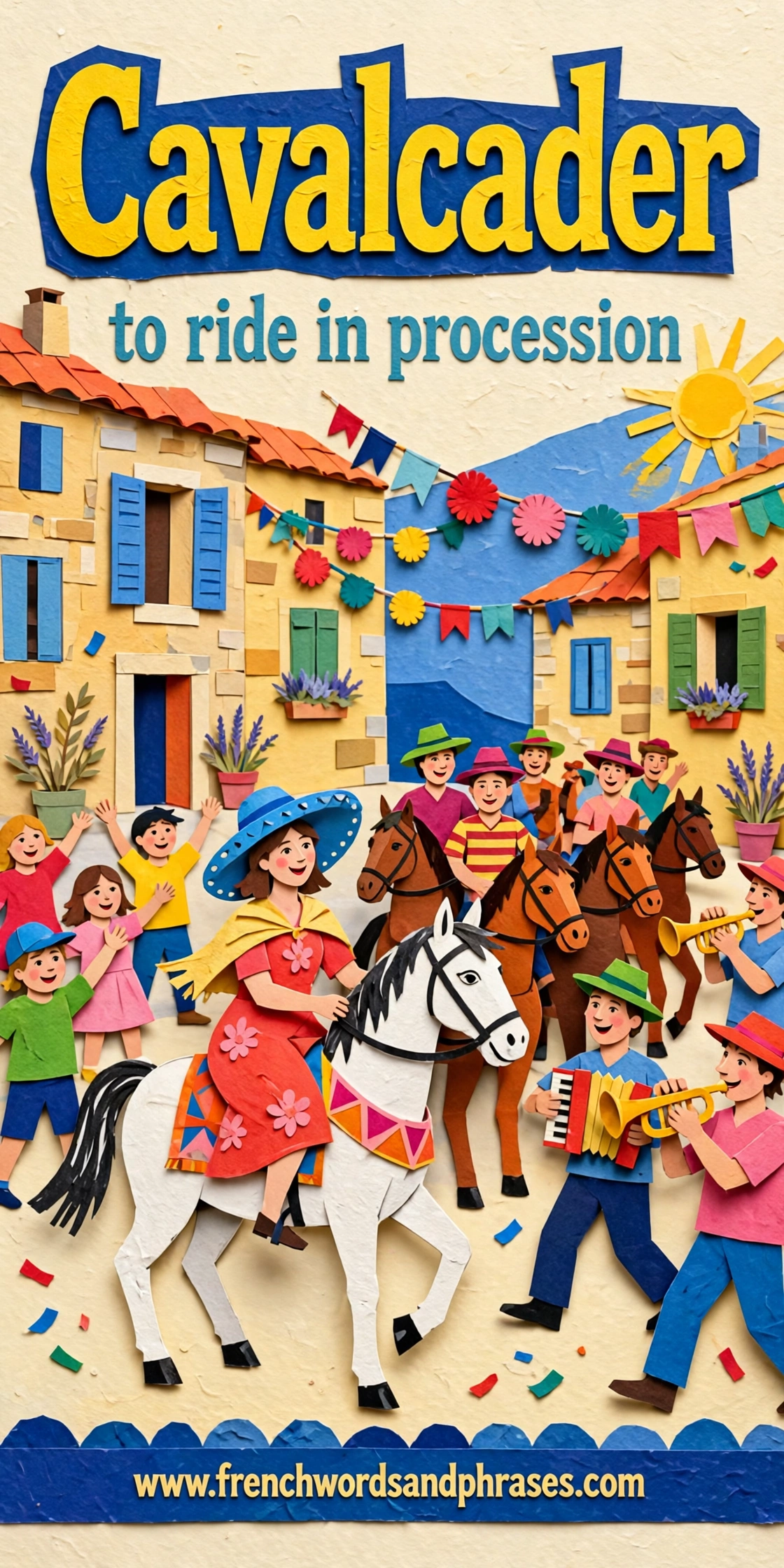
Cavalcader means to ride in procession — to go on horseback in a glittering troop, banners flying, through streets lined with spectators.
Knights entering a town at a medieval festival, gardians trotting through Arles on white Camargue horses, a village fête opening behind its banner — cavalcader is the festive verb of riders on parade: not going anywhere in particular, but arriving magnificently.
In this guide, you’ll learn how to conjugate cavalcader in all the major French tenses and moods. Explore complete conjugation tables, French examples, English translations, and practice quizzes.
Understanding the French Verb Cavalcader
Cavalcader is a regular French verb belonging to the first group of verbs, those ending in-er.
It means to ride in procession. It belongs to descriptions of processions — medieval re-enactments, the gardians of the Camargue, circus parades and village fêtes — and it carries a whiff of dust, banners and applause; it is never the verb for an ordinary ride to the shops.
Verb classification: First group (-er)
Auxiliary verb: Avoir
Past participle: cavalcadé
Present participle: cavalcadant
English equivalents: To ride in procession, to go in a cavalcade; cavalcader dans les rues — to ride through the streets in procession; cavalcader bannière en tête — to ride with the banner at the head; une cavalcade — a cavalcade, a procession of riders; un cavalier — a rider, a horseman.
One important detail: cavalcader is a rare, festive verb — the noun une cavalcade does almost all the work in modern French, and the verb appears mainly in accounts of festivals, fêtes and historical pageants. It is perfectly regular: ils cavalcadent, nous cavalcadons. Its subject is nearly always a group: one rider chevauche or monte à cheval, but a troop cavalcade.
Experience the Word
Cavalcader is the verb of the horse as spectacle — riding not to travel, but to be seen travelling.
Imagine the fête in a Camargue village at ten in the morning. The church bell stops, the gate opens, and fifty gardians on white horses cavalcadent into the main street behind their banner, hooves ringing on the stone, while the whole village applauds from the pavements.
They are going nowhere — the circuit ends where it began. They have processed — cavalcadé — and the riding itself was the ceremony.
How to Conjugate Cavalcader: Complete French Conjugation Guide
Let’s explore every major conjugation of cavalcader, beginning with the indicative mood.
How to Conjugate Cavalcader in the Indicative Mood
The indicative mood is used to express facts, observations, actions, and events.
How to Conjugate Cavalcader in the Present Tense (Présent)
Used for actions happening now, habitual actions, and general truths.
| Subject | Conjugation |
|---|---|
| je | cavalcade |
| tu | cavalcades |
| il / elle | cavalcade |
| nous | cavalcadons |
| vous | cavalcadez |
| ils / elles | cavalcadent |
Example
Les chevaliers cavalcadent dans la grand-rue du village.
The knights ride in procession down the village high street.
Quick Quiz 1
Complete the sentence:
Nous ______ derrière la bannière du village.
Reveal the answer
cavalcadons
Nous cavalcadons derrière la bannière du village.
We ride in procession behind the village banner.
How to Conjugate Cavalcader in the Passé Composé
Used for completed actions in the past. Cavalcader takes the auxiliary verb avoir.
| Subject | Conjugation |
|---|---|
| j’ | ai cavalcadé |
| tu | as cavalcadé |
| il / elle | a cavalcadé |
| nous | avons cavalcadé |
| vous | avez cavalcadé |
| ils / elles | ont cavalcadé |
Example
Les cavaliers ont cavalcadé jusqu’à la place du marché.
The riders rode in procession as far as the market square.
How to Conjugate Cavalcader in the Imparfait (Imperfect Tense)
Used for habitual past actions, descriptions, and ongoing situations in the past.
| Subject | Conjugation |
|---|---|
| je | cavalcadais |
| tu | cavalcadais |
| il / elle | cavalcadait |
| nous | cavalcadions |
| vous | cavalcadiez |
| ils / elles | cavalcadaient |
Example
Chaque été, les gardians cavalcadaient dans les rues d’Arles.
Every summer, the gardians used to ride in procession through the streets of Arles.
Quick Quiz 2
Choose the correct form:
The riders rode to the square.
Les cavaliers ______ jusqu’à la place. (ont cavalcadé / sont cavalcadés)
Reveal the answer
ont cavalcadé
Les cavaliers ont cavalcadé jusqu’à la place.
Cavalcader takes avoir.
How to Conjugate Cavalcader in the Plus-que-parfait
Used to describe an action that had already been completed before another past event.
| Subject | Conjugation |
|---|---|
| j’ | avais cavalcadé |
| tu | avais cavalcadé |
| il / elle | avait cavalcadé |
| nous | avions cavalcadé |
| vous | aviez cavalcadé |
| ils / elles | avaient cavalcadé |
Example
La troupe avait cavalcadé toute la matinée avant la fête.
The troop had ridden in procession all morning before the festival.
How to Conjugate Cavalcader in the Passé Simple
Primarily used in formal writing, literature, and historical narratives. It is rarely used in everyday conversation.
| Subject | Conjugation |
|---|---|
| je | cavalcadai |
| tu | cavalcadas |
| il / elle | cavalcada |
| nous | cavalcadâmes |
| vous | cavalcadâtes |
| ils / elles | cavalcadèrent |
Example
Le cortège entra dans la ville, et les hérauts cavalcadèrent jusqu’au château.
The procession entered the town, and the heralds rode up to the castle.
How to Conjugate Cavalcader in the Passé Antérieur
A literary tense used to express an action completed immediately before another past action, generally in the passé simple.
| Subject | Conjugation |
|---|---|
| j’ | eus cavalcadé |
| tu | eus cavalcadé |
| il / elle | eut cavalcadé |
| nous | eûmes cavalcadé |
| vous | eûtes cavalcadé |
| ils / elles | eurent cavalcadé |
Example
Quand les cavaliers eurent cavalcadé autour de la place, la fête commença.
When the riders had processed around the square, the festival began.
How to Conjugate Cavalcader in the Future Tense (Futur Simple)
Used to describe actions that will take place in the future.
| Subject | Conjugation |
|---|---|
| je | cavalcaderai |
| tu | cavalcaderas |
| il / elle | cavalcadera |
| nous | cavalcaderons |
| vous | cavalcaderez |
| ils / elles | cavalcaderont |
Example
Demain, cent cavaliers cavalcaderont pour la fête du village.
Tomorrow, a hundred riders will ride in procession for the village festival.
How to Conjugate Cavalcader in the Futur Antérieur (Future Perfect)
Used for an action that will have been completed before a particular point in the future.
| Subject | Conjugation |
|---|---|
| j’ | aurai cavalcadé |
| tu | auras cavalcadé |
| il / elle | aura cavalcadé |
| nous | aurons cavalcadé |
| vous | aurez cavalcadé |
| ils / elles | auront cavalcadé |
Example
À midi, les gardians auront cavalcadé trois fois autour de l’église.
By noon, the gardians will have ridden three times around the church.
How to Conjugate Cavalcader in the Near Future (Futur Proche)
Used to describe something that is going to happen soon. Formed with aller + infinitive.
| Subject | Conjugation |
|---|---|
| je | vais cavalcader |
| tu | vas cavalcader |
| il / elle | va cavalcader |
| nous | allons cavalcader |
| vous | allez cavalcader |
| ils / elles | vont cavalcader |
Example
Regardez, les chevaliers vont cavalcader devant le château.
Look, the knights are going to ride in procession in front of the castle.
How to Conjugate Cavalcader in the Conditional Mood
The conditional mood expresses what would happen under certain circumstances. It is also frequently used to make polite requests or express wishes.
How to Conjugate Cavalcader in the Present Conditional
| Subject | Conjugation |
|---|---|
| je | cavalcaderais |
| tu | cavalcaderais |
| il / elle | cavalcaderait |
| nous | cavalcaderions |
| vous | cavalcaderiez |
| ils / elles | cavalcaderaient |
Example
Avec plus de chevaux, nous cavalcaderions jusqu’à la rivière.
With more horses, we would ride in procession as far as the river.
How to Conjugate Cavalcader in the Past Conditional
| Subject | Conjugation |
|---|---|
| j’ | aurais cavalcadé |
| tu | aurais cavalcadé |
| il / elle | aurait cavalcadé |
| nous | aurions cavalcadé |
| vous | auriez cavalcadé |
| ils / elles | auraient cavalcadé |
Example
Ils auraient cavalcadé sous la pluie si la fête n’avait pas été annulée.
They would have ridden in procession in the rain if the festival had not been cancelled.
Cavalcader in the Literary Past Conditional Form
This less common literary form uses the imperfect subjunctive of avoir.
| Subject | Conjugation |
|---|---|
| j’ | eusse cavalcadé |
| tu | eusses cavalcadé |
| il / elle | eût cavalcadé |
| nous | eussions cavalcadé |
| vous | eussiez cavalcadé |
| ils / elles | eussent cavalcadé |
Example
Les hérauts eussent cavalcadé jusqu’au palais sans la tempête.
The heralds would have ridden to the palace had it not been for the storm.
How to Conjugate Cavalcader in the Subjunctive Mood
The subjunctive is used to express wishes, emotions, doubts, necessity, and uncertainty. It frequently follows expressions such as il faut que (it is necessary that) or bien que (although).
How to Conjugate Cavalcader in the Present Subjunctive
| Subject | Conjugation |
|---|---|
| que je | cavalcade |
| que tu | cavalcades |
| qu’il / qu’elle | cavalcade |
| que nous | cavalcadions |
| que vous | cavalcadiez |
| qu’ils / qu’elles | cavalcadent |
Example
Il faut que les cavaliers cavalcadent en ordre serré.
The riders must process in close order.
Quick Quiz 3
Complete the sentence using the subjunctive:
Il faut que vous ______ en ordre serré.
Reveal the answer
cavalcadiez
Il faut que vous cavalcadiez en ordre serré.
You must ride in procession in close order.
How to Conjugate Cavalcader in the Imperfect Subjunctive
A literary tense, rarely encountered in modern spoken French.
| Subject | Conjugation |
|---|---|
| que je | cavalcadasse |
| que tu | cavalcadasses |
| qu’il / qu’elle | cavalcadât |
| que nous | cavalcadassions |
| que vous | cavalcadassiez |
| qu’ils / qu’elles | cavalcadassent |
Example
Le maire souhaitait que la troupe cavalcadât avant le feu d’artifice.
The mayor wished the troop to ride in procession before the fireworks.
How to Conjugate Cavalcader in the Pluperfect Subjunctive
A literary construction used to express an action completed before another past action.
| Subject | Conjugation |
|---|---|
| que j’ | eusse cavalcadé |
| que tu | eusses cavalcadé |
| qu’il / qu’elle | eût cavalcadé |
| que nous | eussions cavalcadé |
| que vous | eussiez cavalcadé |
| qu’ils / qu’elles | eussent cavalcadé |
Example
On admirait qu’ils eussent cavalcadé si longtemps sous un soleil de plomb.
People admired that they had ridden in procession so long under a blazing sun.
How to Conjugate Cavalcader in the Past Subjunctive
| Subject | Conjugation |
|---|---|
| que j’ | aie cavalcadé |
| que tu | aies cavalcadé |
| qu’il / qu’elle | ait cavalcadé |
| que nous | ayons cavalcadé |
| que vous | ayez cavalcadé |
| qu’ils / qu’elles | aient cavalcadé |
Example
Je suis content que les enfants aient cavalcadé avec leurs poneys.
I am glad the children rode in procession with their ponies.
How to Conjugate Cavalcader in the Imperative
The imperative is used to give commands, instructions, invitations, or suggestions. Subject pronouns are omitted.
How to Conjugate Cavalcader in the Present Imperative
| Person | Conjugation |
|---|---|
| (tu) | cavalcade |
| (nous) | cavalcadons |
| (vous) | cavalcadez |
Example
Cavalcadez lentement devant la tribune !
Ride slowly past the stand!
Quick Quiz 4
How would you say Ride slowly past the stand (tu form)?
Reveal the answer
Cavalcade lentement devant la tribune !
French Participles of Cavalcader
Participles are verb forms that can be used in compound tenses and other grammatical constructions.
Present Participle of Cavalcader
cavalcadant
En cavalcadant bannière en tête, ils ouvrirent la fête.
Riding in procession with the banner at their head, they opened the festival.
Past Participle of Cavalcader
cavalcadé
Les rues cavalcadées dès l’aube gardaient l’odeur des chevaux.
The streets, ridden through from dawn, kept the smell of the horses.
Cavalcader in Everyday French: Real-Life Examples
Now that you know the conjugations, let’s see how cavalcader appears in everyday French.
Example 1 — Present
Les gardians cavalcadent dans les rues.
The gardians ride in procession through the streets.
Example 2 — Passé composé
Les cavaliers ont cavalcadé jusqu’à la place.
The riders rode in procession to the square.
Example 3 — Imparfait
Chaque été, la troupe cavalcadait avant la fête.
Every summer, the troop used to process before the festival.
Example 4 — Future
Cent cavaliers cavalcaderont demain.
A hundred riders will ride in procession tomorrow.
Example 5 — Conditional
Nous cavalcaderions jusqu’à la rivière avec plus de chevaux.
We would ride in procession to the river with more horses.
Example 6 — Imperative
Cavalcadez lentement devant la tribune !
Ride slowly past the stand!
Beyond Translation: The Meaning of Cavalcader
English cavalcade was borrowed from this very word — from Italian cavalcata, a ride, built on Latin caballus, the horse.
The noun conquered the world; the verb stayed home.
French speakers announce une cavalcade for any grand procession, but the verb cavalcader survives in the south, at fêtes and re-enactments, where the riders still actually come down the street.
How to Remember the French Verb Cavalcader
Remember it this way: Cavalcader is about fifty white horses processing through the village behind the banner.
- A verb for groups on parade: les gardians cavalcadent — one rider alone does not cavalcade.
- The noun une cavalcade is far commoner than the verb; learn them together.
- Regular -er: ils cavalcadent, nous cavalcadons, past participle cavalcadé.
The key idea is fifty white horses processing through the village behind the banner.
Test Your Knowledge of Cavalcader
Let’s see how much you’ve learned. Try answering these questions before revealing the answers.
Question 1
Who typically cavalcade — a lone rider or a troop?
Reveal the answer
A troop — cavalcader is the verb of riders in procession; a lone rider monte à cheval.
Question 2
How do you say The gardians ride in procession through the streets in French?
Reveal the answer
Les gardians cavalcadent dans les rues.
Question 3
Translate: Tomorrow, a hundred riders will ride in procession.
Reveal the answer
Demain, cent cavaliers cavalcaderont.
Question 4
What is the past participle of cavalcader?
Reveal the answer
Cavalcadé.
Question 5
Complete the sentence:
Il faut que les cavaliers ______ en ordre serré.
Reveal the answer
cavalcadent
Il faut que les cavaliers cavalcadent en ordre serré.
The riders must process in close order.
Your Final Challenge
Can You Use It?
How would you say this in French?
They ride in procession, banner high, down the main street, and the whole village remembers it has horses and a history.
Reveal the answer
Ils cavalcadent bannière haute dans la grand-rue, et le village entier se souvient qu’il a des chevaux et une histoire.
They ride in procession, banner high, down the main street, and the whole village remembers it has horses and a history.
A little French. A little curiosity. A richer everyday life.
LEARN FRENCH ONE WORD AT A TIME