A French Word to Live By
How to Conjugate Cauchemarder in French
/koʃ.maʁ.de/
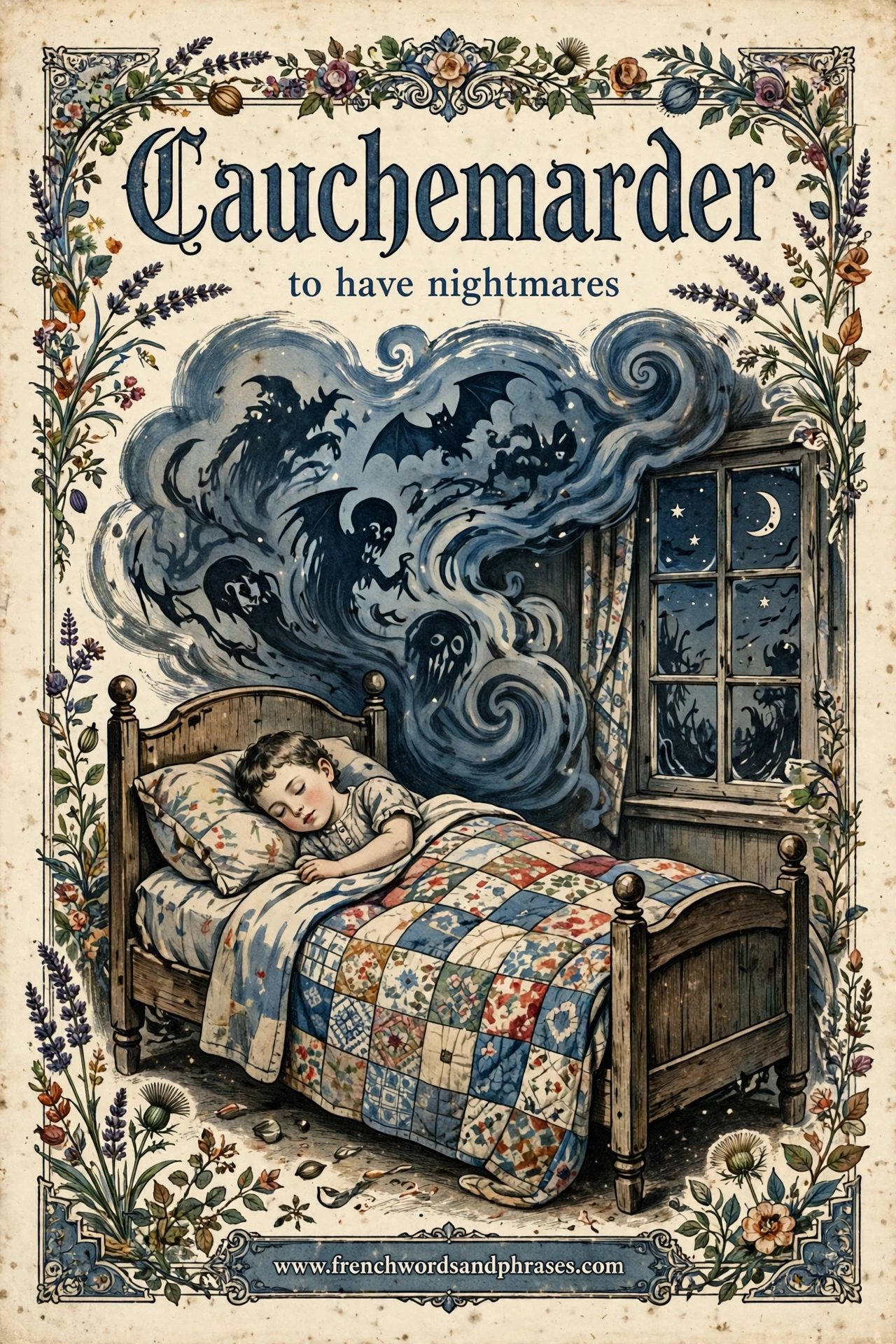
Cauchemarder means to have nightmares — to spend the night wrestling with bad dreams instead of sleeping.
A child who watched the wrong film at nine o’clock, a traveller before a dawn flight, an examinee the night before the results — cauchemarder is the verb of the haunted night: the dreams are bad, the waking is frequent, and morning comes as a rescue.
In this guide, you’ll learn how to conjugate cauchemarder in all the major French tenses and moods. Explore complete conjugation tables, French examples, English translations, and practice quizzes.
Understanding the French Verb Cauchemarder
Cauchemarder is a regular French verb belonging to the first group of verbs, those ending in-er.
It means to have nightmares. It is a familiar, expressive verb of family life — children cauchemardent after scary stories, adults before examinations and operations. The adjective cauchemardesque (nightmarish) has escaped into general use for any ghastly situation, from traffic jams to tax forms, but the verb itself stays close to the bed and the night.
Verb classification: First group (-er)
Auxiliary verb: Avoir
Past participle: cauchemardé
Present participle: cauchemardant
English equivalents: To have nightmares, to be plagued by bad dreams; cauchemarder toute la nuit — to have nightmares all night; faire cauchemarder quelqu’un — to give someone nightmares; un cauchemar — a nightmare; cauchemardesque — nightmarish.
One important detail: cauchemarder is a regular -er verb built on the noun un cauchemar, a nightmare — itself a small horror story: caucher was Old French for to press or trample, and the mare was the night-demon who sat on sleepers’ chests, the same creature hiding inside the English word nightmare. The verb belongs to the dreamer: je cauchemarde, I have nightmares; to say a film gives you nightmares, French turns it round — ce film me fait cauchemarder. There is no reflexive form in ordinary use.
Experience the Word
Cauchemarder is the verb of sleep that fights back — the night as a wrestling match the dreamer never entered willingly.
Imagine a small boy who saw ten minutes of a pirate film at his cousin’s house. All night he cauchemarde — the ship is sinking, the water is rising, the door will not open — until his mother shakes him awake at three in the morning and the pirates dissolve into the familiar shapes of his own room.
By breakfast the sea has vanished. He has nightmared — cauchemardé — and daylight has won, as it always does, eventually.
How to Conjugate Cauchemarder: Complete French Conjugation Guide
Let’s explore every major conjugation of cauchemarder, beginning with the indicative mood.
How to Conjugate Cauchemarder in the Indicative Mood
The indicative mood is used to express facts, observations, actions, and events.
How to Conjugate Cauchemarder in the Present Tense (Présent)
Used for actions happening now, habitual actions, and general truths.
| Subject | Conjugation |
|---|---|
| je | cauchemarde |
| tu | cauchemardes |
| il / elle | cauchemarde |
| nous | cauchemardons |
| vous | cauchemardez |
| ils / elles | cauchemardent |
Example
Depuis le film d’horreur, l’enfant cauchemarde chaque nuit.
Since the horror film, the child has nightmares every night.
Quick Quiz 1
Complete the sentence:
Nous ______ chaque fois que nous mangeons trop tard.
Reveal the answer
cauchemardons
Nous cauchemardons chaque fois que nous mangeons trop tard.
We have nightmares whenever we eat too late.
How to Conjugate Cauchemarder in the Passé Composé
Used for completed actions in the past. Cauchemarder takes the auxiliary verb avoir.
| Subject | Conjugation |
|---|---|
| j’ | ai cauchemardé |
| tu | as cauchemardé |
| il / elle | a cauchemardé |
| nous | avons cauchemardé |
| vous | avez cauchemardé |
| ils / elles | ont cauchemardé |
Example
J’ai cauchemardé toute la nuit après cette histoire.
I had nightmares all night after that story.
How to Conjugate Cauchemarder in the Imparfait (Imperfect Tense)
Used for habitual past actions, descriptions, and ongoing situations in the past.
| Subject | Conjugation |
|---|---|
| je | cauchemardais |
| tu | cauchemardais |
| il / elle | cauchemardait |
| nous | cauchemardions |
| vous | cauchemardiez |
| ils / elles | cauchemardaient |
Example
Elle cauchemardait souvent quand elle était petite.
She often had nightmares when she was little.
Quick Quiz 2
Choose the correct form:
I had nightmares all night.
J’______ toute la nuit. (ai cauchemardé / suis cauchemardé)
Reveal the answer
ai cauchemardé
J’ai cauchemardé toute la nuit.
Cauchemarder takes avoir.
How to Conjugate Cauchemarder in the Plus-que-parfait
Used to describe an action that had already been completed before another past event.
| Subject | Conjugation |
|---|---|
| j’ | avais cauchemardé |
| tu | avais cauchemardé |
| il / elle | avait cauchemardé |
| nous | avions cauchemardé |
| vous | aviez cauchemardé |
| ils / elles | avaient cauchemardé |
Example
Il avait cauchemardé avant même de partir en voyage.
He had had nightmares even before leaving on the trip.
How to Conjugate Cauchemarder in the Passé Simple
Primarily used in formal writing, literature, and historical narratives. It is rarely used in everyday conversation.
| Subject | Conjugation |
|---|---|
| je | cauchemardai |
| tu | cauchemardas |
| il / elle | cauchemarda |
| nous | cauchemardâmes |
| vous | cauchemardâtes |
| ils / elles | cauchemardèrent |
Example
Cette nuit-là, le petit cauchemarda jusqu’à l’aube.
That night, the little boy had nightmares until dawn.
How to Conjugate Cauchemarder in the Passé Antérieur
A literary tense used to express an action completed immediately before another past action, generally in the passé simple.
| Subject | Conjugation |
|---|---|
| j’ | eus cauchemardé |
| tu | eus cauchemardé |
| il / elle | eut cauchemardé |
| nous | eûmes cauchemardé |
| vous | eûtes cauchemardé |
| ils / elles | eurent cauchemardé |
Example
Quand elle eut cauchemardé trois nuits de suite, sa mère consulta un médecin.
When she had had nightmares three nights running, her mother consulted a doctor.
How to Conjugate Cauchemarder in the Future Tense (Futur Simple)
Used to describe actions that will take place in the future.
| Subject | Conjugation |
|---|---|
| je | cauchemarderai |
| tu | cauchemarderas |
| il / elle | cauchemardera |
| nous | cauchemarderons |
| vous | cauchemarderez |
| ils / elles | cauchemarderont |
Example
Si tu regardes ce film, tu cauchemarderas, je te préviens !
If you watch this film, you will have nightmares, I am warning you!
How to Conjugate Cauchemarder in the Futur Antérieur (Future Perfect)
Used for an action that will have been completed before a particular point in the future.
| Subject | Conjugation |
|---|---|
| j’ | aurai cauchemardé |
| tu | auras cauchemardé |
| il / elle | aura cauchemardé |
| nous | aurons cauchemardé |
| vous | aurez cauchemardé |
| ils / elles | auront cauchemardé |
Example
À force de stress, il aura cauchemardé toute la semaine.
With all the stress, he will have had nightmares all week.
How to Conjugate Cauchemarder in the Near Future (Futur Proche)
Used to describe something that is going to happen soon. Formed with aller + infinitive.
| Subject | Conjugation |
|---|---|
| je | vais cauchemarder |
| tu | vas cauchemarder |
| il / elle | va cauchemarder |
| nous | allons cauchemarder |
| vous | allez cauchemarder |
| ils / elles | vont cauchemarder |
Example
Laisse ce livre, tu vas cauchemarder !
Put that book down, you are going to have nightmares!
How to Conjugate Cauchemarder in the Conditional Mood
The conditional mood expresses what would happen under certain circumstances. It is also frequently used to make polite requests or express wishes.
How to Conjugate Cauchemarder in the Present Conditional
| Subject | Conjugation |
|---|---|
| je | cauchemarderais |
| tu | cauchemarderais |
| il / elle | cauchemarderait |
| nous | cauchemarderions |
| vous | cauchemarderiez |
| ils / elles | cauchemarderaient |
Example
Sans ces soucis, elle cauchemarderait beaucoup moins.
Without these worries, she would have far fewer nightmares.
How to Conjugate Cauchemarder in the Past Conditional
| Subject | Conjugation |
|---|---|
| j’ | aurais cauchemardé |
| tu | aurais cauchemardé |
| il / elle | aurait cauchemardé |
| nous | aurions cauchemardé |
| vous | auriez cauchemardé |
| ils / elles | auraient cauchemardé |
Example
Il n’aurait pas cauchemardé sans ce repas trop lourd.
He would not have had nightmares without that heavy meal.
Cauchemarder in the Literary Past Conditional Form
This less common literary form uses the imperfect subjunctive of avoir.
| Subject | Conjugation |
|---|---|
| j’ | eusse cauchemardé |
| tu | eusses cauchemardé |
| il / elle | eût cauchemardé |
| nous | eussions cauchemardé |
| vous | eussiez cauchemardé |
| ils / elles | eussent cauchemardé |
Example
L’enfant eût cauchemardé toute la nuit sans sa veilleuse.
The child would have had nightmares all night without his night-light.
How to Conjugate Cauchemarder in the Subjunctive Mood
The subjunctive is used to express wishes, emotions, doubts, necessity, and uncertainty. It frequently follows expressions such as il faut que (it is necessary that) or bien que (although).
How to Conjugate Cauchemarder in the Present Subjunctive
| Subject | Conjugation |
|---|---|
| que je | cauchemarde |
| que tu | cauchemardes |
| qu’il / qu’elle | cauchemarde |
| que nous | cauchemardions |
| que vous | cauchemardiez |
| qu’ils / qu’elles | cauchemardent |
Example
Je crains que mon fils cauchemarde encore cette nuit.
I fear my son may have nightmares again tonight.
Quick Quiz 3
Complete the sentence using the subjunctive:
Je suis désolé que vous ______ à cause de ce bruit.
Reveal the answer
ayez cauchemardé
Je suis désolé que vous ayez cauchemardé à cause de ce bruit.
I am sorry you had nightmares because of that noise.
How to Conjugate Cauchemarder in the Imperfect Subjunctive
A literary tense, rarely encountered in modern spoken French.
| Subject | Conjugation |
|---|---|
| que je | cauchemardasse |
| que tu | cauchemardasses |
| qu’il / qu’elle | cauchemardât |
| que nous | cauchemardassions |
| que vous | cauchemardassiez |
| qu’ils / qu’elles | cauchemardassent |
Example
Sa mère ne voulait pas qu’il cauchemardât après le film.
His mother did not want him to have nightmares after the film.
How to Conjugate Cauchemarder in the Pluperfect Subjunctive
A literary construction used to express an action completed before another past action.
| Subject | Conjugation |
|---|---|
| que j’ | eusse cauchemardé |
| que tu | eusses cauchemardé |
| qu’il / qu’elle | eût cauchemardé |
| que nous | eussions cauchemardé |
| que vous | eussiez cauchemardé |
| qu’ils / qu’elles | eussent cauchemardé |
Example
On disait qu’elle eût cauchemardé avant l’examen.
People said she had had nightmares before the exam.
How to Conjugate Cauchemarder in the Past Subjunctive
| Subject | Conjugation |
|---|---|
| que j’ | aie cauchemardé |
| que tu | aies cauchemardé |
| qu’il / qu’elle | ait cauchemardé |
| que nous | ayons cauchemardé |
| que vous | ayez cauchemardé |
| qu’ils / qu’elles | aient cauchemardé |
Example
Je suis désolé que tu aies cauchemardé à cause de mon histoire.
I am sorry you had nightmares because of my story.
How to Conjugate Cauchemarder in the Imperative
The imperative is used to give commands, instructions, invitations, or suggestions. Subject pronouns are omitted.
How to Conjugate Cauchemarder in the Present Imperative
| Person | Conjugation |
|---|---|
| (tu) | cauchemarde |
| (nous) | cauchemardons |
| (vous) | cauchemardez |
Example
Ne cauchemarde plus, ce n’était qu’un film !
No more nightmares, it was only a film!
Quick Quiz 4
How would you say No more nightmares, it was only a film (tu form)?
Reveal the answer
Ne cauchemarde plus, ce n’était qu’un film !
French Participles of Cauchemarder
Participles are verb forms that can be used in compound tenses and other grammatical constructions.
Present Participle of Cauchemarder
cauchemardant
En cauchemardant, il a réveillé toute la maison.
By having nightmares, he woke the whole house.
Past Participle of Cauchemarder
cauchemardé
Les nuits cauchemardées laissaient l’enfant épuisé.
Nights full of nightmares left the child exhausted.
Cauchemarder in Everyday French: Real-Life Examples
Now that you know the conjugations, let’s see how cauchemarder appears in everyday French.
Example 1 — Present
L’enfant cauchemarde chaque nuit.
The child has nightmares every night.
Example 2 — Passé composé
J’ai cauchemardé toute la nuit.
I had nightmares all night.
Example 3 — Imparfait
Elle cauchemardait souvent, petite.
She often had nightmares as a little girl.
Example 4 — Future
Tu cauchemarderas si tu regardes ce film.
You will have nightmares if you watch this film.
Example 5 — Conditional
Elle cauchemarderait moins sans ces soucis.
She would have fewer nightmares without these worries.
Example 6 — Imperative
Ne cauchemarde plus, ce n’était qu’un film !
No more nightmares, it was only a film!
Beyond Translation: The Meaning of Cauchemarder
English speakers carry the same demon in their own word: nightmare is not a horse but a mare, the goblin who squats on the sleeper’s chest — and French cauchemar preserves the whole scene, the pressing (caucher) and the demon together.
To cauchemarder is to be visited, nightly and unwillingly.
The verb is modern and homely, but the fear is medieval: something heavy sits on the chest, the legs will not move, and the only rescue is waking — which is why the word belongs to mothers, children and the hour before dawn.
How to Remember the French Verb Cauchemarder
Remember it this way: Cauchemarder is about the demon on the chest — and the child rescued by daylight.
- The dreamer does it: je cauchemarde, j’ai cauchemardé — to give someone nightmares, say ce film me fait cauchemarder.
- Cauchemar = caucher (to press) + the night-demon mare — the same creature as in English nightmare.
- Regular -er: je cauchemarde, nous cauchemardons, past participle cauchemardé.
The key idea is the demon on the chest — and the child rescued by daylight.
Test Your Knowledge of Cauchemarder
Let’s see how much you’ve learned. Try answering these questions before revealing the answers.
Question 1
How do you say This film gives me nightmares in French?
Reveal the answer
Ce film me fait cauchemarder — the dreamer cauchemarde; a cause is added with faire.
Question 2
How do you say I had nightmares all night in French?
Reveal the answer
J’ai cauchemardé toute la nuit.
Question 3
Translate: The child has nightmares every night.
Reveal the answer
L’enfant cauchemarde chaque nuit.
Question 4
What is the past participle of cauchemarder?
Reveal the answer
Cauchemardé.
Question 5
Complete the sentence:
Je crains que mon fils ______ encore cette nuit.
Reveal the answer
cauchemarde
Je crains que mon fils cauchemarde encore cette nuit.
I fear my son may have nightmares again tonight.
Your Final Challenge
Can You Use It?
How would you say this in French?
He had nightmares all night, but the morning chased the pirates away.
Reveal the answer
Il a cauchemardé toute la nuit, mais le matin a chassé les pirates.
He had nightmares all night, but the morning chased the pirates away.
A little French. A little curiosity. A richer everyday life.
LEARN FRENCH ONE WORD AT A TIME