A French Word to Live By
How to Conjugate Catalyser in French
/ka.ta.li.ze/
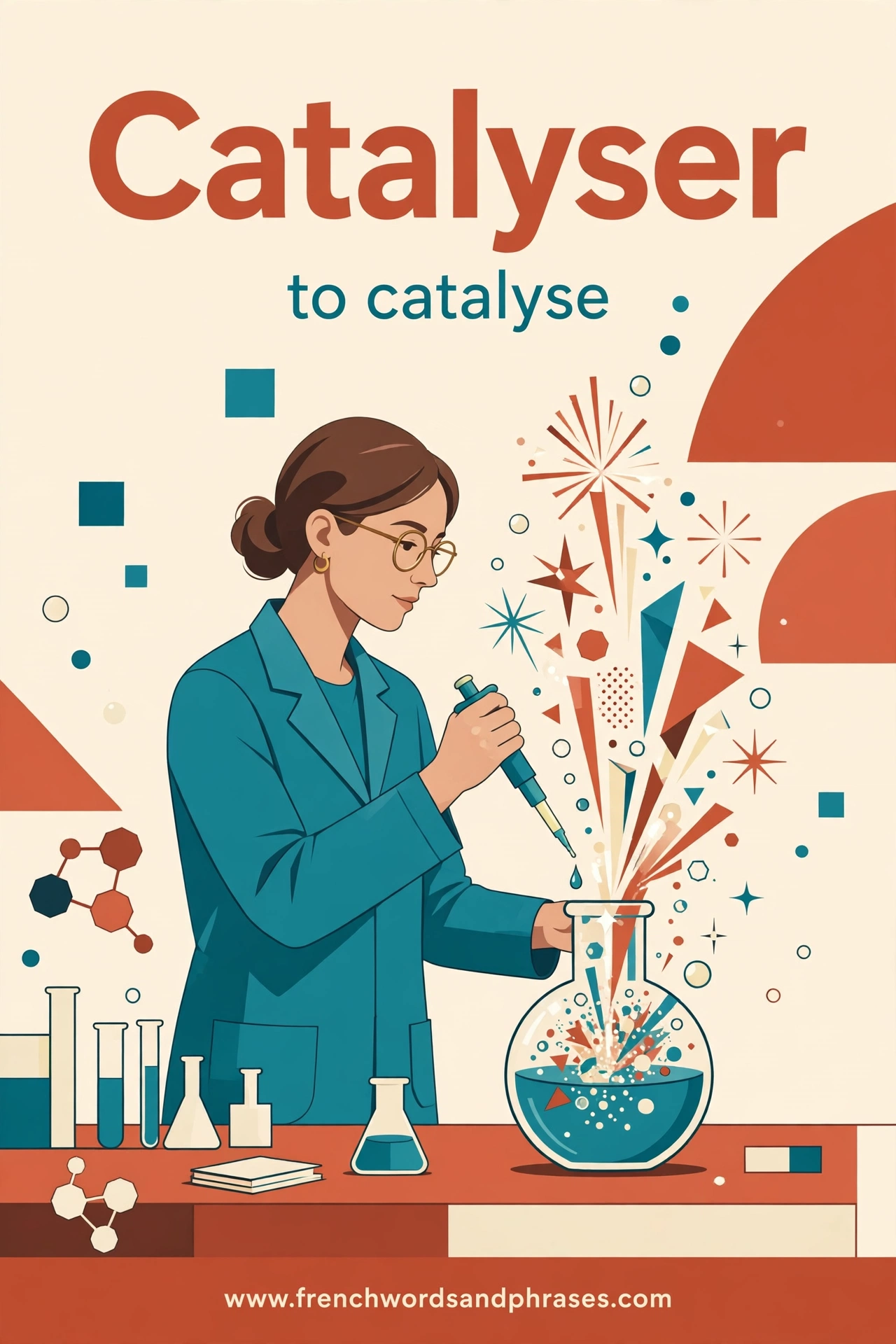
Catalyser means to catalyse — to trigger a change while staying, yourself, mysteriously unchanged.
A pinch of powder that makes a sluggish chemical reaction roar into life, a single speech that suddenly turns grumbling into a movement — catalyser is the verb of the spark: the agent that sets everything moving and walks away untouched.
In this guide, you’ll learn how to conjugate catalyser in all the major French tenses and moods. Explore complete conjugation tables, French examples, English translations, and practice quizzes.
Understanding the French Verb Catalyser
Catalyser is a regular French verb belonging to the first group of verbs, those ending in-er.
It means to catalyse. It lives a double life: in chemistry and medicine it is the precise term for speeding a reaction without being consumed by it, and in journalism and politics it is the standard metaphor for whatever suddenly crystallises a mood — un discours qui catalyse les mécontentements, a speech that brings all the discontent to a head.
Verb classification: First group (-er)
Auxiliary verb: Avoir
Past participle: catalysé
Present participle: catalysant
English equivalents: To catalyse, to act as a catalyst for; catalyser une réaction — to catalyse a reaction; catalyser les énergies — to galvanise people’s energies; catalyser le changement — to spark change; un catalyseur — a catalyst (also a catalytic converter).
One important detail: catalyser is perfectly regular and its y never changes — je catalyse, nous catalysons, je catalyserai — unlike the -oyer verbs (employer, nettoyer), whose y turns to i before a mute e. Do not invent a form like « je catalise »: the y stays. The family is worth learning whole: the noun is la catalyse, the agent is un catalyseur — the same word your mechanic uses for the catalytic converter in your car, le pot catalytique being the full name of the device.
Experience the Word
Catalyser is the verb of the unchanged changer — present at every transformation, consumed by none.
Imagine a town where everyone has complained about the factory for years, in kitchens and cafés, to no effect. One evening a young woman speaks for three minutes at a public meeting — and by Monday there is a committee, a petition and a march. She has changed nothing herself; she has catalysé the town.
The powder stays powder, the speaker stays herself. Everything else has reacted — catalysé — around them.
How to Conjugate Catalyser: Complete French Conjugation Guide
Let’s explore every major conjugation of catalyser, beginning with the indicative mood.
How to Conjugate Catalyser in the Indicative Mood
The indicative mood is used to express facts, observations, actions, and events.
How to Conjugate Catalyser in the Present Tense (Présent)
Used for actions happening now, habitual actions, and general truths.
| Subject | Conjugation |
|---|---|
| je | catalyse |
| tu | catalyses |
| il / elle | catalyse |
| nous | catalysons |
| vous | catalysez |
| ils / elles | catalysent |
Example
Cette enzyme catalyse la réaction en quelques secondes.
This enzyme catalyses the reaction in a few seconds.
Quick Quiz 1
Complete the sentence:
Nous ______ les énergies du quartier.
Reveal the answer
catalysons
Nous catalysons les énergies du quartier.
We are galvanising the neighbourhood’s energies.
How to Conjugate Catalyser in the Passé Composé
Used for completed actions in the past. Catalyser takes the auxiliary verb avoir.
| Subject | Conjugation |
|---|---|
| j’ | ai catalysé |
| tu | as catalysé |
| il / elle | a catalysé |
| nous | avons catalysé |
| vous | avez catalysé |
| ils / elles | ont catalysé |
Example
Son discours a catalysé les mécontentements de tout le pays.
His speech crystallised the discontent of the whole country.
How to Conjugate Catalyser in the Imparfait (Imperfect Tense)
Used for habitual past actions, descriptions, and ongoing situations in the past.
| Subject | Conjugation |
|---|---|
| je | catalysais |
| tu | catalysais |
| il / elle | catalysait |
| nous | catalysions |
| vous | catalysiez |
| ils / elles | catalysaient |
Example
Le platine catalysait les gaz dans le laboratoire.
The platinum used to catalyse the gases in the laboratory.
Quick Quiz 2
Choose the correct form:
The crisis sparked the reforms.
La crise ______ les réformes. (a catalysé / a catalisé)
Reveal the answer
a catalysé
La crise a catalysé les réformes.
The y of catalyser never turns into i.
How to Conjugate Catalyser in the Plus-que-parfait
Used to describe an action that had already been completed before another past event.
| Subject | Conjugation |
|---|---|
| j’ | avais catalysé |
| tu | avais catalysé |
| il / elle | avait catalysé |
| nous | avions catalysé |
| vous | aviez catalysé |
| ils / elles | avaient catalysé |
Example
La crise avait catalysé les réformes attendues depuis des années.
The crisis had sparked the reforms awaited for years.
How to Conjugate Catalyser in the Passé Simple
Primarily used in formal writing, literature, and historical narratives. It is rarely used in everyday conversation.
| Subject | Conjugation |
|---|---|
| je | catalysai |
| tu | catalysas |
| il / elle | catalysa |
| nous | catalysâmes |
| vous | catalysâtes |
| ils / elles | catalysèrent |
Example
Cette rencontre catalysa la création du mouvement.
This meeting sparked the creation of the movement.
How to Conjugate Catalyser in the Passé Antérieur
A literary tense used to express an action completed immediately before another past action, generally in the passé simple.
| Subject | Conjugation |
|---|---|
| j’ | eus catalysé |
| tu | eus catalysé |
| il / elle | eut catalysé |
| nous | eûmes catalysé |
| vous | eûtes catalysé |
| ils / elles | eurent catalysé |
Example
Quand la nouvelle eut catalysé les foules, la place se remplit.
When the news had galvanised the crowds, the square filled up.
How to Conjugate Catalyser in the Future Tense (Futur Simple)
Used to describe actions that will take place in the future.
| Subject | Conjugation |
|---|---|
| je | catalyserai |
| tu | catalyseras |
| il / elle | catalysera |
| nous | catalyserons |
| vous | catalyserez |
| ils / elles | catalyseront |
Example
Ce projet catalysera les énergies de tout le quartier.
This project will galvanise the energies of the whole neighbourhood.
How to Conjugate Catalyser in the Futur Antérieur (Future Perfect)
Used for an action that will have been completed before a particular point in the future.
| Subject | Conjugation |
|---|---|
| j’ | aurai catalysé |
| tu | auras catalysé |
| il / elle | aura catalysé |
| nous | aurons catalysé |
| vous | aurez catalysé |
| ils / elles | auront catalysé |
Example
À la fin, cette invention aura catalysé toute une industrie.
In the end, this invention will have sparked a whole industry.
How to Conjugate Catalyser in the Near Future (Futur Proche)
Used to describe something that is going to happen soon. Formed with aller + infinitive.
| Subject | Conjugation |
|---|---|
| je | vais catalyser |
| tu | vas catalyser |
| il / elle | va catalyser |
| nous | allons catalyser |
| vous | allez catalyser |
| ils / elles | vont catalyser |
Example
Ce film va catalyser le débat sur l’école.
This film is going to spark the debate about schools.
How to Conjugate Catalyser in the Conditional Mood
The conditional mood expresses what would happen under certain circumstances. It is also frequently used to make polite requests or express wishes.
How to Conjugate Catalyser in the Present Conditional
| Subject | Conjugation |
|---|---|
| je | catalyserais |
| tu | catalyserais |
| il / elle | catalyserait |
| nous | catalyserions |
| vous | catalyseriez |
| ils / elles | catalyseraient |
Example
Un bon chef catalyserait les talents de son équipe.
A good leader would bring out the talents of his team.
How to Conjugate Catalyser in the Past Conditional
| Subject | Conjugation |
|---|---|
| j’ | aurais catalysé |
| tu | aurais catalysé |
| il / elle | aurait catalysé |
| nous | aurions catalysé |
| vous | auriez catalysé |
| ils / elles | auraient catalysé |
Example
Sans lui, rien n’aurait catalysé le groupe aussi vite.
Without him, nothing would have galvanised the group so quickly.
Catalyser in the Literary Past Conditional Form
This less common literary form uses the imperfect subjunctive of avoir.
| Subject | Conjugation |
|---|---|
| j’ | eusse catalysé |
| tu | eusses catalysé |
| il / elle | eût catalysé |
| nous | eussions catalysé |
| vous | eussiez catalysé |
| ils / elles | eussent catalysé |
Example
Sa voix eût catalysé les foules de la capitale.
Her voice would have galvanised the crowds of the capital.
How to Conjugate Catalyser in the Subjunctive Mood
The subjunctive is used to express wishes, emotions, doubts, necessity, and uncertainty. It frequently follows expressions such as il faut que (it is necessary that) or bien que (although).
How to Conjugate Catalyser in the Present Subjunctive
| Subject | Conjugation |
|---|---|
| que je | catalyse |
| que tu | catalyses |
| qu’il / qu’elle | catalyse |
| que nous | catalysions |
| que vous | catalysiez |
| qu’ils / qu’elles | catalysent |
Example
Il faut qu’une idée catalyse ce mouvement.
An idea must spark this movement.
Quick Quiz 3
Complete the sentence using the subjunctive:
Il faut que vous ______ les bonnes volontés.
Reveal the answer
catalysiez
Il faut que vous catalysiez les bonnes volontés.
You must rally all the goodwill.
How to Conjugate Catalyser in the Imperfect Subjunctive
A literary tense, rarely encountered in modern spoken French.
| Subject | Conjugation |
|---|---|
| que je | catalysasse |
| que tu | catalysasses |
| qu’il / qu’elle | catalysât |
| que nous | catalysassions |
| que vous | catalysassiez |
| qu’ils / qu’elles | catalysassent |
Example
On espérait qu’il catalysât les bonnes volontés.
People hoped he would rally all the goodwill.
How to Conjugate Catalyser in the Pluperfect Subjunctive
A literary construction used to express an action completed before another past action.
| Subject | Conjugation |
|---|---|
| que j’ | eusse catalysé |
| que tu | eusses catalysé |
| qu’il / qu’elle | eût catalysé |
| que nous | eussions catalysé |
| que vous | eussiez catalysé |
| qu’ils / qu’elles | eussent catalysé |
Example
On racontait que ce livre eût catalysé la révolte.
People said this book had sparked the revolt.
How to Conjugate Catalyser in the Past Subjunctive
| Subject | Conjugation |
|---|---|
| que j’ | aie catalysé |
| que tu | aies catalysé |
| qu’il / qu’elle | ait catalysé |
| que nous | ayons catalysé |
| que vous | ayez catalysé |
| qu’ils / qu’elles | aient catalysé |
Example
Je suis étonné que cette phrase ait catalysé tant de colère.
I am amazed this sentence sparked so much anger.
How to Conjugate Catalyser in the Imperative
The imperative is used to give commands, instructions, invitations, or suggestions. Subject pronouns are omitted.
How to Conjugate Catalyser in the Present Imperative
| Person | Conjugation |
|---|---|
| (tu) | catalyse |
| (nous) | catalysons |
| (vous) | catalysez |
Example
Catalysez les énergies, ne les gaspillez pas !
Galvanise people’s energies, do not waste them!
Quick Quiz 4
How would you say Spark the debate (tu form)?
Reveal the answer
Catalyse le débat !
French Participles of Catalyser
Participles are verb forms that can be used in compound tenses and other grammatical constructions.
Present Participle of Catalyser
catalysant
En catalysant les réactions, l’enzyme accélère la guérison.
By catalysing the reactions, the enzyme speeds up healing.
Past Participle of Catalyser
catalysé
Catalysée par la chaleur, la réaction s’emballe.
Catalysed by the heat, the reaction runs away with itself.
Catalyser in Everyday French: Real-Life Examples
Now that you know the conjugations, let’s see how catalyser appears in everyday French.
Example 1 — Present
Cette enzyme catalyse la réaction.
This enzyme catalyses the reaction.
Example 2 — Passé composé
Son discours a catalysé les mécontentements.
His speech crystallised the discontent.
Example 3 — Imparfait
Le platine catalysait les gaz.
The platinum used to catalyse the gases.
Example 4 — Future
Ce projet catalysera les énergies du quartier.
This project will galvanise the neighbourhood’s energies.
Example 5 — Conditional
Un bon chef catalyserait les talents de son équipe.
A good leader would bring out his team’s talents.
Example 6 — Imperative
Catalyse les énergies de ton équipe !
Galvanise your team’s energies!
Beyond Translation: The Meaning of Catalyser
Catalysis comes from the Greek katalysis, a dissolving or loosening — kata, down, and lyein, to loosen: the catalyst loosens the bonds that keep a reaction frozen, and steps aside.
The catalyst is the guest who changes the whole party by arriving.
French uses the metaphor constantly — catalyser les énergies, catalyser les frustrations — and the device in your car, le pot catalytique, does the same quiet work on exhaust fumes.
How to Remember the French Verb Catalyser
Remember it this way: Catalyser is about the pinch of powder that starts the reaction and walks away unchanged.
- The y never changes: je catalyse, nous catalysons, je catalyserai — not an -oyer verb.
- Learn the family together: la catalyse, un catalyseur, le pot catalytique.
- Regular -er: je catalyse, nous catalysons, past participle catalysé.
The key idea is the pinch of powder that starts the reaction and walks away unchanged.
Test Your Knowledge of Catalyser
Let’s see how much you’ve learned. Try answering these questions before revealing the answers.
Question 1
What happens to the y of catalyser in je catalyse?
Reveal the answer
Nothing — the y stays in every form: je catalyse, nous catalysons, je catalyserai. Catalyser is not an -oyer verb.
Question 2
How do you say His speech crystallised the discontent in French?
Reveal the answer
Son discours a catalysé les mécontentements.
Question 3
Translate: This enzyme catalyses the reaction.
Reveal the answer
Cette enzyme catalyse la réaction.
Question 4
What is the past participle of catalyser?
Reveal the answer
Catalysé.
Question 5
Complete the sentence:
Il faut qu’une idée ______ ce mouvement.
Reveal the answer
catalyse
Il faut qu’une idée catalyse ce mouvement.
An idea must spark this movement.
Your Final Challenge
Can You Use It?
How would you say this in French?
A single speech galvanised the country, and the silence never returned.
Reveal the answer
Un seul discours a catalysé le pays, et le silence n’est jamais revenu.
A single speech galvanised the country, and the silence never returned.
A little French. A little curiosity. A richer everyday life.
LEARN FRENCH ONE WORD AT A TIME