A French Word to Live By
Translate Chauve to English
/ʃov/
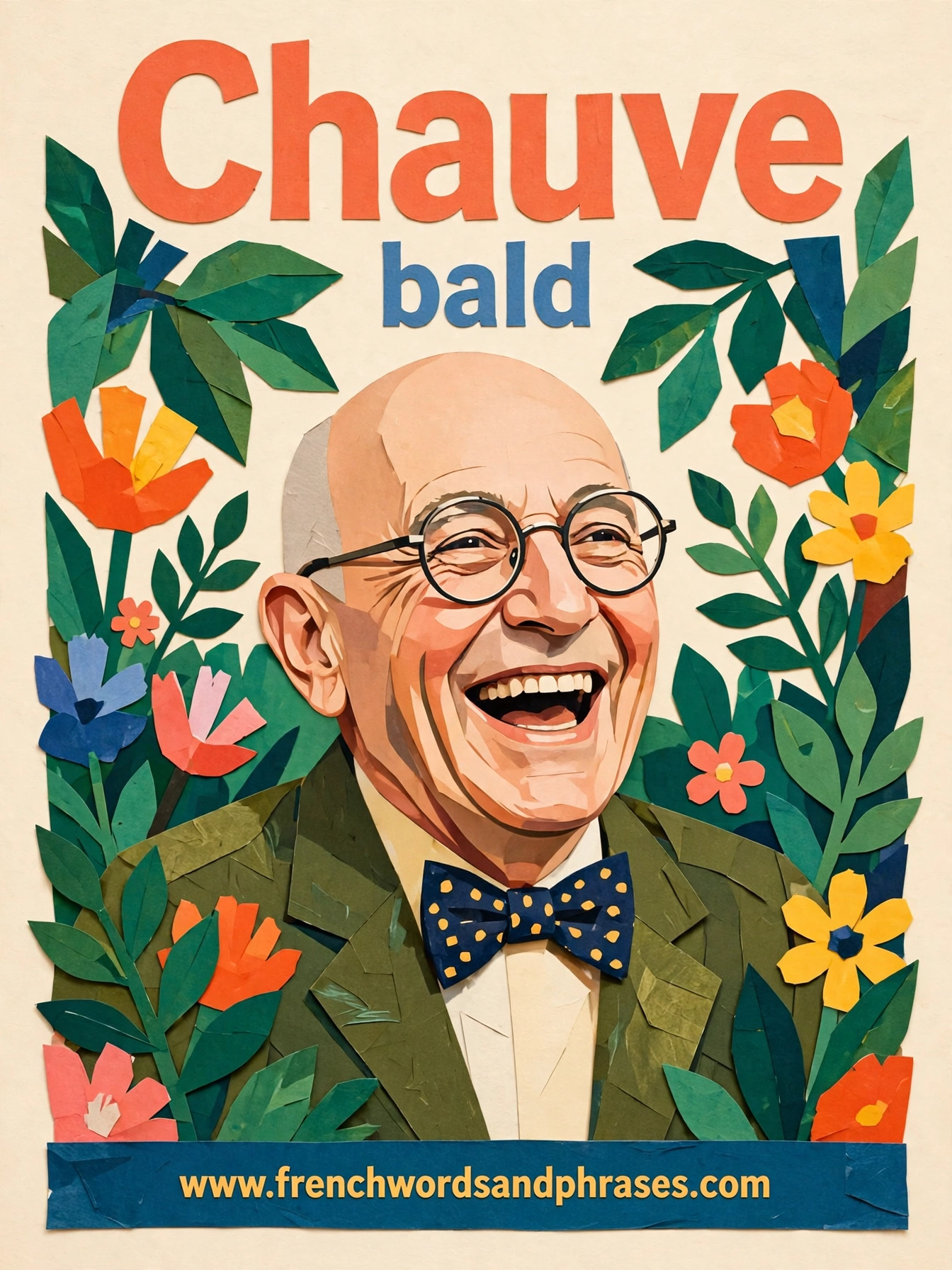
Chauve means bald.
At a long family lunch, the grandfather leans back in his chair, the sun catches his shining head, and his grandson asks — with the honesty only six-year-olds have — why the hair left. The whole table laughs, grandfather first of all. He has made his peace with the word long ago: chauve.
In this guide, you’ll learn what chauve means in English, why it never changes between masculine and feminine, where it stands in the sentence, and the charming secret it hides — the French word for a bat. Explore French examples, English translations, and practice quizzes.
Understanding the French Adjective Chauve
Chauve is a French adjective of quality — the adjective of the hairless head. It already ends in -e, so masculine and feminine are identical: only the plural adds an s. Un homme chauve, une femme chauve, des crânes chauves — one form does nearly all the work.
It means bald: un homme chauve, a bald man; un crâne chauve, a bald head. It describes heads that hair has left, partly or entirely, and French delivers it as a plain fact — grandfathers, babies and eagles (l’aigle chauve, the bald eagle) all wear it without ceremony.
Type: Adjective of quality — baldness
Answers the question: What is it like? — bald
Changes form: Only in the plural — chauve / chauves, the same for masculine and feminine
English equivalents: Bald.
One important usage detail: chauve stands AFTER the noun — un crâne chauve — and after être: il est chauve. For hair that is merely thinning, French softens the picture with dégarni — a forehead that is clearing.
Experience the Word
Chauve is the adjective of the grandfather at the head of the table — the word the family uses with affection, because the head it describes has heard fifty years of family stories.
Imagine a barber sweeping up at the end of the day, looking at the chair where his oldest customer sat that morning. Some heads arrive with less work than others, and the barber, like the language, simply notes it: chauve, and handsome with it.
You have not just counted someone’s hairs. You have described a head that experience has polished.
How to Use Chauve in French: Complete Guide
Let’s explore how chauve works in French, beginning with the whole word on one card.
Chauve at a Glance
Before the details, here is the whole word on one card.
The Whole Word on One Card
Meaning, type, position and forms — chauve in four lines.
| Point | Chauve |
|---|---|
| Meaning | bald |
| Type | adjective of quality — baldness |
| Usual position | after the noun — un crâne chauve |
| Form | chauve for everyone — chauves in the plural |
Example
Mon grand-père est chauve.
My grandfather is bald.
The Four Forms of Chauve
Here is an easy agreement: chauve already ends in -e, so the feminine changes nothing. Only the plural adds an s.
| Form | Chauve | Example |
|---|---|---|
| Masculine singular | chauve | un homme chauve — a bald man |
| Feminine singular | chauve | une femme chauve — a bald woman |
| Masculine plural | chauves | des hommes chauves — bald men |
| Feminine plural | chauves | des têtes chauves — bald heads |
Example
Les deux frères sont chauves comme leur père.
Both brothers are bald like their father.
Quick Quiz 1
Does chauve change for a feminine noun?
Reveal the answer
No
Un homme chauve, une femme chauve — the form is identical.
A bald man, a bald woman.
The Feminine of Chauve: Nothing Changes
Most adjectives build their feminine by adding an e. Chauve was born with one, so the feminine has nothing to add — the same small holiday maigre and calme give you.
| Situation | Example |
|---|---|
| Masculine | un acteur chauve — a bald actor |
| Feminine | une actrice chauve — identical |
| Why | chauve already ends in -e, so the feminine adds nothing |
| The plural | add s — des crânes chauves, bald heads |
Example
Elle joue une reine chauve dans la pièce.
She plays a bald queen in the play.
Where Chauve Goes: After the Noun
Chauve follows the noun it describes, like most French adjectives, and it spends much of its life after être, delivering the plain fact with a shrug.
| Pattern | Example |
|---|---|
| After the noun | un crâne chauve — a bald head |
| After être | il est chauve — he is bald |
| With an adverb | un homme complètement chauve — a completely bald man |
| Before the noun | un chauve crâne — not in everyday French |
Example
À cinquante ans, il est chauve et il s’en moque.
At fifty, he is bald and he doesn’t care.
Quick Quiz 2
How do you say ‘a bald head’ — un chauve crâne or un crâne chauve?
Reveal the answer
un crâne chauve
Chauve stands after the noun.
A bald head.
Balder Still: Comparing with Chauve
Chauve compares the regular way, with plus, moins and aussi — and the superlative agrees as usual: le plus chauve, la plus chauve.
| Degree | Example |
|---|---|
| As bald as | aussi chauve que — as bald as |
| Balder | plus chauve — balder |
| Less bald | moins chauve — less bald |
| The baldest (masc.) | le plus chauve — le plus chauve des frères |
| The baldest (fem.) | la plus chauve — la plus chauve des sœurs |
Example
Le père est plus chauve que le fils.
The father is balder than the son.
Everyday Expressions with Chauve
Chauve keeps company with eggs, eagles and one beloved animal — because the French word for a bat is hiding inside this family, and it is too good to miss.
| Expression | In English |
|---|---|
| un crâne chauve | a bald head |
| chauve comme un œuf | bald as an egg — completely bald (humorous) |
| devenir chauve | to go bald |
| un homme chauve | a bald man |
| l’aigle chauve | the bald eagle |
| la chauve-souris | the bat — literally, the bald mouse |
Example
Le soir, une chauve-souris traverse le jardin.
In the evening, a bat crosses the garden.
Quick Quiz 3
What animal is la chauve-souris?
Reveal the answer
A bat
La chauve-souris dort pendant le jour.
The bat sleeps during the day.
Chauve and Its Neighbours
Chauve describes the head with nothing left to comb; its neighbours cover every stage between a full head of hair and a polished one.
| French | In English |
|---|---|
| dégarni | thinning, receding — the tactful word for hair that is leaving |
| tondu | close-cropped, shaved — bald by the razor, not by time |
| chevelu | long-haired, hairy — the opposite |
| barbu | bearded — the hair that stayed, one floor down |
| lisse | smooth — of the head itself |
Example
Il n’est pas chauve, juste un peu dégarni.
He isn’t bald, just a little thin on top.
Watch Out: The Traps Around Chauve
The traps here are a second e that must never appear, a bat that is feminine, and the difference between time’s work and the barber’s.
| Trap | The truth |
|---|---|
| Agreement | do not add a second e — une femme chauve, never ‘chauvée’ |
| la chauve-souris | the bat is feminine — une chauve-souris, even though souris does the flying |
| chauve vs tondu | chauve is bald by nature; tondu is shaved or close-cropped by choice |
| The sound | say it /ʃov/ — the ch is the soft French ch, as in chat |
Example
Après l’été, le soldat revient tondu, pas chauve.
After the summer, the soldier comes back close-cropped, not bald.
Quick Quiz 4
A soldier with a shaved head is chauve or tondu?
Reveal the answer
tondu
Chauve is bald by nature.
Le soldat est tondu — the soldier has a shaved head.
Chauve in Everyday French: Real-Life Examples
Now that you know the word, let’s see how chauve appears in everyday French.
Example 1 — Family
Mon grand-père est chauve mais très joyeux.
My grandfather is bald but very cheerful.
Example 2 — Describing someone
Le professeur chauve porte des lunettes rondes.
The bald teacher wears round glasses.
Example 3 — With humour
Il est chauve comme un œuf, et fier de l’être.
He is as bald as an egg, and proud of it.
Example 4 — In nature
Une chauve-souris dort sous le toit de la grange.
A bat sleeps under the barn roof.
Example 5 — At the barber’s
Il devient chauve, mais il garde sa barbe.
He is going bald, but he is keeping his beard.
Example 6 — Portraits
Sur la photo, l’homme chauve sourit à côté de sa femme.
In the photo, the bald man smiles beside his wife.
Beyond Translation: The Meaning of Chauve
English says bald for the meaning of chauve — a word English speakers often lower their voices to say. French is more relaxed about it: chauve is a fact, delivered with a shrug and often with affection, the adjective of grandfathers and kings alike.
To say chauve in French is to describe a head the way time left it — without apology.
And the language hides a wink inside the word family: the creature of the night skies, la chauve-souris, is named a bald mouse — proof that French has been joking gently with this word for a thousand years.
How to Remember the French Adjective Chauve
Remember it this way: Chauve is the polished adjective — one form for him and her, an s for the plural, and its place quietly behind the noun.
- You see one form for everyone — un homme chauve, une femme chauve.
- You picture the comparison — chauve comme un œuf, bald as an egg.
- You put it after the noun — un crâne chauve, une tête chauve.
The key idea is chauve never changes except in the plural, and it stands after the noun.
Test Your Knowledge of Chauve
Let’s see how much you’ve learned. Try answering these questions before revealing the answers.
Question 1
What does chauve mean?
Reveal the answer
Bald — without hair on the head.
Question 2
What is the feminine of chauve?
Reveal the answer
chauve — identical. The word already ends in -e.
Question 3
Translate: a bald man.
Reveal the answer
Un homme chauve.
Question 4
What is la chauve-souris?
Reveal the answer
A bat — literally, the bald mouse.
Question 5
What is the plural of chauve?
Reveal the answer
chauves — just add an s.
Your Final Challenge
Can You Use It?
How would you say this in French?
“My grandfather is bald but very cheerful.”
Reveal the answer
Mon grand-père est chauve mais très joyeux.
My grandfather is bald but very cheerful.
A little French. A little curiosity. A richer everyday life.
LEARN FRENCH ONE WORD AT A TIME