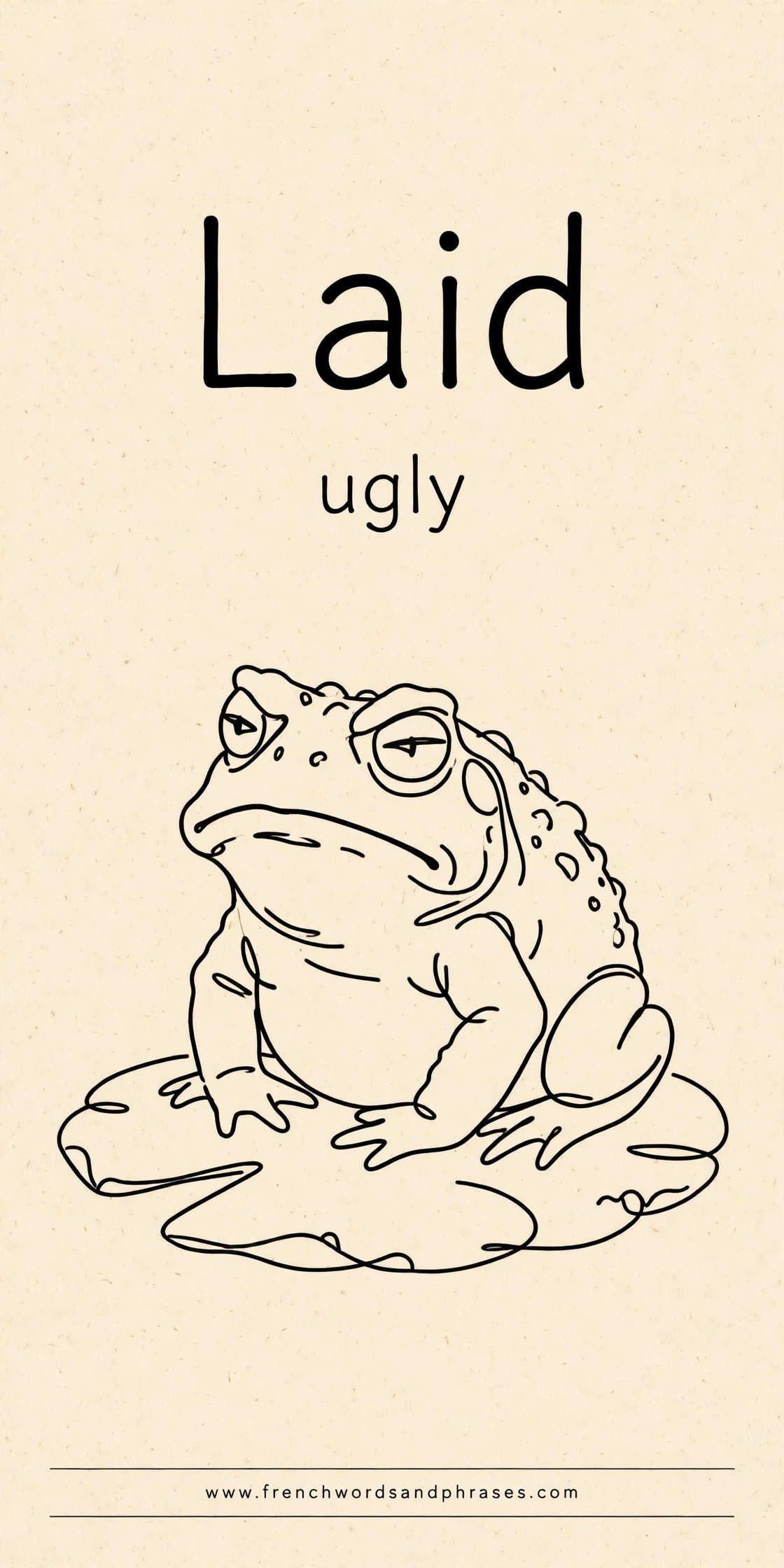
A French Word to Live By
Translate Laid to English
/lɛ/
Laid means ugly.
In the middle of a pretty old town stands one grey concrete building that everybody apologises for. Tourists photograph the church, the fountain and the market hall — and turn their backs, quite deliberately, on the building. French has a plain word for it, and the town uses it without mercy: laid.
In this guide, you’ll learn what laid means in English, how its feminine wakes up the silent d, where it stands in the sentence, and why the French save this blunt little word for buildings and objects rather than people. Explore French examples, English translations, and practice quizzes.
Understanding the French Adjective Laid
Laid is a French adjective of quality — the adjective of ugliness, and the direct opposite of beau. It agrees like any adjective: laid, laide, laids, laides. It is a strong, blunt word, and French speakers handle it the way you handle a loud voice in a library.
It means ugly: un bâtiment laid, an ugly building; un motif laid, an ugly pattern. Said of things, it is honest and common. Said of a person, it is genuinely unkind — French prefers to soften the blow with pas très beau, or to change the subject entirely.
Type: Adjective of quality — ugliness
Answers the question: What is it like? — ugly
Changes form: Yes — laid, laide, laids, laides
English equivalents: Ugly; plain, unattractive.
One important usage detail: laid stands AFTER the noun — un bâtiment laid. And mind the audience: for a building, laid is fair comment; for a person, it is an insult. The polite escape is pas très beau — not very good-looking.
Experience the Word
Laid is the adjective of the one building the town apologises for — the word is short, flat and final, like the façade it describes.
Imagine the ugly duckling of the old story, retold in French as le vilain petit canard, growing up among the elegant ducks of the pond. Every child who hears the story learns the weight of the word before the swan arrives to lift it.
You have not just judged a surface. You have said that beauty skipped this one entirely.
How to Use Laid in French: Complete Guide
Let’s explore how laid works in French, beginning with the whole word on one card.
Laid at a Glance
Before the details, here is the whole word on one card.
The Whole Word on One Card
Meaning, type, position and forms — laid in four lines.
| Point | Laid |
|---|---|
| Meaning | ugly |
| Type | adjective of quality — ugliness |
| Usual position | after the noun — un bâtiment laid |
| Form | laid / laide / laids / laides |
Example
Ce bâtiment est vraiment laid.
This building is really ugly.
The Four Forms of Laid
Laid agrees with the noun it describes. Watch the feminine: the silent d of laid wakes up in laide, and you can hear it at the end of the word.
| Form | Laid | Example |
|---|---|---|
| Masculine singular | laid | un chien laid — an ugly dog |
| Feminine singular | laide | une maison laide — an ugly house |
| Masculine plural | laids | des bâtiments laids — ugly buildings |
| Feminine plural | laides | des maisons laides — ugly houses |
Example
Ces bâtiments sont laids et ces maisons sont laides aussi.
These buildings are ugly and these houses are ugly too.
Quick Quiz 1
Which form of laid goes with maison (feminine)?
Reveal the answer
laide
Une maison laide.
An ugly house.
Laide: The Feminine Where the D Wakes Up
The feminine of laid is formed by adding an e, but the spelling hides a sound: the d, silent in laid, is pronounced in laide. Your ear hears the difference even when the change looks small.
| Situation | Example |
|---|---|
| The rule | just add -e — laid → laide |
| The sound | the d is silent in laid, but you hear it in laide: /lɛd/ |
| Masculine plural | laids — des murs laids |
| Feminine plural | laides — des couleurs laides |
Example
Cette couleur laide ne va avec rien.
This ugly colour goes with nothing.
Where Laid Goes: After the Noun
Laid follows the noun, like most adjectives of quality. Before the noun it sounds literary and old-fashioned — everyday French keeps it firmly behind.
| Pattern | Example |
|---|---|
| After the noun | un motif laid — an ugly pattern |
| After être | ce mur est laid — this wall is ugly |
| With an adverb | un bâtiment très laid — a very ugly building |
| Before the noun | un laid bâtiment — literary, not everyday French |
Example
Le nouvel immeuble est laid et trop grand.
The new block of flats is ugly and too big.
Quick Quiz 2
How do you say ‘an ugly building’ — un laid bâtiment or un bâtiment laid?
Reveal the answer
un bâtiment laid
Laid stands after the noun.
An ugly building.
Uglier Still: Comparing with Laid
Laid compares the regular way, with plus, moins and aussi — and the superlative keeps the agreement: le plus laid, la plus laide.
| Degree | Example |
|---|---|
| As ugly as | aussi laid que — as ugly as |
| Uglier | plus laid — uglier |
| Less ugly | moins laid — less ugly |
| The ugliest (masc.) | le plus laid — le plus laid des bâtiments |
| The ugliest (fem.) | la plus laide — la plus laide des maisons |
Example
Cet immeuble est plus laid que l’ancien.
This block is uglier than the old one.
Everyday Expressions with Laid
French keeps its ugliest phrases for jokes and fairy tales — including one very old comparison involving a louse, best delivered with a smile.
| Expression | In English |
|---|---|
| laid comme un pou | ugly as sin (literally, ugly as a louse — humorous and old-fashioned) |
| le vilain petit canard | the ugly duckling |
| laid à faire peur | so ugly it’s frightening |
| un bâtiment laid | an ugly building |
| pas très beau | not very good-looking — the polite way to say it |
| c’est laid | that’s ugly — plain and final |
Example
Dans le conte, le vilain petit canard devient un cygne.
In the tale, the ugly duckling becomes a swan.
Quick Quiz 3
What is the polite way to avoid calling a person laid?
Reveal the answer
pas très beau
Il n’est pas très beau, mais il est charmant.
He isn’t very good-looking, but he is charming.
Laid and Its Neighbours
Laid is the formal member of an unflattering family; its neighbours range from the slangy moche to the theatrical affreux, with beau waiting at the opposite pole.
| French | In English |
|---|---|
| moche | ugly — the everyday informal word |
| vilain | ugly; also naughty, for children |
| affreux | hideous, dreadful — the strongest of the family |
| disgracieux | ungainly, unsightly — formal |
| beau | beautiful, handsome — the opposite |
| joli | pretty — the gentle opposite |
Example
Ce vieux mur est moche, presque affreux.
This old wall is ugly, almost hideous.
Watch Out: The Traps Around Laid
The traps here are a silent letter, a double meaning, and a word of tact: laid is a heavy stone, so aim it at things.
| Trap | The truth |
|---|---|
| The sound | the d is silent in laid but pronounced in laide |
| vilain | means ugly, but for a child it usually means naughty — un vilain garçon |
| About people | laid said to a person is an insult; pas très beau says it gently |
| English look-alike | laid is not the English word ‘laid’ — it only means ugly |
Example
Ce vilain garçon a dessiné sur le mur.
That naughty boy drew on the wall.
Quick Quiz 4
In un vilain garçon, does vilain mean ugly or naughty?
Reveal the answer
Naughty
For children, vilain usually means naughty.
A naughty boy.
Laid in Everyday French: Real-Life Examples
Now that you know the word, let’s see how laid appears in everyday French.
Example 1 — In town
Le nouveau bâtiment est laid, tout le monde le dit.
The new building is ugly, everyone says so.
Example 2 — Shopping
Ce motif est laid, je préfère l’autre.
This pattern is ugly, I prefer the other one.
Example 3 — A story
Le vilain petit canard est triste au bord du lac.
The ugly duckling is sad by the lake.
Example 4 — At home
Enlève ce tableau laid du salon, s’il te plaît.
Take that ugly painting out of the living room, please.
Example 5 — Being tactful
Il n’est pas très beau, mais il a un beau sourire.
He isn’t very good-looking, but he has a lovely smile.
Example 6 — Joking
Ce vieux chapeau est laid comme un pou !
This old hat is as ugly as sin!
Beyond Translation: The Meaning of Laid
English says ugly for the meaning of laid — but laid in French carries an old, almost moral weight: the same family of words once judged faces, deeds and weather alike. French keeps it short and blunt, a single syllable with nowhere to hide.
To say laid in French is to close the discussion — beauty was not consulted.
Perhaps that is why the language is careful with it, saving it for concrete and cloth, and why its fairy tales take such pleasure in overturning it: the laidest duckling in the pond becomes the swan.
How to Remember the French Adjective Laid
Remember it this way: Laid is the blunt adjective — it follows the noun, wakes its d up for her, and is best aimed at buildings, never at guests.
- You see the family together — laid, laide, laids, laides — with the d heard only in the feminine.
- You put it after the noun — un bâtiment laid, une maison laide.
- You soften it for people — pas très beau says the same thing kindly.
The key idea is laid stands after the noun, its d wakes up in laide, and people deserve the gentler pas très beau.
Test Your Knowledge of Laid
Let’s see how much you’ve learned. Try answering these questions before revealing the answers.
Question 1
What does laid mean?
Reveal the answer
Ugly — the direct opposite of beau.
Question 2
What is the feminine of laid?
Reveal the answer
laide — and in laide, you hear the d.
Question 3
Translate: an ugly building.
Reveal the answer
Un bâtiment laid.
Question 4
How does the ugly duckling say it in French?
Reveal the answer
Le vilain petit canard.
Question 5
Complete the sentence:
Cette maison est vraiment ______ .
Reveal the answer
laide
Cette maison est vraiment laide.
This house is really ugly.
Your Final Challenge
Can You Use It?
How would you say this in French?
“The old building is really ugly.”
Reveal the answer
Le vieux bâtiment est vraiment laid.
The old building is really ugly.
A little French. A little curiosity. A richer everyday life.
LEARN FRENCH ONE WORD AT A TIME