A French Word to Live By
Translate Injuste to English
/ɛ̃ʒyst/
Injuste means unfair.
A schoolyard, a game of football, and a goal refused for a foul nobody else saw. Twenty children are shouting the same two words at the referee — a classmate of eleven with a whistle — and the words need no translation anywhere on earth: c’est injuste !
In this guide, you’ll learn what injuste means in English, why it never changes between masculine and feminine, where it stands in the sentence, and how it grows from the playground cry into the language of courts. Explore French examples, English translations, and practice quizzes.
Understanding the French Adjective Injuste
Injuste is a French adjective of quality — the adjective of unfairness. It already ends in -e, so masculine and feminine are identical: only the plural adds an s. Une décision injuste, un monde injuste, des lois injustes — one form does almost all the work.
It means unfair — not just, not deserved, not equal. It describes decisions (une décision injuste, an unfair decision), people (un professeur injuste, an unfair teacher), punishments (une punition injuste) and the world itself (la vie est injuste, life is unfair). It is often a cry before it is a description: c’est injuste !
Type: Adjective of quality — fairness and justice
Answers the question: What is it like? — unfair
Changes form: Only in the plural — injuste / injustes, the same for masculine and feminine
English equivalents: Unfair; unjust.
One important usage detail: injuste stands after the noun — une décision injuste — and the cry of protest is a complete sentence: c’est injuste ! Keep the family apart: injuste is the adjective, l’injustice is the noun, and juste alone is the happy opposite.
Experience the Word
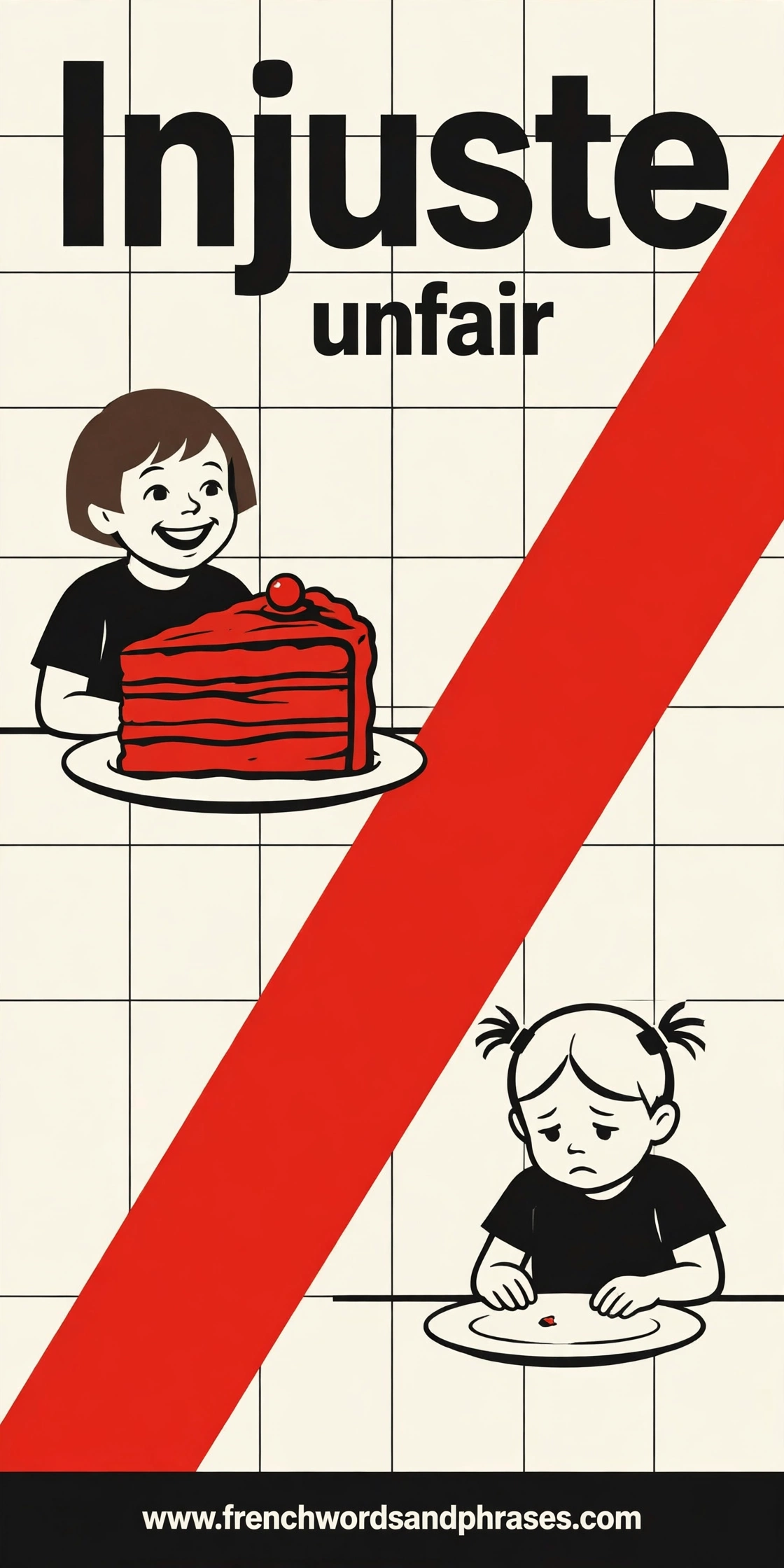
Injuste is the adjective of the shared cake cut unevenly — one slice visibly larger, two children watching, and the whole of human law being invented on the spot to deal with it.
Imagine a small referee with a whistle too big for him, standing his ground while twenty friends explain fairness to him at the tops of their voices. He is wrong, probably. But every child on that pitch is learning the word that courts, newspapers and revolutions are built from.
You have not just described a bad decision. You have appealed to the fairness everyone carries inside them.
How to Use Injuste in French: Complete Guide
Let’s explore how injuste works in French, beginning with the whole word on one card.
Injuste at a Glance
Before the details, here is the whole word on one card.
The Whole Word on One Card
Meaning, type, position and forms — injuste in four lines.
| Point | Injuste |
|---|---|
| Meaning | unfair |
| Type | adjective of quality — fairness and justice |
| Usual position | after the noun — une décision injuste |
| Form | injuste for everyone — injustes in the plural |
Example
C’est injuste !
That’s unfair!
The Four Forms of Injuste
Here is another easy agreement: injuste already ends in -e, so the feminine changes nothing. Only the plural adds an s.
| Form | Injuste | Example |
|---|---|---|
| Masculine singular | injuste | un jugement injuste — an unfair judgement |
| Feminine singular | injuste | une décision injuste — an unfair decision |
| Masculine plural | injustes | des jugements injustes — unfair judgements |
| Feminine plural | injustes | des décisions injustes — unfair decisions |
Example
Ce jugement est injuste et cette décision aussi.
This judgement is unfair and this decision is too.
Quick Quiz 1
Does injuste change for a feminine noun?
Reveal the answer
No
Un monde injuste, une décision injuste — the form is identical.
An unfair world, an unfair decision.
The Feminine of Injuste: Nothing Changes
Most adjectives build their feminine by adding an e. Injuste was born with one, so the feminine has nothing to add — a small holiday for learners.
| Situation | Example |
|---|---|
| Masculine | un partage injuste — an unfair sharing-out |
| Feminine | une punition injuste — identical |
| Why | injuste already ends in -e, so the feminine adds nothing |
| The plural | add s — des lois injustes, unfair laws |
Example
Cette punition est injuste.
This punishment is unfair.
Where Injuste Goes: After the Noun
Injuste follows the noun it describes, and after être it delivers its verdict. With envers, it names the person the unfairness lands on.
| Pattern | Example |
|---|---|
| After the noun | une loi injuste — an unfair law |
| After être | le monde est injuste — the world is unfair |
| The cry | c’est injuste ! — that’s unfair! |
| With envers | injuste envers les petits — unfair to the little ones |
Example
Il est injuste envers les nouveaux élèves.
He is unfair to the new pupils.
Quick Quiz 2
How do you cry ‘That’s unfair!’ in French?
Reveal the answer
C’est injuste !
The adjective follows être in the great cry of protest.
That’s unfair!
More Unfair: Comparing with Injuste
Injuste compares the regular way, with plus, moins and aussi — and the superlative keeps the same single form: le plus injuste, la plus injuste.
| Degree | Example |
|---|---|
| As unfair as | aussi injuste que — as unfair as |
| More unfair | plus injuste — more unfair |
| Less unfair | moins injuste — less unfair |
| The most unfair (masc.) | le plus injuste — le plus injuste des jugements |
| The most unfair (fem.) | la plus injuste — la plus injuste des décisions |
Example
Rien n’est plus injuste qu’une punition sans faute.
Nothing is more unfair than a punishment with no fault behind it.
Everyday Expressions with Injuste
From the playground to the parliament, injuste is the word of protest — graded from a child’s cry to the quiet verdict of profondément injuste.
| Expression | In English |
|---|---|
| c’est injuste ! | that’s unfair! — the great cry of protest |
| une décision injuste | an unfair decision |
| profondément injuste | deeply unfair |
| injuste envers quelqu’un | unfair to someone |
| un sentiment d’injustice | a sense of injustice — the noun at work |
| la vie est injuste | life is unfair |
Example
C’est profondément injuste, il n’a rien fait.
It’s deeply unfair, he did nothing.
Quick Quiz 3
What is the French noun for ‘injustice’?
Reveal the answer
l’injustice
Un sentiment d’injustice.
A sense of injustice.
Injuste and Its Neighbours
Around injuste stands the vocabulary of the tribunal — and, across the room, juste and équitable holding the scales level.
| French | In English |
|---|---|
| injustifié | unjustified — without a good reason |
| arbitraire | arbitrary — decided by whim, not by rules |
| inégal | unequal — of shares and treatment |
| partial | biased — favouring one side |
| juste | fair, right — the opposite |
| équitable | equitable, fair — the formal opposite |
Example
Une règle équitable n’est jamais arbitraire.
A fair rule is never arbitrary.
Watch Out: The Traps Around Injuste
The traps here are a noun that looks like the adjective, and a short phrase — c’est juste — that means nearly the opposite of the cry.
| Trap | The truth |
|---|---|
| The noun | injustice is l’injustice — une injustice, an injustice |
| c’est juste | means ‘that’s right, that’s correct’ — not ‘that’s fair’ and never the cry of protest |
| Agreement | do not add a second e — une décision injuste, never ‘injustée’ |
| envers | unfair TO someone is injuste envers quelqu’un |
Example
Réparer une injustice, c’est rendre le monde plus juste.
To repair an injustice is to make the world fairer.
Quick Quiz 4
How do you say ‘an unfair decision’?
Reveal the answer
une décision injuste
Injuste follows the noun and does not change.
An unfair decision.
Injuste in Everyday French: Real-Life Examples
Now that you know the word, let’s see how injuste appears in everyday French.
Example 1 — At school
C’est injuste, il a eu une meilleure note que moi !
It’s unfair, he got a better mark than me!
Example 2 — Family
Les enfants trouvent toujours le partage injuste.
Children always find the sharing-out unfair.
Example 3 — Sport
Cette décision de l’arbitre est injuste.
This referee’s decision is unfair.
Example 4 — At work
Elle a été injuste envers son équipe.
She was unfair to her team.
Example 5 — Life
Parfois, la vie est injuste, il faut continuer.
Sometimes life is unfair, you have to keep going.
Example 6 — Protest
Les habitants protestent contre une loi injuste.
The residents are protesting against an unfair law.
Beyond Translation: The Meaning of Injuste
English says unfair for the meaning of injuste — and French children learn it as one of their first moral words, long before they can spell it, because the schoolyard teaches it for free.
To cry c’est injuste is to make your first speech as a citizen.
The word grows up with its speaker: the same adjective serves the child with the smaller slice of cake, the employee passed over, and the judge reading a verdict that history will reverse.
How to Remember the French Adjective Injuste
Remember it this way: Injuste is the protesting adjective — one form for him and her, an s for the plural, and a whole cry of protest in c’est injuste.
- You see one form for everyone — un monde injuste, une décision injuste.
- You keep the noun beside it — l’injustice is the thing, injuste is the word for it.
- You hear the opposite inside it — take away the in- and juste means fair and right.
The key idea is injuste never changes except in the plural, and c’est injuste is the great cry of protest.
Test Your Knowledge of Injuste
Let’s see how much you’ve learned. Try answering these questions before revealing the answers.
Question 1
What does injuste mean?
Reveal the answer
Unfair — not just, not deserved.
Question 2
What is the feminine of injuste?
Reveal the answer
injuste — identical. The word already ends in -e.
Question 3
Translate: that’s unfair!
Reveal the answer
C’est injuste !
Question 4
Complete the sentence:
Cette loi est ______ envers les jeunes.
Reveal the answer
injuste
Cette loi est injuste envers les jeunes.
This law is unfair to young people.
Question 5
What is the noun for injustice?
Reveal the answer
l’injustice — injuste is the adjective, injustice the noun.
Your Final Challenge
Can You Use It?
How would you say this in French?
“It’s unfair: he did nothing wrong.”
Reveal the answer
C’est injuste : il n’a rien fait de mal.
It’s unfair: he did nothing wrong.
A little French. A little curiosity. A richer everyday life.
LEARN FRENCH ONE WORD AT A TIME