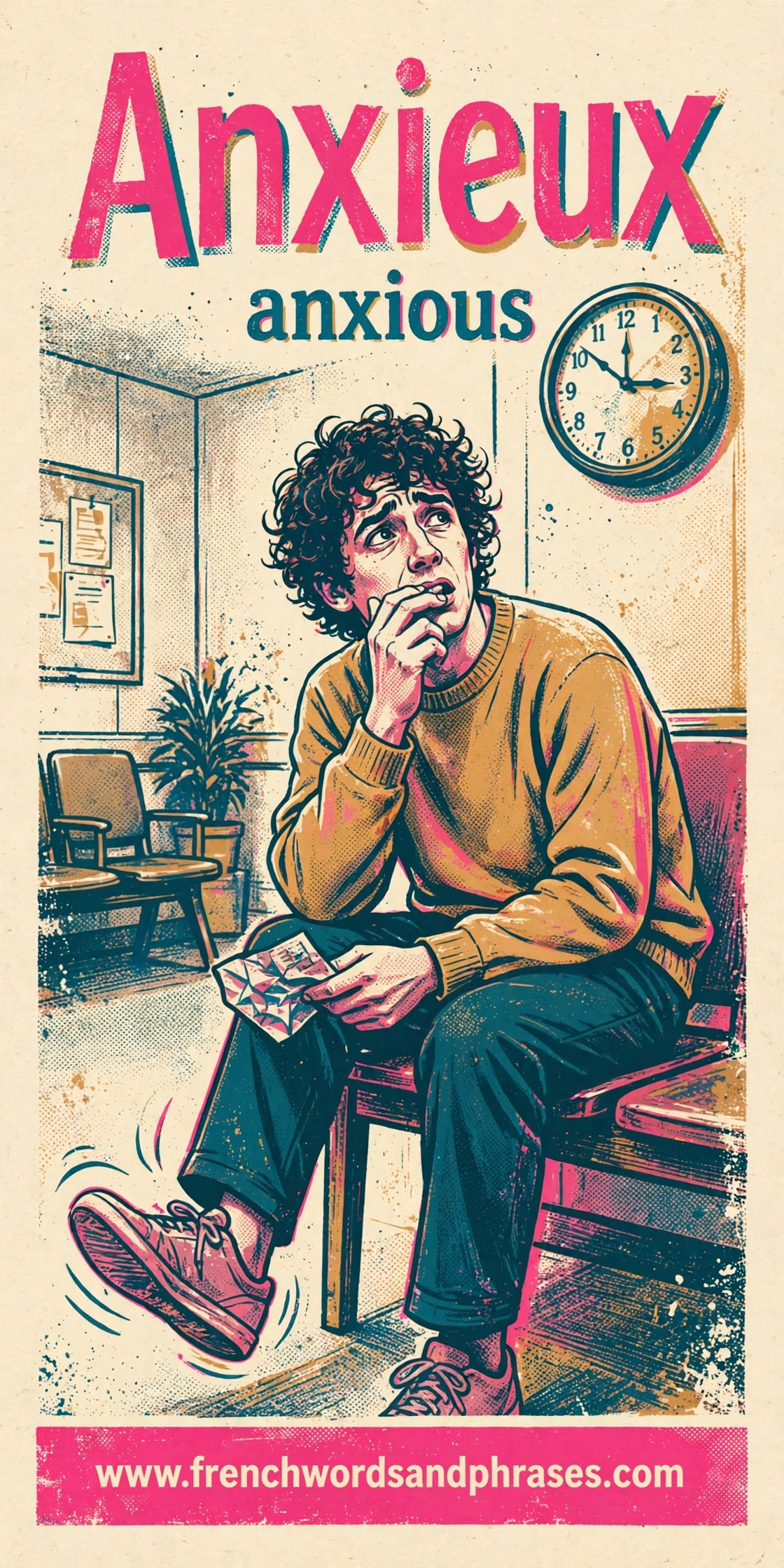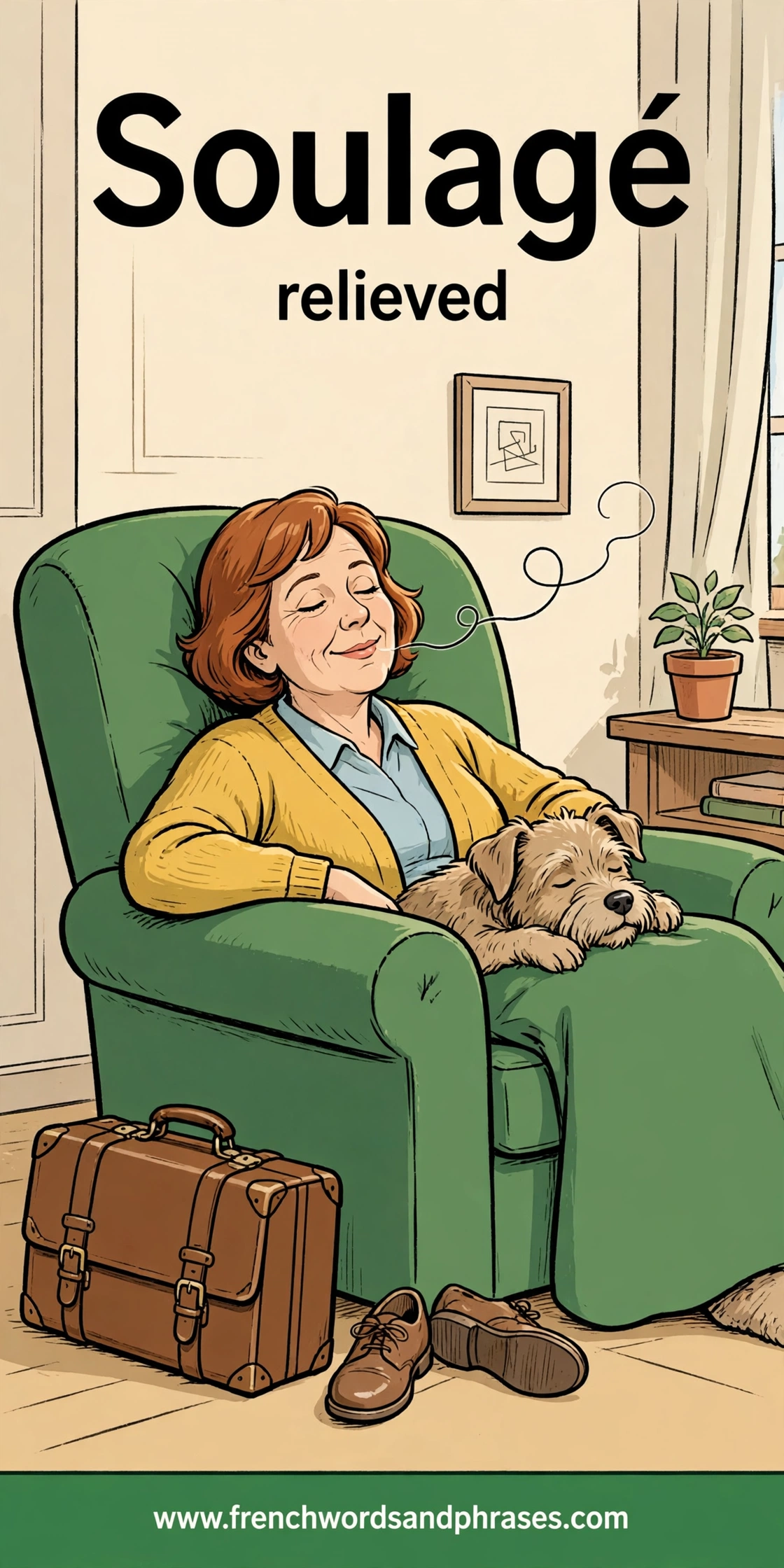
A French Word to Live By
Translate Soulagé to English
/sulaʒe/
Soulagé means relieved.
An airport arrivals hall, a delayed flight finally on the board, and a young father who has been refreshing his phone for six hours. His wife’s plane has landed. He closes his eyes, lets out a breath he seems to have been holding since morning, and smiles at nobody in particular. That breath is soulagé.
In this guide, you’ll learn what soulagé means in English, how it is built from the verb soulager, where it stands in the sentence, and the two little words — de and que — that follow it everywhere. Explore French examples, English translations, and practice quizzes.
Understanding the French Adjective Soulagé
Soulagé is a French adjective of feeling — the past participle of soulager, to relieve, working as an adjective. It agrees in the regular -é way: soulagé, soulagée, soulagés, soulagées.
It means relieved — freed from a worry, a fear or a weight you were carrying. It describes the moment the news turns out well: soulagé d’apprendre que…, relieved to learn that…; soulagé de te voir, relieved to see you. It is the feeling of a stone quietly lifted off the chest.
Type: Adjective of feeling — relief
Answers the question: How does he or she feel? — relieved
Changes form: Yes — soulagé, soulagée, soulagés, soulagées
English equivalents: Relieved; reassured; unburdened.
One important usage detail: soulagé lives after être — je suis soulagé — and it loves company: soulagé de + infinitive (soulagé de te voir) or soulagé que + subjunctive (soulagé qu’il soit arrivé). The noun for the feeling itself is le soulagement.
Experience the Word
Soulagé is the adjective of the shoulders coming down — the exam results in the envelope opened at last, the phone ringing with the one voice you were waiting for.
Imagine a fisherman’s wife in a storm, watching the window until the boat’s light rounds the point and turns for home. She does not cheer. She sits down slowly, both hands flat on the table, and breathes. Relief is a quiet feeling, and French gives it a quiet word.
You have not just described the end of a worry. You have described the exact moment the weight comes off.
How to Use Soulagé in French: Complete Guide
Let’s explore how soulagé works in French, beginning with the whole word on one card.
Soulagé at a Glance
Before the details, here is the whole word on one card.
The Whole Word on One Card
Meaning, type, position and forms — soulagé in four lines.
| Point | Soulagé |
|---|---|
| Meaning | relieved |
| Type | adjective of feeling — relief |
| Usual position | after être — je suis soulagé |
| Form | soulagé / soulagée / soulagés / soulagées |
Example
Je suis soulagé, tout va bien.
I’m relieved, everything is fine.
The Four Forms of Soulagé
Soulagé agrees with the person who feels the relief, following the regular pattern of participles in -é: the feminine adds an e, the plurals add an s.
| Form | Soulagé | Example |
|---|---|---|
| Masculine singular | soulagé | un père soulagé — a relieved father |
| Feminine singular | soulagée | une mère soulagée — a relieved mother |
| Masculine plural | soulagés | des parents soulagés — relieved parents |
| Feminine plural | soulagées | des sœurs soulagées — relieved sisters |
Example
Les parents sont soulagés et les sœurs sont soulagées aussi.
The parents are relieved and the sisters are relieved too.
Quick Quiz 1
Which form of soulagé goes with mère (feminine)?
Reveal the answer
soulagée
Une mère soulagée.
A relieved mother.
Soulagée: The Regular Feminine in -ée
The feminine of soulagé is formed by adding a single e. It changes the spelling only — soulagé and soulagée sound exactly alike.
| Situation | Example |
|---|---|
| The rule | just add -e — soulagé → soulagée |
| The sound | soulagé and soulagée sound exactly the same |
| Masculine plural | soulagés — des pères soulagés |
| Feminine plural | soulagées — des mères soulagées |
Example
Elle est soulagée de voir son fils.
She is relieved to see her son.
Where Soulagé Goes: After Être, with De or Que
Soulagé is a feeling, so it lives after être — and it almost always explains itself, with de before an infinitive or que before a whole clause.
| Pattern | Example |
|---|---|
| After être | nous sommes soulagés — we are relieved |
| With de + infinitive | soulagé de partir — relieved to leave |
| With que + subjunctive | soulagé qu’il soit là — relieved that he is here |
| Before the noun | un soulagé père — not in French |
Example
Je suis soulagé de te voir sain et sauf.
I’m relieved to see you safe and sound.
Quick Quiz 2
Before an infinitive, does soulagé take de or que?
Reveal the answer
de
Soulagé de te voir.
Relieved to see you.
More Relieved: Comparing with Soulagé
Soulagé compares the regular way, with plus, moins and aussi — and the superlative agrees as usual: le plus soulagé, la plus soulagée.
| Degree | Example |
|---|---|
| As relieved as | aussi soulagé que — as relieved as |
| More relieved | plus soulagé — more relieved |
| Less relieved | moins soulagé — less relieved |
| The most relieved (masc.) | le plus soulagé — le plus soulagé des passagers |
| The most relieved (fem.) | la plus soulagée — la plus soulagée des mères |
Example
De nous tous, c’est elle la plus soulagée.
Of all of us, she is the most relieved.
Everyday Expressions with Soulagé
Relief in French has its own small ceremony — the long breath out, which the language has named and kept: un soupir de soulagement.
| Expression | In English |
|---|---|
| soulagé d’apprendre la nouvelle | relieved to hear the news |
| soulagé de te voir | relieved to see you |
| un soupir de soulagement | a sigh of relief |
| quel soulagement ! | what a relief! — the noun in action |
| profondément soulagé | deeply relieved |
Example
Quel soulagement ! Le train arrive enfin.
What a relief! The train is finally arriving.
Quick Quiz 3
What is the French noun for ‘relief’?
Reveal the answer
le soulagement
Un soupir de soulagement.
A sigh of relief.
Soulagé and Its Neighbours
Soulagé belongs to the family of feelings that arrive when danger leaves — rassuré, apaisé, libéré — facing the two that arrive when it approaches.
| French | In English |
|---|---|
| rassuré | reassured — calmed by good news |
| apaisé | soothed, calmed — of people and pain |
| libéré | freed, released — as if a door had opened |
| détendu | relaxed — the feeling afterwards |
| inquiet | worried — the opposite |
| angoissé | anguished — the opposite, and stronger |
Example
Rassurée et apaisée, elle s’endort enfin.
Reassured and soothed, she finally falls asleep.
Watch Out: The Traps Around Soulagé
The traps here are about who feels the relief, and about a noun that learners often reach for in the wrong place.
| Trap | The truth |
|---|---|
| Who feels it | soulagé describes the person, not the news — the news itself is une bonne nouvelle |
| The noun | relief itself is le soulagement — quel soulagement ! |
| Agreement | a relieved woman is soulagée, with the extra e |
| Pain | for pain, French uses the verb — ce médicament soulage la douleur, this medicine relieves the pain |
Example
Elle est soulagée : la douleur a disparu.
She is relieved: the pain has gone.
Quick Quiz 4
How do you say ‘I’m relieved to see you’ to a friend?
Reveal the answer
Je suis soulagé de te voir (a woman says soulagée).
Je suis soulagé de te voir.
I’m relieved to see you.
Soulagé in Everyday French: Real-Life Examples
Now that you know the word, let’s see how soulagé appears in everyday French.
Example 1 — At the airport
Je suis soulagé, son avion a atterri.
I’m relieved, her plane has landed.
Example 2 — Exam results
Elle est soulagée d’avoir réussi son examen.
She is relieved to have passed her exam.
Example 3 — At the doctor’s
Nous sommes soulagés, ce n’est rien de grave.
We’re relieved, it’s nothing serious.
Example 4 — The weather
Les fermiers sont soulagés, la pluie arrive enfin.
The farmers are relieved, the rain is finally coming.
Example 5 — A lost dog
Il est soulagé de retrouver son chien.
He is relieved to find his dog again.
Example 6 — Good news
Quel soulagement ! Tout le monde va bien.
What a relief! Everyone is fine.
Beyond Translation: The Meaning of Soulagé
English says relieved for the meaning of soulagé — and the French word keeps the picture of its verb alive: soulager is to lift a weight off someone, and the soulagé person is the one standing straighter because the load is gone.
To say je suis soulagé is to report that the world just got lighter.
It is one of French’s most physical feelings — it lives in the shoulders, in the breath, in the long sigh that has its own name: un soupir de soulagement.
How to Remember the French Adjective Soulagé
Remember it this way: Soulagé is the lightened adjective — the participle of soulager, regular in its forms, and at home after être with de or que behind it.
- You picture the weight lifted — soulagé is soulager, to relieve, turned into a feeling.
- You follow it with de and an infinitive — soulagé de te voir.
- You keep the noun beside it — le soulagement, relief itself.
The key idea is soulagé means relieved, follows être, and takes de + infinitive.
Test Your Knowledge of Soulagé
Let’s see how much you’ve learned. Try answering these questions before revealing the answers.
Question 1
What does soulagé mean?
Reveal the answer
Relieved — freed from a worry or a weight.
Question 2
What is the feminine of soulagé?
Reveal the answer
soulagée — just add an e.
Question 3
Translate: I am relieved to see you.
Reveal the answer
Je suis soulagé de te voir. (A woman: soulagée.)
Question 4
Complete the sentence:
Quel ______ ! Tout va bien.
Reveal the answer
soulagement
Quel soulagement ! Tout va bien.
What a relief! Everything is fine.
Question 5
What verb is soulagé the participle of?
Reveal the answer
soulager — to relieve, to lift a weight off.
Your Final Challenge
Can You Use It?
How would you say this in French?
“We are relieved: the plane has landed.”
Reveal the answer
Nous sommes soulagés : l’avion a atterri.
We are relieved: the plane has landed.
A little French. A little curiosity. A richer everyday life.
LEARN FRENCH ONE WORD AT A TIME