A French Word to Live By
How to Conjugate Condamner in French
/kɔ̃.da.ne/
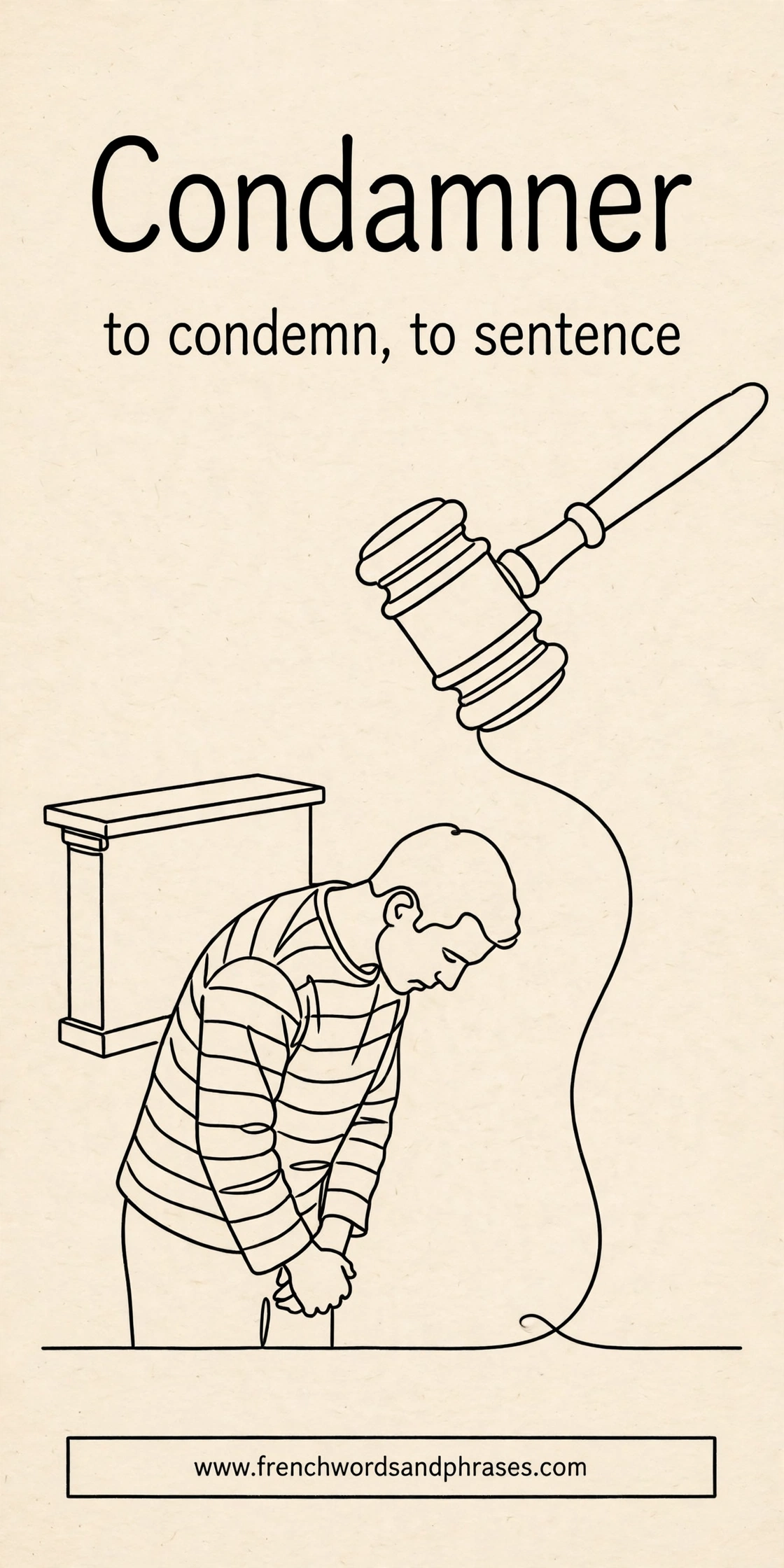
Condamner means to condemn or to sentence — for a court to pass judgement, or for anyone to declare something wrong, doomed or shut forever.
A judge rising to pronounce ten years, a doctor whose diagnosis leaves no hope, a workman nailing boards across a door that will never open again — condamner is the verb of the final verdict: in the courtroom, in the conscience, and even in the corridor.
In this guide, you’ll learn how to conjugate condamner in all the major French tenses and moods. Explore complete conjugation tables, French examples, English translations, and practice quizzes.
Understanding the French Verb Condamner
Condamner is a regular French verb belonging to the first group of verbs, those ending in-er.
It means to condemn, to sentence. It is commonly used in law for sentencing and conviction, in public life for denouncing acts and practices, in medicine when a patient is beyond hope (le médecin l’a condamné), and in the house for doors, windows and rooms sealed permanently — four verdicts, all final.
Verb classification: First group (-er)
Auxiliary verb: Avoir
Past participle: condamné
Present participle: condamnant
English equivalents: To condemn, to sentence, to convict; condamner quelqu’un à mort — to sentence someone to death; condamner à dix ans de prison — to sentence to ten years in prison; condamner une porte, une fenêtre — to board up a door, a window; être condamné à — to be doomed to, to be sentenced to; condamner une pratique — to condemn a practice.
One important detail: condamner is a perfectly regular -er verb — je condamne, nous condamnons, past participle condamné — and its grammar lives in the preposition à: one is condamné à a punishment, à l’exil, au silence, and figuratively à répéter les mêmes erreurs — doomed to repeat the same mistakes. Its surprise sense is pure DIY: condamner une porte is to board up or seal a door for good, and a doorway so treated is une porte condamnée.
Experience the Word
Condamner is the verb of no appeal — once it is pronounced, by judge, doctor or carpenter, the matter is closed.
Imagine the old house being renovated. Behind the wallpaper of the corridor, the workman finds a narrow door nobody has opened for fifty years. He shrugs, takes his boards and nails: il condamne la porte — and the little door, sentenced without a trial, disappears behind plaster for another fifty years.
No judge, no jury, just four nails. The door has been condemned — condamnée, shut by verdict of the hammer.
How to Conjugate Condamner: Complete French Conjugation Guide
Let’s explore every major conjugation of condamner, beginning with the indicative mood.
How to Conjugate Condamner in the Indicative Mood
The indicative mood is used to express facts, observations, actions, and events.
How to Conjugate Condamner in the Present Tense (Présent)
Used for actions happening now, habitual actions, and general truths.
| Subject | Conjugation |
|---|---|
| je | condamne |
| tu | condamnes |
| il / elle | condamne |
| nous | condamnons |
| vous | condamnez |
| ils / elles | condamnent |
Example
Le tribunal condamne l’accusé à dix ans de prison.
The court sentences the accused to ten years in prison.
Quick Quiz 1
Complete the sentence:
Nous ______ cette pratique sans hésiter.
Reveal the answer
condamnons
Nous condamnons cette pratique sans hésiter.
We condemn this practice without hesitation.
How to Conjugate Condamner in the Passé Composé
Used for completed actions in the past. Condamner takes the auxiliary verb avoir.
| Subject | Conjugation |
|---|---|
| j’ | ai condamné |
| tu | as condamné |
| il / elle | a condamné |
| nous | avons condamné |
| vous | avez condamné |
| ils / elles | ont condamné |
Example
On a condamné cette vieille porte pour refaire la pièce.
They boarded up that old door to redo the room.
How to Conjugate Condamner in the Imparfait (Imperfect Tense)
Used for habitual past actions, descriptions, and ongoing situations in the past.
| Subject | Conjugation |
|---|---|
| je | condamnais |
| tu | condamnais |
| il / elle | condamnait |
| nous | condamnions |
| vous | condamniez |
| ils / elles | condamnaient |
Example
Autrefois, on condamnait les gens pour de simples rumeurs.
In the past, people were condemned on mere rumours.
Quick Quiz 2
Choose the correct form:
The king condemned the traitor.
Le roi ______ le traître. (a condamné / est condamné)
Reveal the answer
a condamné
Le roi a condamné le traître.
Condamner takes avoir in the active voice.
How to Conjugate Condamner in the Plus-que-parfait
Used to describe an action that had already been completed before another past event.
| Subject | Conjugation |
|---|---|
| j’ | avais condamné |
| tu | avais condamné |
| il / elle | avait condamné |
| nous | avions condamné |
| vous | aviez condamné |
| ils / elles | avaient condamné |
Example
Le juge avait condamné l’homme avant même le procès, disait-on.
The judge had condemned the man even before the trial, people said.
How to Conjugate Condamner in the Passé Simple
Primarily used in formal writing, literature, and historical narratives. It is rarely used in everyday conversation.
| Subject | Conjugation |
|---|---|
| je | condamnai |
| tu | condamnas |
| il / elle | condamna |
| nous | condamnâmes |
| vous | condamnâtes |
| ils / elles | condamnèrent |
Example
Le roi condamna le traître à l’exil.
The king condemned the traitor to exile.
How to Conjugate Condamner in the Passé Antérieur
A literary tense used to express an action completed immediately before another past action, generally in the passé simple.
| Subject | Conjugation |
|---|---|
| j’ | eus condamné |
| tu | eus condamné |
| il / elle | eut condamné |
| nous | eûmes condamné |
| vous | eûtes condamné |
| ils / elles | eurent condamné |
Example
Quand le jury eut condamné l’accusé, la salle se tut.
When the jury had convicted the accused, the room fell silent.
How to Conjugate Condamner in the Future Tense (Futur Simple)
Used to describe actions that will take place in the future.
| Subject | Conjugation |
|---|---|
| je | condamnerai |
| tu | condamneras |
| il / elle | condamnera |
| nous | condamnerons |
| vous | condamnerez |
| ils / elles | condamneront |
Example
Qui condamnera les innocents si la justice s’endort ?
Who will condemn the innocent if justice falls asleep?
How to Conjugate Condamner in the Futur Antérieur (Future Perfect)
Used for an action that will have been completed before a particular point in the future.
| Subject | Conjugation |
|---|---|
| j’ | aurai condamné |
| tu | auras condamné |
| il / elle | aura condamné |
| nous | aurons condamné |
| vous | aurez condamné |
| ils / elles | auront condamné |
Example
À la fin du procès, le tribunal aura condamné ou acquitté.
By the end of the trial, the court will have convicted or acquitted.
How to Conjugate Condamner in the Near Future (Futur Proche)
Used to describe something that is going to happen soon. Formed with aller + infinitive.
| Subject | Conjugation |
|---|---|
| je | vais condamner |
| tu | vas condamner |
| il / elle | va condamner |
| nous | allons condamner |
| vous | allez condamner |
| ils / elles | vont condamner |
Example
Cette blessure va le condamner au fauteuil roulant.
This injury is going to condemn him to a wheelchair.
How to Conjugate Condamner in the Conditional Mood
The conditional mood expresses what would happen under certain circumstances. It is also frequently used to make polite requests or express wishes.
How to Conjugate Condamner in the Present Conditional
| Subject | Conjugation |
|---|---|
| je | condamnerais |
| tu | condamnerais |
| il / elle | condamnerait |
| nous | condamnerions |
| vous | condamneriez |
| ils / elles | condamneraient |
Example
Sans preuves, je ne condamnerais personne.
Without proof, I would condemn no one.
How to Conjugate Condamner in the Past Conditional
| Subject | Conjugation |
|---|---|
| j’ | aurais condamné |
| tu | aurais condamné |
| il / elle | aurait condamné |
| nous | aurions condamné |
| vous | auriez condamné |
| ils / elles | auraient condamné |
Example
Elle aurait condamné cette pratique si elle l’avait connue.
She would have condemned this practice if she had known of it.
Condamner in the Literary Past Conditional Form
This less common literary form uses the imperfect subjunctive of avoir.
| Subject | Conjugation |
|---|---|
| j’ | eusse condamné |
| tu | eusses condamné |
| il / elle | eût condamné |
| nous | eussions condamné |
| vous | eussiez condamné |
| ils / elles | eussent condamné |
Example
Le sénat eût condamné le général sans l’intervention du peuple.
The senate would have condemned the general without the people’s intervention.
How to Conjugate Condamner in the Subjunctive Mood
The subjunctive is used to express wishes, emotions, doubts, necessity, and uncertainty. It frequently follows expressions such as il faut que (it is necessary that) or bien que (although).
How to Conjugate Condamner in the Present Subjunctive
| Subject | Conjugation |
|---|---|
| que je | condamne |
| que tu | condamnes |
| qu’il / qu’elle | condamne |
| que nous | condamnions |
| que vous | condamniez |
| qu’ils / qu’elles | condamnent |
Example
Il est juste que la loi condamne ce crime.
It is right that the law should condemn this crime.
Quick Quiz 3
Complete the sentence using the subjunctive:
Je crains que le tribunal ______ un innocent.
Reveal the answer
condamne
Je crains que le tribunal condamne un innocent.
I fear the court may sentence an innocent man.
How to Conjugate Condamner in the Imperfect Subjunctive
A literary tense, rarely encountered in modern spoken French.
| Subject | Conjugation |
|---|---|
| que je | condamnasse |
| que tu | condamnasses |
| qu’il / qu’elle | condamnât |
| que nous | condamnassions |
| que vous | condamnassiez |
| qu’ils / qu’elles | condamnassent |
Example
Je craignais que le tribunal condamnât un innocent.
I feared the court might sentence an innocent man.
How to Conjugate Condamner in the Pluperfect Subjunctive
A literary construction used to express an action completed before another past action.
| Subject | Conjugation |
|---|---|
| que j’ | eusse condamné |
| que tu | eusses condamné |
| qu’il / qu’elle | eût condamné |
| que nous | eussions condamné |
| que vous | eussiez condamné |
| qu’ils / qu’elles | eussent condamné |
Example
On racontait que le roi eût condamné son propre fils.
It was told that the king had condemned his own son.
How to Conjugate Condamner in the Past Subjunctive
| Subject | Conjugation |
|---|---|
| que j’ | aie condamné |
| que tu | aies condamné |
| qu’il / qu’elle | ait condamné |
| que nous | ayons condamné |
| que vous | ayez condamné |
| qu’ils / qu’elles | aient condamné |
Example
Je suis surpris qu’on ait condamné la porte de la cave.
I am surprised they boarded up the cellar door.
How to Conjugate Condamner in the Imperative
The imperative is used to give commands, instructions, invitations, or suggestions. Subject pronouns are omitted.
How to Conjugate Condamner in the Present Imperative
| Person | Conjugation |
|---|---|
| (tu) | condamne |
| (nous) | condamnons |
| (vous) | condamnez |
Example
Ne condamne pas ton frère avant de l’avoir écouté !
Do not condemn your brother before hearing him out!
Quick Quiz 4
How would you say Do not condemn him (tu form)?
Reveal the answer
Ne le condamne pas !
French Participles of Condamner
Participles are verb forms that can be used in compound tenses and other grammatical constructions.
Present Participle of Condamner
condamnant
En condamnant cette fenêtre, on a perdu la lumière du matin.
By boarding up this window, we lost the morning light.
Past Participle of Condamner
condamné
Condamnée à l’exil, la reine quitta le pays en silence.
Condemned to exile, the queen left the country in silence.
Condamner in Everyday French: Real-Life Examples
Now that you know the conjugations, let’s see how condamner appears in everyday French.
Example 1 — Present
Le tribunal condamne l’accusé à dix ans de prison.
The court sentences the accused to ten years in prison.
Example 2 — Passé composé
On a condamné la vieille porte.
They boarded up the old door.
Example 3 — Imparfait
On condamnait les gens pour de simples rumeurs.
People were condemned on mere rumours.
Example 4 — Future
Qui condamnera les innocents ?
Who will condemn the innocent?
Example 5 — Conditional
Je ne condamnerais personne sans preuves.
I would condemn no one without proof.
Example 6 — Imperative
Ne condamne pas avant d’avoir écouté !
Do not condemn before you have listened!
Beyond Translation: The Meaning of Condamner
English condemn covers the courtroom and the conscience, but only French condamner sends for the carpenter: a condemned building in English is a building declared unfit, while une porte condamnée in French is simply a door that has been boarded up.
One verb for every final judgement.
The judge condamne à mort, the doctor condamne a patient, public opinion condamne a scandal, and the workman condamne a door — and in every case, something that was open is shut for good.
How to Remember the French Verb Condamner
Remember it this way: Condamner is about the judge’s sentence — and the workman’s nails across the little door.
- The preposition is à: condamné à mort, à dix ans de prison, à l’exil — and figuratively condamné à répéter ses erreurs.
- The DIY sense: condamner une porte ou une fenêtre = to board it up for good.
- Regular -er: je condamne, nous condamnons, past participle condamné.
The key idea is the judge’s sentence — and the workman’s nails across the little door.
Test Your Knowledge of Condamner
Let’s see how much you’ve learned. Try answering these questions before revealing the answers.
Question 1
What does condamner une porte mean?
Reveal the answer
To board up a door — to seal it shut permanently, not to pass judgement on it.
Question 2
How do you say The court sentences the accused to ten years in French?
Reveal the answer
Le tribunal condamne l’accusé à dix ans de prison.
Question 3
Translate: They boarded up the old door.
Reveal the answer
On a condamné la vieille porte.
Question 4
What is the past participle of condamner?
Reveal the answer
Condamné.
Question 5
Complete the sentence:
Il est juste que la loi ______ ce crime.
Reveal the answer
condamne
Il est juste que la loi condamne ce crime.
It is right that the law should condemn this crime.
Your Final Challenge
Can You Use It?
How would you say this in French?
The court condemns the guilty man, then silence condemns the whole room to wait for the verdict.
Reveal the answer
Le tribunal condamne le coupable, puis le silence condamne la salle entière à attendre le verdict.
The court condemns the guilty man, then silence condemns the whole room to wait for the verdict.
A little French. A little curiosity. A richer everyday life.
LEARN FRENCH ONE WORD AT A TIME