A French Word to Live By
How to Conjugate Conclure in French
/kɔ̃.klyʁ/
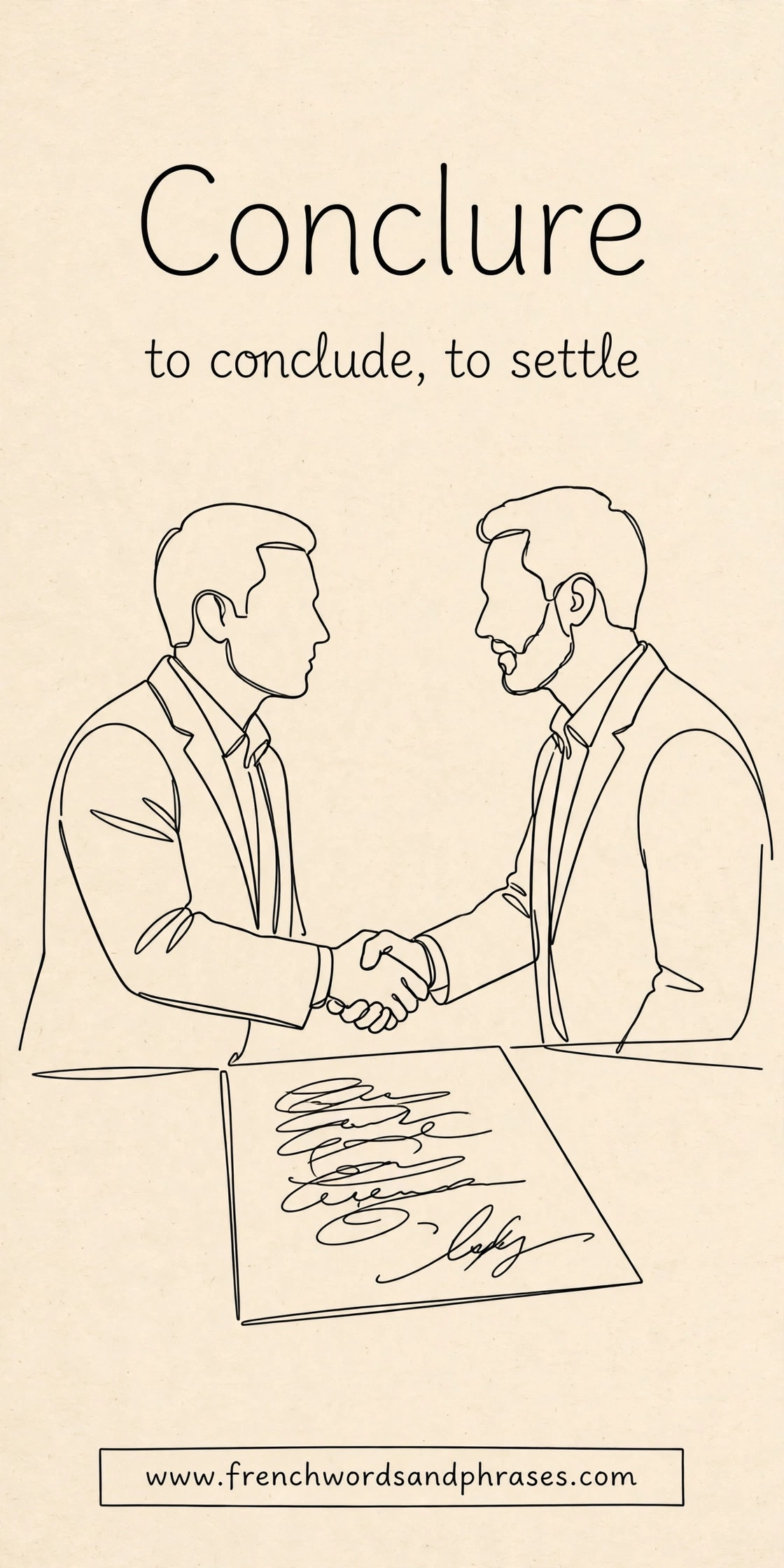
Conclure means to conclude — to bring something to its end, to settle a deal, or to draw a conclusion from the facts.
A lawyer’s last sentence to the jury, two merchants shaking hands over a price, a detective laying out the clues one by one — conclure is the verb of endings that settle things: speeches end, deals close, and minds conclude.
In this guide, you’ll learn how to conjugate conclure in all the major French tenses and moods. Explore complete conjugation tables, French examples, English translations, and practice quizzes.
Understanding the French Verb Conclure
Conclure is a French verb ending in -clure, conjugated like inclure: regular in most tenses but with the past participle conclu and il conclut in the present.
It means to conclude, to settle. It does three jobs in French: ending (conclure une réunion, un discours), settling (conclure un contrat, une vente — the deal is signed and done), and inferring (j’en conclus qu’il est parti — I conclude from this that he has left). The second job is the one English has nearly lost: in a French market or notary’s office, conclure is the handshake that closes the bargain.
Verb classification: Irregular (-clure)
Auxiliary verb: Avoir
Past participle: conclu
Present participle: concluant
English equivalents: To conclude, to settle, to close; conclure un accord — to conclude an agreement; conclure un marché — to close a deal; conclure son discours — to conclude one’s speech; conclure de quelque chose que… — to conclude from something that…; j’en conclus que… — I conclude from it that…
One important detail: watch the third person singular of the present — je conclus, tu conclus, but il conclut, with a -t found nowhere else in the present. The past participle is conclu — never ‘conclut’ and never ‘conclus’. That last form exists, but it is the passé simple (and the present singular): je conclus can mean ‘I conclude’ or ‘I concluded’, and only the context will tell you which. The subjunctive runs que je conclue, que nous concluions, and the present participle is concluant — also an adjective meaning ‘conclusive’.
Experience the Word
Conclure is the verb of the full stop that means something — it does not just end a thing, it settles it.
Imagine a notary’s office in Bordeaux, where two families have argued over a vineyard for a year. At noon the notary reads the last page aloud, the pens come out — ils concluent la vente en silence, et le vignoble change de mains avant le déjeuner.
A year of quarrels ends in one signature. They have concluded — conclu — and the matter is settled for good.
How to Conjugate Conclure: Complete French Conjugation Guide
Let’s explore every major conjugation of conclure, beginning with the indicative mood.
How to Conjugate Conclure in the Indicative Mood
The indicative mood is used to express facts, observations, actions, and events.
How to Conjugate Conclure in the Present Tense (Présent)
Used for actions happening now, habitual actions, and general truths.
| Subject | Conjugation |
|---|---|
| je | conclus |
| tu | conclus |
| il / elle | conclut |
| nous | concluons |
| vous | concluez |
| ils / elles | concluent |
Example
Je conclus de son silence qu’il est d’accord.
I conclude from his silence that he agrees.
Quick Quiz 1
Complete the sentence:
Nous ______ la réunion par un vote.
Reveal the answer
concluons
Nous concluons la réunion par un vote.
We conclude the meeting with a vote.
How to Conjugate Conclure in the Passé Composé
Used for completed actions in the past. Conclure takes the auxiliary verb avoir.
| Subject | Conjugation |
|---|---|
| j’ | ai conclu |
| tu | as conclu |
| il / elle | a conclu |
| nous | avons conclu |
| vous | avez conclu |
| ils / elles | ont conclu |
Example
Ils ont conclu l’accord après des mois de discussions.
They concluded the agreement after months of talks.
How to Conjugate Conclure in the Imparfait (Imperfect Tense)
Used for habitual past actions, descriptions, and ongoing situations in the past.
| Subject | Conjugation |
|---|---|
| je | concluais |
| tu | concluais |
| il / elle | concluait |
| nous | concluions |
| vous | concluiez |
| ils / elles | concluaient |
Example
Le président concluait toujours la réunion par une histoire.
The chairman always concluded the meeting with a story.
Quick Quiz 2
Choose the correct form:
He concluded his speech.
Il ______ son discours. (a conclu / a conclut)
Reveal the answer
a conclu
Il a conclu son discours.
The participle is conclu; conclut is a present-tense form.
How to Conjugate Conclure in the Plus-que-parfait
Used to describe an action that had already been completed before another past event.
| Subject | Conjugation |
|---|---|
| j’ | avais conclu |
| tu | avais conclu |
| il / elle | avait conclu |
| nous | avions conclu |
| vous | aviez conclu |
| ils / elles | avaient conclu |
Example
Elle avait conclu son discours avant l’arrivée du ministre.
She had concluded her speech before the minister arrived.
How to Conjugate Conclure in the Passé Simple
Primarily used in formal writing, literature, and historical narratives. It is rarely used in everyday conversation.
| Subject | Conjugation |
|---|---|
| je | conclus |
| tu | conclus |
| il / elle | conclut |
| nous | conclûmes |
| vous | conclûtes |
| ils / elles | conclurent |
Example
L’avocat conclut en demandant la clémence du jury.
The lawyer concluded by asking for the jury’s clemency.
How to Conjugate Conclure in the Passé Antérieur
A literary tense used to express an action completed immediately before another past action, generally in the passé simple.
| Subject | Conjugation |
|---|---|
| j’ | eus conclu |
| tu | eus conclu |
| il / elle | eut conclu |
| nous | eûmes conclu |
| vous | eûtes conclu |
| ils / elles | eurent conclu |
Example
Quand ils eurent conclu la paix, les cloches sonnèrent.
When they had concluded the peace, the bells rang.
How to Conjugate Conclure in the Future Tense (Futur Simple)
Used to describe actions that will take place in the future.
| Subject | Conjugation |
|---|---|
| je | conclurai |
| tu | concluras |
| il / elle | conclura |
| nous | conclurons |
| vous | conclurez |
| ils / elles | concluront |
Example
Demain, nous conclurons la vente de la maison.
Tomorrow, we will conclude the sale of the house.
How to Conjugate Conclure in the Futur Antérieur (Future Perfect)
Used for an action that will have been completed before a particular point in the future.
| Subject | Conjugation |
|---|---|
| j’ | aurai conclu |
| tu | auras conclu |
| il / elle | aura conclu |
| nous | aurons conclu |
| vous | aurez conclu |
| ils / elles | auront conclu |
Example
À midi, ils auront conclu l’affaire.
By noon, they will have settled the deal.
How to Conjugate Conclure in the Near Future (Futur Proche)
Used to describe something that is going to happen soon. Formed with aller + infinitive.
| Subject | Conjugation |
|---|---|
| je | vais conclure |
| tu | vas conclure |
| il / elle | va conclure |
| nous | allons conclure |
| vous | allez conclure |
| ils / elles | vont conclure |
Example
Le directeur va conclure la réunion dans cinq minutes.
The director is going to conclude the meeting in five minutes.
How to Conjugate Conclure in the Conditional Mood
The conditional mood expresses what would happen under certain circumstances. It is also frequently used to make polite requests or express wishes.
How to Conjugate Conclure in the Present Conditional
| Subject | Conjugation |
|---|---|
| je | conclurais |
| tu | conclurais |
| il / elle | conclurait |
| nous | conclurions |
| vous | concluriez |
| ils / elles | concluraient |
Example
Sans ce document, on conclurait trop vite.
Without this document, we would conclude too hastily.
How to Conjugate Conclure in the Past Conditional
| Subject | Conjugation |
|---|---|
| j’ | aurais conclu |
| tu | aurais conclu |
| il / elle | aurait conclu |
| nous | aurions conclu |
| vous | auriez conclu |
| ils / elles | auraient conclu |
Example
Il aurait conclu l’accord si le prix avait été juste.
He would have concluded the agreement if the price had been fair.
Conclure in the Literary Past Conditional Form
This less common literary form uses the imperfect subjunctive of avoir.
| Subject | Conjugation |
|---|---|
| j’ | eusse conclu |
| tu | eusses conclu |
| il / elle | eût conclu |
| nous | eussions conclu |
| vous | eussiez conclu |
| ils / elles | eussent conclu |
Example
Il eût conclu la paix avant l’hiver, sans l’orgueil des rois.
He would have concluded the peace before winter, without the pride of kings.
How to Conjugate Conclure in the Subjunctive Mood
The subjunctive is used to express wishes, emotions, doubts, necessity, and uncertainty. It frequently follows expressions such as il faut que (it is necessary that) or bien que (although).
How to Conjugate Conclure in the Present Subjunctive
| Subject | Conjugation |
|---|---|
| que je | conclue |
| que tu | conclues |
| qu’il / qu’elle | conclue |
| que nous | concluions |
| que vous | concluiez |
| qu’ils / qu’elles | concluent |
Example
Il faut que tu conclues ton exposé en deux phrases.
You must conclude your presentation in two sentences.
Quick Quiz 3
Complete the sentence using the subjunctive:
Il faut que vous ______ avant midi.
Reveal the answer
concluiez
Il faut que vous concluiez avant midi.
You must conclude before noon.
How to Conjugate Conclure in the Imperfect Subjunctive
A literary tense, rarely encountered in modern spoken French.
| Subject | Conjugation |
|---|---|
| que je | conclusse |
| que tu | conclusses |
| qu’il / qu’elle | conclût |
| que nous | conclussions |
| que vous | conclussiez |
| qu’ils / qu’elles | conclussent |
Example
Le juge attendait que l’avocat conclût son plaidoyer.
The judge was waiting for the lawyer to conclude his plea.
How to Conjugate Conclure in the Pluperfect Subjunctive
A literary construction used to express an action completed before another past action.
| Subject | Conjugation |
|---|---|
| que j’ | eusse conclu |
| que tu | eusses conclu |
| qu’il / qu’elle | eût conclu |
| que nous | eussions conclu |
| que vous | eussiez conclu |
| qu’ils / qu’elles | eussent conclu |
Example
On racontait qu’ils eussent conclu un pacte secret.
It was said they had concluded a secret pact.
How to Conjugate Conclure in the Past Subjunctive
| Subject | Conjugation |
|---|---|
| que j’ | aie conclu |
| que tu | aies conclu |
| qu’il / qu’elle | ait conclu |
| que nous | ayons conclu |
| que vous | ayez conclu |
| qu’ils / qu’elles | aient conclu |
Example
Je suis content que vous ayez conclu cette affaire.
I am glad you settled this deal.
How to Conjugate Conclure in the Imperative
The imperative is used to give commands, instructions, invitations, or suggestions. Subject pronouns are omitted.
How to Conjugate Conclure in the Present Imperative
| Person | Conjugation |
|---|---|
| (tu) | conclus |
| (nous) | concluons |
| (vous) | concluez |
Example
Concluez maintenant, le jury attend !
Conclude now, the jury is waiting!
Quick Quiz 4
How would you say Conclude your speech (tu form)?
Reveal the answer
Conclus ton discours !
French Participles of Conclure
Participles are verb forms that can be used in compound tenses and other grammatical constructions.
Present Participle of Conclure
concluant
En concluant son discours par un merci, elle a ému la salle.
By concluding her speech with a thank-you, she moved the room.
Past Participle of Conclure
conclu
Conclu à la hâte, l’accord a déçu les deux parties.
Concluded in haste, the agreement disappointed both parties.
Conclure in Everyday French: Real-Life Examples
Now that you know the conjugations, let’s see how conclure appears in everyday French.
Example 1 — Present
L’orateur conclut par une citation.
The speaker concludes with a quotation.
Example 2 — Passé composé
Nous avons conclu un excellent marché.
We closed an excellent deal.
Example 3 — Imparfait
Il concluait toujours trop vite.
He always concluded too quickly.
Example 4 — Future
Je conclurai mon rapport demain.
I will conclude my report tomorrow.
Example 5 — Conditional
On conclurait la même chose à votre place.
We would conclude the same thing in your place.
Example 6 — Imperative
Conclus ton discours, il est tard !
Conclude your speech, it is late!
Beyond Translation: The Meaning of Conclure
Latin concludere means to shut up completely — claudere, to close — and English conclude is the same word wearing a different coat. French keeps one sense English has mostly dropped: the commercial closing, conclure un marché, the deal sealed with a handshake.
Its participle leads a second life as an adjective.
Concluant means conclusive: une preuve concluante, une expérience concluante — evidence that does what the verb promises, and settles the question for good.
How to Remember the French Verb Conclure
Remember it this way: Conclure is about the notary’s last page and the pens coming out.
- Il conclut with a -t in the present third person, but the past participle is conclu — no t, no s.
- Passé simple and present look alike in the singular (je conclus) — let the context tell you which one you are reading.
- Three jobs: end a speech, close a deal, draw a conclusion — conclure un accord covers the first two, conclure que covers the third.
The key idea is the notary’s last page and the pens coming out.
Test Your Knowledge of Conclure
Let’s see how much you’ve learned. Try answering these questions before revealing the answers.
Question 1
What are the three main jobs of conclure?
Reveal the answer
To end (a speech, a meeting), to settle or sign (a deal, an agreement), and to infer (conclure de quelque chose que…).
Question 2
How do you say They concluded the agreement in French?
Reveal the answer
Ils ont conclu l’accord.
Question 3
Translate: I conclude from his silence that he agrees.
Reveal the answer
Je conclus de son silence qu’il est d’accord.
Question 4
What is the past participle of conclure?
Reveal the answer
Conclu — il conclut is the present third person; conclu is the participle.
Question 5
Complete the sentence:
Il faut que tu ______ ton discours en deux phrases.
Reveal the answer
conclues
Il faut que tu conclues ton discours en deux phrases.
You must conclude your speech in two sentences.
Your Final Challenge
Can You Use It?
How would you say this in French?
To conclude is to choose the moment when words stop and deeds begin.
Reveal the answer
Conclure, c’est choisir le moment où les mots s’arrêtent et où les actes commencent.
To conclude is to choose the moment when words stop and deeds begin.
A little French. A little curiosity. A richer everyday life.
LEARN FRENCH ONE WORD AT A TIME