A French Word to Live By
How to Conjugate Concasser in French
/kɔ̃.ka.se/
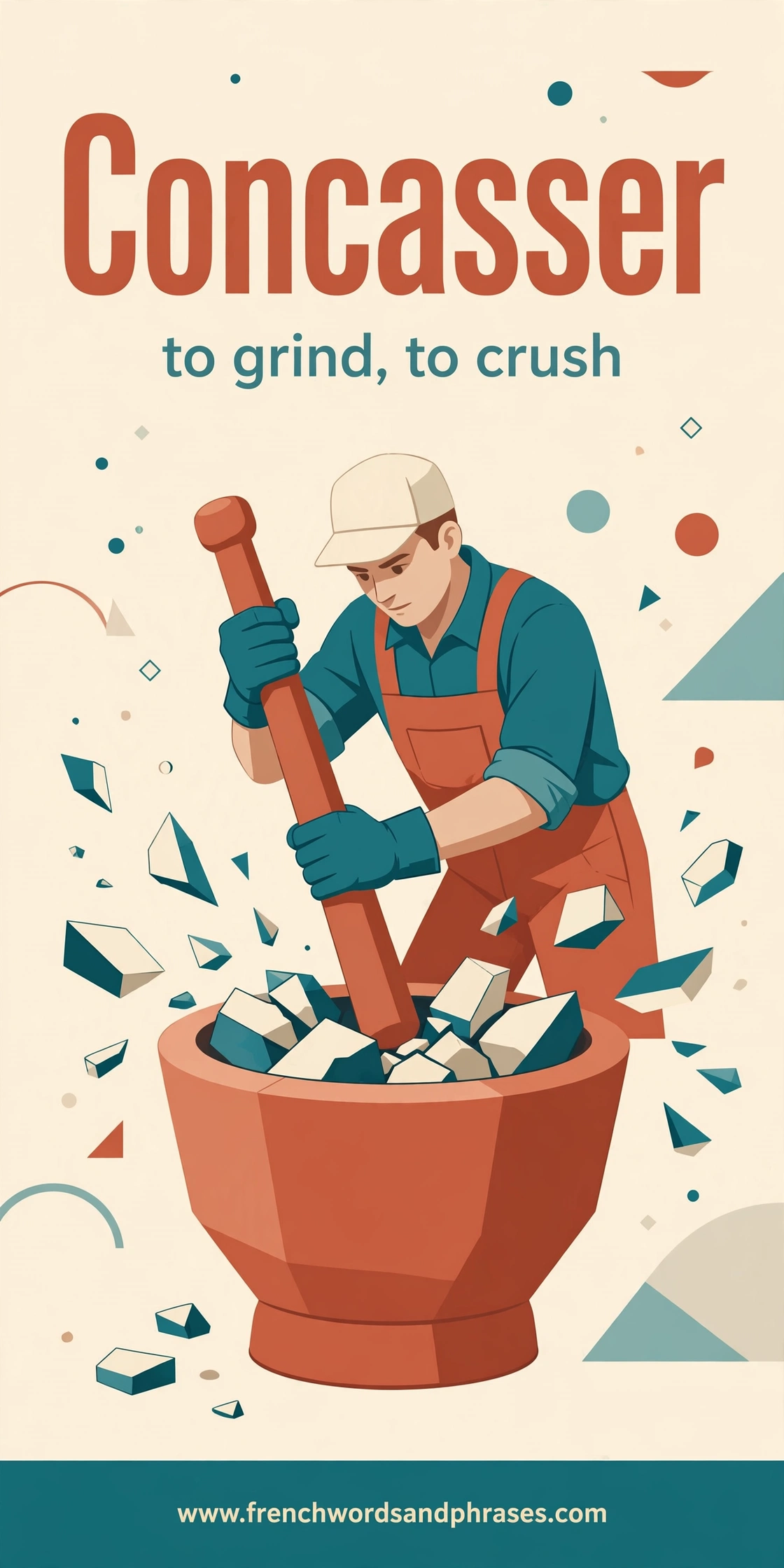
Concasser means to grind, to crush — to break hard things into coarse pieces, never into powder.
A quarry machine swallowing boulders and spitting out gravel, a cook cracking peppercorns in a heavy mortar, tomatoes crushed by hand for a sauce — concasser is the verb of coarse crushing: stones, grain, nuts and spices, all broken into honest chunks.
In this guide, you’ll learn how to conjugate concasser in all the major French tenses and moods. Explore complete conjugation tables, French examples, English translations, and practice quizzes.
Understanding the French Verb Concasser
Concasser is a regular French verb belonging to the first group of verbs, those ending in-er.
It means to grind, to crush. It is at home in three worlds: the quarry and the building site, where rock becomes gravel; the mill, where grain is cracked before milling; and the kitchen, where pepper, nuts, ice and tomatoes are coarsely crushed so they keep their texture. Anything concassé is broken but still recognisable.
Verb classification: First group (-er)
Auxiliary verb: Avoir
Past participle: concassé
Present participle: concassant
English equivalents: To crush, to grind coarsely, to crack, to break up; concasser des pierres — to crush stones; concasser du poivre — to crack pepper; des tomates concassées — crushed tomatoes; concasser des noix — to crack nuts; un concasseur — a crusher (machine).
One important detail: concasser breaks things into pieces, not dust — that is its whole identity. Écraser flattens, broyer grinds finer, moudre reduces to powder; concasser stops at gravel, cracked pepper and chunky tomatoes: du poivre concassé, des tomates concassées. The double -ss- keeps the s hard between the vowels, and the verb is regular everywhere: je concasse, nous concassons, past participle concassé. The machine that does it on building sites is un concasseur.
Experience the Word
Concasser is the verb of the satisfying crunch — hard things giving way into pieces that still have character.
Imagine a small quarry above a Provençal village. All morning the concasseur takes in pale boulders and pours out a grey river of gravel for the roads below — chaque pierre entre entière et ressort concassée, broken into a thousand useful pieces, none of them dust.
The rock has not been powdered or flattened. It has been crushed — concassée — into pieces with a job to do.
How to Conjugate Concasser: Complete French Conjugation Guide
Let’s explore every major conjugation of concasser, beginning with the indicative mood.
How to Conjugate Concasser in the Indicative Mood
The indicative mood is used to express facts, observations, actions, and events.
How to Conjugate Concasser in the Present Tense (Présent)
Used for actions happening now, habitual actions, and general truths.
| Subject | Conjugation |
|---|---|
| je | concasse |
| tu | concasses |
| il / elle | concasse |
| nous | concassons |
| vous | concassez |
| ils / elles | concassent |
Example
La machine concasse les pierres en gravier pour la route.
The machine crushes the stones into gravel for the road.
Quick Quiz 1
Complete the sentence:
Nous ______ les pierres pour le chemin.
Reveal the answer
concassons
Nous concassons les pierres pour le chemin.
We are crushing the stones for the path.
How to Conjugate Concasser in the Passé Composé
Used for completed actions in the past. Concasser takes the auxiliary verb avoir.
| Subject | Conjugation |
|---|---|
| j’ | ai concassé |
| tu | as concassé |
| il / elle | a concassé |
| nous | avons concassé |
| vous | avez concassé |
| ils / elles | ont concassé |
Example
Ils ont concassé du poivre noir pour la sauce.
They cracked black pepper for the sauce.
How to Conjugate Concasser in the Imparfait (Imperfect Tense)
Used for habitual past actions, descriptions, and ongoing situations in the past.
| Subject | Conjugation |
|---|---|
| je | concassais |
| tu | concassais |
| il / elle | concassait |
| nous | concassions |
| vous | concassiez |
| ils / elles | concassaient |
Example
Le moulin concassait le blé avant de le moudre.
The mill used to crack the wheat before grinding it.
Quick Quiz 2
Choose the correct form:
I cracked some pepper.
J’______ du poivre. (ai concassé / suis concassé)
Reveal the answer
ai concassé
J’ai concassé du poivre.
Concasser takes avoir.
How to Conjugate Concasser in the Plus-que-parfait
Used to describe an action that had already been completed before another past event.
| Subject | Conjugation |
|---|---|
| j’ | avais concassé |
| tu | avais concassé |
| il / elle | avait concassé |
| nous | avions concassé |
| vous | aviez concassé |
| ils / elles | avaient concassé |
Example
Elle avait concassé des noix pour le gâteau de dimanche.
She had cracked walnuts for Sunday’s cake.
How to Conjugate Concasser in the Passé Simple
Primarily used in formal writing, literature, and historical narratives. It is rarely used in everyday conversation.
| Subject | Conjugation |
|---|---|
| je | concassai |
| tu | concassas |
| il / elle | concassa |
| nous | concassâmes |
| vous | concassâtes |
| ils / elles | concassèrent |
Example
Le concasseur concassa les rochers en quelques heures.
The crusher crushed the boulders in a few hours.
How to Conjugate Concasser in the Passé Antérieur
A literary tense used to express an action completed immediately before another past action, generally in the passé simple.
| Subject | Conjugation |
|---|---|
| j’ | eus concassé |
| tu | eus concassé |
| il / elle | eut concassé |
| nous | eûmes concassé |
| vous | eûtes concassé |
| ils / elles | eurent concassé |
Example
Quand il eut concassé le dernier bloc, le chantier se tut.
When he had crushed the last block, the site fell silent.
How to Conjugate Concasser in the Future Tense (Futur Simple)
Used to describe actions that will take place in the future.
| Subject | Conjugation |
|---|---|
| je | concasserai |
| tu | concasseras |
| il / elle | concassera |
| nous | concasserons |
| vous | concasserez |
| ils / elles | concasseront |
Example
Cette machine concassera vingt tonnes de roche par jour.
This machine will crush twenty tonnes of rock a day.
How to Conjugate Concasser in the Futur Antérieur (Future Perfect)
Used for an action that will have been completed before a particular point in the future.
| Subject | Conjugation |
|---|---|
| j’ | aurai concassé |
| tu | auras concassé |
| il / elle | aura concassé |
| nous | aurons concassé |
| vous | aurez concassé |
| ils / elles | auront concassé |
Example
À la fin de la journée, l’atelier aura concassé dix tonnes de minerai.
By the end of the day, the plant will have crushed ten tonnes of ore.
How to Conjugate Concasser in the Near Future (Futur Proche)
Used to describe something that is going to happen soon. Formed with aller + infinitive.
| Subject | Conjugation |
|---|---|
| je | vais concasser |
| tu | vas concasser |
| il / elle | va concasser |
| nous | allons concasser |
| vous | allez concasser |
| ils / elles | vont concasser |
Example
Le cuisinier va concasser des grains de poivre noir.
The cook is going to crack some black peppercorns.
How to Conjugate Concasser in the Conditional Mood
The conditional mood expresses what would happen under certain circumstances. It is also frequently used to make polite requests or express wishes.
How to Conjugate Concasser in the Present Conditional
| Subject | Conjugation |
|---|---|
| je | concasserais |
| tu | concasserais |
| il / elle | concasserait |
| nous | concasserions |
| vous | concasseriez |
| ils / elles | concasseraient |
Example
Sans électricité, nous concasserions les pierres à la main.
Without electricity, we would crush the stones by hand.
How to Conjugate Concasser in the Past Conditional
| Subject | Conjugation |
|---|---|
| j’ | aurais concassé |
| tu | aurais concassé |
| il / elle | aurait concassé |
| nous | aurions concassé |
| vous | auriez concassé |
| ils / elles | auraient concassé |
Example
Ils auraient concassé plus de roche avec une meilleure machine.
They would have crushed more rock with a better machine.
Concasser in the Literary Past Conditional Form
This less common literary form uses the imperfect subjunctive of avoir.
| Subject | Conjugation |
|---|---|
| j’ | eusse concassé |
| tu | eusses concassé |
| il / elle | eût concassé |
| nous | eussions concassé |
| vous | eussiez concassé |
| ils / elles | eussent concassé |
Example
Il eût concassé les plus durs rochers de ses propres mains.
He would have crushed the hardest boulders with his own hands.
How to Conjugate Concasser in the Subjunctive Mood
The subjunctive is used to express wishes, emotions, doubts, necessity, and uncertainty. It frequently follows expressions such as il faut que (it is necessary that) or bien que (although).
How to Conjugate Concasser in the Present Subjunctive
| Subject | Conjugation |
|---|---|
| que je | concasse |
| que tu | concasses |
| qu’il / qu’elle | concasse |
| que nous | concassions |
| que vous | concassiez |
| qu’ils / qu’elles | concassent |
Example
Il faut que tu concasses les noisettes grossièrement, pas en poudre.
You must crush the hazelnuts coarsely, not into powder.
Quick Quiz 3
Complete the sentence using the subjunctive:
Il faut que vous ______ le poivre au dernier moment.
Reveal the answer
concassiez
Il faut que vous concassiez le poivre au dernier moment.
You must crack the pepper at the last moment.
How to Conjugate Concasser in the Imperfect Subjunctive
A literary tense, rarely encountered in modern spoken French.
| Subject | Conjugation |
|---|---|
| que je | concassasse |
| que tu | concassasses |
| qu’il / qu’elle | concassât |
| que nous | concassassions |
| que vous | concassassiez |
| qu’ils / qu’elles | concassassent |
Example
Le chef exigeait que l’on concassât le poivre au dernier moment.
The chef insisted that the pepper be cracked at the last moment.
How to Conjugate Concasser in the Pluperfect Subjunctive
A literary construction used to express an action completed before another past action.
| Subject | Conjugation |
|---|---|
| que j’ | eusse concassé |
| que tu | eusses concassé |
| qu’il / qu’elle | eût concassé |
| que nous | eussions concassé |
| que vous | eussiez concassé |
| qu’ils / qu’elles | eussent concassé |
Example
On vérifia qu’il eût concassé le minerai à la bonne taille.
They checked that he had crushed the ore to the right size.
How to Conjugate Concasser in the Past Subjunctive
| Subject | Conjugation |
|---|---|
| que j’ | aie concassé |
| que tu | aies concassé |
| qu’il / qu’elle | ait concassé |
| que nous | ayons concassé |
| que vous | ayez concassé |
| qu’ils / qu’elles | aient concassé |
Example
Je suis content qu’elle ait concassé les tomates pour la sauce.
I am glad she crushed the tomatoes for the sauce.
How to Conjugate Concasser in the Imperative
The imperative is used to give commands, instructions, invitations, or suggestions. Subject pronouns are omitted.
How to Conjugate Concasser in the Present Imperative
| Person | Conjugation |
|---|---|
| (tu) | concasse |
| (nous) | concassons |
| (vous) | concassez |
Example
Concassez le poivre juste avant de servir !
Crack the pepper just before serving!
Quick Quiz 4
How would you say Crush the tomatoes (tu form)?
Reveal the answer
Concasse les tomates !
French Participles of Concasser
Participles are verb forms that can be used in compound tenses and other grammatical constructions.
Present Participle of Concasser
concassant
En concassant les pierres, la machine soulève un nuage de poussière.
By crushing the stones, the machine raises a cloud of dust.
Past Participle of Concasser
concassé
Concassées au mortier, les épices gardent tout leur parfum.
Crushed in the mortar, the spices keep all their fragrance.
Concasser in Everyday French: Real-Life Examples
Now that you know the conjugations, let’s see how concasser appears in everyday French.
Example 1 — Present
La machine concasse les rochers.
The machine crushes the rocks.
Example 2 — Passé composé
J’ai concassé du poivre pour la marinade.
I cracked some pepper for the marinade.
Example 3 — Imparfait
Le moulin concassait le grain.
The mill used to crush the grain.
Example 4 — Future
Nous concasserons les noix ce soir.
We will crack the nuts tonight.
Example 5 — Conditional
Il concasserait les pierres à la main si nécessaire.
He would crush the stones by hand if necessary.
Example 6 — Imperative
Concasse les tomates !
Crush the tomatoes!
Beyond Translation: The Meaning of Concasser
English to crush covers more ground; French divides the labour, and concasser owns the coarse end of the scale.
Its signature is the chunk.
That is why French menus boast tomates concassées and poivre concassé: the word promises texture — pieces you can see and bite — where a purée or a powder would say nothing at all.
How to Remember the French Verb Concasser
Remember it this way: Concasser is about pepper cracked in the mortar.
- Coarse is the key: concasser breaks into pieces — gravel, cracked pepper, chunky tomatoes — never powder.
- The family: un concasseur is the crushing machine; concassé is the adjective on menus.
- Regular -er: je concasse, nous concassons, past participle concassé.
The key idea is pepper cracked in the mortar.
Test Your Knowledge of Concasser
Let’s see how much you’ve learned. Try answering these questions before revealing the answers.
Question 1
How does concasser differ from moudre?
Reveal the answer
Concasser breaks into coarse pieces; moudre grinds right down to powder or flour.
Question 2
How do you say They cracked black pepper for the sauce in French?
Reveal the answer
Ils ont concassé du poivre noir pour la sauce.
Question 3
Translate: The machine crushes the stones into gravel.
Reveal the answer
La machine concasse les pierres en gravier.
Question 4
What is the past participle of concasser?
Reveal the answer
Concassé.
Question 5
Complete the sentence:
Il faut que tu ______ les noisettes grossièrement.
Reveal the answer
concasses
Il faut que tu concasses les noisettes grossièrement.
You must crush the hazelnuts coarsely.
Your Final Challenge
Can You Use It?
How would you say this in French?
Pepper cracked in the mortar wakes the sauce like a beat of a drum.
Reveal the answer
Le poivre concassé au mortier réveille la sauce comme un coup de tambour.
Pepper cracked in the mortar wakes the sauce like a beat of a drum.
A little French. A little curiosity. A richer everyday life.
LEARN FRENCH ONE WORD AT A TIME