A French Word to Live By
How to Conjugate Compasser in French
/kɔ̃.pa.se/
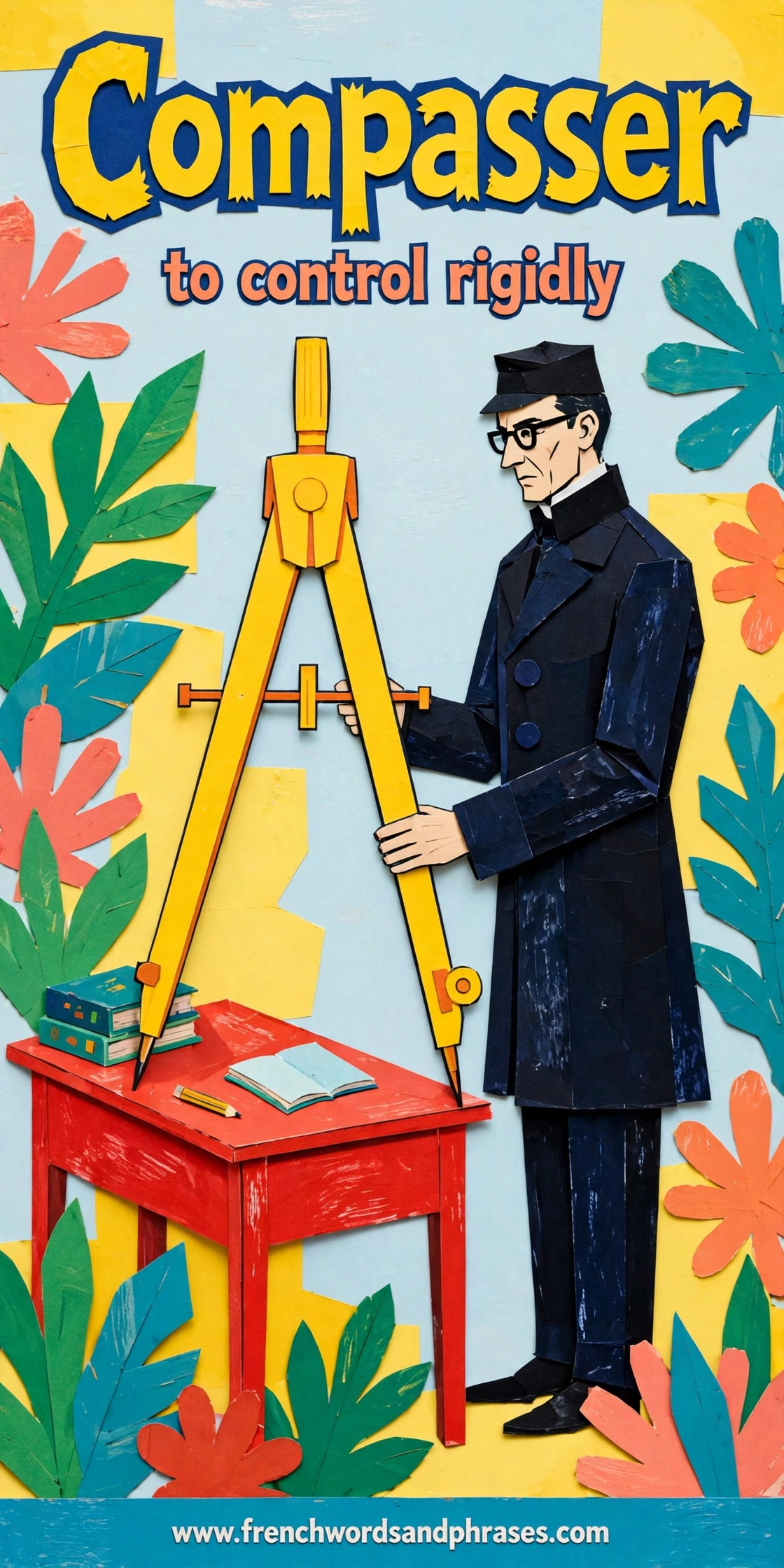
Compasser means to control rigidly — to measure everything out with a pair of compasses, exact and stiff, leaving nothing to ease or chance.
A draughtsman bent over his table, compass in hand, spacing every line to the millimetre; a drawing-room where every gesture is measured and no voice ever rises. Compasser is the verb of that measured stiffness: life ruled off with a compass, elegant and airless.
In this guide, you’ll learn how to conjugate compasser in all the major French tenses and moods. Explore complete conjugation tables, French examples, English translations, and practice quizzes.
Understanding the French Verb Compasser
Compasser is a regular French verb belonging to the first group of verbs, those ending in-er.
It means to control rigidly. Compasser itself is technical and rare; compassé is the word French actually uses, for manners, styles and welcomes that are correct to the point of coldness. A close cousin, guindé, says the same of people; compassé keeps the draughtsman’s flavour — everything measured out, as if with compasses.
Verb classification: First group (-er)
Auxiliary verb: Avoir
Past participle: compassé
Present participle: compassant
English equivalents: To measure with compasses, to space out exactly, to control rigidly; compasser un dessin — to set out a drawing with compasses; un air compassé — a stiff, formal manner; des manières compassées — stiff, measured manners; marcher d’un pas compassé — to walk with measured steps; un style compassé — a stiff, laboured style.
Compasser is the verb of un compas, a pair of compasses: literally, to measure or set out with the instrument. But the living form of the word is its past participle used as an adjective — compassé: un air compassé, des gestes compassés, un accueil compassé — stiff, formal, over-measured, the opposite of warmth and ease. The verb itself is a regular -er: je compasse, nous compassons. Just do not expect to hear it at the café — it belongs to drawing offices, and to irony about stiff people.
Experience the Word
Compasser is the verb of the over-measured life — every step paced, every word weighed, spontaneity ruled out by design.
Imagine a provincial notary receiving clients in 1890: the bow at exactly the right depth, the voice at exactly the right level, the papers squared precisely to the desk’s edge. Il compasse chacun de ses gestes — he measures every gesture with an invisible compass, and his clients leave chilled by so much correctness.
Nothing he did was wrong. Everything was measured — compassé, to the millimetre, and warmth had no place in the drawing.
How to Conjugate Compasser: Complete French Conjugation Guide
Let’s explore every major conjugation of compasser, beginning with the indicative mood.
How to Conjugate Compasser in the Indicative Mood
The indicative mood is used to express facts, observations, actions, and events.
How to Conjugate Compasser in the Present Tense (Présent)
Used for actions happening now, habitual actions, and general truths.
| Subject | Conjugation |
|---|---|
| je | compasse |
| tu | compasses |
| il / elle | compasse |
| nous | compassons |
| vous | compassez |
| ils / elles | compassent |
Example
Le dessinateur compasse les distances avant de tracer le plan.
The draughtsman measures the distances with compasses before drawing the plan.
Quick Quiz 1
Complete the sentence:
Nous ______ les distances sur le plan.
Reveal the answer
compassons
Nous compassons les distances sur le plan.
We measure the distances on the plan with compasses.
How to Conjugate Compasser in the Passé Composé
Used for completed actions in the past. Compasser takes the auxiliary verb avoir.
| Subject | Conjugation |
|---|---|
| j’ | ai compassé |
| tu | as compassé |
| il / elle | a compassé |
| nous | avons compassé |
| vous | avez compassé |
| ils / elles | ont compassé |
Example
Il a compassé ses gestes pendant toute la cérémonie.
He measured out his gestures throughout the whole ceremony.
How to Conjugate Compasser in the Imparfait (Imperfect Tense)
Used for habitual past actions, descriptions, and ongoing situations in the past.
| Subject | Conjugation |
|---|---|
| je | compassais |
| tu | compassais |
| il / elle | compassait |
| nous | compassions |
| vous | compassiez |
| ils / elles | compassaient |
Example
Elle compassait ses paroles comme un diplomate de métier.
She measured her words like a professional diplomat.
Quick Quiz 2
Choose the correct form:
She measured her words.
Elle ______ ses paroles. (a compassé / est compassée)
Reveal the answer
a compassé
Elle a compassé ses paroles.
Compasser takes avoir.
How to Conjugate Compasser in the Plus-que-parfait
Used to describe an action that had already been completed before another past event.
| Subject | Conjugation |
|---|---|
| j’ | avais compassé |
| tu | avais compassé |
| il / elle | avait compassé |
| nous | avions compassé |
| vous | aviez compassé |
| ils / elles | avaient compassé |
Example
Le professeur avait compassé chaque exercice au quart d’heure près.
The teacher had measured out each exercise to the nearest quarter of an hour.
How to Conjugate Compasser in the Passé Simple
Primarily used in formal writing, literature, and historical narratives. It is rarely used in everyday conversation.
| Subject | Conjugation |
|---|---|
| je | compassai |
| tu | compassas |
| il / elle | compassa |
| nous | compassâmes |
| vous | compassâtes |
| ils / elles | compassèrent |
Example
D’un geste sec, il compassa l’écart sur la carte.
With a dry movement, he measured the gap on the map with compasses.
How to Conjugate Compasser in the Passé Antérieur
A literary tense used to express an action completed immediately before another past action, generally in the passé simple.
| Subject | Conjugation |
|---|---|
| j’ | eus compassé |
| tu | eus compassé |
| il / elle | eut compassé |
| nous | eûmes compassé |
| vous | eûtes compassé |
| ils / elles | eurent compassé |
Example
Quand il eut compassé la feuille, il traça enfin le cercle.
When he had set out the sheet with compasses, he finally drew the circle.
How to Conjugate Compasser in the Future Tense (Futur Simple)
Used to describe actions that will take place in the future.
| Subject | Conjugation |
|---|---|
| je | compasserai |
| tu | compasseras |
| il / elle | compassera |
| nous | compasserons |
| vous | compasserez |
| ils / elles | compasseront |
Example
Demain, l’architecte compassera les plans du nouveau bâtiment.
Tomorrow, the architect will set out the plans of the new building with compasses.
How to Conjugate Compasser in the Futur Antérieur (Future Perfect)
Used for an action that will have been completed before a particular point in the future.
| Subject | Conjugation |
|---|---|
| j’ | aurai compassé |
| tu | auras compassé |
| il / elle | aura compassé |
| nous | aurons compassé |
| vous | aurez compassé |
| ils / elles | auront compassé |
Example
À midi, le géomètre aura compassé tout le terrain.
By noon, the surveyor will have measured the whole plot with compasses.
How to Conjugate Compasser in the Near Future (Futur Proche)
Used to describe something that is going to happen soon. Formed with aller + infinitive.
| Subject | Conjugation |
|---|---|
| je | vais compasser |
| tu | vas compasser |
| il / elle | va compasser |
| nous | allons compasser |
| vous | allez compasser |
| ils / elles | vont compasser |
Example
Le maître va compasser les exercices de la semaine.
The teacher is going to measure out the week’s exercises.
How to Conjugate Compasser in the Conditional Mood
The conditional mood expresses what would happen under certain circumstances. It is also frequently used to make polite requests or express wishes.
How to Conjugate Compasser in the Present Conditional
| Subject | Conjugation |
|---|---|
| je | compasserais |
| tu | compasserais |
| il / elle | compasserait |
| nous | compasserions |
| vous | compasseriez |
| ils / elles | compasseraient |
Example
On compasserait moins la conversation sans l’invité d’honneur.
People would measure the conversation less without the guest of honour.
How to Conjugate Compasser in the Past Conditional
| Subject | Conjugation |
|---|---|
| j’ | aurais compassé |
| tu | aurais compassé |
| il / elle | aurait compassé |
| nous | aurions compassé |
| vous | auriez compassé |
| ils / elles | auraient compassé |
Example
Elle aurait compassé son discours si le ministre était venu.
She would have measured her speech if the minister had come.
Compasser in the Literary Past Conditional Form
This less common literary form uses the imperfect subjunctive of avoir.
| Subject | Conjugation |
|---|---|
| j’ | eusse compassé |
| tu | eusses compassé |
| il / elle | eût compassé |
| nous | eussions compassé |
| vous | eussiez compassé |
| ils / elles | eussent compassé |
Example
Le notaire eût compassé ses gestes jusqu’au bout.
The notary would have measured his gestures to the very end.
How to Conjugate Compasser in the Subjunctive Mood
The subjunctive is used to express wishes, emotions, doubts, necessity, and uncertainty. It frequently follows expressions such as il faut que (it is necessary that) or bien que (although).
How to Conjugate Compasser in the Present Subjunctive
| Subject | Conjugation |
|---|---|
| que je | compasse |
| que tu | compasses |
| qu’il / qu’elle | compasse |
| que nous | compassions |
| que vous | compassiez |
| qu’ils / qu’elles | compassent |
Example
Je doute qu’il compasse encore ses plans à la main.
I doubt he still sets out his plans by hand with compasses.
Quick Quiz 3
Complete the sentence using the subjunctive:
Il faut que vous ______ vos réponses devant le jury.
Reveal the answer
compassiez
Il faut que vous compassiez vos réponses devant le jury.
You must measure your answers before the jury.
How to Conjugate Compasser in the Imperfect Subjunctive
A literary tense, rarely encountered in modern spoken French.
| Subject | Conjugation |
|---|---|
| que je | compassasse |
| que tu | compassasses |
| qu’il / qu’elle | compassât |
| que nous | compassassions |
| que vous | compassassiez |
| qu’ils / qu’elles | compassassent |
Example
Il fallait qu’elle compassât ses réponses devant le jury.
She had to measure her answers before the jury.
How to Conjugate Compasser in the Pluperfect Subjunctive
A literary construction used to express an action completed before another past action.
| Subject | Conjugation |
|---|---|
| que j’ | eusse compassé |
| que tu | eusses compassé |
| qu’il / qu’elle | eût compassé |
| que nous | eussions compassé |
| que vous | eussiez compassé |
| qu’ils / qu’elles | eussent compassé |
Example
On souriait qu’il eût compassé même ses silences.
People smiled that he had measured even his silences.
How to Conjugate Compasser in the Past Subjunctive
| Subject | Conjugation |
|---|---|
| que j’ | aie compassé |
| que tu | aies compassé |
| qu’il / qu’elle | ait compassé |
| que nous | ayons compassé |
| que vous | ayez compassé |
| qu’ils / qu’elles | aient compassé |
Example
Je suis surpris qu’elle ait compassé son accueil à ce point.
I am surprised she made her welcome so stiff and measured.
How to Conjugate Compasser in the Imperative
The imperative is used to give commands, instructions, invitations, or suggestions. Subject pronouns are omitted.
How to Conjugate Compasser in the Present Imperative
| Person | Conjugation |
|---|---|
| (tu) | compasse |
| (nous) | compassons |
| (vous) | compassez |
Example
Compassez les distances avant de découper la pièce.
Measure the distances with compasses before cutting the piece.
Quick Quiz 4
How would you say Measure the distances before drawing (tu form)?
Reveal the answer
Compasse les distances avant de tracer !
French Participles of Compasser
Participles are verb forms that can be used in compound tenses and other grammatical constructions.
Present Participle of Compasser
compassant
En compassant chaque mot, il finit par ne plus rien dire.
By measuring every word, he ended up saying nothing at all.
Past Participle of Compasser
compassé
Compassée au millimètre, la cérémonie manquait de chaleur.
Measured to the millimetre, the ceremony lacked warmth.
Compasser in Everyday French: Real-Life Examples
Now that you know the conjugations, let’s see how compasser appears in everyday French.
Example 1 — Present
Le géomètre compasse le terrain avant de tracer.
The surveyor measures the plot with compasses before drawing.
Example 2 — Passé composé
Il a compassé tous ses gestes pendant l’entretien.
He measured all his gestures during the interview.
Example 3 — Imparfait
Elle compassait ses paroles devant les inconnus.
She measured her words in front of strangers.
Example 4 — Future
L’architecte compassera le plan demain.
The architect will set out the plan with compasses tomorrow.
Example 5 — Conditional
On compasserait moins sans le directeur.
We would be less stiffly measured without the director.
Example 6 — Imperative
Compasse les distances avant de tracer !
Measure the distances with compasses before drawing!
Beyond Translation: The Meaning of Compasser
Compasser is a verb that survives chiefly inside its own past participle: compassé is the adjective French reaches for when correctness has frozen into stiffness.
Measured with compasses, judged without them.
Un accueil compassé, un style compassé, un pas compassé — the draughtsman’s instrument became the critic’s metaphor for every manner and every sentence with the life carefully measured out of it.
How to Remember the French Verb Compasser
Remember it this way: Compasser is about the notary’s invisible compass, measuring every gesture.
- From un compas, a pair of compasses: to measure out exactly — and stiffly.
- The living form is the adjective compassé: un air compassé = a stiff, formal manner.
- Regular -er: je compasse, nous compassons, past participle compassé.
The key idea is the notary’s invisible compass, measuring every gesture.
Test Your Knowledge of Compasser
Let’s see how much you’ve learned. Try answering these questions before revealing the answers.
Question 1
What is the living, everyday form of compasser?
Reveal the answer
The adjective compassé — un air compassé, des manières compassées: stiff, formal, over-measured.
Question 2
How do you say He measured all his gestures in French?
Reveal the answer
Il a compassé tous ses gestes.
Question 3
Translate: The surveyor measures the plot with compasses.
Reveal the answer
Le géomètre compasse le terrain.
Question 4
What is the past participle of compasser?
Reveal the answer
Compassé.
Question 5
Complete the sentence:
Il fallait qu’elle ______ ses réponses devant le jury.
Reveal the answer
compassât
Il fallait qu’elle compassât ses réponses devant le jury.
She had to measure her answers before the jury.
Your Final Challenge
Can You Use It?
How would you say this in French?
He measures out his gestures, his words and even his silences: in his house, nothing overflows, not even joy.
Reveal the answer
Il compasse ses gestes, ses mots et même ses silences : chez lui, rien ne dépasse, pas même la joie.
He measures out his gestures, his words and even his silences: in his house, nothing overflows, not even joy.
A little French. A little curiosity. A richer everyday life.
LEARN FRENCH ONE WORD AT A TIME