A French Word to Live By
How to Conjugate Combiner in French
/kɔ̃.bi.ne/
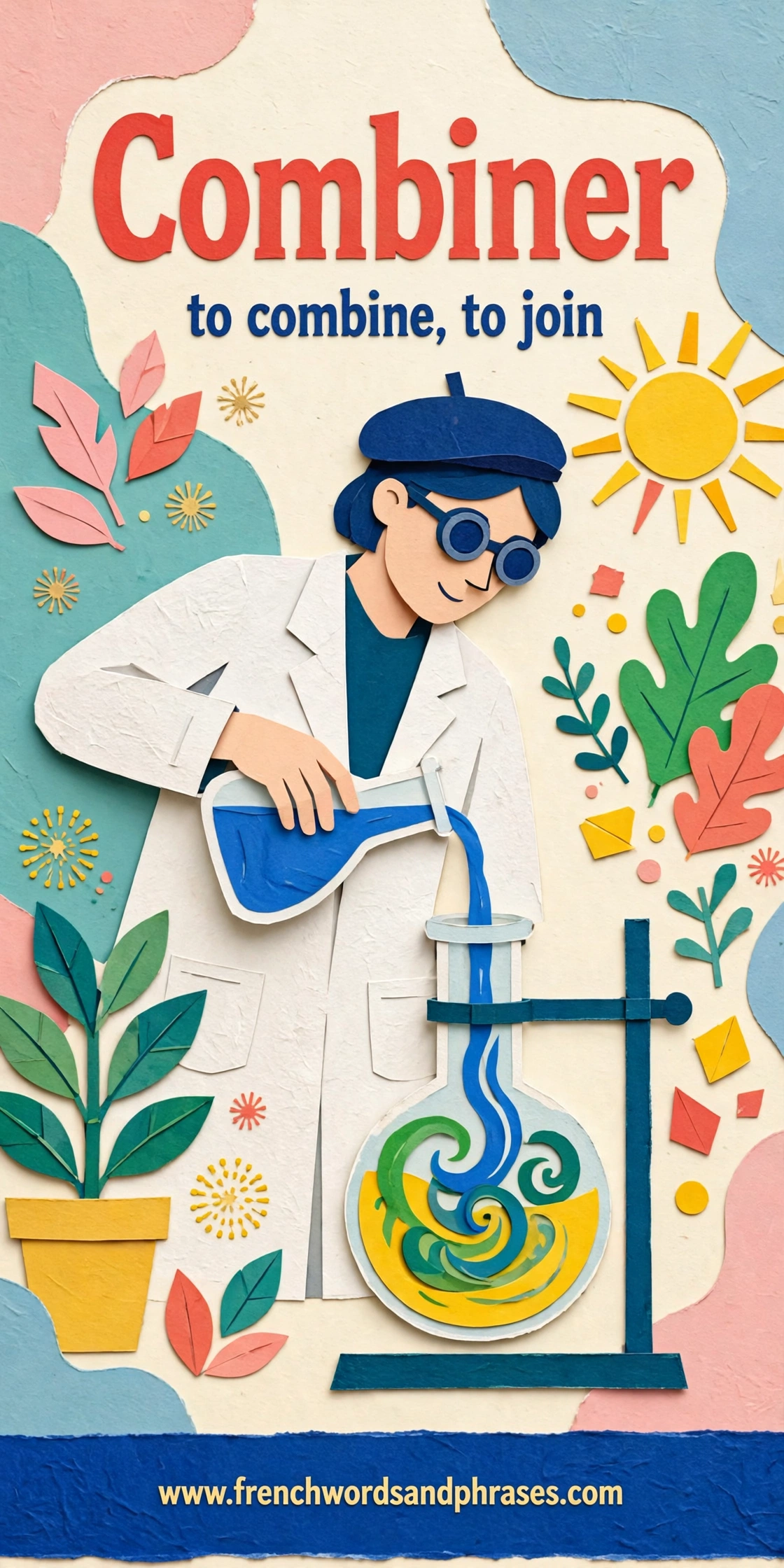
Combiner means to combine, to join — to bring two or more things together so that they work as one.
A cook marrying sweet and sour, an engineer joining two metals, a schemer quietly joining two plans into one — combiner is the verb of putting things together: ingredients, colours, efforts and, in familiar French, plots.
In this guide, you’ll learn how to conjugate combiner in all the major French tenses and moods. Explore complete conjugation tables, French examples, English translations, and practice quizzes.
Understanding the French Verb Combiner
Combiner is a regular French verb belonging to the first group of verbs, those ending in-er.
It means to combine, to join. It is the neutral verb of combination in cooking, chemistry, design and planning — combiner des saveurs, combiner des efforts — and it turns sly the moment its object is a plan or a coup: combiner un mauvais coup is to plot something underhand.
Verb classification: First group (-er)
Auxiliary verb: Avoir
Past participle: combiné
Present participle: combinant
English equivalents: To combine, to join, to mix; combiner deux couleurs — to combine two colours; combiner travail et plaisir — to combine work and pleasure; combiner un plan, combiner un coup (familiar) — to hatch a plan, to scheme; une combine (familiar) — a scheme, a fiddle.
One important detail: combiner is a perfectly regular -er verb — je combine, nous combinons, ils combinent, past participle combiné — with one small trap in the imperfect and the subjunctive plural, where the stem meets the ending’s i: nous combinions, que vous combiniez. The second trap is lexical: in familiar French, combiner also means to scheme — qu’est-ce que tu combines ? is ‘what are you plotting?’, and une combine is a dodge or a fiddle.
Experience the Word
Combiner is the verb of the mixture that works — two things that were separate, suddenly better together.
Imagine a young chef tasting her sauce for the third time. A spoonful of honey, a thread of vinegar, a pinch of salt — elle combine, ajuste, goûte encore, until sweet and sharp stop fighting and start singing together.
Nothing was added at random. She has combined — combiné — each flavour with intent.
How to Conjugate Combiner: Complete French Conjugation Guide
Let’s explore every major conjugation of combiner, beginning with the indicative mood.
How to Conjugate Combiner in the Indicative Mood
The indicative mood is used to express facts, observations, actions, and events.
How to Conjugate Combiner in the Present Tense (Présent)
Used for actions happening now, habitual actions, and general truths.
| Subject | Conjugation |
|---|---|
| je | combine |
| tu | combines |
| il / elle | combine |
| nous | combinons |
| vous | combinez |
| ils / elles | combinent |
Example
Ce logiciel combine la vitesse et la simplicité.
This software combines speed and simplicity.
Quick Quiz 1
Complete the sentence:
Nous ______ nos efforts pour finir à temps.
Reveal the answer
combinons
Nous combinons nos efforts pour finir à temps.
We are combining our efforts to finish on time.
How to Conjugate Combiner in the Passé Composé
Used for completed actions in the past. Combiner takes the auxiliary verb avoir.
| Subject | Conjugation |
|---|---|
| j’ | ai combiné |
| tu | as combiné |
| il / elle | a combiné |
| nous | avons combiné |
| vous | avez combiné |
| ils / elles | ont combiné |
Example
Elle a combiné deux tissus pour créer la robe.
She combined two fabrics to create the dress.
How to Conjugate Combiner in the Imparfait (Imperfect Tense)
Used for habitual past actions, descriptions, and ongoing situations in the past.
| Subject | Conjugation |
|---|---|
| je | combinais |
| tu | combinais |
| il / elle | combinait |
| nous | combinions |
| vous | combiniez |
| ils / elles | combinaient |
Example
Les enfants combinaient leurs économies pour acheter un cadeau.
The children used to pool their savings to buy a present.
Quick Quiz 2
Choose the correct form:
She combined two fabrics.
Elle ______ deux tissus. (a combiné / est combinée)
Reveal the answer
a combiné
Elle a combiné deux tissus.
Combiner takes avoir.
How to Conjugate Combiner in the Plus-que-parfait
Used to describe an action that had already been completed before another past event.
| Subject | Conjugation |
|---|---|
| j’ | avais combiné |
| tu | avais combiné |
| il / elle | avait combiné |
| nous | avions combiné |
| vous | aviez combiné |
| ils / elles | avaient combiné |
Example
Il avait combiné plusieurs ingrédients pour inventer la sauce.
He had combined several ingredients to invent the sauce.
How to Conjugate Combiner in the Passé Simple
Primarily used in formal writing, literature, and historical narratives. It is rarely used in everyday conversation.
| Subject | Conjugation |
|---|---|
| je | combinai |
| tu | combinas |
| il / elle | combina |
| nous | combinâmes |
| vous | combinâtes |
| ils / elles | combinèrent |
Example
L’architecte combina le bois et le verre dans cette maison.
The architect combined wood and glass in this house.
How to Conjugate Combiner in the Passé Antérieur
A literary tense used to express an action completed immediately before another past action, generally in the passé simple.
| Subject | Conjugation |
|---|---|
| j’ | eus combiné |
| tu | eus combiné |
| il / elle | eut combiné |
| nous | eûmes combiné |
| vous | eûtes combiné |
| ils / elles | eurent combiné |
Example
Quand elle eut combiné les deux méthodes, les résultats s’améliorèrent.
When she had combined the two methods, the results improved.
How to Conjugate Combiner in the Future Tense (Futur Simple)
Used to describe actions that will take place in the future.
| Subject | Conjugation |
|---|---|
| je | combinerai |
| tu | combineras |
| il / elle | combinera |
| nous | combinerons |
| vous | combinerez |
| ils / elles | combineront |
Example
Le chef combinera les épices avec audace.
The chef will combine the spices boldly.
How to Conjugate Combiner in the Futur Antérieur (Future Perfect)
Used for an action that will have been completed before a particular point in the future.
| Subject | Conjugation |
|---|---|
| j’ | aurai combiné |
| tu | auras combiné |
| il / elle | aura combiné |
| nous | aurons combiné |
| vous | aurez combiné |
| ils / elles | auront combiné |
Example
À la fin du cours, vous aurez combiné théorie et pratique.
By the end of the course, you will have combined theory and practice.
How to Conjugate Combiner in the Near Future (Futur Proche)
Used to describe something that is going to happen soon. Formed with aller + infinitive.
| Subject | Conjugation |
|---|---|
| je | vais combiner |
| tu | vas combiner |
| il / elle | va combiner |
| nous | allons combiner |
| vous | allez combiner |
| ils / elles | vont combiner |
Example
Nous allons combiner nos efforts pour finir à temps.
We are going to combine our efforts to finish on time.
How to Conjugate Combiner in the Conditional Mood
The conditional mood expresses what would happen under certain circumstances. It is also frequently used to make polite requests or express wishes.
How to Conjugate Combiner in the Present Conditional
| Subject | Conjugation |
|---|---|
| je | combinerais |
| tu | combinerais |
| il / elle | combinerait |
| nous | combinerions |
| vous | combineriez |
| ils / elles | combineraient |
Example
Avec plus de temps, je combinerais les deux approches.
With more time, I would combine the two approaches.
How to Conjugate Combiner in the Past Conditional
| Subject | Conjugation |
|---|---|
| j’ | aurais combiné |
| tu | aurais combiné |
| il / elle | aurait combiné |
| nous | aurions combiné |
| vous | auriez combiné |
| ils / elles | auraient combiné |
Example
Tu aurais combiné les couleurs autrement, je parie.
You would have combined the colours differently, I bet.
Combiner in the Literary Past Conditional Form
This less common literary form uses the imperfect subjunctive of avoir.
| Subject | Conjugation |
|---|---|
| j’ | eusse combiné |
| tu | eusses combiné |
| il / elle | eût combiné |
| nous | eussions combiné |
| vous | eussiez combiné |
| ils / elles | eussent combiné |
Example
Il eût combiné les forces de tous les villages.
He would have combined the forces of all the villages.
How to Conjugate Combiner in the Subjunctive Mood
The subjunctive is used to express wishes, emotions, doubts, necessity, and uncertainty. It frequently follows expressions such as il faut que (it is necessary that) or bien que (although).
How to Conjugate Combiner in the Present Subjunctive
| Subject | Conjugation |
|---|---|
| que je | combine |
| que tu | combines |
| qu’il / qu’elle | combine |
| que nous | combinions |
| que vous | combiniez |
| qu’ils / qu’elles | combinent |
Example
Il faut que le plat combine douceur et acidité.
The dish must combine sweetness and acidity.
Quick Quiz 3
Complete the sentence using the subjunctive:
Il faut que le plat ______ douceur et acidité.
Reveal the answer
combine
Il faut que le plat combine douceur et acidité.
The dish must combine sweetness and acidity.
How to Conjugate Combiner in the Imperfect Subjunctive
A literary tense, rarely encountered in modern spoken French.
| Subject | Conjugation |
|---|---|
| que je | combinasse |
| que tu | combinasses |
| qu’il / qu’elle | combinât |
| que nous | combinassions |
| que vous | combinassiez |
| qu’ils / qu’elles | combinassent |
Example
Je voulais qu’elle combinât les deux motifs.
I wanted her to combine the two patterns.
How to Conjugate Combiner in the Pluperfect Subjunctive
A literary construction used to express an action completed before another past action.
| Subject | Conjugation |
|---|---|
| que j’ | eusse combiné |
| que tu | eusses combiné |
| qu’il / qu’elle | eût combiné |
| que nous | eussions combiné |
| que vous | eussiez combiné |
| qu’ils / qu’elles | eussent combiné |
Example
On doutait qu’ils eussent combiné un plan si habile.
People doubted they had hatched such a clever plan.
How to Conjugate Combiner in the Past Subjunctive
| Subject | Conjugation |
|---|---|
| que j’ | aie combiné |
| que tu | aies combiné |
| qu’il / qu’elle | ait combiné |
| que nous | ayons combiné |
| que vous | ayez combiné |
| qu’ils / qu’elles | aient combiné |
Example
Je suis ravi que vous ayez combiné ces deux idées.
I am delighted that you combined these two ideas.
How to Conjugate Combiner in the Imperative
The imperative is used to give commands, instructions, invitations, or suggestions. Subject pronouns are omitted.
How to Conjugate Combiner in the Present Imperative
| Person | Conjugation |
|---|---|
| (tu) | combine |
| (nous) | combinons |
| (vous) | combinez |
Example
Combine les couleurs avec goût !
Combine the colours tastefully!
Quick Quiz 4
How would you say Combine the colours (tu form)?
Reveal the answer
Combine les couleurs !
French Participles of Combiner
Participles are verb forms that can be used in compound tenses and other grammatical constructions.
Present Participle of Combiner
combinant
En combinant le travail et le plaisir, elle a trouvé l’équilibre.
By combining work and pleasure, she found balance.
Past Participle of Combiner
combiné
Combinés avec soin, ces ingrédients donnent un plat étonnant.
Combined with care, these ingredients make an astonishing dish.
Combiner in Everyday French: Real-Life Examples
Now that you know the conjugations, let’s see how combiner appears in everyday French.
Example 1 — Present
Ce plat combine douceur et acidité.
This dish combines sweetness and acidity.
Example 2 — Passé composé
Elle a combiné deux tissus anciens.
She combined two old fabrics.
Example 3 — Imparfait
Ils combinaient travail et plaisir.
They used to combine work and pleasure.
Example 4 — Future
Nous combinerons nos efforts.
We will combine our efforts.
Example 5 — Conditional
Je combinerais les deux approches.
I would combine the two approaches.
Example 6 — Imperative
Combine les couleurs avec goût !
Combine the colours tastefully!
Beyond Translation: The Meaning of Combiner
The word comes from Latin combinare, to join two by two — bini, two at a time — and French still loves the pairings: colours, sounds, timetables, alibis.
And then there is the combine.
In familiar French, une combine is a scheme — the little arrangement that bends the rules — which is why qu’est-ce que tu combines ?, asked with a smile, never really means ‘what are you mixing?’.
How to Remember the French Verb Combiner
Remember it this way: Combiner is about the chef marrying sweet and sour — and the schemer marrying two plans.
- Regular -er from top to bottom: je combine, nous combinons, past participle combiné.
- Watch the single i in nous combinions and que vous combiniez.
- Familiar bonus: combiner un coup = to scheme; une combine = a fiddle.
The key idea is the chef marrying sweet and sour — and the schemer marrying two plans.
Test Your Knowledge of Combiner
Let’s see how much you’ve learned. Try answering these questions before revealing the answers.
Question 1
In familiar French, what does Qu’est-ce que tu combines ? really ask?
Reveal the answer
What are you plotting? — combiner un coup is to scheme, and une combine is a scheme or fiddle.
Question 2
How do you say She combined two colours in French?
Reveal the answer
Elle a combiné deux couleurs.
Question 3
Translate: We are combining our efforts.
Reveal the answer
Nous combinons nos efforts.
Question 4
What is the past participle of combiner?
Reveal the answer
Combiné.
Question 5
Complete the sentence:
Il faut que le plat ______ douceur et acidité.
Reveal the answer
combine
Il faut que le plat combine douceur et acidité.
The dish must combine sweetness and acidity.
Your Final Challenge
Can You Use It?
How would you say this in French?
Good cooks combine flavours the way good friends combine memories.
Reveal the answer
Les bons cuisiniers combinent les saveurs comme les bons amis combinent les souvenirs.
Good cooks combine flavours the way good friends combine memories.
A little French. A little curiosity. A richer everyday life.
LEARN FRENCH ONE WORD AT A TIME