A French Word to Live By
How to Conjugate Coloniser in French
/kɔ.lɔ.ni.ze/
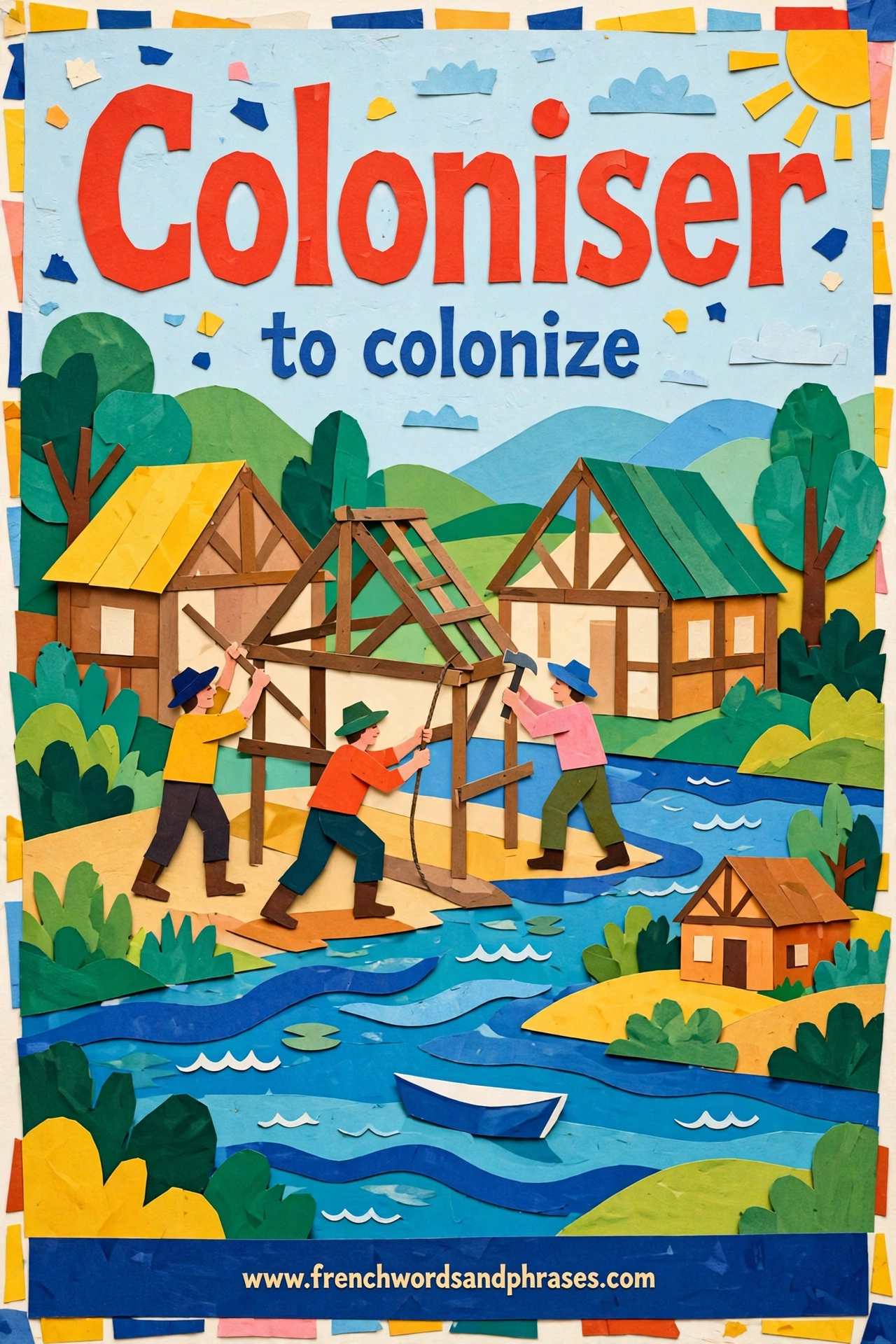
Coloniser means to colonize — to settle a place and take root there, as empires, settlers, ants and ideas all do.
Ships unloading settlers on a distant shore, ants pouring into a kitchen crack, engineers sketching domes for Mars — coloniser is the verb of arriving somewhere and staying: planting a flag, a nest or a colony, and calling the place home.
In this guide, you’ll learn how to conjugate coloniser in all the major French tenses and moods. Explore complete conjugation tables, French examples, English translations, and practice quizzes.
Understanding the French Verb Coloniser
Coloniser is a regular French verb belonging to the first group of verbs, those ending in-er.
It means to colonize. It is used in history for the settlement of territories by foreign powers, in biology for species spreading into a new habitat, and in futurology for the settlement of the Moon and Mars. The tone shifts with the subject: solemn for empires, neutral for microbes, wry for the ants on your terrace.
Verb classification: First group (-er)
Auxiliary verb: Avoir
Past participle: colonisé
Present participle: colonisant
English equivalents: To colonize, to settle; coloniser un territoire — to colonize a territory; coloniser une planète — to settle a planet; coloniser un milieu (biology) — to colonize a habitat; les colons — the settlers; une colonie — a colony.
One important detail: coloniser is perfectly regular, and its interest is its range. Historically it is the verb of empires — coloniser un territoire, with les colons, the settlers, and la colonisation as its heavy nouns; modern French also uses its opposite, décoloniser, to decolonize. But the verb has quietly escaped into biology and everyday life: bacteria, ants and algae colonisent a pond, a terrace, a kitchen — and science fiction has sent it to space: coloniser Mars. Learn the historical sense first, then enjoy the ants.
Experience the Word
Coloniser is the verb of the foothold that becomes a home — arrive, settle, multiply, and one day the map has changed.
Imagine the first morning after the ships land. Tents become huts, huts become a street, the street gets a name in a language the valley has never heard. In a single season, les colons ont colonisé la vallée — and nothing there will ever be quite as it was.
They came to stay a winter. They colonized — colonisé — and the winter never ended.
How to Conjugate Coloniser: Complete French Conjugation Guide
Let’s explore every major conjugation of coloniser, beginning with the indicative mood.
How to Conjugate Coloniser in the Indicative Mood
The indicative mood is used to express facts, observations, actions, and events.
How to Conjugate Coloniser in the Present Tense (Présent)
Used for actions happening now, habitual actions, and general truths.
| Subject | Conjugation |
|---|---|
| je | colonise |
| tu | colonises |
| il / elle | colonise |
| nous | colonisons |
| vous | colonisez |
| ils / elles | colonisent |
Example
Les fourmis colonisent le moindre recoin du jardin.
The ants are colonizing every corner of the garden.
Quick Quiz 1
Complete the sentence:
Nous ______ ce nouvel espace pas à pas.
Reveal the answer
colonisons
Nous colonisons ce nouvel espace pas à pas.
We are colonizing this new space step by step.
How to Conjugate Coloniser in the Passé Composé
Used for completed actions in the past. Coloniser takes the auxiliary verb avoir.
| Subject | Conjugation |
|---|---|
| j’ | ai colonisé |
| tu | as colonisé |
| il / elle | a colonisé |
| nous | avons colonisé |
| vous | avez colonisé |
| ils / elles | ont colonisé |
Example
Les Phéniciens ont colonisé les côtes de la Méditerranée.
The Phoenicians colonized the Mediterranean coasts.
How to Conjugate Coloniser in the Imparfait (Imperfect Tense)
Used for habitual past actions, descriptions, and ongoing situations in the past.
| Subject | Conjugation |
|---|---|
| je | colonisais |
| tu | colonisais |
| il / elle | colonisait |
| nous | colonisions |
| vous | colonisiez |
| ils / elles | colonisaient |
Example
Au XIXe siècle, les puissances européennes colonisaient l’Afrique.
In the nineteenth century, the European powers were colonizing Africa.
Quick Quiz 2
Choose the correct form:
The Phoenicians colonized the coasts.
Les Phéniciens ______ les côtes. (ont colonisé / sont colonisés)
Reveal the answer
ont colonisé
Les Phéniciens ont colonisé les côtes.
Coloniser takes avoir.
How to Conjugate Coloniser in the Plus-que-parfait
Used to describe an action that had already been completed before another past event.
| Subject | Conjugation |
|---|---|
| j’ | avais colonisé |
| tu | avais colonisé |
| il / elle | avait colonisé |
| nous | avions colonisé |
| vous | aviez colonisé |
| ils / elles | avaient colonisé |
Example
Ils avaient colonisé l’île bien avant l’arrivée des cartes.
They had colonized the island long before the maps arrived.
How to Conjugate Coloniser in the Passé Simple
Primarily used in formal writing, literature, and historical narratives. It is rarely used in everyday conversation.
| Subject | Conjugation |
|---|---|
| je | colonisai |
| tu | colonisas |
| il / elle | colonisa |
| nous | colonisâmes |
| vous | colonisâtes |
| ils / elles | colonisèrent |
Example
Les Vikings colonisèrent l’Islande au IXe siècle.
The Vikings colonized Iceland in the ninth century.
How to Conjugate Coloniser in the Passé Antérieur
A literary tense used to express an action completed immediately before another past action, generally in the passé simple.
| Subject | Conjugation |
|---|---|
| j’ | eus colonisé |
| tu | eus colonisé |
| il / elle | eut colonisé |
| nous | eûmes colonisé |
| vous | eûtes colonisé |
| ils / elles | eurent colonisé |
Example
Quand les colons eurent colonisé la vallée, ils fondèrent un village.
When the settlers had colonized the valley, they founded a village.
How to Conjugate Coloniser in the Future Tense (Futur Simple)
Used to describe actions that will take place in the future.
| Subject | Conjugation |
|---|---|
| je | coloniserai |
| tu | coloniseras |
| il / elle | colonisera |
| nous | coloniserons |
| vous | coloniserez |
| ils / elles | coloniseront |
Example
Un jour, les humains coloniseront peut-être Mars.
One day, humans may colonize Mars.
How to Conjugate Coloniser in the Futur Antérieur (Future Perfect)
Used for an action that will have been completed before a particular point in the future.
| Subject | Conjugation |
|---|---|
| j’ | aurai colonisé |
| tu | auras colonisé |
| il / elle | aura colonisé |
| nous | aurons colonisé |
| vous | aurez colonisé |
| ils / elles | auront colonisé |
Example
Dans cent ans, l’humanité aura colonisé Mars, disent les optimistes.
In a hundred years, humanity will have colonized Mars, say the optimists.
How to Conjugate Coloniser in the Near Future (Futur Proche)
Used to describe something that is going to happen soon. Formed with aller + infinitive.
| Subject | Conjugation |
|---|---|
| je | vais coloniser |
| tu | vas coloniser |
| il / elle | va coloniser |
| nous | allons coloniser |
| vous | allez coloniser |
| ils / elles | vont coloniser |
Example
Ces algues vont coloniser tout l’étang.
These algae are going to colonize the whole pond.
How to Conjugate Coloniser in the Conditional Mood
The conditional mood expresses what would happen under certain circumstances. It is also frequently used to make polite requests or express wishes.
How to Conjugate Coloniser in the Present Conditional
| Subject | Conjugation |
|---|---|
| je | coloniserais |
| tu | coloniserais |
| il / elle | coloniserait |
| nous | coloniserions |
| vous | coloniseriez |
| ils / elles | coloniseraient |
Example
Avec plus d’eau, les plantes coloniseraient ce désert.
With more water, the plants would colonize this desert.
How to Conjugate Coloniser in the Past Conditional
| Subject | Conjugation |
|---|---|
| j’ | aurais colonisé |
| tu | aurais colonisé |
| il / elle | aurait colonisé |
| nous | aurions colonisé |
| vous | auriez colonisé |
| ils / elles | auraient colonisé |
Example
Ils auraient colonisé la vallée sans la résistance des habitants.
They would have colonized the valley without the inhabitants’ resistance.
Coloniser in the Literary Past Conditional Form
This less common literary form uses the imperfect subjunctive of avoir.
| Subject | Conjugation |
|---|---|
| j’ | eusse colonisé |
| tu | eusses colonisé |
| il / elle | eût colonisé |
| nous | eussions colonisé |
| vous | eussiez colonisé |
| ils / elles | eussent colonisé |
Example
Les moines eussent colonisé ces terres marécageuses sans la peste.
The monks would have colonized these marshy lands without the plague.
How to Conjugate Coloniser in the Subjunctive Mood
The subjunctive is used to express wishes, emotions, doubts, necessity, and uncertainty. It frequently follows expressions such as il faut que (it is necessary that) or bien que (although).
How to Conjugate Coloniser in the Present Subjunctive
| Subject | Conjugation |
|---|---|
| que je | colonise |
| que tu | colonises |
| qu’il / qu’elle | colonise |
| que nous | colonisions |
| que vous | colonisiez |
| qu’ils / qu’elles | colonisent |
Example
Il est possible que ces insectes colonisent tout le grenier.
It is possible these insects will colonize the whole attic.
Quick Quiz 3
Complete the sentence using the subjunctive:
Il est possible que les algues ______ tout l’étang.
Reveal the answer
colonisent
Il est possible que les algues colonisent tout l’étang.
It is possible the algae will colonize the whole pond.
How to Conjugate Coloniser in the Imperfect Subjunctive
A literary tense, rarely encountered in modern spoken French.
| Subject | Conjugation |
|---|---|
| que je | colonisasse |
| que tu | colonisasses |
| qu’il / qu’elle | colonisât |
| que nous | colonisassions |
| que vous | colonisassiez |
| qu’ils / qu’elles | colonisassent |
Example
On ne pensait pas que les colons colonisassent l’île si vite.
Nobody thought the settlers would colonize the island so quickly.
How to Conjugate Coloniser in the Pluperfect Subjunctive
A literary construction used to express an action completed before another past action.
| Subject | Conjugation |
|---|---|
| que j’ | eusse colonisé |
| que tu | eusses colonisé |
| qu’il / qu’elle | eût colonisé |
| que nous | eussions colonisé |
| que vous | eussiez colonisé |
| qu’ils / qu’elles | eussent colonisé |
Example
Les sagas racontent que les Vikings eussent colonisé l’Islande dès le IXe siècle.
The sagas tell that the Vikings had colonized Iceland as early as the ninth century.
How to Conjugate Coloniser in the Past Subjunctive
| Subject | Conjugation |
|---|---|
| que j’ | aie colonisé |
| que tu | aies colonisé |
| qu’il / qu’elle | ait colonisé |
| que nous | ayons colonisé |
| que vous | ayez colonisé |
| qu’ils / qu’elles | aient colonisé |
Example
Je regrette que les Européens aient colonisé ces terres par la force.
I regret that the Europeans colonized these lands by force.
How to Conjugate Coloniser in the Imperative
The imperative is used to give commands, instructions, invitations, or suggestions. Subject pronouns are omitted.
How to Conjugate Coloniser in the Present Imperative
| Person | Conjugation |
|---|---|
| (tu) | colonise |
| (nous) | colonisons |
| (vous) | colonisez |
Example
Colonisez la Lune si vous voulez, mais laissez ce jardin aux abeilles !
Colonize the Moon if you like, but leave this garden to the bees!
Quick Quiz 4
How would you say Do not colonize my garden (tu form), said to the ants?
Reveal the answer
Ne colonise pas mon jardin !
French Participles of Coloniser
Participles are verb forms that can be used in compound tenses and other grammatical constructions.
Present Participle of Coloniser
colonisant
En colonisant l’île, les marins y ont introduit des rats.
By colonizing the island, the sailors introduced rats there.
Past Participle of Coloniser
colonisé
Colonisée par les fourmis, la terrasse est devenue impraticable.
Colonized by ants, the terrace has become unusable.
Coloniser in Everyday French: Real-Life Examples
Now that you know the conjugations, let’s see how coloniser appears in everyday French.
Example 1 — Present
Les fourmis colonisent la terrasse.
The ants are colonizing the terrace.
Example 2 — Passé composé
Les Vikings ont colonisé l’Islande.
The Vikings colonized Iceland.
Example 3 — Imparfait
Les puissances européennes colonisaient l’Afrique.
The European powers were colonizing Africa.
Example 4 — Future
Les humains coloniseront peut-être Mars.
Humans may colonize Mars.
Example 5 — Conditional
Les plantes coloniseraient ce désert avec plus d’eau.
The plants would colonize this desert with more water.
Example 6 — Imperative
Ne colonisez pas mon jardin, les fourmis !
Do not colonize my garden, ants!
Beyond Translation: The Meaning of Coloniser
Coloniser grows from un colon, a settler, and behind that the Latin colonus, a farmer — the original colonist was simply the man who tilled new land.
The verb has travelled as far as its settlers.
From imperial history it passed to the laboratory (une colonie de bactéries), to the summer camp (une colonie de vacances), and finally to the space agencies: wherever French needs a word for settling in and multiplying, coloniser is already there, unpacking.
How to Remember the French Verb Coloniser
Remember it this way: Coloniser is about ships, ants and spaceships — whatever arrives and stays.
- Un colon is a settler, une colonie a colony — and a summer camp: une colonie de vacances.
- Three ranges: empires (un territoire), biology (un milieu), space (Mars).
- Regular -er: je colonise, nous colonisons, past participle colonisé.
The key idea is ships, ants and spaceships — whatever arrives and stays.
Test Your Knowledge of Coloniser
Let’s see how much you’ve learned. Try answering these questions before revealing the answers.
Question 1
What is a colon, in the family of coloniser?
Reveal the answer
A settler — the person who settles a colony; une colonie is the colony itself (and also a summer camp).
Question 2
How do you say The ants are colonizing the terrace in French?
Reveal the answer
Les fourmis colonisent la terrasse.
Question 3
Translate: The Vikings colonized Iceland.
Reveal the answer
Les Vikings ont colonisé l’Islande.
Question 4
What is the past participle of coloniser?
Reveal the answer
Colonisé.
Question 5
Complete the sentence:
Il est possible que ces insectes ______ tout le grenier.
Reveal the answer
colonisent
Il est possible que ces insectes colonisent tout le grenier.
It is possible these insects will colonize the whole attic.
Your Final Challenge
Can You Use It?
How would you say this in French?
The ants colonized the terrace in a week, and we now have lunch indoors.
Reveal the answer
Les fourmis ont colonisé la terrasse en une semaine, et nous déjeunons désormais à l’intérieur.
The ants colonized the terrace in a week, and we now have lunch indoors.
A little French. A little curiosity. A richer everyday life.
LEARN FRENCH ONE WORD AT A TIME