A French Word to Live By
How to Conjugate Bouffer in French
/bu.fe/
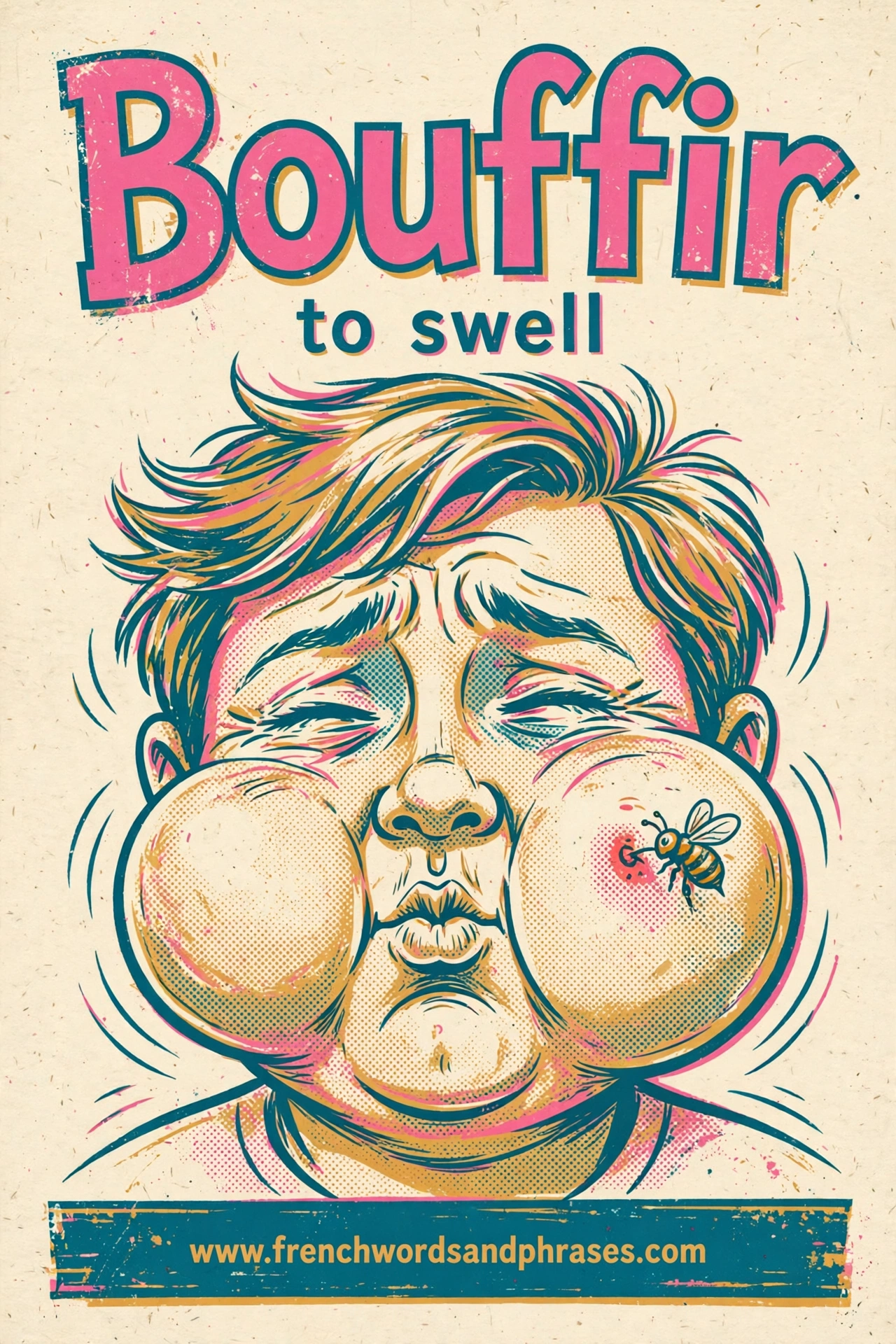
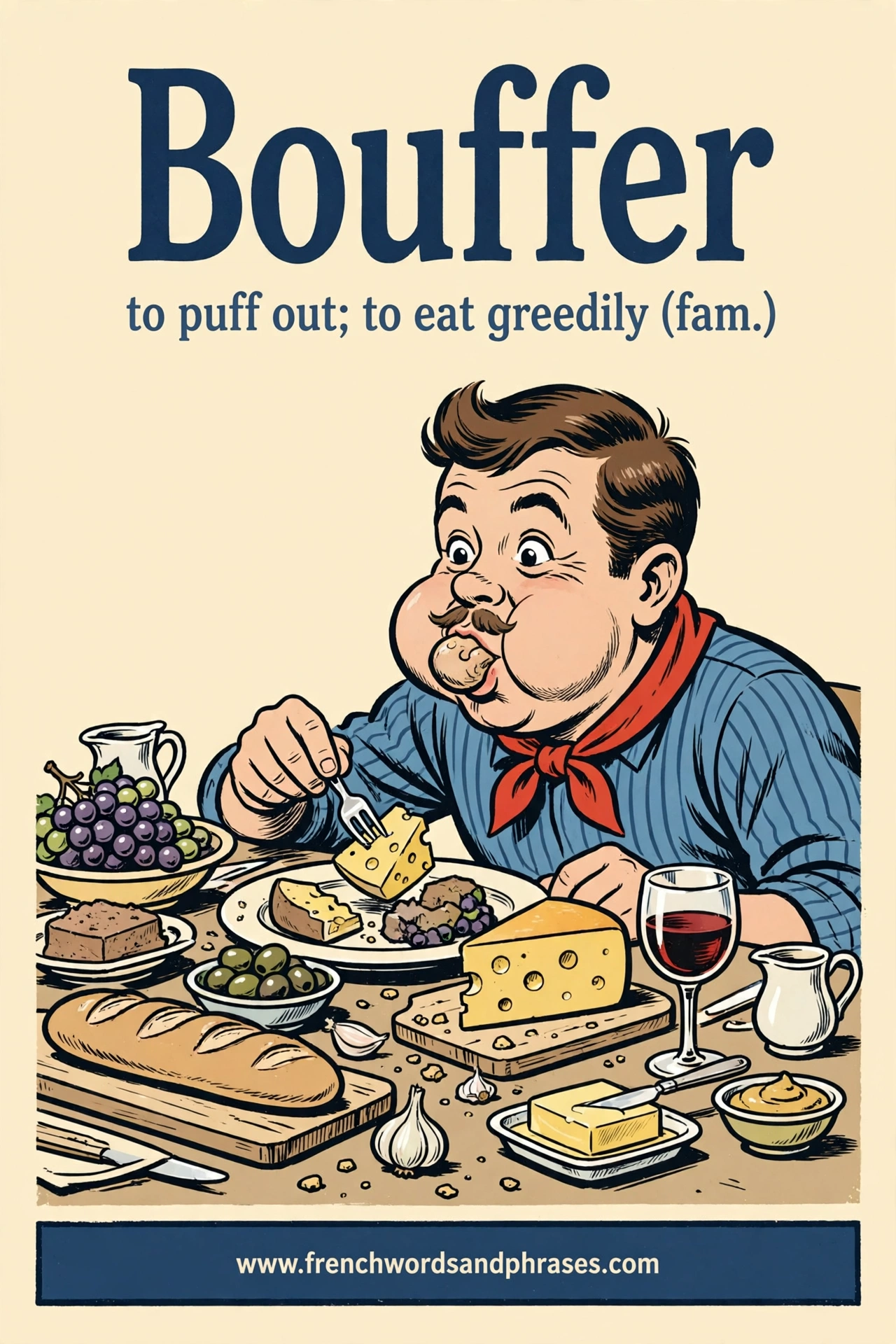
Bouffer means to puff out — and, in familiar French, to scoff food down greedily, the way hungry teenagers empty a plate.
A cat inhaling its dinner, schoolboys falling on a pile of chips, cheeks blown out like a trumpeter’s — bouffer is the familiar verb of greedy eating, born from the puffed-out cheeks of someone with a mouth too full.
In this guide, you’ll learn how to conjugate bouffer in all the major French tenses and moods. Explore complete conjugation tables, French examples, English translations, and practice quizzes.
Understanding the French Verb Bouffer
Bouffer is a regular French verb belonging to the first group of verbs, those ending in-er.
It means to puff out; to eat greedily (fam.). Between friends it is warm and funny rather than rude — tu as bien bouffé ? is an affectionate question — but it always suggests appetite without ceremony: food eaten fast, gladly and in quantity.
Verb classification: First group (-er)
Auxiliary verb: Avoir
Past participle: bouffé
Present participle: bouffant
English equivalents: To puff out; (familiar) to scoff, to stuff oneself; bouffer des frites — to scoff chips; on bouffe à quelle heure ? — when do we eat?; la bouffe — grub, food (familiar); bouffer du lion — to be bursting with energy (familiar); des manches qui bouffent — sleeves that puff out.
Register first: bouffer is familiar French — the word of playgrounds, barracks and family kitchens, not of formal dinners, where manger and dîner rule. Its literal sense explains the slang: to bouffer is first to puff out — les joues bouffent, the cheeks swell — and the eater with puffed cheeks gave the verb its second life. The noun la bouffe is the everyday slang for food itself. The verb is a regular -er: je bouffe, nous bouffons, ils bouffent.
Experience the Word
Bouffer is the verb of the full mouth — cheeks puffed, plate emptying, no time for conversation.
Imagine a school canteen at twelve-fifteen. Thirty collégiens land on their trays like a flight of sparrows: the chips vanish, the bread vanishes, someone trades a yoghurt for a second helping — ils bouffent, laughing with their mouths full, and by twelve-thirty every plate is clean.
No ceremony, no leftovers. They have bouffé — scoffed — like only the truly hungry can.
How to Conjugate Bouffer: Complete French Conjugation Guide
Let’s explore every major conjugation of bouffer, beginning with the indicative mood.
How to Conjugate Bouffer in the Indicative Mood
The indicative mood is used to express facts, observations, actions, and events.
How to Conjugate Bouffer in the Present Tense (Présent)
Used for actions happening now, habitual actions, and general truths.
| Subject | Conjugation |
|---|---|
| je | bouffe |
| tu | bouffes |
| il / elle | bouffe |
| nous | bouffons |
| vous | bouffez |
| ils / elles | bouffent |
Example
Les ados bouffent des frites à la cantine.
The teenagers are scoffing chips in the canteen.
Quick Quiz 1
Complete the sentence:
Nous ______ toujours bien chez mamie.
Reveal the answer
bouffons
Nous bouffons toujours bien chez mamie.
We always eat well at granny’s.
How to Conjugate Bouffer in the Passé Composé
Used for completed actions in the past. Bouffer takes the auxiliary verb avoir.
| Subject | Conjugation |
|---|---|
| j’ | ai bouffé |
| tu | as bouffé |
| il / elle | a bouffé |
| nous | avons bouffé |
| vous | avez bouffé |
| ils / elles | ont bouffé |
Example
Le chat a bouffé toute sa pâtée en deux minutes.
The cat scoffed all its food in two minutes.
How to Conjugate Bouffer in the Imparfait (Imperfect Tense)
Used for habitual past actions, descriptions, and ongoing situations in the past.
| Subject | Conjugation |
|---|---|
| je | bouffais |
| tu | bouffais |
| il / elle | bouffait |
| nous | bouffions |
| vous | bouffiez |
| ils / elles | bouffaient |
Example
À l’internat, on bouffait ce qu’on nous donnait.
At boarding school, we used to eat whatever we were given.
Quick Quiz 2
Choose the correct form:
The cat scoffed all its food.
Le chat ______ toute sa pâtée. (a bouffé / est bouffé)
Reveal the answer
a bouffé
Le chat a bouffé toute sa pâtée.
Bouffer takes avoir.
How to Conjugate Bouffer in the Plus-que-parfait
Used to describe an action that had already been completed before another past event.
| Subject | Conjugation |
|---|---|
| j’ | avais bouffé |
| tu | avais bouffé |
| il / elle | avait bouffé |
| nous | avions bouffé |
| vous | aviez bouffé |
| ils / elles | avaient bouffé |
Example
Ils avaient bouffé avant même que les parents arrivent.
They had scoffed everything before the parents even arrived.
How to Conjugate Bouffer in the Passé Simple
Primarily used in formal writing, literature, and historical narratives. It is rarely used in everyday conversation.
| Subject | Conjugation |
|---|---|
| je | bouffai |
| tu | bouffas |
| il / elle | bouffa |
| nous | bouffâmes |
| vous | bouffâtes |
| ils / elles | bouffèrent |
Example
Le chien bouffa sa gamelle et réclama la suite.
The dog wolfed down its bowl and demanded more.
How to Conjugate Bouffer in the Passé Antérieur
A literary tense used to express an action completed immediately before another past action, generally in the passé simple.
| Subject | Conjugation |
|---|---|
| j’ | eus bouffé |
| tu | eus bouffé |
| il / elle | eut bouffé |
| nous | eûmes bouffé |
| vous | eûtes bouffé |
| ils / elles | eurent bouffé |
Example
Quand ils eurent bouffé, ils s’endormirent sur l’herbe.
When they had eaten their fill, they fell asleep on the grass.
How to Conjugate Bouffer in the Future Tense (Futur Simple)
Used to describe actions that will take place in the future.
| Subject | Conjugation |
|---|---|
| je | boufferai |
| tu | boufferas |
| il / elle | bouffera |
| nous | boufferons |
| vous | boufferez |
| ils / elles | boufferont |
Example
Ce soir, on bouffera chez mamie comme des rois.
Tonight, we will eat at granny’s like kings.
How to Conjugate Bouffer in the Futur Antérieur (Future Perfect)
Used for an action that will have been completed before a particular point in the future.
| Subject | Conjugation |
|---|---|
| j’ | aurai bouffé |
| tu | auras bouffé |
| il / elle | aura bouffé |
| nous | aurons bouffé |
| vous | aurez bouffé |
| ils / elles | auront bouffé |
Example
À huit heures, les enfants auront bouffé et seront au lit.
By eight o’clock, the children will have eaten and be in bed.
How to Conjugate Bouffer in the Near Future (Futur Proche)
Used to describe something that is going to happen soon. Formed with aller + infinitive.
| Subject | Conjugation |
|---|---|
| je | vais bouffer |
| tu | vas bouffer |
| il / elle | va bouffer |
| nous | allons bouffer |
| vous | allez bouffer |
| ils / elles | vont bouffer |
Example
Pose les plats, tout le monde va bouffer.
Put the dishes down, everyone is going to tuck in.
How to Conjugate Bouffer in the Conditional Mood
The conditional mood expresses what would happen under certain circumstances. It is also frequently used to make polite requests or express wishes.
How to Conjugate Bouffer in the Present Conditional
| Subject | Conjugation |
|---|---|
| je | boufferais |
| tu | boufferais |
| il / elle | boufferait |
| nous | boufferions |
| vous | boufferiez |
| ils / elles | boufferaient |
Example
Sans ce goûter, ils boufferaient encore plus ce soir.
Without that snack, they would eat even more tonight.
How to Conjugate Bouffer in the Past Conditional
| Subject | Conjugation |
|---|---|
| j’ | aurais bouffé |
| tu | aurais bouffé |
| il / elle | aurait bouffé |
| nous | aurions bouffé |
| vous | auriez bouffé |
| ils / elles | auraient bouffé |
Example
Il aurait bouffé deux assiettes s’il avait eu le temps.
He would have scoffed two platefuls if he had had the time.
Bouffer in the Literary Past Conditional Form
This less common literary form uses the imperfect subjunctive of avoir.
| Subject | Conjugation |
|---|---|
| j’ | eusse bouffé |
| tu | eusses bouffé |
| il / elle | eût bouffé |
| nous | eussions bouffé |
| vous | eussiez bouffé |
| ils / elles | eussent bouffé |
Example
Le chien eût bouffé sa gamelle en un instant.
The dog would have wolfed down its bowl in an instant.
How to Conjugate Bouffer in the Subjunctive Mood
The subjunctive is used to express wishes, emotions, doubts, necessity, and uncertainty. It frequently follows expressions such as il faut que (it is necessary that) or bien que (although).
How to Conjugate Bouffer in the Present Subjunctive
| Subject | Conjugation |
|---|---|
| que je | bouffe |
| que tu | bouffes |
| qu’il / qu’elle | bouffe |
| que nous | bouffions |
| que vous | bouffiez |
| qu’ils / qu’elles | bouffent |
Example
Il faut que les enfants bouffent avant le départ.
The children must eat before we leave.
Quick Quiz 3
Complete the sentence using the subjunctive:
Il faut que vous ______ avant le départ.
Reveal the answer
bouffiez
Il faut que vous bouffiez avant le départ.
You must eat before we leave.
How to Conjugate Bouffer in the Imperfect Subjunctive
A literary tense, rarely encountered in modern spoken French.
| Subject | Conjugation |
|---|---|
| que je | bouffasse |
| que tu | bouffasses |
| qu’il / qu’elle | bouffât |
| que nous | bouffassions |
| que vous | bouffassiez |
| qu’ils / qu’elles | bouffassent |
Example
On s’étonnait qu’il bouffât si vite sans mâcher.
People were surprised he ate so fast without chewing.
How to Conjugate Bouffer in the Pluperfect Subjunctive
A literary construction used to express an action completed before another past action.
| Subject | Conjugation |
|---|---|
| que j’ | eusse bouffé |
| que tu | eusses bouffé |
| qu’il / qu’elle | eût bouffé |
| que nous | eussions bouffé |
| que vous | eussiez bouffé |
| qu’ils / qu’elles | eussent bouffé |
Example
On disait qu’ils eussent bouffé tout le buffet avant la fête.
People said they had scoffed the whole buffet before the party.
How to Conjugate Bouffer in the Past Subjunctive
| Subject | Conjugation |
|---|---|
| que j’ | aie bouffé |
| que tu | aies bouffé |
| qu’il / qu’elle | ait bouffé |
| que nous | ayons bouffé |
| que vous | ayez bouffé |
| qu’ils / qu’elles | aient bouffé |
Example
Je suis content que vous ayez bien bouffé.
I am glad you ate well.
How to Conjugate Bouffer in the Imperative
The imperative is used to give commands, instructions, invitations, or suggestions. Subject pronouns are omitted.
How to Conjugate Bouffer in the Present Imperative
| Person | Conjugation |
|---|---|
| (tu) | bouffe |
| (nous) | bouffons |
| (vous) | bouffez |
Example
Bouffe tant qu’il en reste, après il sera trop tard !
Eat while there is some left, afterwards it will be too late!
Quick Quiz 4
How would you say Eat while there is some left (tu form)?
Reveal the answer
Bouffe tant qu’il en reste !
French Participles of Bouffer
Participles are verb forms that can be used in compound tenses and other grammatical constructions.
Present Participle of Bouffer
bouffant
En bouffant trop vite, il s’est étranglé avec une frite.
By eating too fast, he choked on a chip.
Past Participle of Bouffer
bouffé
Bouffées par le vent, les manches de sa robe ressemblaient à des ballons.
Puffed out by the wind, her dress sleeves looked like balloons.
Bouffer in Everyday French: Real-Life Examples
Now that you know the conjugations, let’s see how bouffer appears in everyday French.
Example 1 — Present
Les ados bouffent des frites à la cantine.
The teenagers are scoffing chips in the canteen.
Example 2 — Passé composé
Le chat a bouffé toute sa pâtée en deux minutes.
The cat scoffed all its food in two minutes.
Example 3 — Imparfait
À l’internat, on bouffait ce qu’on nous donnait.
At boarding school, we used to eat whatever we were given.
Example 4 — Future
Ce soir, on bouffera chez mamie comme des rois.
Tonight, we will eat at granny’s like kings.
Example 5 — Conditional
Il boufferait deux assiettes s’il avait le temps.
He would scoff two platefuls if he had the time.
Example 6 — Imperative
Bouffe tant qu’il en reste !
Eat while there is some left!
Beyond Translation: The Meaning of Bouffer
The puff came first: bouffer begins with cheeks and sleeves that swell — des manches bouffantes are still the puffed sleeves of fashion — and the greedy eater inherited the word from his own cheeks.
Its noun runs French daily life.
La bouffe is what students cook, what soldiers queue for and what families argue about at seven o’clock: qu’est-ce qu’on bouffe ce soir ? — what’s for dinner tonight, in the language of real kitchens.
How to Remember the French Verb Bouffer
Remember it this way: Bouffer is about cheeks puffed out, plate emptied in minutes.
- Familiar register: bouffer is the slang twin of manger — save it for friends, family and cats.
- Picture the puffed cheeks of the fast eater: that puff is the verb’s first sense.
- Regular -er: je bouffe, nous bouffons, past participle bouffé; the noun is la bouffe, grub.
The key idea is cheeks puffed out, plate emptied in minutes.
Test Your Knowledge of Bouffer
Let’s see how much you’ve learned. Try answering these questions before revealing the answers.
Question 1
What register is bouffer, and when should you avoid it?
Reveal the answer
Familiar/slang — perfect with friends and family, but at a formal dinner say manger or dîner.
Question 2
How do you say The teenagers are scoffing chips in French?
Reveal the answer
Les ados bouffent des frites.
Question 3
Translate: The cat scoffed all its food in two minutes.
Reveal the answer
Le chat a bouffé toute sa pâtée en deux minutes.
Question 4
What is the past participle of bouffer?
Reveal the answer
Bouffé.
Question 5
Complete the sentence:
Il faut que les enfants ______ avant le départ.
Reveal the answer
bouffent
Il faut que les enfants bouffent avant le départ.
The children must eat before we leave.
Your Final Challenge
Can You Use It?
How would you say this in French?
After the match, they eat like lions and retell every goal with their mouths full.
Reveal the answer
Après le match, ils bouffent comme des lions et racontent chaque but la bouche pleine.
After the match, they eat like lions and retell every goal with their mouths full.
A little French. A little curiosity. A richer everyday life.
LEARN FRENCH ONE WORD AT A TIME