A French Word to Live By
How to Conjugate Se boucher in French
/sə bu.ʃe/
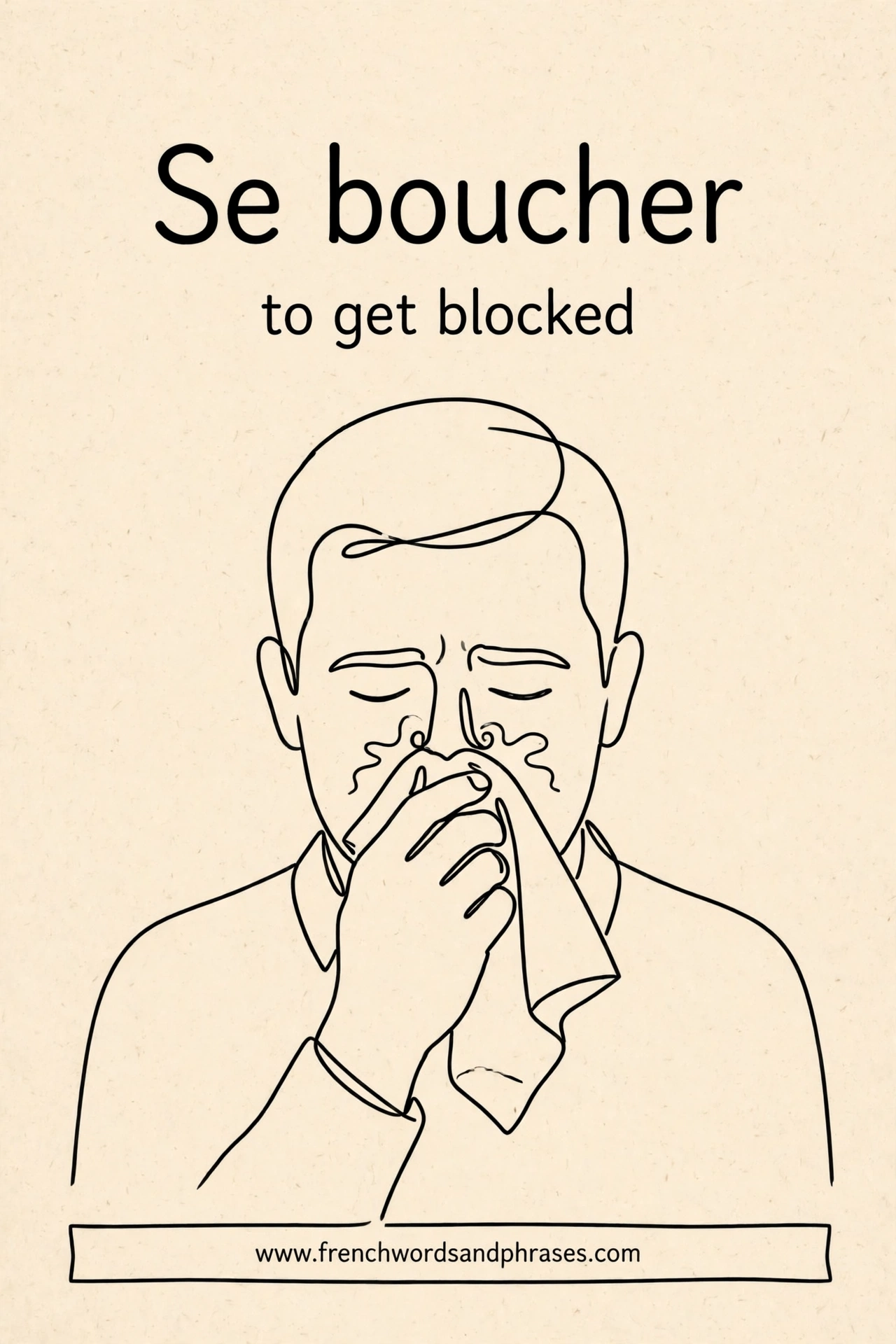
Se boucher means to get blocked — ears, noses and drains closing up on their own, until nothing can pass.
Ears that pop shut in a plane, a nose that closes on the first night of a cold, a sink that suddenly refuses to empty — se boucher is what passages do when they block themselves: the opening closes, and everything behind it waits.
In this guide, you’ll learn how to conjugate se boucher in all the major French tenses and moods. Explore complete conjugation tables, French examples, English translations, and practice quizzes.
Understanding the French Verb Se boucher
Se boucher is a regular French verb belonging to the first group of verbs, those ending in-er.
It means to get blocked. It is the standard verb for blocked ears in planes and pools, blocked noses in colds, and blocked sinks and drains at home — and with les oreilles or le nez as its object, it describes the deliberate gesture of shutting out a noise or a smell.
Verb classification: First group (-er), reflexive
Auxiliary verb: Être
Past participle: bouché
Present participle: bouchant
English equivalents: To get blocked, to block up; le nez se bouche — my nose is blocked; les oreilles se bouchent — ears pop/block; l’évier se bouche — the sink gets blocked; se boucher les oreilles — to plug one’s ears (with one’s fingers); se boucher le nez — to hold one’s nose.
One important detail: se boucher covers two scenes. When a passage closes by itself, the thing is the subject and the participle agrees with it: les canalisations se sont bouchées, mon nez s’est bouché. But when a person plugs their own ears or nose, the body part follows the verb and the participle does NOT agree: elle s’est bouché les oreilles — no extra e, because les oreilles comes after. Being reflexive, it always takes être: je me bouche, tu te bouches, nous nous bouchons.
Experience the Word
Se boucher is the verb of passages closing themselves — the door of the ear, the nose or the drain swinging silently shut.
Imagine the descent into Marseille on a winter flight. The baby in the next row starts to cry, an old man yawns and rubs his jaw, and your own world goes muffled and far away: vos oreilles se bouchent, and every sound arrives as if through cotton wool.
Nothing is broken, nothing hurts for long. Your ears have simply blocked — bouchées — and one good yawn will set them free.
How to Conjugate Se boucher: Complete French Conjugation Guide
Let’s explore every major conjugation of se boucher, beginning with the indicative mood.
How to Conjugate Se boucher in the Indicative Mood
The indicative mood is used to express facts, observations, actions, and events.
How to Conjugate Se boucher in the Present Tense (Présent)
Used for actions happening now, habitual actions, and general truths.
| Subject | Conjugation |
|---|---|
| je | me bouche |
| tu | te bouches |
| il / elle | se bouche |
| nous | nous bouchons |
| vous | vous bouchez |
| ils / elles | se bouchent |
Example
Mon nez se bouche dès que je prends l’avion.
My nose blocks up as soon as I get on a plane.
Quick Quiz 1
Complete the sentence:
Nous nous ______ les oreilles quand le train freine.
Reveal the answer
bouchons
Nous nous bouchons les oreilles quand le train freine.
We plug our ears when the train brakes.
How to Conjugate Se boucher in the Passé Composé
Used for completed actions in the past. Se boucher takes the auxiliary verb être.
| Subject | Conjugation |
|---|---|
| je | me suis bouché / me suis bouchée |
| tu | t’es bouché / t’es bouchée |
| il / elle | s’est bouché / s’est bouchée |
| nous | nous sommes bouchés / nous sommes bouchées |
| vous | vous êtes bouchés / vous êtes bouchées / vous êtes bouché / vous êtes bouchée |
| ils / elles | se sont bouchés / se sont bouchées |
Example
L’évier s’est bouché pendant la nuit.
The sink got blocked during the night.
How to Conjugate Se boucher in the Imparfait (Imperfect Tense)
Used for habitual past actions, descriptions, and ongoing situations in the past.
| Subject | Conjugation |
|---|---|
| je | me bouchais |
| tu | te bouchais |
| il / elle | se bouchait |
| nous | nous bouchions |
| vous | vous bouchiez |
| ils / elles | se bouchaient |
Example
Ses oreilles se bouchaient à chaque plongée.
Her ears used to block up with every dive.
Quick Quiz 2
Choose the correct form:
The sink got blocked.
L’évier ______ pendant la nuit. (s’est bouché / a bouché)
Reveal the answer
s’est bouché
L’évier s’est bouché pendant la nuit.
Se boucher is reflexive and takes être.
How to Conjugate Se boucher in the Plus-que-parfait
Used to describe an action that had already been completed before another past event.
| Subject | Conjugation |
|---|---|
| je | m’étais bouché / m’étais bouchée |
| tu | t’étais bouché / t’étais bouchée |
| il / elle | s’était bouché / s’était bouchée |
| nous | nous étions bouchés / nous étions bouchées |
| vous | vous étiez bouchés / vous étiez bouchées / vous étiez bouché / vous étiez bouchée |
| ils / elles | s’étaient bouchés / s’étaient bouchées |
Example
Le tuyau s’était bouché bien avant notre arrivée.
The pipe had got blocked long before we arrived.
How to Conjugate Se boucher in the Passé Simple
Primarily used in formal writing, literature, and historical narratives. It is rarely used in everyday conversation.
| Subject | Conjugation |
|---|---|
| je | me bouchai |
| tu | te bouchas |
| il / elle | se boucha |
| nous | nous bouchâmes |
| vous | vous bouchâtes |
| ils / elles | se bouchèrent |
Example
Le canal se boucha en quelques heures.
The canal blocked up within a few hours.
How to Conjugate Se boucher in the Passé Antérieur
A literary tense used to express an action completed immediately before another past action, generally in the passé simple.
| Subject | Conjugation |
|---|---|
| je | me fus bouché / me fus bouchée |
| tu | te fus bouché / te fus bouchée |
| il / elle | se fut bouché / se fut bouchée |
| nous | nous fûmes bouchés / nous fûmes bouchées |
| vous | vous fûtes bouchés / vous fûtes bouchées / vous fûtes bouché / vous fûtes bouchée |
| ils / elles | se furent bouchés / se furent bouchées |
Example
Dès que le passage se fut bouché, les secours passèrent par les champs.
As soon as the way had become blocked, the rescuers went through the fields.
How to Conjugate Se boucher in the Future Tense (Futur Simple)
Used to describe actions that will take place in the future.
| Subject | Conjugation |
|---|---|
| je | me boucherai |
| tu | te boucheras |
| il / elle | se bouchera |
| nous | nous boucherons |
| vous | vous boucherez |
| ils / elles | se boucheront |
Example
Si tu verses la graisse dans l’évier, il se bouchera.
If you pour fat down the sink, it will get blocked.
How to Conjugate Se boucher in the Futur Antérieur (Future Perfect)
Used for an action that will have been completed before a particular point in the future.
| Subject | Conjugation |
|---|---|
| je | me serai bouché / me serai bouchée |
| tu | te seras bouché / te seras bouchée |
| il / elle | se sera bouché / se sera bouchée |
| nous | nous serons bouchés / nous serons bouchées |
| vous | vous serez bouchés / vous serez bouchées / vous serez bouché / vous serez bouchée |
| ils / elles | se seront bouchés / se seront bouchées |
Example
À ce rythme, la canalisation se sera bouchée avant l’hiver.
At this rate, the drain will have got blocked before winter.
How to Conjugate Se boucher in the Near Future (Futur Proche)
Used to describe something that is going to happen soon. Formed with aller + infinitive.
| Subject | Conjugation |
|---|---|
| je | vais me boucher |
| tu | vas te boucher |
| il / elle | va se boucher |
| nous | allons nous boucher |
| vous | allez vous boucher |
| ils / elles | vont se boucher |
Example
Attention, le tube va se boucher.
Careful, the tube is going to get blocked.
How to Conjugate Se boucher in the Conditional Mood
The conditional mood expresses what would happen under certain circumstances. It is also frequently used to make polite requests or express wishes.
How to Conjugate Se boucher in the Present Conditional
| Subject | Conjugation |
|---|---|
| je | me boucherais |
| tu | te boucherais |
| il / elle | se boucherait |
| nous | nous boucherions |
| vous | vous boucheriez |
| ils / elles | se boucheraient |
Example
Sans filtre, le robinet se boucherait en une semaine.
Without a filter, the tap would block up within a week.
How to Conjugate Se boucher in the Past Conditional
| Subject | Conjugation |
|---|---|
| je | me serais bouché / me serais bouchée |
| tu | te serais bouché / te serais bouchée |
| il / elle | se serait bouché / se serait bouchée |
| nous | nous serions bouchés / nous serions bouchées |
| vous | vous seriez bouchés / vous seriez bouchées / vous seriez bouché / vous seriez bouchée |
| ils / elles | se seraient bouchés / se seraient bouchées |
Example
Ton nez se serait bouché si tu avais dormi dans la poussière.
Your nose would have got blocked if you had slept in the dust.
Se boucher in the Literary Past Conditional Form
This less common literary form uses the imperfect subjunctive of être.
| Subject | Conjugation |
|---|---|
| je | me fusse bouché / me fusse bouchée |
| tu | te fusses bouché / te fusses bouchée |
| il / elle | se fût bouché / se fût bouchée |
| nous | nous fussions bouchés / nous fussions bouchées |
| vous | vous fussiez bouchés / vous fussiez bouchées / vous fussiez bouché / vous fussiez bouchée |
| ils / elles | se fussent bouchés / se fussent bouchées |
Example
Le canal se fût bouché sans l’entretien régulier.
The canal would have blocked up without regular maintenance.
How to Conjugate Se boucher in the Subjunctive Mood
The subjunctive is used to express wishes, emotions, doubts, necessity, and uncertainty. It frequently follows expressions such as il faut que (it is necessary that) or bien que (although).
How to Conjugate Se boucher in the Present Subjunctive
| Subject | Conjugation |
|---|---|
| que je | me bouche |
| que tu | te bouches |
| qu’il / qu’elle | se bouche |
| que nous | nous bouchions |
| que vous | vous bouchiez |
| qu’ils / qu’elles | se bouchent |
Example
Je crains que ton nez ne se bouche pendant le vol.
I am afraid your nose will get blocked during the flight.
Quick Quiz 3
Complete the sentence using the subjunctive:
Je crains que les canalisations ne se ______ cet hiver.
Reveal the answer
bouchent
Je crains que les canalisations ne se bouchent cet hiver.
I am afraid the drains will get blocked this winter.
How to Conjugate Se boucher in the Imperfect Subjunctive
A literary tense, rarely encountered in modern spoken French.
| Subject | Conjugation |
|---|---|
| que je | me bouchasse |
| que tu | te bouchasses |
| qu’il / qu’elle | se bouchât |
| que nous | nous bouchassions |
| que vous | vous bouchassiez |
| qu’ils / qu’elles | se bouchassent |
Example
Il fallait que rien ne se bouchât dans la vieille maison.
Nothing was allowed to get blocked in the old house.
How to Conjugate Se boucher in the Pluperfect Subjunctive
A literary construction used to express an action completed before another past action.
| Subject | Conjugation |
|---|---|
| que je | me fusse bouché / me fusse bouchée |
| tu | te fusses bouché / te fusses bouchée |
| qu’il / qu’elle | se fût bouché / se fût bouchée |
| que nous | nous fussions bouchés / nous fussions bouchées |
| que vous | vous fussiez bouchés / vous fussiez bouchées / vous fussiez bouché / vous fussiez bouchée |
| qu’ils / qu’elles | se fussent bouchés / se fussent bouchées |
Example
Elle pensait que le tuyau se fût bouché pendant son absence.
She thought the pipe had got blocked during her absence.
How to Conjugate Se boucher in the Past Subjunctive
| Subject | Conjugation |
|---|---|
| que je | me sois bouché / me sois bouchée |
| que tu | te sois bouché / te sois bouchée |
| qu’il / qu’elle | se soit bouché / se soit bouchée |
| que nous | nous soyons bouchés / nous soyons bouchées |
| que vous | vous soyez bouchés / vous soyez bouchées / vous soyez bouché / vous soyez bouchée |
| qu’ils / qu’elles | se soient bouchés / se soient bouchées |
Example
Je suis surpris que l’évier se soit bouché si vite.
I am surprised the sink got blocked so quickly.
How to Conjugate Se boucher in the Imperative
The imperative is used to give commands, instructions, invitations, or suggestions. Subject pronouns are omitted.
How to Conjugate Se boucher in the Present Imperative
| Person | Conjugation |
|---|---|
| (tu) | bouche-toi |
| (nous) | bouchons-nous |
| (vous) | bouchez-vous |
Example
Bouche-toi les oreilles, ça va faire du bruit !
Plug your ears, it is going to be loud!
Quick Quiz 4
How would you say Plug your ears (tu form)?
Reveal the answer
Bouche-toi les oreilles !
French Participles of Se boucher
Participles are verb forms that can be used in compound tenses and other grammatical constructions.
Present Participle of Se boucher
bouchant
En se bouchant les oreilles, elle a souri au milieu du vacarme.
Plugging her ears, she smiled in the middle of the racket.
Past Participle of Se boucher
bouché
Bouchée par les feuilles mortes, la gouttière débordait.
Blocked by dead leaves, the gutter was overflowing.
Se boucher in Everyday French: Real-Life Examples
Now that you know the conjugations, let’s see how se boucher appears in everyday French.
Example 1 — Present
Mon nez se bouche dès que je prends l’avion.
My nose blocks up as soon as I get on a plane.
Example 2 — Passé composé
L’évier s’est bouché pendant la nuit.
The sink got blocked during the night.
Example 3 — Imparfait
Ses oreilles se bouchaient à chaque plongée.
Her ears used to block up with every dive.
Example 4 — Future
Si tu verses la graisse dedans, il se bouchera.
If you pour fat in it, it will get blocked.
Example 5 — Conditional
Sans filtre, le robinet se boucherait en une semaine.
Without a filter, the tap would block up within a week.
Example 6 — Imperative
Bouche-toi les oreilles, ça va faire du bruit !
Plug your ears, it is going to be loud!
Beyond Translation: The Meaning of Se boucher
The plain verb boucher needs a plumber, a mason, a hand; se boucher needs nobody — the blockage happens all by itself, which is exactly why it is the verb of colds, flights and old plumbing.
And it gives you a gesture, too.
Se boucher les oreilles is the universal sign of refusal to listen, and se boucher le nez the sign of a smell nobody should have to endure — two small plugs that say everything.
How to Remember the French Verb Se boucher
Remember it this way: Se boucher is about ears and drains blocking themselves up.
- Always reflexive, always être: je me bouche, l’évier s’est bouché.
- Ears, noses and drains are its home: les oreilles se bouchent, le nez se bouche.
- With a body part after it, no agreement: elle s’est bouché les oreilles.
The key idea is ears and drains blocking themselves up.
Test Your Knowledge of Se boucher
Let’s see how much you’ve learned. Try answering these questions before revealing the answers.
Question 1
Which auxiliary does se boucher use, and why?
Reveal the answer
Être — it is a reflexive verb: l’évier s’est bouché pendant la nuit.
Question 2
How do you say The sink got blocked in French?
Reveal the answer
L’évier s’est bouché.
Question 3
Translate: Her ears used to block up with every dive.
Reveal the answer
Ses oreilles se bouchaient à chaque plongée.
Question 4
What is the past participle of se boucher?
Reveal the answer
Bouché — agreeing with the subject: bouchée, bouchés, bouchées.
Question 5
Complete the sentence:
Je crains que ton nez ne se ______ pendant le vol.
Reveal the answer
bouche
Je crains que ton nez ne se bouche pendant le vol.
I am afraid your nose will get blocked during the flight.
Your Final Challenge
Can You Use It?
How would you say this in French?
As soon as the plane descends, my ears block up and the world turns to cotton wool.
Reveal the answer
Dès que l’avion descend, mes oreilles se bouchent et le monde devient tout cotonneux.
As soon as the plane descends, my ears block up and the world turns to cotton wool.
A little French. A little curiosity. A richer everyday life.
LEARN FRENCH ONE WORD AT A TIME