A French Word to Live By
How to Conjugate Boucher in French
/bu.ʃe/
Boucher means to stop up — to plug a hole, cork a bottle, fill a gap or block a passage so that nothing gets through.
A cork pushed into a bottle, a hand of cement pressed into a crack, a van parked so it hides the whole street — boucher is the verb of blocking: wherever something open needs closing, French reaches for boucher.
In this guide, you’ll learn how to conjugate boucher in all the major French tenses and moods. Explore complete conjugation tables, French examples, English translations, and practice quizzes.
Understanding the French Verb Boucher
Boucher is a regular French verb belonging to the first group of verbs, those ending in-er.
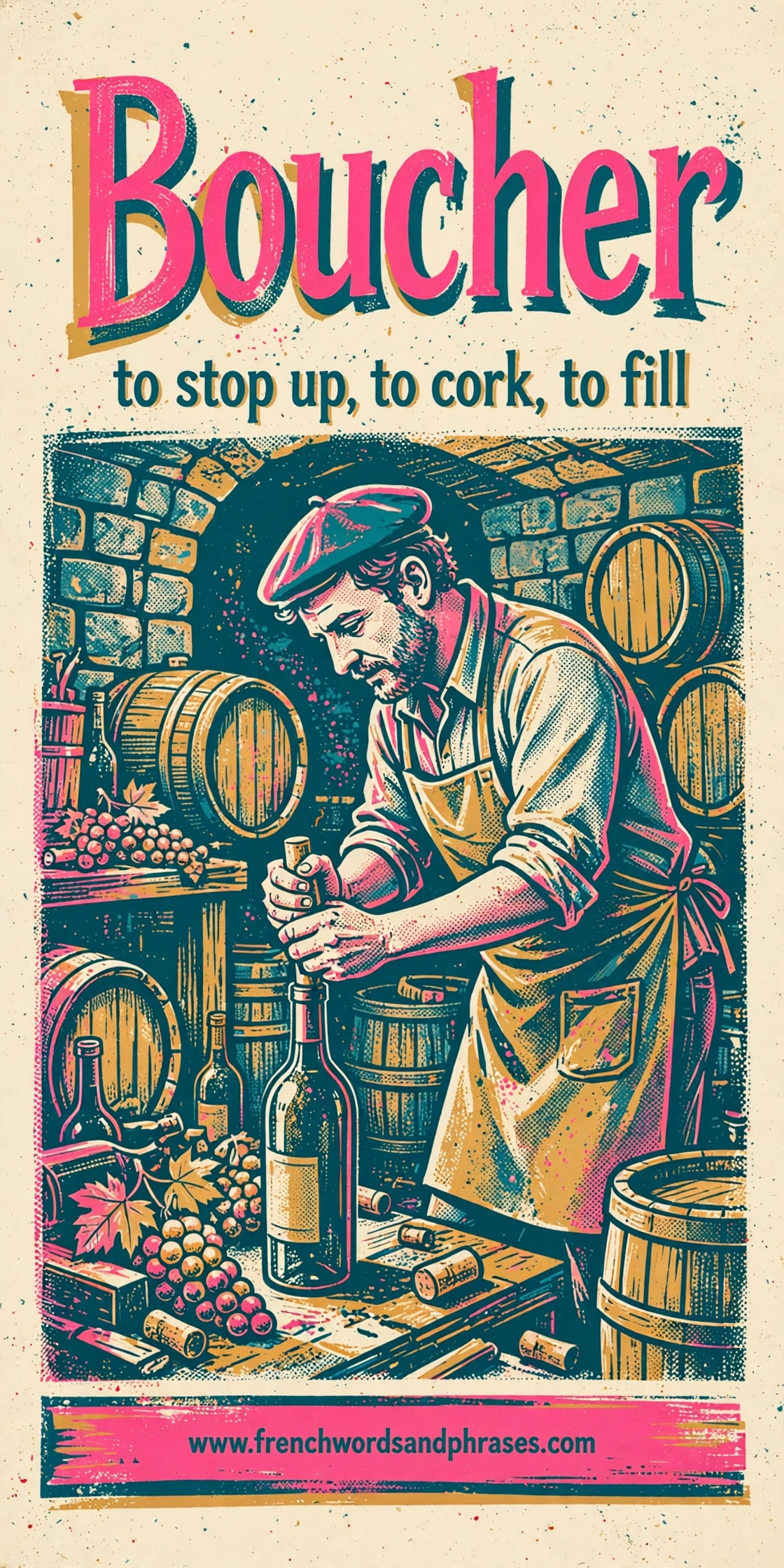
It means to stop up, to cork, to fill. It is the everyday verb for closing any opening that should stay open — drains, ears, bottles, cracks, views — and it stretches figuratively to gaps in a schedule or a market: boucher un trou dans un emploi du temps, boucher un créneau.
Verb classification: First group (-er)
Auxiliary verb: Avoir
Past participle: bouché
Present participle: bouchant
English equivalents: To stop up, to plug, to cork, to fill in; boucher un trou — to plug a hole; boucher une bouteille — to cork a bottle; boucher un tuyau — to block a pipe; boucher la vue à quelqu’un — to block someone’s view; boucher une fissure — to fill a crack.
One important warning: boucher the verb (to plug) is a perfect twin of le boucher, the butcher — same spelling, same sound, two different words living side by side. Context decides: le boucher bouche les trous du mur would mean the butcher is plugging the holes in the wall. The verb itself is a regular -er with no traps: je bouche, nous bouchons, ils bouchent, past participle bouché. And when the hole blocks itself, French turns reflexive — see se boucher.
Experience the Word
Boucher is the verb of the plug — if there is a hole and something must fill it, boucher is at work.
Imagine a plumber under a kitchen sink in an old Paris flat. Water drips from a cracked pipe, the tenant holds a torch, and the plumber presses sealant into the fissure with his thumb: il bouche le trou, tests the tap, and the dripping stops.
One thumbful of paste, one blocked crack. He has bouché — plugged — the leak, and the kitchen is dry again.
How to Conjugate Boucher: Complete French Conjugation Guide
Let’s explore every major conjugation of boucher, beginning with the indicative mood.
How to Conjugate Boucher in the Indicative Mood
The indicative mood is used to express facts, observations, actions, and events.
How to Conjugate Boucher in the Present Tense (Présent)
Used for actions happening now, habitual actions, and general truths.
| Subject | Conjugation |
|---|---|
| je | bouche |
| tu | bouches |
| il / elle | bouche |
| nous | bouchons |
| vous | bouchez |
| ils / elles | bouchent |
Example
Le maçon bouche les fissures du mur.
The mason is filling the cracks in the wall.
Quick Quiz 1
Complete the sentence:
Nous ______ les bouteilles après la mise en cave.
Reveal the answer
bouchons
Nous bouchons les bouteilles après la mise en cave.
We cork the bottles after putting them in the cellar.
How to Conjugate Boucher in the Passé Composé
Used for completed actions in the past. Boucher takes the auxiliary verb avoir.
| Subject | Conjugation |
|---|---|
| j’ | ai bouché |
| tu | as bouché |
| il / elle | a bouché |
| nous | avons bouché |
| vous | avez bouché |
| ils / elles | ont bouché |
Example
Elle a bouché la bouteille après le repas.
She corked the bottle after the meal.
How to Conjugate Boucher in the Imparfait (Imperfect Tense)
Used for habitual past actions, descriptions, and ongoing situations in the past.
| Subject | Conjugation |
|---|---|
| je | bouchais |
| tu | bouchais |
| il / elle | bouchait |
| nous | bouchions |
| vous | bouchiez |
| ils / elles | bouchaient |
Example
Un grand camion bouchait la vue aux piétons.
A big lorry was blocking the pedestrians’ view.
Quick Quiz 2
Choose the correct form:
She corked the bottle.
Elle ______ la bouteille. (a bouché / est bouché)
Reveal the answer
a bouché
Elle a bouché la bouteille.
Boucher takes avoir.
How to Conjugate Boucher in the Plus-que-parfait
Used to describe an action that had already been completed before another past event.
| Subject | Conjugation |
|---|---|
| j’ | avais bouché |
| tu | avais bouché |
| il / elle | avait bouché |
| nous | avions bouché |
| vous | aviez bouché |
| ils / elles | avaient bouché |
Example
Ils avaient bouché le tuyau avec un chiffon.
They had blocked the pipe with a rag.
How to Conjugate Boucher in the Passé Simple
Primarily used in formal writing, literature, and historical narratives. It is rarely used in everyday conversation.
| Subject | Conjugation |
|---|---|
| je | bouchai |
| tu | bouchas |
| il / elle | boucha |
| nous | bouchâmes |
| vous | bouchâtes |
| ils / elles | bouchèrent |
Example
Le vigneron boucha les tonneaux avant l’hiver.
The winegrower sealed the barrels before winter.
How to Conjugate Boucher in the Passé Antérieur
A literary tense used to express an action completed immediately before another past action, generally in the passé simple.
| Subject | Conjugation |
|---|---|
| j’ | eus bouché |
| tu | eus bouché |
| il / elle | eut bouché |
| nous | eûmes bouché |
| vous | eûtes bouché |
| ils / elles | eurent bouché |
Example
Quand il eut bouché la dernière fissure, il peignit le mur.
When he had filled the last crack, he painted the wall.
How to Conjugate Boucher in the Future Tense (Futur Simple)
Used to describe actions that will take place in the future.
| Subject | Conjugation |
|---|---|
| je | boucherai |
| tu | boucheras |
| il / elle | bouchera |
| nous | boucherons |
| vous | boucherez |
| ils / elles | boucheront |
Example
Demain, nous boucherons ce trou dans la clôture.
Tomorrow, we will plug this hole in the fence.
How to Conjugate Boucher in the Futur Antérieur (Future Perfect)
Used for an action that will have been completed before a particular point in the future.
| Subject | Conjugation |
|---|---|
| j’ | aurai bouché |
| tu | auras bouché |
| il / elle | aura bouché |
| nous | aurons bouché |
| vous | aurez bouché |
| ils / elles | auront bouché |
Example
À midi, ils auront bouché toutes les bouteilles.
By noon, they will have corked all the bottles.
How to Conjugate Boucher in the Near Future (Futur Proche)
Used to describe something that is going to happen soon. Formed with aller + infinitive.
| Subject | Conjugation |
|---|---|
| je | vais boucher |
| tu | vas boucher |
| il / elle | va boucher |
| nous | allons boucher |
| vous | allez boucher |
| ils / elles | vont boucher |
Example
Verse doucement, tu vas boucher l’entonnoir.
Pour gently, you are going to block the funnel.
How to Conjugate Boucher in the Conditional Mood
The conditional mood expresses what would happen under certain circumstances. It is also frequently used to make polite requests or express wishes.
How to Conjugate Boucher in the Present Conditional
| Subject | Conjugation |
|---|---|
| je | boucherais |
| tu | boucherais |
| il / elle | boucherait |
| nous | boucherions |
| vous | boucheriez |
| ils / elles | boucheraient |
Example
Un peu de mastic boucherait ce petit trou.
A little filler would plug this small hole.
How to Conjugate Boucher in the Past Conditional
| Subject | Conjugation |
|---|---|
| j’ | aurais bouché |
| tu | aurais bouché |
| il / elle | aurait bouché |
| nous | aurions bouché |
| vous | auriez bouché |
| ils / elles | auraient bouché |
Example
Elle aurait bouché la bouteille s’il était resté du vin.
She would have corked the bottle if there had been wine left.
Boucher in the Literary Past Conditional Form
This less common literary form uses the imperfect subjunctive of avoir.
| Subject | Conjugation |
|---|---|
| j’ | eusse bouché |
| tu | eusses bouché |
| il / elle | eût bouché |
| nous | eussions bouché |
| vous | eussiez bouché |
| ils / elles | eussent bouché |
Example
Le maçon eût bouché la fissure avant la pluie.
The mason would have filled the crack before the rain.
How to Conjugate Boucher in the Subjunctive Mood
The subjunctive is used to express wishes, emotions, doubts, necessity, and uncertainty. It frequently follows expressions such as il faut que (it is necessary that) or bien que (although).
How to Conjugate Boucher in the Present Subjunctive
| Subject | Conjugation |
|---|---|
| que je | bouche |
| que tu | bouches |
| qu’il / qu’elle | bouche |
| que nous | bouchions |
| que vous | bouchiez |
| qu’ils / qu’elles | bouchent |
Example
Il faut que tu bouches ce trou avant de peindre.
You must fill this hole before painting.
Quick Quiz 3
Complete the sentence using the subjunctive:
Il faut que vous ______ la vue aux voisins ? Non, surtout pas !
Reveal the answer
bouchiez
Il faut que vous bouchiez la vue aux voisins ? Non, surtout pas !
You must block the neighbours’ view? No, absolutely not!
How to Conjugate Boucher in the Imperfect Subjunctive
A literary tense, rarely encountered in modern spoken French.
| Subject | Conjugation |
|---|---|
| que je | bouchasse |
| que tu | bouchasses |
| qu’il / qu’elle | bouchât |
| que nous | bouchassions |
| que vous | bouchassiez |
| qu’ils / qu’elles | bouchassent |
Example
On craignait que le sable bouchât l’entrée du port.
People feared the sand might block the harbour entrance.
How to Conjugate Boucher in the Pluperfect Subjunctive
A literary construction used to express an action completed before another past action.
| Subject | Conjugation |
|---|---|
| que j’ | eusse bouché |
| que tu | eusses bouché |
| qu’il / qu’elle | eût bouché |
| que nous | eussions bouché |
| que vous | eussiez bouché |
| qu’ils / qu’elles | eussent bouché |
Example
On disait que les ouvriers eussent bouché la rue dès l’aube.
People said the workmen had blocked off the street at dawn.
How to Conjugate Boucher in the Past Subjunctive
| Subject | Conjugation |
|---|---|
| que j’ | aie bouché |
| que tu | aies bouché |
| qu’il / qu’elle | ait bouché |
| que nous | ayons bouché |
| que vous | ayez bouché |
| qu’ils / qu’elles | aient bouché |
Example
Je suis étonné qu’il ait bouché la vue avec une haie si haute.
I am surprised he blocked the view with such a tall hedge.
How to Conjugate Boucher in the Imperative
The imperative is used to give commands, instructions, invitations, or suggestions. Subject pronouns are omitted.
How to Conjugate Boucher in the Present Imperative
| Person | Conjugation |
|---|---|
| (tu) | bouche |
| (nous) | bouchons |
| (vous) | bouchez |
Example
Bouche cette bouteille, le vin s’évente !
Cork this bottle, the wine is going flat!
Quick Quiz 4
How would you say Plug this hole (tu form)?
Reveal the answer
Bouche ce trou !
French Participles of Boucher
Participles are verb forms that can be used in compound tenses and other grammatical constructions.
Present Participle of Boucher
bouchant
En bouchant le tuyau, il a arrêté la fuite.
By blocking the pipe, he stopped the leak.
Past Participle of Boucher
bouché
Bouchée par un bouchon de liège, la bouteille attendra des années.
Sealed with a cork, the bottle will wait for years.
Boucher in Everyday French: Real-Life Examples
Now that you know the conjugations, let’s see how boucher appears in everyday French.
Example 1 — Present
Le maçon bouche les fissures du mur.
The mason is filling the cracks in the wall.
Example 2 — Passé composé
Elle a bouché la bouteille après le repas.
She corked the bottle after the meal.
Example 3 — Imparfait
Un camion bouchait la vue aux piétons.
A lorry was blocking the pedestrians’ view.
Example 4 — Future
Nous boucherons ce trou dans la clôture.
We will plug this hole in the fence.
Example 5 — Conditional
Un peu de mastic boucherait ce petit trou.
A little filler would plug this small hole.
Example 6 — Imperative
Bouche cette bouteille, le vin s’évente !
Cork this bottle, the wine is going flat!
Beyond Translation: The Meaning of Boucher
French builds the whole family around the plug: un bouchon is a cork, a stopper — and, by extension, a traffic jam, because the cars are corked in the road.
One word for the cork and the jam.
The butcher, le boucher, is a historical accident sharing the spelling — he comes from bouc, the goat whose meat he sold, while the verb comes from blocking mouths and openings.
How to Remember the French Verb Boucher
Remember it this way: Boucher is about a cork pushed into every hole.
- If a hole needs filling — a crack, a bottle, a pipe — the verb is boucher.
- Careful with the twin: le boucher is the butcher; boucher is to plug.
- Regular -er: je bouche, nous bouchons, past participle bouché.
The key idea is a cork pushed into every hole.
Test Your Knowledge of Boucher
Let’s see how much you’ve learned. Try answering these questions before revealing the answers.
Question 1
What is the difference between boucher and le boucher?
Reveal the answer
Boucher (verb) means to plug or cork; le boucher (noun) is the butcher.
Question 2
How do you say The mason is filling the cracks in the wall in French?
Reveal the answer
Le maçon bouche les fissures du mur.
Question 3
Translate: She corked the bottle after the meal.
Reveal the answer
Elle a bouché la bouteille après le repas.
Question 4
What is the past participle of boucher?
Reveal the answer
Bouché.
Question 5
Complete the sentence:
Il faut que tu ______ ce trou avant de peindre.
Reveal the answer
bouches
Il faut que tu bouches ce trou avant de peindre.
You must fill this hole before painting.
Your Final Challenge
Can You Use It?
How would you say this in French?
The mason fills the last crack, and the old wall looks brand new.
Reveal the answer
Le maçon bouche la dernière fissure, et le vieux mur semble tout neuf.
The mason fills the last crack, and the old wall looks brand new.
A little French. A little curiosity. A richer everyday life.
LEARN FRENCH ONE WORD AT A TIME